


Software for UK small-animal vet practices
Lab result lands at 4pm. By 6 the owner’s rung twice. We’re trying to get clinician sign-off in two minutes.
You’re a vet running a small-animal practice in a Suffolk market town, or the practice manager at a four-vet group on Provet Cloud + Vetstoria, or an independent doing mixed practice (small animal plus the occasional equine or farm round). The PMS is fine - Provet Cloud / ezyVet / RoboVet / Animana / IDEXX Cornerstone do the chart, the chart works. What doesn’t work is what sits around the chart: the lab result the owner’s already rung twice about by the time the vet’s seen it; the annual booster recall the owner ignored in September with the Lepto / DHP / KC / FeLV cycle slipping into a first-vaccination protocol; the monthly wellness plan you sell but don’t have great recurring-DD visibility on; the Petplan claim for Mrs Patel’s elderly cat needing the right-format paperwork and her previous claims history. Saturday morning a dog-in-distress call goes to your emergency line and the OOH practice down the road handles it - Tuesday the customer record is split across two systems and the owner’s confused about what was charged where.
This page is for small-animal vet practices specifically - the clinics hub covers the cross-clinic operational loop. What’s on this page is the vet-distinct moments. If you’re a mixed practice doing equine or farm alongside, also see the equine vertical for the rotational species-specific pieces.
What your week actually looks like
- 4pm Tuesday - IDEXX lab results land for Mrs Patel’s elderly cat. By 5 the owner’s rung once. By 6 she’s rung again. The vet’s elbow-deep in the next consult; the receptionist can’t release results without clinician sign-off.
- Annual cat / dog vac recall - the Lepto / DHP / KC / FeLV cycle. Provet Cloud reminded at 30 days; owner ignored it; vac lapsed in October. You’re at a clinical-decision tree on first-vaccination protocol and the owner thinks you’re being awkward.
- Monthly wellness plan (worming + flea + vac + 2 health checks a year, £25-£60/month per pet) - sold at puppy stage, DD on Stripe or GoCardless, but the who’s on plan, who’s lapsed, who’s overdue for the included consult visibility is patchy.
- Saturday 9am - a dog-in-distress phone call. The OOH practice three miles away handles it; the customer record splits; Tuesday the owner’s confused about what was charged where.
- Petplan claim for the elderly cat - needs Petplan-format paperwork, previous-claims history, the diagnosis coded against their schedule, the invoice itemised their way. Bought By Many, Agria, More Than - each has its own format quirks.
- Vetstoria booking online - Saturday morning, six bookings while reception’s closed, two of them are emergencies that should have rung the OOH line first.
- Pet-passport / TRACES export check on the spaniel going to France - owner brings paperwork at 4pm Friday, flight Saturday morning, you’re on the gov.uk-side checks at five past five.
- A 17-year-old cat’s quality-of-life conversation - the records, the trend, the prognosis, the what comes next document - currently a handwritten practitioner letter.
- Mixed-practice rota - small animal in surgery 9-5, on-call equine vet for a colic at 11pm, the farm-side fertility round on Wednesday morning.
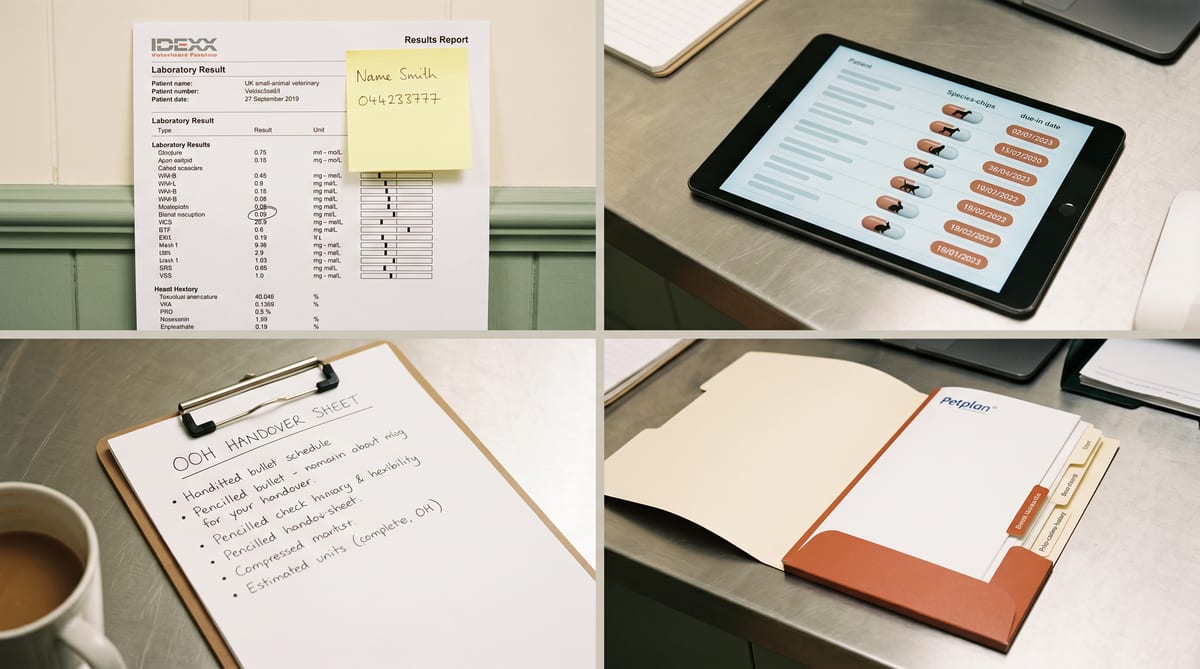
Example problems we could solve
1. The lab-result-to-owner notify that doesn’t make her ring twice
The 4pm-to-8pm moment: IDEXX result lands at 4pm. The receptionist can’t release it. The vet’s in consult. By 6 the owner’s rung twice. The vet sees the result at 7 and rings the owner back at 8. The owner’s been worrying for four hours.
Solved looks like: lab result arrives → vet-sign-off prompt fires to the named vet’s phone (and to the cover vet where the named vet’s off-shift). A sixty-second review interface shows the result against the prior baseline (where one exists), the clinical context (the working diagnosis the test was for), and a good news / ring needed / urgent ring now triage. The vet taps; the owner gets an SMS or WhatsApp in the vet’s voice - “hi Mrs Patel, Mr Tibbs’s bloods are back; nothing scary, vet will ring you between 4 and 5 tomorrow with the detail. Reply Q for a quick call back today.” - or the urgent variant, or the vet wants to talk through the detail variant. The owner stops ringing because she’s been told what’s happening; the vet rings when the vet rings, not when the owner pushes. Lab-result anxiety is the single biggest owner-comms pain in a vet practice and the build is shaped around getting the holding message out within thirty minutes of the result landing. The longer version lives at /solutions/multi-channel-comms-thread.
2. The vaccination recall ladder that runs across the lapse, not stops at it
The October-lapse moment: Mrs Khan’s cat - booster reminder September, ignored October, vac lapsed November; now on first-vaccination protocol because the booster window’s closed. The post-lapse window changes the protocol; the cadence has to run across pre-lapse AND post-lapse, not stop at reminder sent.
Solved looks like: the recall ladder runs against last-visit + species + vaccine + practice protocol, with one-tap booking back into Provet Cloud / ezyVet / RoboVet / Animana. Pre-lapse cadence at 30 / 14 / 7-day; post-lapse cadence at lapse-day + 14-day “chat with the nurse” check-in (the conversation where the owner finds out the protocol’s changed and that’s why you’re not just rebooking the booster). The Lepto / DHP / KC / FeLV split lives on the patient record so the cadence respects the vaccine due rather than treating annual booster as a single event. The longer version lives at /solutions/recurring-service-recall - the cross-clinic recall annuity that runs the vaccination cycle, the wellness-plan DD lifecycle, and the dental six-month recall through the same engine.

3. The monthly wellness plan as a real recurring-revenue dashboard
The “where’s the plan?” moment: wellness plan sold at puppy stage; the DD goes through every month; who’s on plan, who’s lapsed, who’s overdue for the included consult, lifetime value per plan member - all in scattered places. Most practices leave a meaningful share of plan revenue on the table because the operational state isn’t captured.
Solved looks like: the wellness plan as a structured object alongside the booster recall - per pet, DD state (active / paused-for-holiday / paused-for-bereavement / cancelled), services-remaining-this-year tracking, failed-DD recovery flow (the same hour the bank tells the payment provider, not three weeks later), and a plan-member visit tag visible in the chair so the vet knows she’s looking at a plan patient. Practice-side dashboard surfaces services-consumed-vs-paid-for per pet - which plan tiers are over- or under-priced for actual usage, which can only be seen if the operational state’s structured. The recall ladder respects the paused-for-bereavement state - no nudges to an owner who just lost her cat. The longer version lives at /solutions/recurring-service-recall - the same engine that runs the booster cadence, with the wellness-plan DD lifecycle on top.
4. The pet-insurance claim that goes out in the right format the first time
The Petplan / BBM / Agria moment: Petplan claim for Mrs Patel’s elderly cat. Petplan-specific format, previous-claims history, diagnosis coded their way, invoice itemised their way. Bought By Many’s format’s different; Agria’s different again. Receptionist spends Wednesday on this.
Solved looks like: at consultation-close where the pet’s insured, the claim object pre-fills from the clinical record - diagnosis coded against the insurer’s accepted list (Petplan, Bought By Many, Agria, More Than, Vetsure each have their own), the invoice itemised in their format, the prior-claims history (held in the patient record once gathered) attached. The submission renders against the insurer’s preferred channel (some accept structured submission, others want PDF + email, some still want post for the prior-history pack). Claim tracker watches the status; when the insurer pays, the bank feed auto-reconciles the open claim. Rejections surface the reason with a one-tap re-submit. The owner sees her side of the claim too - “the claim’s gone in, typical Petplan turnaround is 21 days, we’ll let you know when it’s paid” - so she’s not ringing to ask. The longer version lives at /solutions/invoice-and-dunning-ladder.
5. The OOH handover that doesn’t split the customer record
The split-record moment: Saturday morning, dog-in-distress phone call. The OOH practice three miles away takes it. Tuesday the owner comes back to you, the OOH treatment notes are on a paper sheet she’s holding, your PMS doesn’t know what was done.
Solved looks like: the OOH handover as a structured event between your practice and the partner OOH service. Your inbound call (via your AI agent or your phone diversion) triages; where it’s a true emergency the call routes with the patient’s record (consent-mediated) to the OOH practice with a one-tap acknowledge. The OOH visit writes back a structured summary (presenting complaint, treatment given, drugs administered with batch numbers, follow-up needed) into your PMS via the integration we build with the OOH service. The owner gets a single record - “this happened on Saturday, this is what was done, your follow-up with us is Tuesday at 10” - without having to relay paper between practices. The longer version lives at /solutions/trainable-inbound-ai-agent.
Closest builds we’ve shipped
- mendbuddythe agent platform behind the lab-result-to-owner messaging in problem 1, the vaccination recall ladder in problem 2, and the inbound triage that splits routine booking from true emergency on the Saturday-morning call. Voice + WhatsApp + SMS, trained on your practice’s scope language and your vet-voice. See /case-studies/mendbuddy.
- repairminderour software for running an inbound-items service business. The clinical-record-with-status-cascade pattern in a vet practice is shape-wise the same as the device-repair ticket-with-status pattern: item in (the pet), work tracked (the consult / surgery), deliverable out (discharge), customer kept informed throughout. See /case-studies/repairminder.
- pharmaceutical-analytics.coma custom analytics dashboard we built for an analytics consultancy. The wellness-plan dashboard in problem 3 and the lifetime-value-per-plan-member view share the same shape: operational data captured at every patient touchpoint, decision dashboard for the principal. See /case-studies/pharmaceutical-analytics.
FAQ
Will the lab-notify work with IDEXX, Antech, NationWide Laboratories?
IDEXX exposes a feed we can read; the lab-result event triggers the vet-sign-off prompt. Antech and NationWide - typically a daily import where the PMS doesn’t have a real-time integration; the notify ladder still works just with a slightly longer cycle. We confirm against your specific lab and PMS in discovery.
Will the recall ladder integrate with Provet Cloud / ezyVet / RoboVet / Animana?
All four. Each exposes API or webhooks for patient + visit events; the ladder reads from there, writes the booking back. The booking-source tag distinguishes online-booking (Vetstoria) from reception-booked from recall-ladder-booked so you can see which channel’s driving the rebook.
Can the wellness-plan engine handle the paused-for-bereavement state?
Yes. The plan state model includes active / paused (with reason: holiday, financial, bereavement, owner-illness) / cancelled and the comms ladder respects the pause - no recall nudges to an owner who just lost her cat. Reactivation from pause is one tap from the owner’s side.
Will pet-insurance claims be insurer-format-correct on first submission?
For Petplan, Bought By Many, Agria, More Than, Vetsure - yes; the format wrinkles are coded in. For smaller / newer insurers we add as the practice runs into them. Where an insurer updates their format ahead of our integration, the rejection workflow surfaces the reason rather than buries it.
Will you handle the RCVS Practice Standards Scheme / VMD side on my behalf?
No. RCVS practice standards, VMD controlled-drugs accountability, pet-passport / TRACES - all vet-side professional accountabilities. What the system does is make the evidence trail (CD register, vaccine batch-number traceability, controlled-drugs balance) assemble itself as you work, so when inspection lands the folder is one URL.
What does it cost?
Every build is scoped per practice - depends on practice size, PMS, OOH partnership, pet-insurance mix, whether the wellness-plan engine + lab-notify + recall ladder are all in scope. We talk it through, agree price in writing. See pricing.
Up to the hub
← UK private clinics (hub) · Dental (sibling) → · Aesthetic / cosmetic (sibling) → · Private GP (sibling) → · Equine (adjacent) → · Pet services (adjacent) →
Tell us about your practice
What practice you run, how many vets, what PMS, what the wellness-plan / pet-insurance mix looks like, where the owner-comms pain sits - the lab notify, the recall, the OOH split. Send an enquiry - we’ll come back with a sketch of what we’d build.