


Software for UK commercial grounds-maintenance contractors
Council parish-mowing contract renewal sat in the clerk’s inbox for four months. Margin on a year’s mowing - gone.
Commercial grounds maintenance is a different business from a domestic mowing round. The customer is a council parish, a care home, a school, a residential management agent, a business-park manager, a retail-estate FM commissioner; the deliverable is a year-round routine of mowing rounds, hedge cuts, leaf clearance, winter gritting, spring planting, and a monthly photo-report-with-invoice that proves the maintenance has happened. CHAS / SafeContractor / Constructionline accreditation is the gate to the panel; BALI Registered Contractor or APL membership is the second gate; RAMS per site lives as the operating envelope; SLAs on the FM-commissioner contracts attach credit-notes to breach. The cash cycle is 30-60 days against PAYE wages on Friday, with retention on the bigger council and FM contracts held at year-end and released at the renewal anniversary. The year is the annual contract renewal - the four-month-inbox-queue at the parish clerk’s office is the single biggest revenue risk you carry, and the build is shaped around that anniversary as the spine of the whole book.
This page is for firms whose week is mostly commercial grounds-maintenance contracts. If commercial is one part of a mixed week, the main landscapers page is the better fit. Commercial grounds-maintenance is its own business because the cash cycle, the accreditation gate, and the annual-renewal anniversary all run on different clocks from a domestic mowing round - and the audit trail alongside the invoice is what the customer is really buying.
What your week actually looks like
- A council parish-mowing contract renewal sat in the clerk’s inbox for four months - the year’s contract value, on the edge of going to whoever the parish remembered last.
- A care-home grounds-maintenance contract wanting a monthly photo-report PDF alongside the invoice - last contractor lost it because he sent the invoice and forgot the photos.
- A business-park FM commissioner with a P3 ticket on a fallen-branch - 24-hour SLA, credit-note attached to breach, the inbox notification you missed because you were on the chipper.
- A multi-site Tuesday round - five care homes, three schools, two business parks, a residential block - 60 miles, three crews, the planner who keeps doing the easy sites and skipping the awkward one.
- CHAS / SafeContractor / Constructionline annual re-accreditation - same evidence, four different formats, four different anniversaries; BALI Registered Contractor renewal alongside.
- A school’s PTA-driven question on the “is the playing field’s striping compliant with the FA Charter Standard guidance” - the spec lives somewhere, but not in one place.
- An RAMS audit on the council contract - three years of method statements wanted on a single PDF by Friday.
- The annual contract renewal on six contracts in March (the council fiscal-year refresh) all at once, all needing a re-priced proposal with the inflation update and the “and also…?” scope conversation.
- A residential-management agent wanting the leaf-clearance schedule for next autumn signed off in February - the planner’s a glove-box-receipt, the spec wants a quarterly calendar.
- Retention on the bigger council contract - 5% held at year-end, released at the next renewal anniversary; tracked in the bookkeeper’s head.
- A council biodiversity-action-plan species list on the parish contract - late-cut wildflower verges, no-mow May, native-hedgerow reinstatement; you’ve half-tracked it on the foreman’s notebook.
This isn’t a job-management software problem. It’s an audit-trail-is-the-deliverable problem with a 30-60-day cash cycle, an annual renewal anniversary, and a CHAS / SafeContractor / Constructionline gate stapled to it.
Example problems we could solve
1. The annual contract renewal engine - the parish clerk’s inbox, on a calendar
The “sat in the clerk’s inbox” moment: “Council parish-mowing contract renewal sat in the clerk’s inbox for four months. By the time he opened it, another contractor had quoted half the price. The year’s contract value - gone.”
Solved looks like: every contract enters the system with a renewal anniversary attached. 90 days before the renewal date, the engine fires a renewal proposal draft to you with last year’s scope + last year’s actual delivery (photos, hours, materials) + inflation-indexed pricing + suggested “and also…?” scope additions based on what the site needed but wasn’t in scope (the leaning conifer the foreman flagged in April, the tired bed that wants replanting in the spring). You approve on phone; the proposal lands in the customer’s inbox - and on their portal - with a one-tap “renew on these terms” button. 60 days before renewal, a polite chase if no response; 30 days before, an escalation to the named decision-maker (the parish clerk, the care-home manager, the FM commissioner, the residential block’s managing director). Multi-contract customers (a residential management agent with twelve blocks; a council with a parish-plus-cemetery contract) get a portfolio-view proposal so the conversation is “keep the lot, here’s the pricing” not twelve separate negotiations. The commercial-specific moment: the “sat in the clerk’s inbox” problem is universal, the four-month silence is what costs the contract, and the build is shaped around making the proposal visible in three channels (email, portal, optional SMS to the decision-maker) so it can’t be quietly forgotten. The longer version lives at /solutions/recurring-service-recall; the renewal anniversary is the spine of the whole commercial book and the engine treats it that way.
2. Monthly photo-report + invoice bundle
The “switched contractor” moment: “Care home wanted invoice + photo report monthly. I send the invoice; nothing else. They asked twice, I forgot, they switched contractor at renewal.”
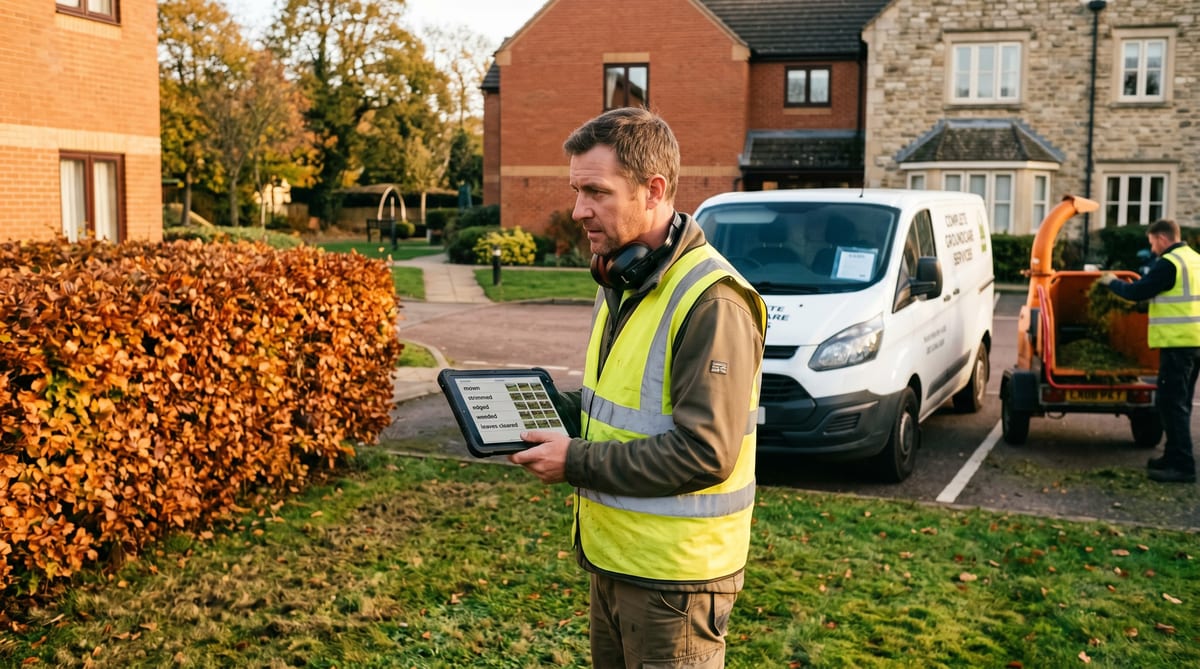
Solved looks like: every commercial-site visit captures photo evidence on the foreman’s tablet - “lawn mown”, “edges strimmed”, “beds weeded”, “hedge cut”, “leaves cleared”, “weather-deferred” - with the date and the location-stamp. On the 1st of the following month, the engine consolidates the visits per site into a structured PDF report - “site A: mowing 4 visits, hedge cut 1 visit, leaf clearance 2 visits, weather-deferred 1; photo evidence per visit attached” - and bundles it with the invoice for that site. The report includes a “recommendations for next month” section the foreman drafts on his tablet (the leaning conifer that needs reduction, the dead patch in the lawn that needs over-seed); the customer-side decision-maker reads it on her phone the same morning. CHAS / SafeContractor evidence (RAMS sign-offs per visit, incident logs, near-miss reports) rides alongside as audit attachments where the contract requires it. FA Charter Standard playing-field striping spec on school contracts, RHS-aligned plant-list on show-garden contracts, council biodiversity-action-plan species lists on parish contracts - each site’s spec carries through to the report so the “is this compliant with our spec” question answers itself. The commercial-specific moment: the photo-report-with-invoice is what differentiates a contractor who keeps the contract from one who loses it at renewal - and the build is shaped around making the report assemble itself rather than depending on the foreman’s memory. The longer version lives at /solutions/invoice-and-dunning-ladder.
3. Multi-site dispatch + SLA-aware FM ticket integration
The “P3-on-the-chipper” moment: “FM commissioner at the business park runs every ticket through their helpdesk. P3 24-hour SLA on a fallen-branch. I’m under a chipper somewhere else, the email lands at 11, I see it at 4. Breach. Credit note next month.”
Solved looks like: the FM commissioner’s helpdesk feed pulls into a dispatch dashboard alongside the planned-round schedule. Concept Evolution, Maximo, SI7, Fixflo, Propertyfile - most major UK FM and residential-agent helpdesks publish a feed (email, webhook, or in some cases a small API). Tickets land tagged by priority, SLA clock, and site; auto-acknowledgement back to the FM in their template; SMS to the on-call foreman with the postcode and the SLA expiry time. SLA-breach risk shows on a red-amber-green dashboard. The Tuesday-round route auto-re-times when a P2 or P3 ticket lands on a covered site - the foreman gets a one-tap “add to today’s route after 14:00” prompt; the residential block on the same round gets its visit either bumped or held depending on the agent’s stated priorities. Multi-van firms see the dispatch by van + by priority + by location, so the call routing considers which crew is closest to the next P1 callback. The commercial-specific moment: SLA-attached credit-notes are a real cost, the 24-hour clock on a fallen-branch is the most common breach, and the build is shaped around making the SLA visible on the same dashboard the operator opens with morning coffee.
4. CHAS / SafeContractor / Constructionline / BALI annual evidence pack
The “four-different-anniversaries” moment: “CHAS annual due in April. SafeContractor in July. Constructionline in October. BALI Registered Contractor renewal in November. Same RAMS, same incident log, same PL evidence, four different formats, four different anniversaries.”
Solved looks like: the SSIP accreditation pack as a single store with format-specific exports. Per-operative training records (NPTC certs, PA1 / PA2 / PA6 spraying certs, RHS qualifications, MEWP / IPAF / PASMA where applicable, first-aid-at-work, toolbox-talk attendance log), per-kit PUWER + LOLER inspection logs, per-site RAMS history, public liability + employer’s liability + commercial vehicle insurance certs with current policy numbers + renewal dates, COSHH register for the PA1 / PA6 sprays + 2-stroke fuels + chainsaw oils, environmental policy + carbon-reporting where applicable. When the CHAS / SafeContractor / Constructionline annual portal opens, the export-to-their-format runs at one click - same underlying evidence, four different schemas at the surface. BALI Registered Contractor and APL member-renewal evidence assemble from the same store; ISO 9001 / 14001 / 45001 layer alongside for the firms carrying them. The commercial-specific moment: SSIP accreditation is the gate to council-and-FM panel work, and the four-different-anniversaries problem is what causes most firms to drift off-panel temporarily; the build is shaped around making the evidence one store, not four.
5. Retention release tracker - 5% held, released at the anniversary
The “held by the council” moment: “5% retention on the £80,000 council grounds contract held at year-end. Released at the renewal anniversary - except the bookkeeper at the council moves last spring, the email goes to a dead address, and three months on I’m wondering whether to chase or assume it’s lost.”
Solved looks like: retention as a tracked object on every contract that carries it. The percentage, the release date, the named decision-maker on the council / FM / agent side, the contract reference. 30 days before the release date, a friendly chase to the named decision-maker (and a CC to the bookkeeper) lands in their inbox with the year’s photo-report PDFs attached and the “per our contract, retention release is due on [date]” line in your voice. Where the named contact’s moved, the engine flags the bounce so the chase goes to the next-up rather than into the void. Same engine shape as the commercial fit-out builder spoke and the commercial plumber spoke, tuned for grounds-maintenance contract anniversaries. The longer version lives at /solutions/stage-payment-and-retention-ledger.

Closest builds we’ve shipped
- HC Electricaldifferent trade, same CHAS-and-commercial-cert pattern on the EICR / commercial-electrical side. The closest live reference for how the same SSIP evidence + monthly-report-with-invoice cadence runs in a Suffolk trade business - the per-customer recurring history kept against each property indefinitely ports straight across to the council / FM / agent portfolio. (Pull-quote held behind the permission checklist; see /case-studies/hc-electrical.)
- pharmaceutical-analytics.coman analytics dashboard for an analytics consultancy. The monthly photo-report-with-invoice bundle and the contract-renewal dashboard are the same shape: operational data captured per visit, decision dashboard for the operator and the customer. Own-brand case study, ships full-fat - see /case-studies/pharmaceutical-analytics.
- mendbuddyour own multi-channel AI agent platform behind the FM helpdesk triage and the residential-agent multi-channel comms. Useful when a parish clerk, an FM commissioner and a residential agent are all trying to reach the same inbox. See /case-studies/mendbuddy.
FAQ
Will the contract-renewal engine spam my parish clerk?
No. One renewal proposal per contract per cycle, at the right point in the year. The follow-up chase ladder is in your voice, runs at -90 / -60 / -30 day intervals, and respects the decision-maker’s stated reply preference.
Will the FM helpdesk integration work with Fixflo / Propertyfile / ARPM / Concept Evolution / Maximo / SI7?
Yes. Residential-agent helpdesks (Fixflo, Propertyfile, ARPM) and FM helpdesks (Concept Evolution, Maximo, SI7) all work either via published feed (most) or via structured email parse (the rest). New helpdesk or a format change, we extend the parser inside a week.
Can the photo-report bundle handle the FA Charter Standard playing-field spec?
Yes - site-specific spec captures into the site profile (FA Charter striping spec for school playing fields, RHS-aligned plant-list for show-garden sites, council biodiversity-action-plan species lists for parish sites, late-cut wildflower verge protocols). The monthly report references the site-specific spec where applicable, so the “is this compliant with our contract” question answers itself.
My contract carries retention. Will the engine track retention release?
Yes - retention is a first-class tracked object on the contract record. 30 days before release, a friendly chase to the named decision-maker lands with the year’s photo-report PDFs attached. Same retention-tracker pattern as the commercial fit-out builder spoke, tuned for grounds-maintenance contract anniversaries.
Will you handle CHAS / SafeContractor / Constructionline / BALI / APL submission on my behalf?
No - the submission carries a duty-of-truth that stays with the firm. We build the evidence store, the format-specific export, the renewal-reminder calendar, and the audit-log discipline that makes the four-different-anniversaries problem disappear. The submission itself is yours; the assembly is ours.
Will the multi-site dispatch board show me the round by van?
Yes. Multi-van firms see the dispatch by van + by priority + by location, so the SLA clock and the planned-round schedule live on one screen and the call routing considers which crew is closest to the next P1 callback.
What does it cost?
Every build is scoped per firm - depends on contract count, site count, accreditation depth, whether retention tracking is in scope, what FM and agent helpdesks you need to live alongside. We talk it through, agree price in writing. See pricing.
Up to the hub
← UK landscapers (main page) · Tree surgery (sibling) → · Commercial fit-out builder (adjacent trade) → · Commercial plumber (adjacent trade) →
Tell us about the commercial side
What contracts you carry, what FM commissioners and residential agents are on the book, what your CHAS / SafeContractor / Constructionline / BALI / APL status is, where the monthly photo-report is breaking, what your retention exposure looks like. Send an enquiry - we’ll sketch what we’d build.