

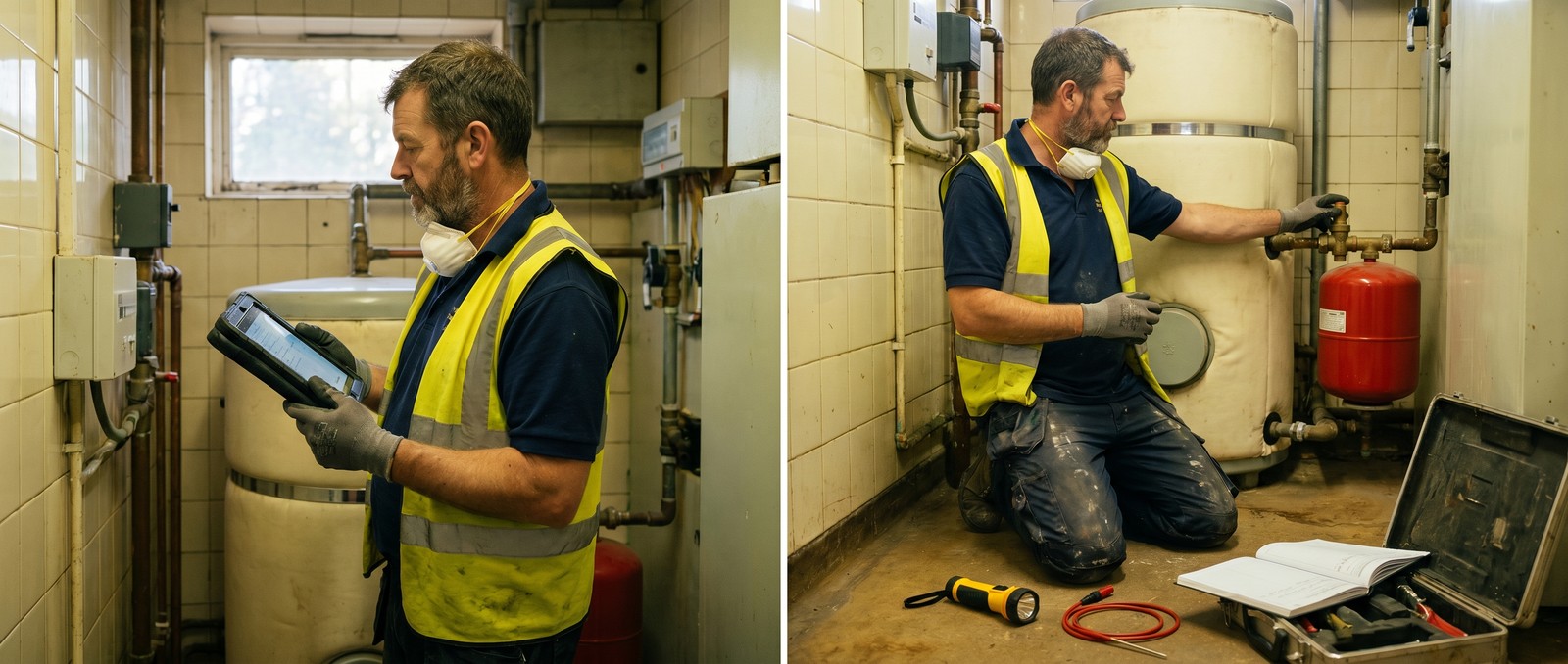
Software for UK commercial plumbers
Same-day cash on a Sunday emergency. Sixty-day terms on a Mayfair restaurant. The bookkeeping app can only hold one of those.
You did the office-block leak callout on a Friday and the building’s facilities manager signed off on the doorstep - “send the invoice through the portal”. Two months later you’re chasing the same portal. You’re four months into a fit-out for a builder who’s withholding 5% retention until practical completion, with CIS reverse-charge stripping the VAT out of every interim - and your bookkeeping flow can’t decide whether the line should reverse-charge or not. You’re running a quarterly Legionella ACoP L8 monitoring round across thirty commercial water systems and the actual evidence - temperature logs, photos of the storage tank lid, sentinel-outlet flushing record - lives across three notebooks, a Google Drive folder, and your head.
This page is for plumbers whose week is mostly commercial - sub-contract install work for main builders, recurring FM contracts, Legionella duty-of-care rounds, plant-room maintenance. If your week is mostly domestic with the occasional commercial job, the main plumbers page is the better fit. Commercial is its own thing because the cash cycle is its own thing - and the duty-of-care record is what the customer is actually buying.
What your week actually looks like
- A main-builder PO for a £42,000 fit-out at the new restaurant on Cornhill - CIS reverse-charge, 30-day terms, 5% retention released at practical completion (which becomes 12 months) - and the project manager who answers emails on Tuesday afternoons.
- An FM helpdesk ticket queue from the facilities-management contractor at the office block - “P2 leak in the kitchenette, attend within 4 hours” - and a service-level agreement that says you owe a credit note if you don’t.
- Quarterly Legionella ACoP L8 monitoring rounds across thirty water systems - sentinel outlets flushed, calorifier base temperatures logged, cold-water storage tanks inspected - and the evidence pack the duty-holder needs at the year-end audit.
- The £4,200 restaurant install from May still chasing in August; the restaurant manager who “can’t pay until head office releases the invoice”.
- A CIS reverse-charge invoice that one bookkeeper at the builder won’t accept because she doesn’t recognise the wording; a phone call you’re making for the third month running.
- Snag-list at practical completion for the fit-out - twenty-eight items across plumbing, drainage, and the calorifier; the architect’s contract administrator wants it on a single PDF with photos by Friday.
- A 24-hour public liability cert chase from a new FM commissioner who won’t put you on the panel until the Companies House SIC code and the £10m PL cover are evidenced.
- Plant-room PPM rounds on three sites - the schedule that lives in the bookkeeper’s diary and the engineer who keeps doing the easy site and skipping the awkward one.
This isn’t a job-management software problem. It’s a 60-day-cash-cycle-plus-12-month-retention problem with a duty-of-care record stapled to it.

Example problems we could solve
1. CIS reverse-charge invoicing that builders actually accept
The “almost right” moment: Xero’s CIS handling is almost right. QuickBooks is almost right. FreeAgent doesn’t really do it. The “almost” is what trips you - and the builder’s bookkeeper bounces the invoice for the third month running.
Solved looks like: an interim-and-final invoice generator that bakes the CIS reverse-charge logic in at the line level, not the invoice level. Per main-builder customer, we store their VAT number, their CIS verification status (gross / 20% / 30%), the project reference, and the contract administrator’s name. Each interim valuation lands as a single PDF with the work-package breakdown, the labour-and-materials split, the retention line itemised, the reverse-charge VAT line worded the way HMRC and your builder’s bookkeeper both recognise, and an embedded payment link. Xero rules push the same record to the books with the right CIS treatment automatically - the line that’s CIS-applicable reverse-charges; the line that isn’t (materials supplied direct to a non-CIS counterparty) doesn’t. The “my bookkeeper doesn’t recognise this” delay isn’t a software bug, it’s a communication problem; the build is shaped around making the invoice harder to misread than to accept.
2. The Legionella ACoP L8 evidence vault
The year-end-audit moment: facilities want the L8 evidence pack - six quarters of sentinel outlet temperatures, twelve months of calorifier checks, the photographic record of the storage tank lid. You’ve got the data, just not in one place.
Solved looks like: every L8 monitoring visit logs into a single evidence record per site. On site the engineer captures temperatures into a structured form on the tablet (sentinel outlets, calorifier base, calorifier flow, cold-water storage tank) with the photo set the HSE expects (tank lid, insulation condition, sentinel labels); the system flags an out-of-spec reading against the risk-assessment in the moment so the engineer doesn’t sign off and walk away from a problem. At the year-end, the audit pack assembles on demand - risk-assessment reference, ongoing-monitoring history with timestamps, exception log with remediation actions and resolution dates, sample-taking records where bacteriological is in scope. The duty-holder side: a portal per site where the facilities manager can pull the current compliance status without ringing you. ACoP L8 keeps the duty-holder responsibility with the building owner, not with you - but the evidence the duty-holder needs to discharge that duty is what they’re paying you for, and the audit-pack-on-demand is what turns a Legionella round into a year-on-year retention.
3. The FM helpdesk integration that hits the SLA
The 4-hour-SLA moment: FM commissioner runs every ticket through their helpdesk. P2 leak - 4-hour SLA. P3 - 24 hours. You’re watching the email refresh and missing the SLA on a Tuesday morning when you’re under a different boiler.
Solved looks like: the FM commissioner’s helpdesk feed pulls into a single dispatch dashboard. Where the helpdesk publishes a feed (most major UK FMs run Concept Evolution, Maximo, or SI7 with email or webhook integration), tickets land in the system tagged by priority and SLA clock; where they don’t, the structured email parses out the same data. Each ticket triggers an automatic acknowledgement back to the FM in their template, an SMS to the on-call engineer with the postcode and the SLA expiry time, and a one-tap en-route status that updates the FM portal. SLA breach risk shows on a red-amber-green dashboard the operator opens with their morning coffee. FM contracts have credit notes attached to SLA breach - a missed 4-hour P2 is a £150 credit on the next month’s invoice; the dispatch dashboard is shaped around the SLA clock, not the work itself.
4. The retention release tracker that doesn’t forget the 12-month half
The forgotten-half moment: practical completion was October last year. Half of retention released at PC; the other half is due at end-of-defects-liability - twelve months on. By the time the date rolls round you’ve forgotten the project.
Solved looks like: retention is a tracked object that doesn’t go to sleep. On every commercial contract, the retention percentage, the practical-completion date, the first-half release date, the end-of-defects-liability date, and the second-half release date go into the record. Each release date triggers a friendly chase to the builder’s quantity surveyor 30 days before - “the second half of retention on the Cornhill fit-out is due on the 14th; here’s the snag-list sign-off and the as-built drawings from PC” - and an escalation if it slips. Retention is the bit that legally should be released but practically gets forgotten by the builder’s QS until you remind them; the system reminds them in your voice with the evidence attached, so the conversation is short. The longer version lives at /solutions/stage-payment-and-retention-ledger.

5. The plant-room PPM round that runs itself
The skipped-site moment: three commercial sites with quarterly PPM rounds - calorifiers, BPHE plate heat exchangers, expansion vessels, pressure relief valves. The engineer keeps doing the easy site and skipping the awkward one. The skipped site is the one that calls in March with a failure.
Solved looks like: the PPM schedule as a first-class object per site. Per asset, the manufacturer’s service interval, the last-completed date, the next-due date, the parts list, the engineer time estimate. Quarterly rounds auto-generate the route - “this Tuesday: site A, calorifier service + expansion vessel pressure check + PRV test; Thursday: site B, BPHE descale + system pressure log” - with the tablet-side checklist the engineer signs through on completion. The annual report assembles for the building owner: assets serviced, failures caught, parts replaced, time-on-site, recommendations for next year’s budget. Most plumbing firms run PPM rounds out of the bookkeeper’s diary because PPM-specific software starts at the £150/mo enterprise tier; the engine here is shaped to the actual asset list of a small commercial plumber, not the ten-thousand-asset CAFM portfolio.
The closest things we’ve already built
- HC Electricaldomestic-and-commercial sparky chassis with the same CIS-aware commercial-sub flow on the electrical side. The reference for how the same CIS reverse-charge invoicing pattern runs in a Suffolk trade business. (Pull-quote held until the permission checklist clears; see /case-studies/hc-electrical.)
- pharmaceutical-analytics.comanalytics dashboard for an analytics consultancy. The Legionella evidence vault and the PPM annual report are the same shape: operational data captured on site, decision dashboard for the operator and the customer. See /case-studies/pharmaceutical-analytics.
- MMI Serviceslegacy insurance-claims surface, being modernised. Proof we can take over and modernise older internal systems - useful when an FM commissioner already runs Concept Evolution or Maximo and the work has to live alongside it without rip-and-replace.
A named commercial-plumbing case study isn’t yet in the portfolio. When one lands and clears permission, it’ll appear here.
FAQ
Will this integrate with my main builder’s Procore / Aconex / 4Projects?
Yes for the major construction collaboration platforms - interim valuations submit through their preferred channel, snag-lists upload as PDFs, RFIs flow through where the builder runs them. We hook into what the builder mandates rather than trying to replace it.
My FM commissioner runs Concept Evolution / Maximo / SI7. Will the helpdesk feed work?
The dispatch side reads from the FM’s feed (email, webhook, or in some cases a small integration the FM exposes) and writes status updates back in their format. We don’t replace the FM helpdesk; we make sure the SLA clock doesn’t beat you.
Will you take on the ACoP L8 risk assessment for the duty-holder?
No. The risk assessment and the duty-of-care responsibility stay with the building owner / responsible person. We build the evidence vault, the monitoring round, and the audit-pack assembly - the responsibility itself is theirs.
Can you handle CIS reverse-charge for split material-and-labour invoices?
Yes - that’s the line-level treatment in problem 1. The reverse-charge applies to the labour-and-services line, not to materials supplied as a direct supply to a non-CIS counterparty; the engine handles the split inside one invoice.
Will this replace Sage / Pegasus / Eque2 / SimPro / Joblogic?
Usually no. The commercial-plumbing software stack is heavier than the domestic one and the cost of ripping it out rarely pays back. We sit on top, replace the bits that hurt (CIS wording, retention tracking, FM dispatch, PPM rounds, L8 evidence), and leave the bits that work.
What does it cost?
Every build is scoped per firm - depends on van count, FM-contract count, Legionella round size, retention exposure, and which CIS-aware bookkeeping you’re already on. We talk it through, agree price in writing. See pricing.
Up to the hub
← UK plumbers (main page) · Bathroom-fitter → · Lettings / property maintenance → · Leak detection / trace-and-access → · Construction →
Tell us about the commercial side
What FM commissioners you work with, what main builders you sub to, how many Legionella sites you cover, where the CIS reverse-charge wording keeps tripping the invoice. Send an enquiry - we’ll come back with a sketch.