

Software for UK leak-detection specialists
The leak’s behind a tiled wall on the first floor. The insurer’s bookkeeper is in a different time zone. You’re owed £2,800 and laying out materials.
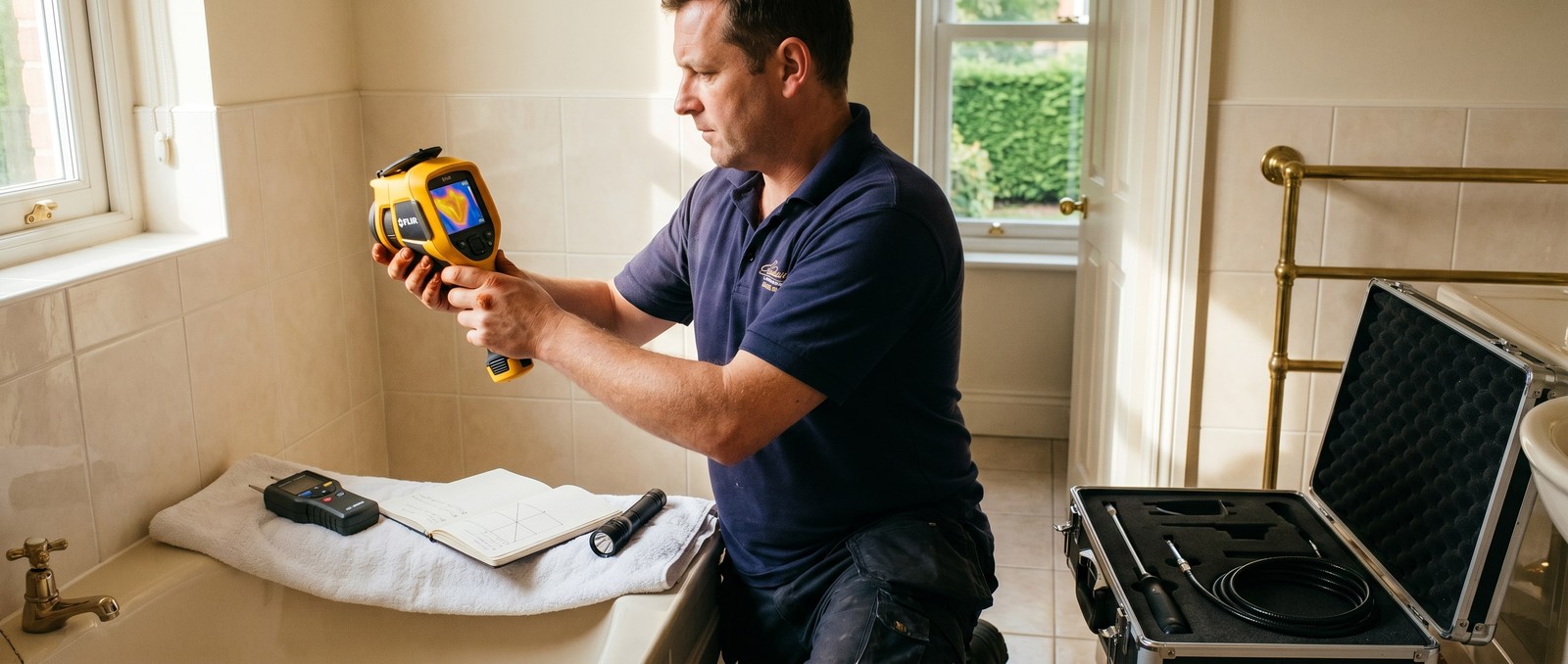
Trace-and-access is a different plumbing business. You spent half a day with the thermal camera, the acoustic probe, and the tracer-gas kit pin-pointing a £40 olive joint behind a bathroom wall - saved the customer a £20,000 ceiling replacement - and now you’re three weeks into a loss-adjuster paperwork cycle for a £2,800 invoice on a different template per insurer. The customer in the house is fine. The customer paying you is Sedgwick on Tuesdays, Crawford on Fridays, Davies sometimes, and a direct claims handler at LV the rest of the time. None of them have the same report template, the same submission portal, or the same payment terms.
This page is for plumbers whose week is mostly insurance-pipeline leak detection and trace-and-access. If trace-and-access is one of several things you do, the main plumbers page is the better fit. The trace-and-access business is its own thing because the customer paying you isn’t the customer in the house, and the deliverable isn’t the fix - it’s the evidence pack the insurer needs to release the claim.
What your week actually looks like
- A loss-adjuster referral from Sedgwick for a high-ticket claim - “trace and access leak in master ensuite, attend within 72 hours, report on our template please” - and a different template arriving from Crawford the same morning.
- £900 in materials laid out on a trace-and-access job from June; the insurer’s claims handler is on holiday; the homeowner’s been living with a hole in the bathroom ceiling for three weeks.
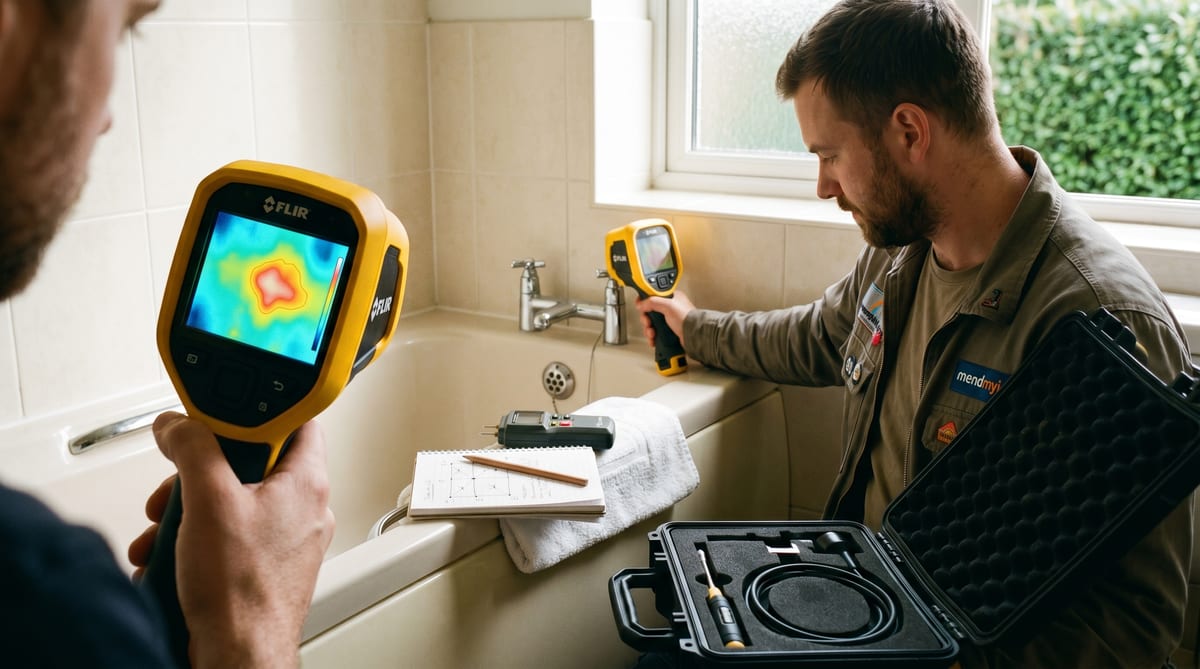
- Thermal-imaging evidence captured on the FLIR, acoustic logs from the Sewerin, tracer-gas readings, moisture-meter values - and a report you write up in Word at midnight with the photos pasted in landscape and the conclusions in bullet points.
- The homeowner who keeps texting “have you heard back?” every other day for three weeks while you wait on the insurer.
- A panel commissioner audit - Sedgwick wants the last twelve months of trace-and-access reports in their proforma with timestamps, the photo set per claim, and the £-per-job audit trail.
- A direct private leak hunt at £750 - same diagnostic kit, paid on the doorstep by card, no insurer in the loop. Lovely. One a fortnight.
- Annual recalibration / certification on the FLIR thermal camera and the Sewerin acoustic kit; manufacturer service records that need to be evidenced on the insurer’s panel application.
- One-man-band PI insurance that’s £840/year because the trade is “high-claim-risk” per the insurer’s actuarial - and a renewal conversation where every quid off depends on what you can show the broker.
This isn’t a job-management software problem. It’s a per-insurer-template + deferred-payment problem with the diagnostic evidence as the actual deliverable.
Example problems we could solve
1. The per-insurer report templates that submit themselves
The four-templates-one-leak moment: Sedgwick wants their template. Crawford has a different one. Davies has a Word doc from 2019 nobody’s updated. You’re writing the same job four ways.
Solved looks like: one structured on-site capture flow that pivots to whichever insurer’s report the job needs at the end. On site, the engineer captures the leak location (postcode, room, fitting), the diagnostic evidence (thermal images tagged with surface temperatures, acoustic readings, tracer-gas concentrations, moisture-meter values at the five-point grid), the access required (number of tiles lifted, plasterboard cuts, floorboard lifts), the materials replaced, the reinstatement scope, and the next-step recommendation. At the end, the report renders to whichever loss adjuster commissioned - Sedgwick proforma, Crawford template, Davies form, the direct-insurer claims-handler PDF - with the same evidence formatted to that template’s conventions. The loss adjuster cares about a particular evidence shape (thermal contour against the moisture map, against the acoustic localisation, against the pinpoint photo) and the templates change quarterly - the engine treats the template as a config, not a hard-coded layout, so a new Sedgwick form is a one-day update on the retainer rather than a rewrite.
2. The insurer payment ladder with a homeowner-side comms loop
The two-customers moment: invoice with Sedgwick day one; day 15 no reply; day 30 payment scheduled for day 45; day 45 delayed. Homeowner still texting every other day. She isn’t the payer, but she is the relationship - and the one-star review at day 28 is what costs you the next direct-private job.
Solved looks like: two parallel cadences from the same record. Direct chase to the loss adjuster (day 14 / 28 / 45 escalation to panel manager, with the claim reference, the invoice number, and the agreed-payment-terms quoted back at them). Soft homeowner-side status SMS at the same beats - “quick update: Sedgwick acknowledged on the 12th, expected release week of the 18th, I’ll let you know when funds clear” - in your voice, so she feels handled rather than chased. The longer version lives at /solutions/invoice-and-dunning-ladder; the leak-detection version’s distinct feature is the two-audience routing - direct chase to the adjuster, soft status to the homeowner, off the same claim record.
3. The panel-evidence pack for loss-adjuster onboarding
The Saturday-lost-to-PDFs moment: Sedgwick wants you on their panel. They want PI insurance £2m, public liability £5m, FLIR cert, twelve months of past reports as a portfolio, your Companies House SIC code, and a £20-an-hour-junior on staff. You’ve got the evidence; getting it into one PDF kills a Saturday.
Solved looks like: a panel-evidence pack that assembles on demand. Per-trade-credential - PI insurance (current cert, renewal date, policy number, broker), public liability, employer’s liability if any staff, FLIR camera cert with last calibration date, Sewerin cert, manufacturer training records, IPAF / IOSH where applicable - lives as a structured record. The portfolio side: past reports anonymised and aggregated (last twelve months, top ten by complexity, with the homeowner identifiers redacted). When a new loss adjuster commissioner asks for the pack, it generates as a single PDF or a portal link - current state, no Saturday assembly. Panel-onboarding is the gate to insurer work - without it, you’re working direct or you’re not working at all - and the gate-keepers move at their own pace; the assembly time is what you control.
4. The thermal-imaging evidence library that scales with you
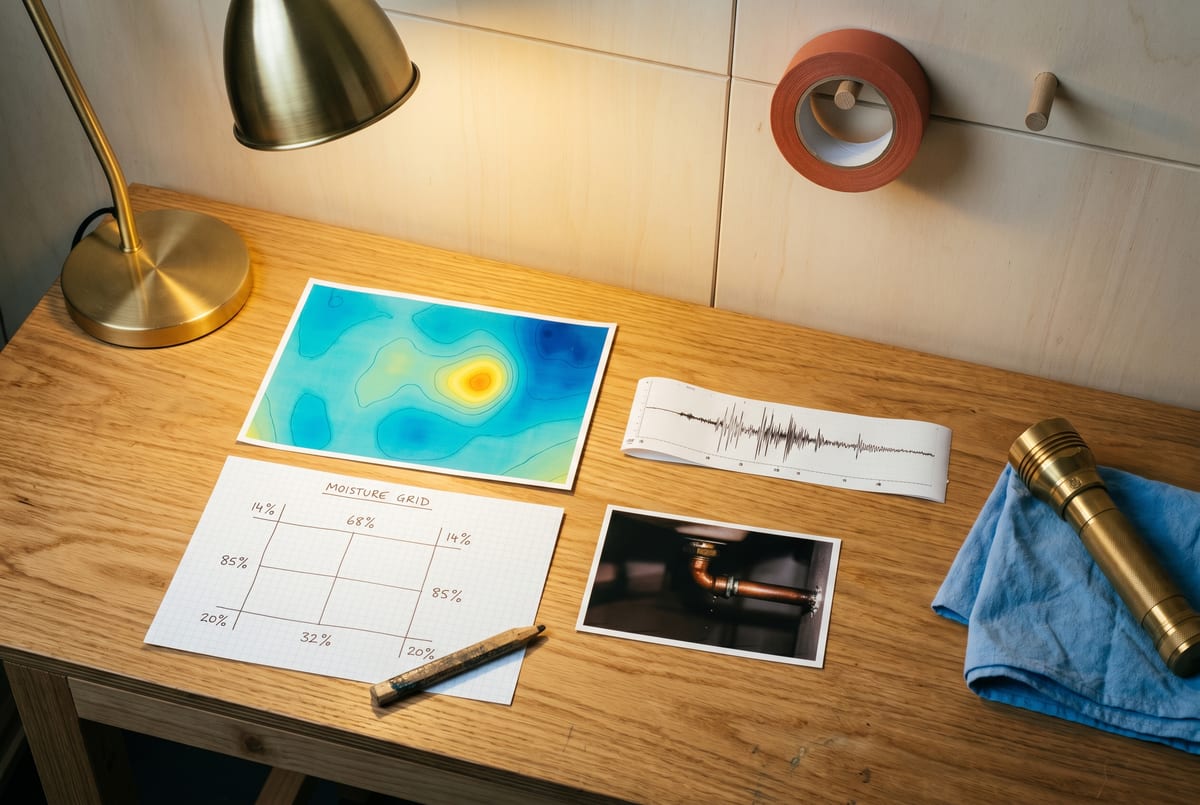
The midnight-rewrite moment: captured the FLIR images, the acoustic, the tracer-gas. By the time you’re writing the report at midnight the file numbering’s lost and you can’t find the moisture-meter shot of the skirting. The job pre-dates Photos cloud sync.
Solved looks like: a structured on-site capture flow that knows what a leak-detection job is. Each job has a fixed photo grid the engineer steps through: arrival shot of the affected area, baseline thermal of the surrounding wall, thermal at the suspected location with surface-temp legend, acoustic spectrum capture, tracer-gas concentration plot, moisture-grid readings at the five-point pattern, access photos (before / during / after), pinpoint photo of the actual leak once exposed, reinstatement photo. Each capture tags to the job and to the report template; nothing has to be renamed or re-found at midnight. The diagnostic kit (FLIR Ex-Series, Sewerin SDR / Stethophon, tracer-gas Sewerin SNOOPER, Tramex moisture meters) talks to the app where the manufacturer publishes a sync; where it doesn’t, the photo plus a structured form is the canonical record. The diagnostic evidence is the deliverable, not a supporting artefact, and structured capture on site is what stops the midnight rewrite.
5. The direct-private fast-lane that runs alongside the insurer pipeline
The £750-cashflow moment: private leak hunt this morning. £750 on the doorstep by card. Lovely. Three of those a month would change the business but you haven’t got time to market for them while you’re chasing Sedgwick.
Solved looks like: the direct-private route as a separate lane on the same chassis. Local SEO surface for direct leak-hunt enquiries (a “trace and access leak detection [town]” page per the catchment, fed by the same evidence library and the same engineer); a sub-15-minute enquiry agent for the direct enquiry that goes straight to a quote and a deposit link; payment on the doorstep via card terminal; the diagnostic report on the homeowner’s email by the time you’ve packed the kit. The insurer pipeline runs on the same engineer’s calendar with different SLAs and different reporting; the system shows the operator a single diary across both. The direct-private side is the cashflow that smooths over the insurer-side wait - and the marketing surface that brings it in is a local-SEO page, not an Ads spend.
The closest things we’ve already built
- MMI Serviceslegacy insurance-claims surface being modernised. Closest shape-match for any plumbing firm where the insurer is the actual payer: claim references, loss-adjuster relationships, deferred payment cycles, audit-pack assembly. See /case-studies/mmi-services.
- HC Electricaldifferent trade, same Suffolk trade-chassis with the front-end site driving direct local enquiries while the back-office handles the slower commissioner side. The reference for how the direct-private fast-lane runs in a trade business. (Pull-quote held behind the permission checklist; see /case-studies/hc-electrical.)
- mendbuddythe agent platform behind the direct-enquiry triage in problem 5. Voice + SMS + WhatsApp + web chat, trained on your direct-private price list. See /case-studies/mendbuddy.
FAQ
Will this submit reports through the loss adjuster’s portal?
Where the loss adjuster exposes a submission interface (some do, most don’t), yes. Where they don’t, the report renders to their template and submits by their preferred email or portal upload; the system records the submission timestamp and the chase clock starts from there.
Will you chase Sedgwick on my behalf?
The chase emails go out in your voice, on your address, on the cadence you sign off. We’re not your credit-control agency; we build the ladder that runs the chase for you. The escalation conversations (panel manager, complaints to the FOS where applicable) stay with you.
Can the diagnostic-evidence app talk to my FLIR / Sewerin / Tramex kit?
Where the manufacturer publishes a sync (FLIR’s ResearchIR / Tools+, some Sewerin models with USB export), yes. Where they don’t, the app is shaped for structured capture from the engineer’s phone camera plus the meter readouts entered manually - which is what most leak-detection plumbers do today anyway, only the structure is missing.
My PI insurance is £840/year because the trade is high-claim-risk. Can the audit trail bring that down?
Indirectly. A structured evidence library plus a per-claim audit trail plus a panel-onboarding pack is what an insurance broker uses to argue your premium down at renewal. We can’t promise the broker will deliver; we can promise the evidence will be in one place when they need it.
What does it cost?
Every build is scoped per firm - depends on the insurer-panel count, the diagnostic kit, the direct-private mix. We talk it through, agree price in writing. See pricing.
Up to the hub
← UK plumbers (main page) · Bathroom-fitter → · Commercial → · Lettings / property maintenance →
Tell us about the trace-and-access side
What insurer panel you’re on, what kit you carry (FLIR, Sewerin, Tramex, tracer-gas), what the direct-private mix looks like today, where the loss-adjuster paperwork keeps eating your evenings. Send an enquiry - we’ll come back with a sketch.