


Software for UK lettings agents and property managers
Rightmove enquiry at 9:47. By 10:15 they’ve enquired with three other agents and booked with whoever rang back fastest. Twenty-eight minutes cost us a £1,200 fee.
You’re the principal at a lettings agency in a market town, or the property-management lead at a small firm with 180 properties under management, or a sole-trader running 30 lets out of a kitchen office. Reapit (or Alto, or Jupix, or Street, or Apex27) is the CRM you live in. Goodlord runs the references, the holding deposit, the e-sign. Fixflo eats the maintenance tickets. PayProp keeps the rent ledger. Rightmove, Zoopla and OnTheMarket feed the enquiries in. None of those tools were designed to be the source of truth - you and your team are the integration layer. You retype the tenant’s new phone number in three places. You chase the EICR that should chase itself. You take the 11pm boiler-down message and turn it into a 3am decision tree. You explain the same monthly landlord statement to the same landlord on the same Thursday, because she doesn’t open the landlord portal you pay Reapit for.
We make custom software for UK lettings agents and property managers - scoped per firm. Not a Reapit replacement (it’s fine at the CRM bit). Not a Goodlord replacement (referencing works). Not a Fixflo replacement. The bit between the Rightmove portal feed at 9:47 and the cert filed, the rent paid, the landlord statement out on the 1st, the EICR booked round the move-in, the principal home by six on a Friday - that’s the bit we build. The spine is the three-way comms between agent, landlord and tenant. The texture is the regulator vocabulary - Renters’ Rights Bill, Section 8, deposit protection (TDS / DPS / mydeposits), Right to Rent, gas safety / CP12, EICR, EPC, HMO licensing, Tenant Fees Act, Awaab’s-Law-style mould response timeframes - and the system carries the current version so you don’t have to.
What you spend your week on that you shouldn’t have to
- Rightmove enquiry at 9:47 - you’re on a viewing in Bury - by 10:15 the punter’s enquired with three other agents and booked with the one who replied in two minutes. £1,200 fee, gone in twenty-eight minutes.
- Friday-evening, Saturday and Sunday portal enquiries piling up to twenty-three by Monday 9am, eleven of those already viewed elsewhere by the time you open Reapit.
- Tenant texts at 11:08pm - “boiler’s down, no hot water, baby in the house”. Out-of-hours fee, contractor finding, landlord-approval at 3am for a £400 call-out, one-star pending either way.
- EICR coming up for renewal on 87 properties this calendar year; the contractor you trust is solid-booked till March; the cert on 14 Apple Drive expires next Friday and the move-in is Saturday morning.
- Tenant reports mould Friday afternoon. Awaab’s-Law-style response timeframes are landing in the private rented sector - landlord-approved dehumidifier in by Wednesday, contractor booked for the survey next week, every comms step time-stamped because every case is now a potential headline.
- New tenancy completing Saturday - Goodlord referencing finished Thursday, the AST is drafted in Reapit, the deposit needs registering with TDS inside 30 days, the Right to Rent share-code expires next month, the inventory clerk is booked for 9am Saturday - three of those four currently live on a Post-it on your monitor.
- Tenant 22 days late on rent. PayProp flagged it day 3. The chase ladder needs the right statutory wording on the right day; the guarantor letter goes out on day 35; Section 8 (with Section 21 and the old Form 6A gone under the bill) means an evidence-pack assembly that currently lives across nine folders in your filing cabinet.
- Monthly landlord statement on the 1st - PayProp generates a beautiful PDF and the landlord still rings on the 4th to ask about the £42 contractor line, then again on the 7th, because she hasn’t logged into the landlord portal since the day you onboarded her.
- Tenant changed phone numbers. You’ve fixed it in Reapit. Goodlord still has the old one. Fixflo still has the old one. The next maintenance ticket goes to a dead number and lands as a Trustpilot complaint by Thursday.
- HMO licence renewal across the portfolio - every council wants its own format, every licence is its own afternoon.
- The Renters’ Rights Bill commencement dates that keep nudging the AST template, the periodic-tenancy treatment, the Section 8 grounds wording - and the Tenant Fees Act audit you keep meaning to do before the next council visit.
These aren’t problems a generic CRM solves. They’re the bit between the portal feed and the rent paid, the tenancy renewed, the property compliant, the landlord retained, the tenant out of your inbox on Sunday. That’s the bit we build.
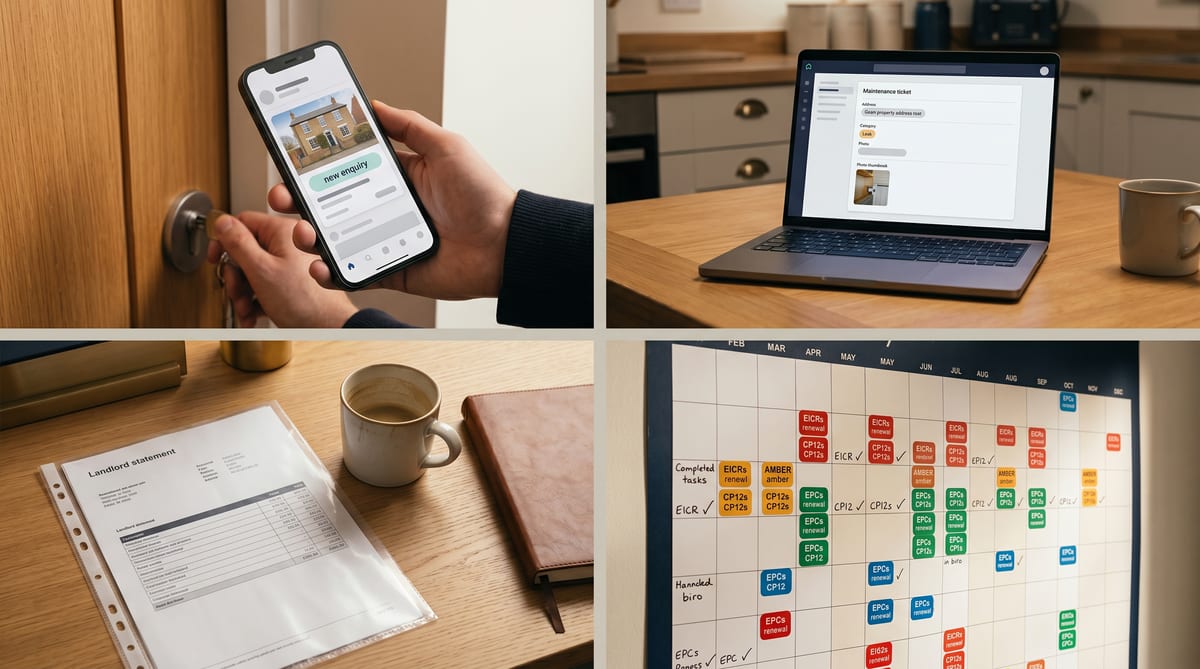
Example problems we could solve
Six things we hear most often from lettings agents and property managers - with what the solved version looks like in your week. Every build is scoped per firm: a sole-trader running 30 lets probably needs the first three; a small agency with 180 properties under management and an HMO block might want all six. None of it means binning what already works - Reapit / Alto / Jupix / Street stays the CRM, Goodlord stays the referencing partner, Fixflo stays the maintenance system, PayProp stays the rent ledger. We add the layer that holds them together.
1. The 9:47 Rightmove enquiry that gets a reply at 9:48
The fastest-back-wins moment: Rightmove enquiry lands at 9:47. You’re on a viewing in Bury. By 10:15 the punter has enquired with three other agents and booked the viewing with whoever rang back fastest - twenty-eight minutes from enquiry to “thanks, all booked” with the agency across the road. £1,200 fee, lost in the time it took you to finish the kitchen walk-through. Out-of-hours it’s worse: a Friday-night enquiry that sits in Reapit till Monday 9am has effectively already booked elsewhere by the time you read it.
Solved looks like: every portal enquiry (Rightmove, Zoopla, OnTheMarket) gets a reply within sixty seconds, in your agency’s voice, with the available viewing slots from the diary and the structured questions a qualified lead would expect - affordability band, move-in date, pets, household composition, references-ready state. The reply lands on the channel the punter actually opens, with the structured contact written back to Reapit / Alto / Jupix / Street / Apex27 so your team picks up a qualified lead, not a cold one. Critically for lettings, the same inbound channel splits between viewing enquiry and critical maintenance from a current tenant - boiler-down / leak / lockout / mould messages route to the on-call manager on WhatsApp + SMS with the property reference attached, while genuine viewing enquiries get the slot offer in the same minute. Out-of-hours, the same loop runs on the same response time, so the Friday-evening twenty-three-message pile-up never happens. The longer version lives at Trainable Inbound AI Agent; the lettings version’s distinct feature is the simultaneous critical-maintenance-vs-viewing-enquiry triage on a single trained inbound agent.
2. Three-way comms - agent, landlord, tenant - on the channel they actually open
The “why didn’t you tell me” moment: monthly landlord statement on the 1st. Beautiful PDF from PayProp. Landlord still rings on the 4th to ask about the £42 contractor line. Tenant emails the same day to ask if her deposit’s registered with TDS. Landlord rings again on the 7th. You’re explaining the same thing three times, to three people, in two systems, and the landlord-portal nobody logs into stays the symptom that swallows your Wednesdays.
Solved looks like: one ticket, three audiences, three voices, one record. The landlord gets her monthly statement on the channel she actually opens - usually WhatsApp - with the headlines pre-summarised (“April: £1,250 in, £75 management, £42 contractor - smoke alarm replaced, see thread, £1,133 to your account on the 5th”) and a read-receipt visible to the office. Tap a line and the detail expands inline; tap “any questions” and it lands as a structured ticket against her record, not as a phone call you have to take in between viewings. The tenant gets her side on the same channel - “April rent received, deposit £1,800 registered with TDS [reference], next gas safety check booked for 14 May, smoke alarm replaced last Tuesday”. The portal exists as a fallback for the few landlords who genuinely prefer it; for the eighty-five per cent who don’t, the system speaks to them where they read. Service messages (rent receipts, maintenance updates, compliance reminders, statement summaries) sit on soft opt-in once the tenant or landlord’s given you their number for the management relationship; cold landlord-prospecting marketing stays on a separate explicit-consent channel - the system enforces the split, because that’s where the ICO concern lands. The lettings-specific moment: the three-way comms is the spine of the business, the landlord portal nobody logs into is the symptom, and the build is shaped around being on the channel the landlord and tenant actually open.
3. Maintenance triage where the tenant’s status updates write themselves
The 11:08pm moment: tenant texts - boiler’s down, no hot water, baby in the house. Contractor-finding-on-WhatsApp at 11:30, landlord-approval at 3am, contractor on site by 6am - and by Monday it’s a Trustpilot complaint about “the agency that left a family with no hot water” because nobody updated the tenant between 11:30pm and the engineer arriving. Fixflo handled the ticket fine; the tenant- and landlord-side updates are still you, on your phone, in bed.
Solved looks like: tenant report (WhatsApp, web form, or phone to the trained inbound agent) creates a ticket → triage decision tree with the right escalation per urgency (boiler-down with vulnerable occupant = emergency call-out; window-stuck-but-warm = next-working-day; mould with damp meter reading = the Awaab’s-Law-style SLA clock starts and a survey is booked inside the response window your firm has set) → landlord-approval SMS with the contractor estimate, the photo of the fault, the urgency framing and a one-tap “approve to £400” - landlord taps yes, contractor is dispatched. Status updates fire to both tenant and landlord at every milestone - “contractor on the way, ETA 30 min”, “diagnosis: capacitor blown, part needed, ETA 24 hours, here’s a fan heater being couriered tonight”, “fixed, gas safety record attached, owner notified”. The mould / damp response carries an explicit SLA clock against your firm’s set response window (typically 24 / 48 / 72 hours depending on severity), and the audit log captures every step - what was reported, when you knew, what you did, when the contractor arrived, what was found, what was remediated, when the tenant confirmed - in case the property ombudsman, the TDS dispute, or the future PRS redress portal asks. Fixflo stays your contractor-side system of record where you use it; the layer on top runs the triage AI, the three-way comms, the landlord-approval flow, and writes the status transitions back to Fixflo. Where you’re not on Fixflo, the same pattern runs against direct contractor dispatch via WhatsApp + structured task records. The lettings-specific moment: maintenance is half the property manager’s week and the source of half the complaints, the three-way orchestration is what currently happens in the agent’s head, and the build is shaped around making the status updates the system’s job, not yours.
4. The tenancy that lands compliant on Saturday morning
The Post-it-on-the-monitor moment: move-in this Saturday at 9am. Holding deposit taken Tuesday. Goodlord referencing finished Thursday. The AST is drafted in Reapit. Right to Rent share-code needs checking and the result archived. The deposit needs registering with TDS / DPS / mydeposits inside 30 days with the prescribed-info pack to the tenant. The smoke + CO alarm signature is signed but the cert needs filing. The EICR is in-date till next year, the gas safety certificate is six weeks old, the EPC is fine. The inventory clerk is booked for 9am Saturday. Half of that is a Post-it on your monitor; the other half is in three different systems. If you miss one of those steps the agency wears a £5,000 Tenant Fees Act fine or a Right to Rent civil penalty.
Solved looks like: the new-tenancy workflow as one screen, with every dependency visible and every gate explicit. The Goodlord (or Vouch / Let Alliance) referencing event lands and triggers the next step; the holding deposit captures cleanly against the property; the AST template generates with the periodic-tenancy structure (post-Renters’ Rights Bill commencement, when applicable) and the per-property variables pre-filled; the Right to Rent share-code lookup runs against the gov.uk service and the share-code expiry lands as a calendar object that re-checks itself; the deposit registers with TDS / DPS / mydeposits and the prescribed-info pack drops to the tenant inside the 30-day window; the smoke + CO alarm signature, the gas safety record, the EICR cert, the EPC and the legionella assessment all attach to the tenancy as structured artefacts; the inventory clerk’s appointment is confirmed on a shared schedule; the welcome pack lands with the tenant the night before. On the agent dashboard, every active onboarding shows its current step and the dependency blocking the next one - “3 Apple Drive: AST drafted, share-code archived, deposit pending registration (12 days remaining), inventory clerk booked” - so the Friday-evening “what’s blocking Saturday” check is a thirty-second scan, not a Post-it audit. The lettings-specific moment: a tenancy that lands non-compliant is a Tenant Fees Act fine, a Right to Rent civil penalty, or a TDS dispute waiting to happen, and the build is shaped around making every gate explicit rather than relying on muscle-memory.
5. The rent + arrears ladder with the right statutory wording on the right day
The day-22-PayProp-flag moment: tenant 22 days late. PayProp flagged it on day 3. You sent the soft reminder, then the firm one, then nothing for a week because the landlord’s been ringing every other day asking why he hasn’t been paid. The guarantor notification has to go out on the right day with the right statutory wording (and the wording moves under you as the Renters’ Rights Bill commencement unfolds). If it goes to possession, the Section 8 evidence pack - every comm, every late date, every contact attempt, every offer of a repayment plan - has to assemble itself, because doing it from your filing cabinet on the day of the hearing isn’t a strategy.
Solved looks like: the rent-arrears ladder reads PayProp’s (or Goodlord Rent’s) feed and starts the cadence at day 3 with the soft prompt, day 7 with the firm one, day 14 with the “this is now formal - here’s how we can talk” offer of a repayment plan, day 22 with the guarantor notification (using the version of the statutory wording that’s current the moment the letter goes out - the template library updates as commencement proceeds, you don’t keep the version in your head), and day 35 with the Section 8 pre-notice trigger. Every comm is logged against the tenancy with timestamp, read-receipt state, and channel. The landlord-side gets the automatic “day 14: arrears chase escalated, repayment plan offered” digest so he isn’t ringing you every other day for an update. If it goes to possession, the Section 8 evidence pack - comms log, late-payment history, repayment-plan correspondence, safeguarding flags - assembles on one URL ready for counsel. The longer version lives at Invoice & Dunning Ladder; the lettings version’s distinct feature is the tenant-arrears wording library kept current against the bill’s commencement state, plus the auto-assembled Section 8 evidence pack and the landlord-side digest that stops the every-other-day phone call.
6. Compliance renewals that schedule around the tenant, not the spreadsheet
The 87-EICRs-and-one-Friday moment: 87 EICRs expiring across the calendar year. The contractor you use is solid-booked. The cert on 14 Apple Drive expires next Friday - there’s a tenant in residence, she works Monday-to-Friday in Cambridge, she won’t have a contractor in the flat on weekday evenings without proper notice. The CP12 round is the same problem on the gas side - annual rather than five-yearly, but you’ve got 140 of them and a similar contractor-access-tenant calendar tangle. You’ve got a spreadsheet that says you’re three weeks behind on chase, and the next council inspection visit could be any week now.
Solved looks like: the per-property compliance calendar (EICR 5-yr, gas safety / CP12 annual, EPC 10-yr, smoke + CO replacement, legionella assessment, HMO licence renewal, fire-door checks on blocks) projects forward and starts the book the contractor workflow at the right lead-time per cert type - 12 weeks ahead for EICR on a portfolio block, 8 weeks for annual gas / CP12, 4 weeks for a flat-by-flat smoke check. The contractor-side scheduling (Fixflo where you use it, direct WhatsApp dispatch where you don’t) coordinates with the tenant’s access preferences captured at move-in - she said “Tuesday or Thursday evenings work, weekends don’t” in the welcome-pack survey, so the slot offer respects that. The tenant confirms; the contractor visits; the cert captures (PDF or photo, structured) into the property record; the landlord gets a “new EICR cert attached, valid till May 2031” update; the calendar resets to the next renewal. Where the contractor can’t get there in time, the system escalates to your backup list or surfaces a “do we accept this exposure window or do we serve notice” decision with the legal context attached. The longer version lives at Recurring Service Recall; the lettings version’s distinct feature is the tenant-access-aware scheduling layered on top of the renewal cadence - so renewals stop being a Friday-afternoon chase and start being the system’s job to orchestrate around the tenant.

The closest things we’ve already built
- HC Electricala domestic and EICR electrician in Haverhill, Suffolk. From your side of the conversation: he’s the contractor you chase for the EICR cert on 14 Apple Drive before Saturday’s move-in. The software we built him is what makes the cert land in your inbox before he’s washed his hands, the agent-portal status visible to your property manager without a phone call, and the day-31 statutory-interest line on the late agency invoice run politely-and-automatically. Useful as a reference because it’s the other side of the conversation your team has every week. (Named pull-quote and final outcome figures hold until the permission checklist clears - full case study at Hc Electrical.)
- mendbuddyour own multi-channel AI agent platform for inbound conversations across voice, SMS, WhatsApp, web chat, Facebook Messenger and Instagram. The 60-second portal-enquiry reply in problem 1, the three-way comms layer in problem 2, the maintenance-triage agent in problem 3, and the out-of-hours coverage that closes the Friday-evening-to-Monday-9am response gap - all are lettings-shaped configurations of the same platform, trained on your scope-of-service, your asking-rents, and your agent-voice. See Mendbuddy.
- mmi-servicesa legacy insurance-claims surface we’re modernising. Different domain (motor claims), same operational shape: a ticket with multi-stakeholder approval and a status pipeline (claimant, insurer, garage, loss adjuster - the same pattern as tenant, landlord, agent, contractor). The maintenance-triage flow in problem 3 lifts the loss-adjuster-style approval pattern straight into a lettings frame. The reference when the agency has a long-running internal way of doing things that’s worth modernising without rip-and-replace.
- pharmaceutical-analytics.coma custom analytics dashboard we built for an analytics consultancy. The property-manager KPI surface (portal-enquiry conversion by channel, arrears age by property, compliance-renewal exposure window, landlord-retention rate by portfolio, contractor-response SLA performance, monthly-statement read-receipt rate) is the same shape: operational data captured at every touchpoint, decision dashboard for the principal and the lettings director. See Pharmaceutical Analytics.
Adjacent verticals
- Trades - EICR specialist electricianthe engineer doing the EICR cycle across your portfolio, from his side of the same conversation. The two pages link to each other.
- Trades - landlord-CP12 gas engineerthe gas engineer running the August-to-October CP12 round across a landlord’s portfolio; the contractor-side mirror of the compliance renewals problem in problem 6.
- Trades - lettings plumberthe plumber on a maintenance retainer for letting agents; the contractor-side mirror of the three-way comms in problem 2 and the maintenance triage in problem 3.
- Holiday letsthe FHL-side cousin. Same property, materially different operational spine (short-stay registration, FHL tax changes, mid-let turnover, OTA channels) - covered separately.
- Constructionfor the larger commercial / civils work above the small-scale property-maintenance frame.
FAQ
Will the portal speed-to-lead work with my Reapit / Alto / Jupix / Street / Apex27 / Dezrez install?
Yes for all the named ones. Reapit and Street expose APIs for booking, contact create, and viewing-schedule writes; Alto and Jupix expose the same via the Houseful umbrella; Apex27 has a webhook surface; Dezrez exposes its own API. We read the portal feed from Rightmove, Zoopla and OnTheMarket, reply within sixty seconds on WhatsApp / SMS / email, and write the structured contact and the booked viewing slot back to the CRM. Out-of-hours coverage runs on the same loop on a 24/7 schedule. Your CRM stays the system of record; we add the speed-of-response layer on top.
Will the maintenance triage integrate with Fixflo / Propertyfile / ARPM?
Yes. Fixflo and Propertyfile expose feeds for incoming reports and accept status updates back; we sit on top, run the triage, the three-way comms and the landlord-approval flow, and write status transitions back so your maintenance system stays the contractor-side system of record. ARPM’s a closed system; we run the integration one-way (ticket in, status synced) and the comms layer runs alongside. Where you’re not on any of those, the same pattern runs against direct contractor dispatch via WhatsApp + structured task records.
Will the system handle the Renters’ Rights Bill / RRO transition correctly?
The build is wired against the current commencement state of the bill - periodic-only tenancies where commencement applies, Section 8 evidence-pack assembly with the current grounds wording, decent-homes-standard for the PRS, redress-portal integration when that lands. Templates and statutory wording stay current as commencement proceeds; the rest of the system (rent ledger, comms cadence, compliance calendar) doesn’t change shape underneath. When the next commencement date moves a template, we update the library, not the agent.
Will the WhatsApp three-way comms be compliant with tenant and landlord data rules?
Yes. Service messages (rent receipts, maintenance updates, compliance reminders, statement summaries) sit under soft opt-in once the tenant or landlord has given you their number for the tenancy or management relationship - established lawful basis for service comms. Cold landlord prospecting needs explicit consent and runs on a separate channel that the system enforces as separate, because that’s where the ICO concern lands. Data residency stays in the EU/UK. Subject-access requests resolve as a one-click export.
Will you do the AML / Right to Rent / HMO licence work on my behalf?
No. Each is a regulatory accountability that stays with the agent or property manager - the agency’s named role, ARLA Propertymark / RICS membership rules sit alongside. What the system does is make the evidence assemble itself as you work: the Right to Rent share-code is captured, archived, and re-checked at expiry; the AML CDD record per sales-arm transaction lands as a structured artefact; the HMO licence renewal calendar runs per property with the per-council format library so the right paperwork lands inside the council’s window. When inspection arrives, the folder is one URL; the inspection itself is yours to run.
What does it cost?
Every build is scoped per firm - depends on properties under management, agency size, CRM stack, which of the six sketches above are in scope, and which referencing / rent / maintenance partners you’re integrating with. We talk it through, agree the scope and the price in writing, then build. Send an enquiry and we’ll come back with a sketch. See pricing for how we work.
How long until something’s live?
The portal speed-to-lead reply layer typically goes from scope conversation to a working version inside a few weeks, then a couple more weeks of running real Rightmove / Zoopla traffic through it before go-live. The three-way comms layer and the maintenance triage ship next, inside a couple of months - the per-CRM and per-maintenance-system integrations build out as each one confirms. The tenancy onboarding, arrears ladder, and compliance orchestrator slot in alongside as the underlying property and rent data lands.

Tell us what your week looks like
What firm you run, properties under management, CRM stack (Reapit / Alto / Jupix / Street / Apex27 / Dezrez), referencing partner (Goodlord / Vouch / Let Alliance), maintenance tool (Fixflo / Propertyfile / ARPM / direct), rent partner (PayProp / Goodlord Rent), what the operational pain looks like - the 9:47 portal enquiry, the 11pm boiler-down message, the 1st-of-the-month landlord statement queries, the EICRs slipping, the arrears ladder you’re three weeks behind on, the Renters’ Rights Bill commencement keeping you up at night. Send an enquiry - what you do, what’s slowing you down, what you’ve already tried. We’ll come back with a sketch of what we’d build and what it would cost. No calendar, no demo to sit through. Email reply, scoped sketch, you decide.