


An AI receptionist that picks up while you’re on the tools, on a school run, or asleep at 3am
Every UK SME has the same problem: inbound doesn’t stop when you’re busy, and the next-best version of you isn’t there to pick up.
We build a virtual receptionist that picks up every channel a customer might use - web chat on your site, WhatsApp, SMS, Facebook Messenger, Instagram DM, and inbound voice calls - and handles the conversations in your voice, trained on your pricing, your FAQ, your policy. Not a generic chatbot. Not a script. The thing that answers the missed call while you’re with a customer, asleep at 3am, on a school run, or in a meeting - and only escalates to you when the situation actually needs you.
This is the shape of mendbuddy, our own build, now shipping multi-tenant and running across reactive trades, clinics, hospitality, lettings, funeral directors, accountants - anywhere with phones ringing while people are busy. New clients get their own version, trained on their own business.
What you lose when no one picks up
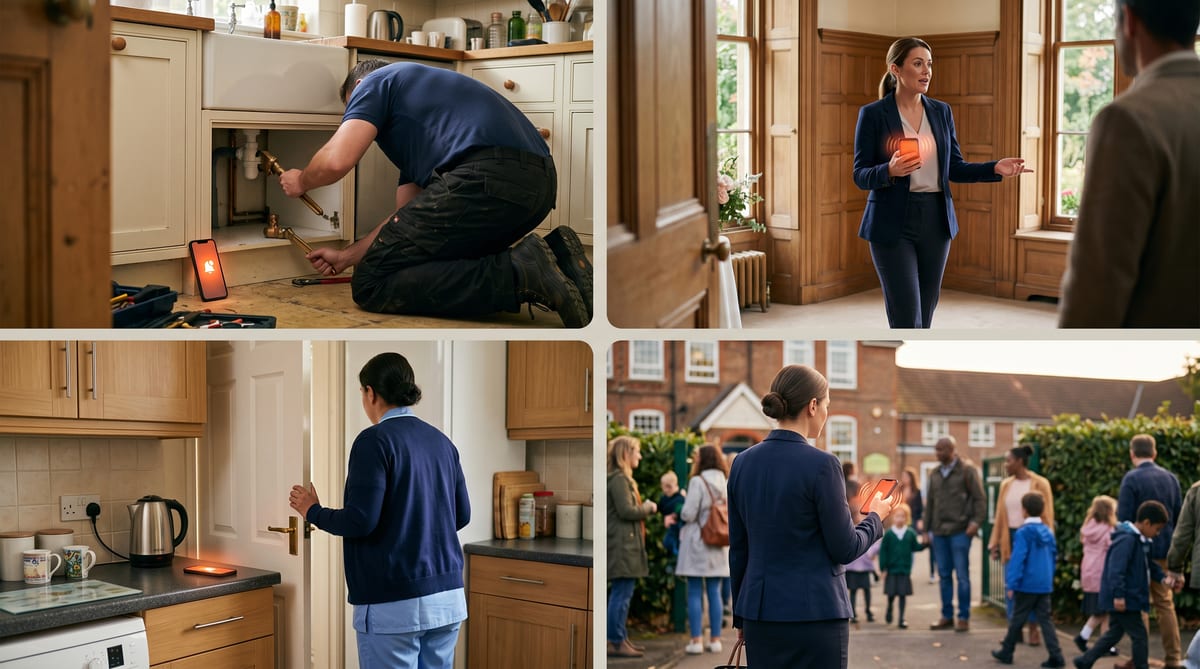
Every business loses the same thing in a slightly different shape. A few real moments - pick the ones that sound like your week:
- Reactive tradesthe emergency call that rang four times while you were on a job, then went to whoever picked up first on Google.
- Hospitality and wedding venuesthe “is your hall free for the 14th of June” DM at midnight from a couple who sent the same DM to four venues. First reply wins.
- Care, domiciliary, and clinicsthe 3am call to a duty line about a fall or a worried family member, heard at 8.30 the next morning after the family rang someone else.
- Letting agentsthe Rightmove or Zoopla enquiry at 11pm from a tenant who’s already messaged four other agents.
- Accountants and solicitorsthe “have you got my P60 yet” / “is my matter still on for Thursday” call at 5.45pm that lands in the partner’s voicemail.
- Recruiters and HRthe candidate CV dropped on LinkedIn at 9pm - by 9am tomorrow they’re on the next agency’s job listing.
- Device repair, garages, retailthe “how much do you charge” and “are you open Saturday” questions answerable from your price list - but you’re elbow-deep in the next job.
- Holiday lets, self-storage, gymsthe booking enquiry that needed an answer in five minutes but didn’t get one until tomorrow morning.
- Funeral directorsthe first-call at 3am to a number that’s gone to voicemail.
These aren’t problems for a generic chatbot. “I can’t help with that, please ring during business hours” makes the missed-call problem worse. What’s needed is an agent that knows enough about your business to actually be useful, on the channels your customers actually use.
What solved looks like - across every channel
1. Picks up on every channel a customer might use
The lost-customer moment: customers don’t all use one channel. The 60-year-old plumber’s client rings. The 35-year-old letting agent WhatsApps. The 22-year-old wedding venue enquirer DMs on Instagram. The web visitor at 11pm uses the chat box because they don’t want to ring. Currently, four of those five conversations never reach you in time.
Solved looks like: the same agent picks up across web chat on your site, WhatsApp, SMS, Facebook Messenger, Instagram DM, and inbound voice calls - same trained knowledge, same voice, no matter which channel the customer chose. The voice line picks up calls on no-answer (or busy, or out-of-hours - your choice). The web chat goes on any site you already have. The Messenger / Instagram / WhatsApp / SMS accounts plug in once and that’s it.
2. Trained on you, not the open web
The wrong-answer moment: a generic chatbot trained on the internet invents prices, invents policies, quotes on jobs it doesn’t understand, and says yes to things you’d never agree to. Worse than no answer.
Solved looks like: you give the agent your actual price list, your actual FAQ, your actual scope-of-service and scheduling rules, your actual escalation criteria. We feed in your documents, point it at the pages on your existing site that already describe what you do, and walk through the gaps with you in a simple form. From that point on, it answers from your business - not the internet’s idea of your business. Updates happen the way you’d update a team handbook: change the document, push it through, and tomorrow it knows what it didn’t know today.
3. Customisable in all the ways that matter
The “this doesn’t sound like us” moment: the canned chatbot replies in corporate English with a smiley face. Your customers know it isn’t you on the line.
Solved looks like: the agent’s tone is yours - direct or warm, formal or casual, plumber-blunt or funeral-director-gentle. The voice on the phone has an accent, a pace, and a greeting you’ve signed off on. The web chat carries your brand colours, your logo, and the wording you’d use yourself. Out-of-hours behaviour is tuned per channel. Different team members get different levels of access to the back-office view. None of it is rigid.
4. Knows when to step aside
The “it tried to handle something it shouldn’t have” moment: the agent that confidently quotes on a job it didn’t understand, or tells a bereaved family the wrong thing at 3am, is worse than no agent.
Solved looks like: the escalation matrix is tuned per business. For a plumber, water-pouring-through-a-ceiling routes to your phone in under sixty seconds. For an accountant, anything that’s genuine tax advice escalates to the partner with the question summarised. For a vet practice, anything clinical lifts straight to the on-call. The agent’s failure mode is escalating too eagerly, not answering wrong. We tune that ratio as you see real traffic.
5. You can step into any conversation at any time
The “I want to take over this one” moment: the agent’s handled the first three messages, but you can see from your phone that this is the £4,800 quote - you want to reply yourself.
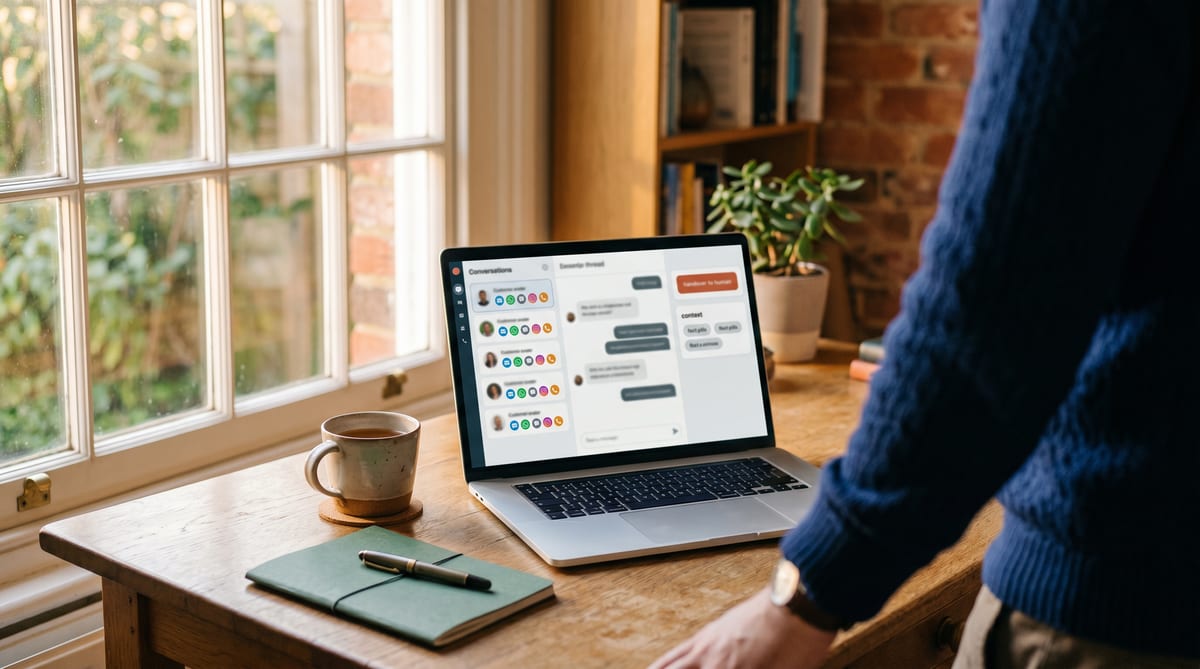
Solved looks like: every conversation across every channel writes to one place - searchable, with the full transcript. You see new messages live on your phone or laptop. You can pause the agent on any thread and reply as yourself. The agent stays out of the way until you hand it back. Multiple team members can be in, each at the access level you decide.
6. Books, quotes, captures the lead - not just chat
The “great conversation, but did anything come of it” moment: the bot was friendly and answered three questions. The customer drifted off. No booking, no lead, no follow-up.
Solved looks like: the agent doesn’t just talk - it gets to the next step. A quote band, a booking slot, a confirmed call-back, a captured email + phone + postcode + symptom, paired with a one-line summary to your phone. The thread is logged with the customer’s details so the follow-up - by you or by the agent - picks up where the conversation left off.
The channels we wire, explicitly
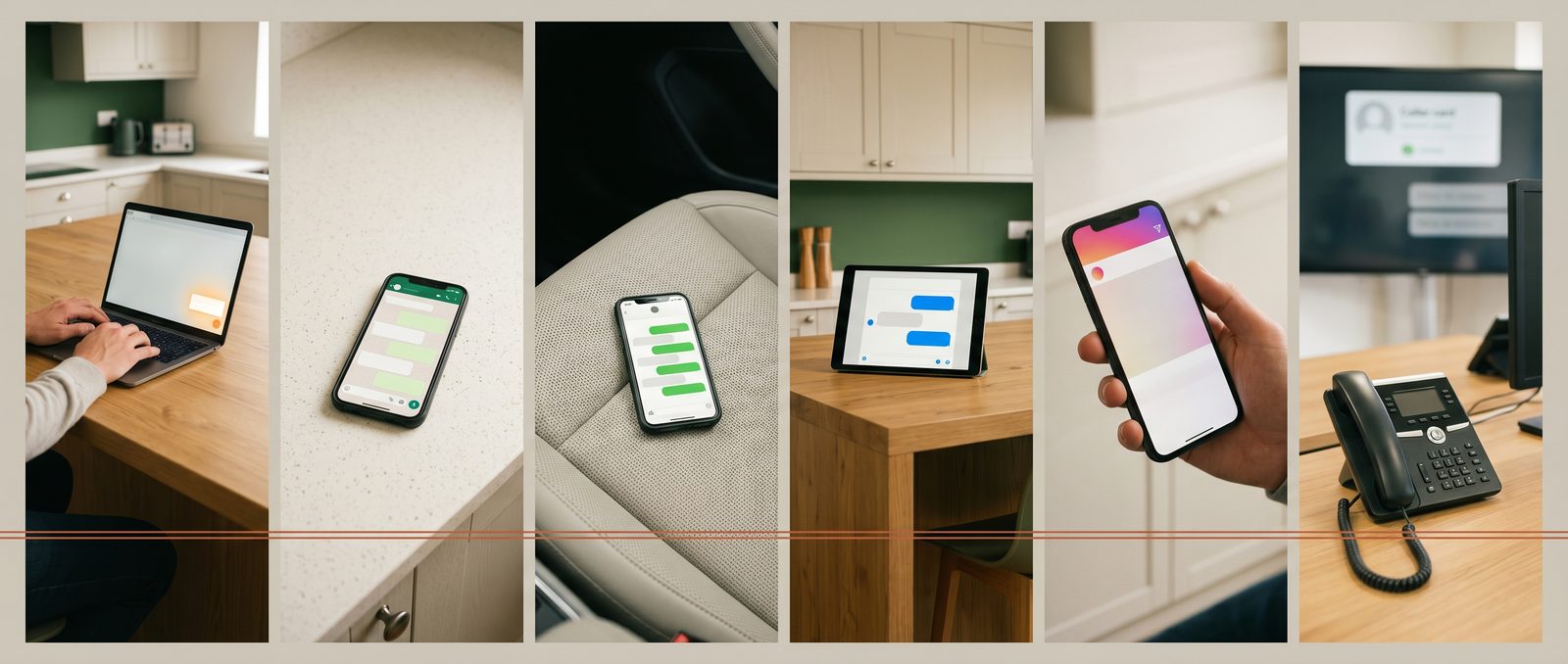
- Web chata widget that sits on any site you already have (WordPress, Shopify, Squarespace, plain HTML, or anything else). Branded as yours, trained on your knowledge.
- WhatsApp Businessyour business number gets the agent on the receiving end. Customers send photos, videos, voice notes; the agent reads them, replies in thread, attaches them to the lead record.
- SMStext messages to your business number get answered. The same agent, same voice, same trained knowledge. Useful for the customer who doesn’t want WhatsApp.
- Facebook MessengerDMs to your Facebook page get answered. Same voice, same knowledge, replies inside Meta’s response window automatically.
- Instagram DirectDMs to your business Instagram. Same agent, same shape.
- Inbound voice callsyour existing landline ported in, or a fresh number we provision, so the call gets picked up on no-answer / busy / out-of-hours. Natural conversation, holds context, can interrupt and be interrupted, knows when to stop trying and offer a call-back.
The customer dials the same number they always have. The page they DM is the same page they always have. You don’t ask your customer base to learn anything new.
Who this is for
It comes up everywhere. The shape repeats; the training data and the channels change per trade.
Reactive trades - plumbers, electricians, gas engineers, roofers, locksmiths. You’re on a ladder, under a sink, on a roof; the next leaky kitchen is ringing the next plumber on Google. The agent picks up, triages, books the survey slot, and pings your phone with a one-line summary.
Clinics and care - dental practices, private GPs, aesthetic clinics, vets, domiciliary care agencies. The 3am call doesn’t always need a clinician; the ones that do get the call-back, prepared. The ones that don’t get an answer that’s actually useful.
Hospitality - pubs, restaurants, wedding venues. The sub-15-minute reply to a midnight enquiry is the difference between winning and losing a £6,000 booking.
Letting and lettings - letting agents and landlord portfolios. Portal enquiries from Rightmove / Zoopla get the qualifying questions answered; tenant out-of-hours emergency calls get the severity triage before anyone’s woken up.
Professional services - accountants, solicitors, recruiters and HR teams. The records-chase, the “is my CT600 filed”, the candidate CV at 9pm - answered, captured, escalated only when they need a partner.
Everywhere else with phones ringing - device repair, independent garages, pet services, holiday lets, funeral directors, self-storage, wedding suppliers, driving instructors, tutors and nurseries, equine yards, agriculture.
Same shape; different training data; different channels; different escalation rules.
The closest thing we’ve already built
mendbuddy - our own build of this exact shape, shipped as SaaS. Voice + web chat + WhatsApp + SMS + Facebook Messenger + Instagram DM, trained on the business’s own knowledge, with a dashboard the owner uses to see what’s been handled, what’s been escalated, and which leads came in. Built originally for mendmyi, the studio’s device-repair business, then ported to dozens of other operations. The full case study walks through what it does, who it’s running for, and what changed.
We don’t sell mendbuddy as a sign-up-here product from this site. It appears as proof of what we can build for your business. If you want a version of it - trained on your pricing, your voice, your channels, your escalation rules - we’d build you one.

Tell us what your inbound looks like
What you do, what channels your inbound comes through, what fraction of it is answerable from a price list or FAQ, what fraction genuinely needs you, and what it’s currently costing you when nobody picks up. Send an enquiry - we’ll come back with a sketch of what we’d train, what we’d wire, and what the build would look like for your business.
FAQ
Will it actually sound like us, or will it sound like a chatbot?
It’ll sound like you, because we train it on your existing voice - the emails you’ve sent, the quotes you’ve written, the way you describe what you do. The first two weeks after go-live, we sit on every conversation and tune the voice; after that, it’s checking in periodically and adjusting when you change something about how you operate.
What if it gets something wrong?
Two safety nets. The first is that the agent refuses to answer anything outside the trained scope - it doesn’t make up prices, invent policies, or quote on jobs the training data doesn’t cover; it escalates to you instead. The second is that the escalation matrix is tuned per business, so the things that must hit a human (a leak in progress, a bereavement first-call, a clinical question, a complaint) route to your phone within seconds. The failure mode is escalating too eagerly, not answering wrong. We tune that ratio as you see real traffic.
Does it replace my existing phone number?
No. The agent sits behind your existing number - we either provision a fresh line we forward to, or port your existing landline, or wire into your carrier’s call-routing so the agent picks up on no-answer or busy. The customer dials the number they’ve always dialled.
What channels does it cover, exactly?
Voice (inbound calls), web chat, WhatsApp Business, SMS, Facebook Messenger, Instagram Direct, and a branded iOS / Android app for verticals where customers come back regularly. Email is supported but we treat it as the slowest channel because response expectations on email are slower.
Will it interfere with our existing CRM / phone system / WhatsApp Business?
No. The agent sits alongside what you have and writes conversations back as records. We integrate; we don’t replace. If you don’t have a CRM, the agent writes to its own thread store and you can decide later whether to migrate.
How long until it’s running?
Discovery: one to two weeks. Initial training and channel wiring: two to four weeks, depending on how messy the existing pricing-and-policy documentation is. Soft-launch with you watching every conversation: one to two weeks. Then full handover. Typically six to ten weeks for a shape we’ve shipped before, longer for a brand-new vertical.
What if our business changes - new services, new pricing, new policies?
That’s what the monthly arrangement covers. You change a document, we push it through, the agent knows tomorrow what it didn’t know today. No re-build, no version-2 cycle. Big changes (new channel, new vertical, new escalation rule) we’d scope separately; small changes are inside the monthly.
Can I take over a conversation manually?
Yes. Any thread, any channel, any time. The agent pauses on that thread until you hand it back. Multiple team members can be in, each at the access level you choose.