

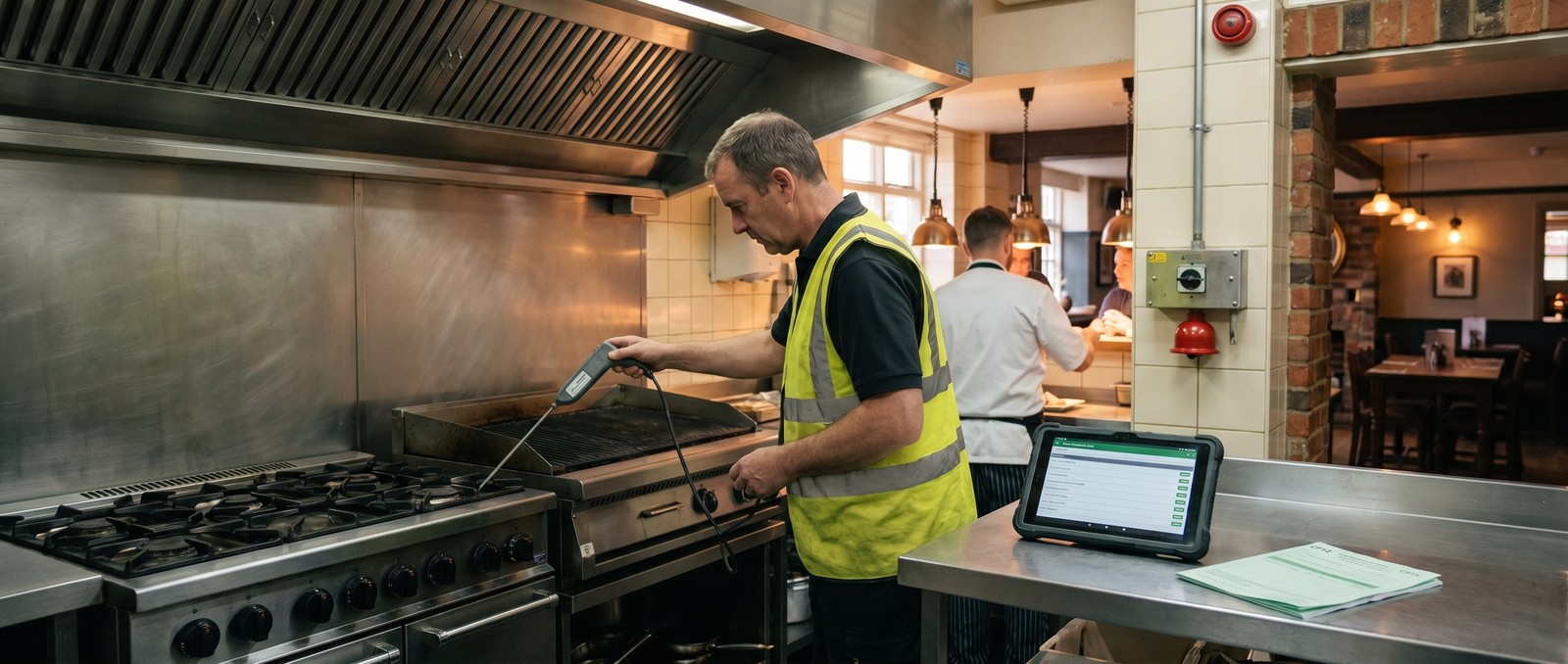
Software for UK commercial-catering gas engineers
Kitchen-down on a Friday night. Sixty-day terms on the Mayfair office. The customer who pays fastest is the one with eighty covers stacked up.
Commercial gas is a different trade again. The customer is a kitchen - or a hotel, a school canteen, a mobile catering van on a festival site, an office boiler-room - and the deliverable is the kitchen running for service tonight. COMCAT 1-5 says you’re certified across cookers, deep-fat fryers, ovens, hot-cupboards, char-grills; CP15 / CP16 / CP17 say you’re certified to issue the commercial gas safety certs the council or the insurer or the FM commissioner wants on file. LPG turns up on mobile vans and festival catering and the odd rural property. The cash cycle is split: restaurants pay the kitchen-down emergency in days because the kitchen has to run tomorrow; the FM commissioner on the Mayfair office pays in sixty days because that’s the contract.
This page is for engineers whose week is mostly commercial. If commercial is one part of a mixed gas-engineer week, the main gas-engineers page is the better fit. Commercial is its own thing because the customer is a business with covers stacked up, the cert is what the EHO + the insurer + the FM commissioner all want, and the cash cycle splits between same-week emergency cash and sixty-day contract terms.
What your week actually looks like
- 19:30 Friday: the gastropub on Cornhill calls. Deep-fat fryer out, sixty covers booked, the kitchen has to run by 18:00 Saturday.
- A CP15 commercial gas safety cert renewal at the school canteen - half a day, the bursar wants the cert and the invoice on Monday morning so the term can start without an EHO question mark.
- A COMCAT-scope kitchen install - char-grill, two combination ovens, three induction tops, a walk-in cold room, the extract canopy + gas-interlock system. Twelve weeks of project work alongside the architect’s contract administrator.
- An LPG check on a mobile catering van going to a festival in two weeks; the gas-bottle rack and the regulator both flagged as out-of-cert.
- An FM commissioner’s helpdesk ticket - a P2 leak in the kitchenette at the Mayfair office - SLA four hours, credit-note attached to breach.
- A sixty-day-terms invoice from May that the FM commissioner’s bookkeeper is still queuing for the August payment run.
- An emergency Tuesday-evening callout to a Greek restaurant whose char-grill flame-failure-device is tripping; the owner is paying you £400 cash on the doorstep and the kitchen is open by 17:00 Wednesday.
- A CDM 2015 obligation on a construction-adjacent install at the new hotel - the principal contractor’s CDM file wants the gas-side commissioning record alongside the electrical.
- The annual COMCAT reassessment + F-Gas company cert + your van MOT all stacking into the same fortnight.
Example problems we could solve
1. The kitchen-down out-of-hours dispatch + same-week invoice
The Friday-19:30 moment: gastropub rings Friday 19:30. The kitchen has to run by 18:00 Saturday. You’re at the dinner table; the owner’s panicking. The part you need (a flame-failure device on a Lincat range) is at the trade counter that opens at 06:00 Saturday and shuts at 12:00, and you need to know that on the inbound call.
Solved looks like: an answer-on-your-behalf line that picks up while you’re at dinner - across calls, SMS, WhatsApp, and the chat box on your website - in your voice, trained on your COMCAT scope and your kitchen-down triage policy. The agent asks the right questions on the inbound (“is service tonight at risk?”, “is the kitchen out completely or just one piece?”, “how many covers are booked?”, “what’s the equipment make and model - Falcon / Lincat / Foster / Williams / MKN?”), routes the P1 to your phone with the part-number identified, and pre-checks the Saturday trade-counter opening hours so the part is on the van by 8am rather than midday. The same engine drafts the kitchen-down invoice on completion with the doorstep card link - restaurants pay the kitchen-down job in days because the kitchen has to run again tomorrow. The longer version lives at /solutions/trainable-inbound-ai-agent; the commercial-catering version is shaped around kitchen-down triage with parts-route prefetch from your usual supplier.
2. The CP15 / CP16 / CP17 cert + the EHO evidence pack
The Monday-morning-bursar moment: school canteen wants the CP15 by Monday morning. Bursar’s printing the term-start paperwork. You’ve got the readings, just not in one PDF - half on the tablet, half on a paper sheet you photographed in the van.
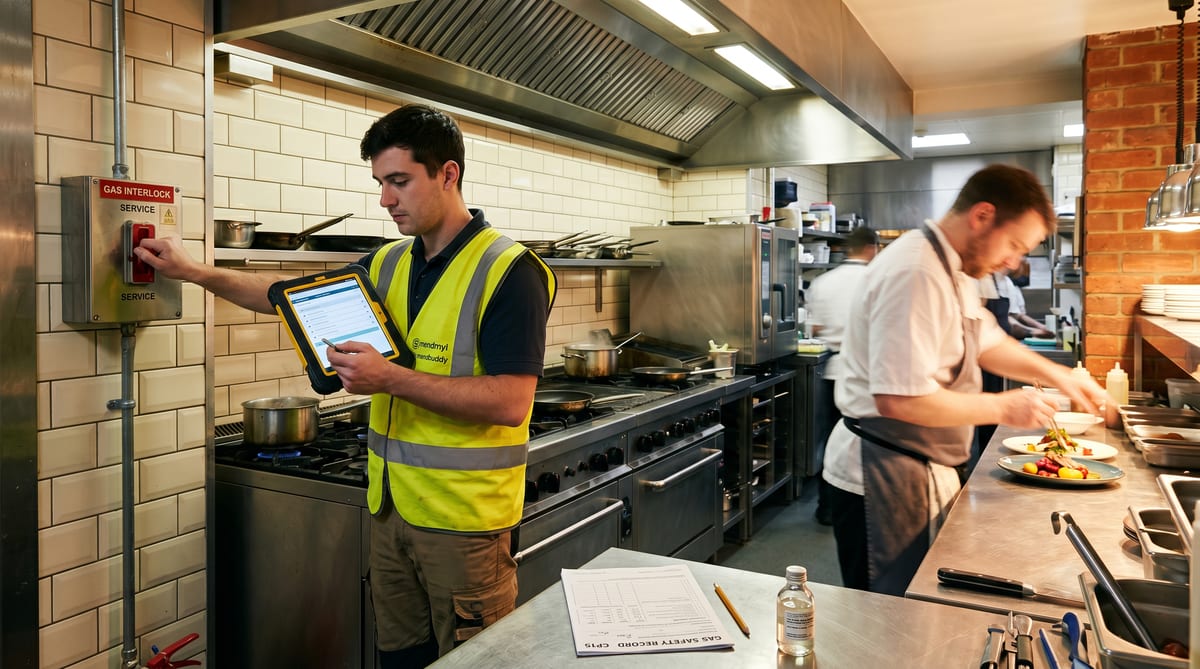
Solved looks like: every commercial cert visit captures the structured fields the cert requires - installation reference, equipment list (cooker, fryer, hot-cupboard, water-heater, instantaneous water-heater, with manufacturer + model + serial per appliance), gas-rate test, pressure test, flame-supervision-device test, ventilation check (extract canopy + interlock + makeup air), and the unsafe / At-Risk / Immediately-Dangerous classification per IGEM/G/11. The cert renders to the CP15 (commercial premises) / CP16 (commercial catering) / CP17 (commercial laundry & boiler-room) PDF inside two minutes of close-out; emails to the customer + the FM commissioner + (where requested) the EHO with the same record attached. The annual renewal calendar auto-books eleven months out. Commercial certs aren’t issued through Gas Safe - they’re issued under IGEM scheme + the engineer’s commercial registration - and the build is shaped around the cert being the operational deliverable, not a footnote.
3. FM helpdesk integration that hits the four-hour SLA
The four-hour-SLA moment: FM commissioner runs every ticket through Concept Evolution. P2 leak, four-hour SLA. You’re under a different boiler in Sudbury when the email lands. The SLA breach is a £150 credit on next month’s invoice - and the third breach this quarter is the conversation about whether the panel keeps you on.
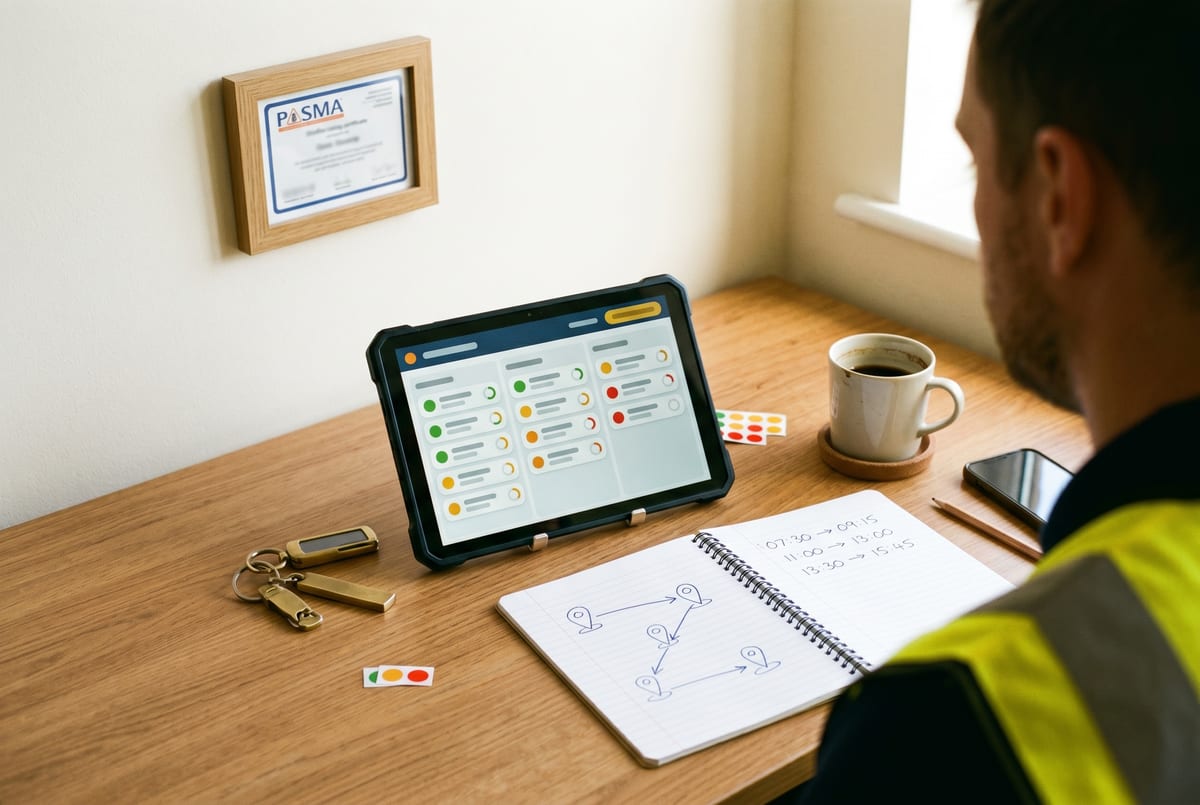
Solved looks like: the FM commissioner’s helpdesk feed pulls into a single dispatch dashboard. Concept Evolution, Maximo, SI7 - most major UK FMs publish a feed (email, webhook, or a small published interface) and the dispatch side reads tickets tagged by priority and SLA clock. Auto-acknowledgement back to the FM in their template; SMS to the on-call engineer with the postcode and the SLA expiry time; one-tap en-route status that updates the FM portal in their format. SLA breach risk shows on a red-amber-green dashboard the operator opens with their morning coffee. FM contracts have credit notes attached to SLA breach - a missed 4-hour P2 is a £150 credit on the next month’s invoice - and the dispatch dashboard is shaped around the SLA clock, not the work itself. The same pattern lives on the commercial plumber spoke for plumbing-and-gas hybrids.
4. The sixty-day FM invoice + the same-week kitchen-down invoice, on one cashflow
The two-cycles moment: kitchen-down at the gastropub Friday paid £450 doorstep Saturday; FM contract at the Mayfair office from May still chasing in August. The bank balance can’t tell you which cycle is bleeding because Xero shows both as invoiced - and the wage bill goes out the same day either way.
Solved looks like: invoices that go out on completion with the customer-type already tagged. Kitchen-down doorstep cash cycles on a 7-day reminder pattern with a card link in the first email; festival-event paid-on-cert-issued bundles the cert and invoice together for the organiser at the end of the run; FM contracts run on the 60-day clock with the cost-coding the FM’s bookkeeper recognises, the SLA-credit-note tracking baked into the line, and a day-31 statutory-interest line citing the Late Payment of Commercial Debts (Interest) Act 1998. The operator-side forecast shows the four cycles side-by-side so you can see whether the FM-pipeline shortfall is going to bite before it does, not after. The longer version lives at /solutions/invoice-and-dunning-ladder; the commercial-catering version’s distinct features are the kitchen-down same-week doorstep cycle running alongside the FM 60-day batch with SLA-credit-note reconciliation.
The closest things we’ve already built
- HC Electricaldifferent trade, same Suffolk trade-chassis with the commercial-side CIS-aware invoicing on the electrical side. The reference for how the same commercial-cert-and-FM-helpdesk pattern runs in a Suffolk trade business. (Pull-quote held behind the permission checklist; see /case-studies/hc-electrical.)
- mendbuddyour own multi-channel AI agent across SMS, WhatsApp, web chat, and inbound + outbound voice. The platform behind the kitchen-down triage in problem 1 and the customer-side comms with restaurant managers under pressure. Trained on your COMCAT scope, your supplier list, and your commercial customer voice. See /case-studies/mendbuddy.
- MMI Serviceslegacy insurance-claims surface, being modernised. Proof we can take over and modernise older internal systems - useful when the FM commissioner already runs Concept Evolution or Maximo and the work has to live alongside it without rip-and-replace. See /case-studies/mmi-services.
FAQ
Will the system handle COMCAT scope across the kitchen equipment list?
Yes - COMCAT 1 (cookers), COMCAT 2 (deep-fat fryers + grills), COMCAT 3 (forced-convection ovens), COMCAT 4 (hot-cupboards + bain-maries), COMCAT 5 (commercial catering equipment specialist additions). The cert engine captures the scope per appliance so the certificate reflects what’s actually in scope, not a generic “commercial kitchen” line that the EHO will query.
My FM commissioner runs Concept Evolution / Maximo / SI7. Will the helpdesk feed work?
Yes - the dispatch side reads from the FM’s feed (email, webhook, or where available a small interface they publish) and writes status updates back in their format. We don’t replace the FM helpdesk; we make sure the SLA clock doesn’t beat you.
Can the engine handle LPG kit on mobile catering vans + festival catering?
Yes - LPG-specific kit (gas-bottle racks, regulators, hoses, mobile installs under the Gas Safety (Installation and Use) Regulations 1998 + the LPGA Code of Practice) captures into the cert with the right scope. Festival-event certs auto-bundle for the organiser at the end of the run.
Will you take on CDM 2015 responsibilities on construction-adjacent installs?
No. CDM duty-holder responsibilities (principal designer, principal contractor) stay with the construction client. We build the evidence record and the commissioning record that fits into the principal contractor’s CDM file.
Can the engine handle the F-Gas company cert renewal alongside COMCAT and the personal RGI / Gas Safe reassessment?
Yes. The renewals tab tracks the F-Gas company cert (three-year cycle), the engineer’s COMCAT reassessment (five-year), the F-Gas engineer category cert, the personal Gas Safe / ACS reassessment, and the van MOT in one place so they stop stacking into the same fortnight unnoticed.
What does it cost?
Every build is scoped per firm - depends on van count, FM-contract count, kitchen-equipment install volume, and whether the LPG / festival layer is in scope. We talk it through, agree the scope and the price in writing. See pricing.
Up to the hub
← UK gas engineers (hub) · Landlord CP12 (sibling) → · Boiler installer (sibling) → · Heat-pump installer (sibling) → · Commercial plumber (adjacent trade) →
Tell us about the commercial side
What COMCAT scope you carry, what FM commissioners you work with, how many kitchens are on the recurring round, where the LPG / mobile-catering side fits. Send an enquiry - we’ll come back with a sketch.