

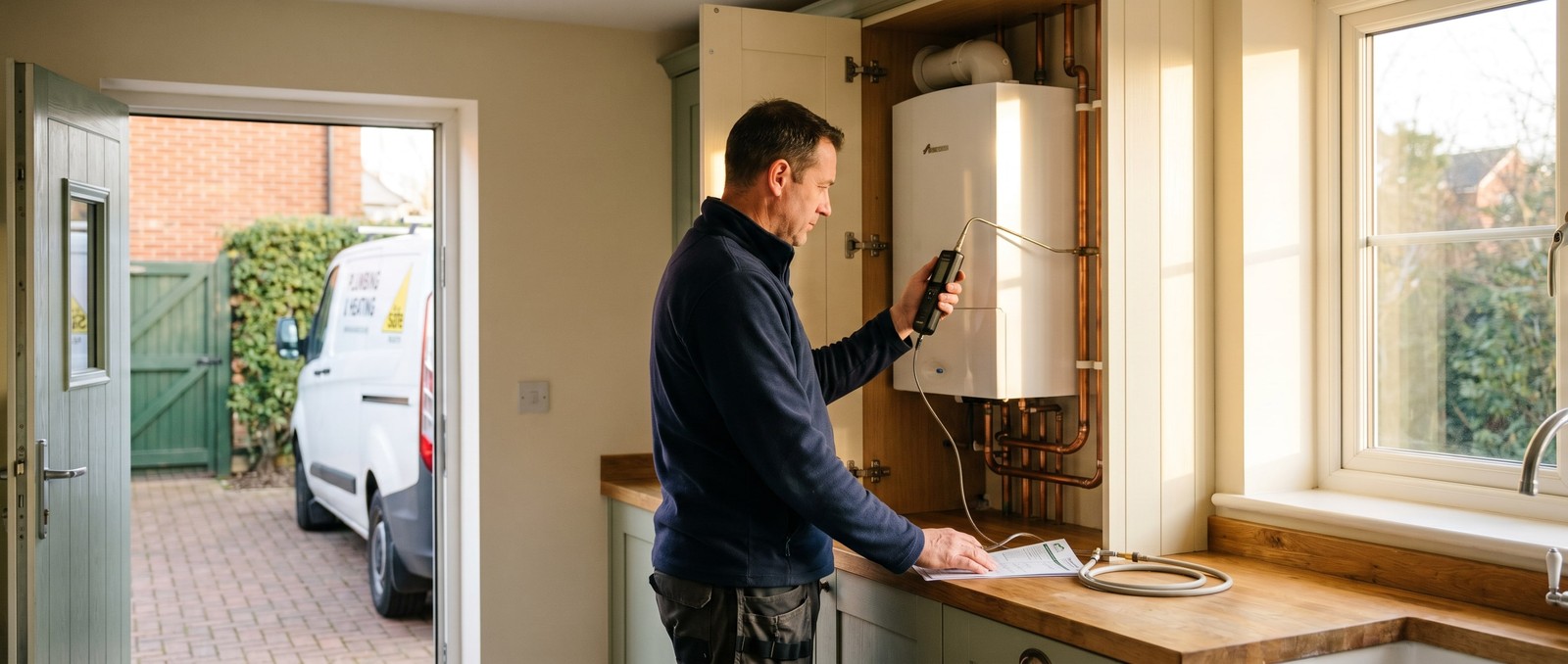
Software for UK gas engineers
You’re a gas engineer. Not an Ofgem admin clerk.
It’s late August. The first wave of “can you do my CP12 before October?” texts has started landing - twelve from one Suffolk letting agent on Monday, six from another on Tuesday. You’re under a boiler at half five with both hands black, the phone in the van is ringing, and the customer on the other end is the kitchen at a Burnley restaurant with no hot water and sixty covers booked. You did a Worcester Greenstar swap last Thursday and forgot the thirty-day warranty registration window again - that’s another Sunday-evening recovery. You’ve got fifty-odd landlord properties on your books, ten of them with annual CP12 renewals stacked into September, and a Gas Safe scheme notification you keep meaning to do before the £30 fine email lands.
We make custom software for Gas Safe engineers - solo through small commercial firms. Small apps and automations that sit on top of what already works for you - Commusoft, Joblogic, Klipboard, Tradify, ServiceM8, paper-and-WhatsApp, whatever you run - and quietly do the bits that waste your Sunday evening. Not another app to learn on a 5-inch screen with one hand. The bit between job done and paid, notified, warranty registered, customer booked back in next September - that’s the bit we take off your plate. Tell us what’s slowing you down and we’ll come back with a sketch of how to fix it.
What you spend your week on that you shouldn’t have to
- The CP12 round each August-to-October - letting agents wanting last year’s certs, tenants needing access slots, fifty-odd properties batched into six weeks.
- The Worcester / Vaillant / Baxi / Ideal thirty-day warranty registration window you keep slipping - customer claims on the ten-year guarantee three years later, manufacturer asks for the registration, it isn’t there.
- Gas Safe scheme notification within thirty days of every install - the £3 + VAT fee isn’t the issue, the “two weeks late again” is.
- The phone in the van going while you’re under a boiler at half five - the breakdown call you missed cost you £180 and a one-star review.
- A new-boiler enquiry on Sunday at 22:15; Heatable replies at 22:17 with a price; you see it Monday morning.
- The MagnaClean upsell at the annual service that’s a £400 line you’d quote if you remembered to ask at the doorstep.
- Boiler-care service plans at £8-£12/month that should be £20k recurring across two hundred customers - instead they’re a Friday-afternoon spreadsheet that doesn’t get done.
- ACS reassessment every five years, F-Gas company cert every three, MCS annual surveillance - a renewals tab you only open the morning after the fine lands.
- A heat-pump install signed off Friday with the MCS certificate due inside fourteen days, the BUS voucher submission to Ofgem, the cylinder warranty, the EPC update - that’s the next Sunday afternoon.
- A commercial catering call-out at the Mayfair restaurant on sixty-day terms, an out-of-hours landlord CP12 ring the same evening, and one Xero trying to hold both.
These aren’t problems for a generic field-service app. They’re the bit between engineer at the boiler and certified, notified, warranty-registered, on the books, booked back in next September. That’s the bit we take off your plate.
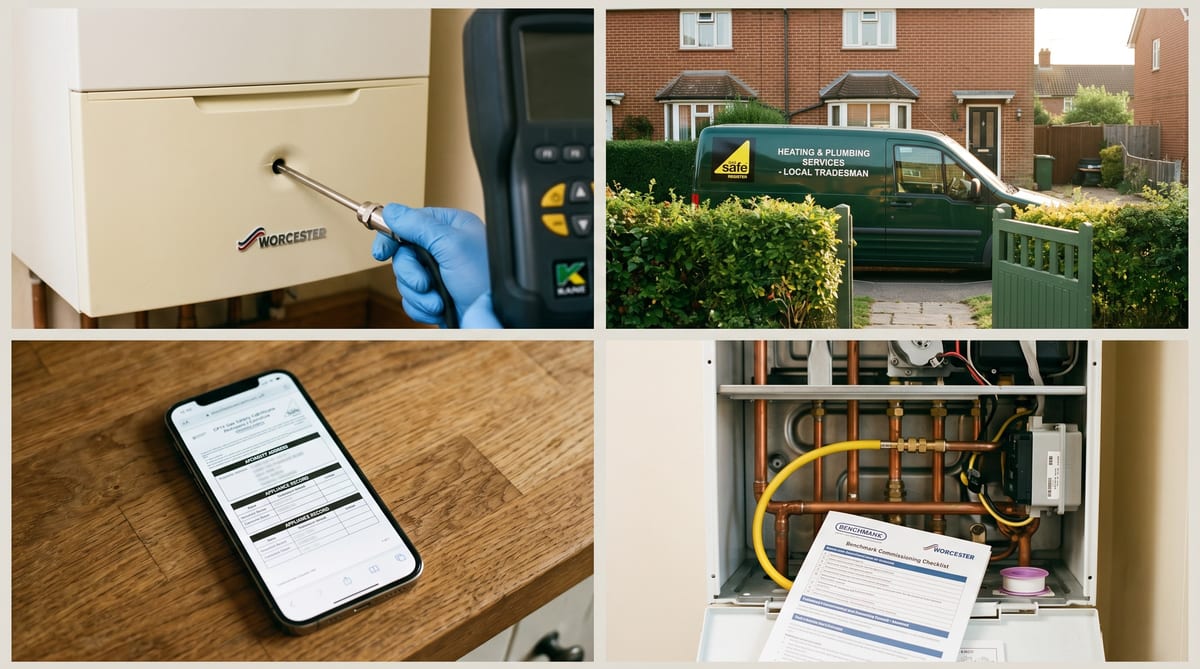
Example problems we could solve
Six things we hear most often from gas engineers - with what the solved version looks like in your week. Every job is sized to your business: a sole-trader heating engineer probably needs the first two; a small firm running CP12 rounds, boiler installs, and the occasional heat-pump might want all six. None of it means binning what already works.
1. The under-a-boiler line that triages breakdowns from quotes
The lost-emergency moment: phone rings four times while you’re knelt in front of a combi with a flue gas analyser in one hand and a multimeter in the other. By the time you’re up, the caller with no heat has rung the next gas engineer on Google. Most missed calls in this trade are breakdowns, and they go to whoever picks up first.
Solved looks like: an answer-on-your-behalf line that picks up while you’re on the tools - across calls, SMS, WhatsApp, and the chat box on your website - in your voice, trained on your out-of-hours policy and your last-sent quote. Crucially for gas work, fault-code recognition on inbound is first-class: a customer who reads off “the boiler’s flashing F75 on the front” gets a sensible same-channel reply - “that’s a pump pressure sensor fault on a Worcester, usually a frozen condensate when it’s below zero; can you pour a kettle of warm water over the white plastic pipe coming out the back wall?” - without you having to climb down. The longer version lives at Trainable Inbound AI Agent; the gas-engineer setup is tuned to triage breakdown-vs-install-quote-vs-CP12-booking on the line, with the Worcester / Vaillant / Baxi / Ideal fault libraries wired in alongside your own pricing.
2. Three options, photograph-driven, finance link inline - before the kettle’s boiled
The Heatable moment: customer wants three quotes on a new boiler; you drive over, photograph the old setup, get back and spend an hour pricing; then radio silence - Heatable replied to her in fifteen minutes with an online price and BOXT followed up the next morning. By the time your quote lands, you’re a footnote on her shortlist.
Solved looks like: the photo set the customer sends (or you take on the survey) drives a three-option quote - a modal Worcester, a modal Vaillant, a modal Baxi or Ideal at the right sizing for the property - pre-loaded at your trade-supplier pricing, with MagnaClean and power-flush options where the system flags for them, and a V12 / Novuna / Kanda finance link inline. The quote PDF sends inside thirty minutes of the photos landing, in the same channel the customer enquired on. The chase ladder runs behind it without you having to remember. The longer version lives at Quote & Chase Ladder; the gas-engineer version is shaped to match the online-installer speed expectation without abandoning the trade-installer relationship. The depth on the install side lives on the boiler-installer spoke.
3. Booking, en-route SMS, MagnaClean upsell, and the review chase
The Wednesday-morning moment: annual service booked Wednesday morning. Customer takes a half-day. You’re thirty minutes late from a Tuesday breakdown; she’s writing the Google review by 09:45. And you forgot to quote the MagnaClean filter again - that’s the £400 line you’d have written up if you’d remembered to ask at the doorstep.
Solved looks like: booking → reminder the night before → en-route SMS that fires off your calendar flipping to travelling → at-doorstep service checklist with the MagnaClean / power-flush prompt baked in (system age, sludge sample if you took one, photo evidence for the upsell quote) → digital Benchmark commissioning capture → ninety-minute review prompt with one-tap links to Google, Checkatrade, and Trustist. Negative sentiment routes back to you privately before it lands public; positive sentiment goes straight out. The MagnaClean upsell stops being a memory test and becomes part of the routine - that’s the biggest single revenue line the trade leaves on the table. The longer version lives at Booking & Review Loop.
4. Four cash cycles on one engine
The whiplash moment: Sunday emergency call-out paid £180 cash on the doorstep. £4,200 Worcester swap on V12 finance. Landlord agent’s monthly CP12 batch sitting in the bookkeeper’s queue. Commercial catering call-out at the Mayfair restaurant on sixty-day terms. Four cash cycles, one Xero, one phone, one you - and no way to tell from the bank balance which one is bleeding.
Solved looks like: invoices that go out on completion with the customer-type already tagged. Domestic gets a 14-day cadence and a card link in the first email. Letting-agent CP12 batches land monthly with the per-property breakdown the agent’s bookkeeper expects, and a day-31 statutory-interest line citing the Late Payment of Commercial Debts (Interest) Act 1998 - politely, automatically, without you having to feel awkward about asking. Installs route through V12 / Novuna / Kanda where the customer chose finance, with the affordability check reconciling back against the invoice. Commercial catering on FM contracts runs on the 60-day clock with credit-note tracking against any SLA breach. Heat-pump invoices show the BUS grant deducted on the line the customer pays, with the Ofgem voucher payout reconciling separately. The longer version lives at Invoice & Dunning Ladder; the depth on each sub-audience lives on the landlord-CP12, commercial-catering, and heat-pump installer spokes.
5. The boiler-care engine that turns the install ticket into a ten-year customer
The forgotten-renewal moment: two hundred customers on the books, two hundred boilers fitted in the last decade. On paper £20,000 a year of recurring revenue at £8.50/month for an annual service + priority breakdown line + parts cover. In practice the GoCardless mandate is signed at install sometimes, the failed-direct-debit retry never happens, and the annual-service-due auto-booking lives in your partner’s diary on a good year.
Solved looks like: every install captures the boiler-care mandate on the tablet at the door - GoCardless DD set up before you leave, the customer’s enrolled in the cohort, the twelve-month service auto-books from the install date. Failed payments retry on a recovery ladder in your voice rather than dropping the customer silently. Eleven months out, the “your annual service is due - reply YES to book” SMS lands; the diary fills itself; the cohort dashboard shows the at-risk customers in red so your Friday afternoon is a five-minute glance rather than a missed renewal year. The manufacturer-warranty conditions on annual servicing reconcile against each customer’s actual service history, so the warranty risk is visible to the customer in February - not at the moment the boiler fails. The longer version lives at Recurring Service Recall; the engine is the highest-leverage recurring-revenue layer in the gas trade.
6. The thirty-day double window - Gas Safe scheme + manufacturer warranty, on one screen
The double-paperwork moment: Worcester thirty days for the warranty registration. Gas Safe scheme notification thirty days. Both. Every install. You keep slipping one or the other and the customer carries it ten years later when she claims on the guarantee and the registration isn’t there.
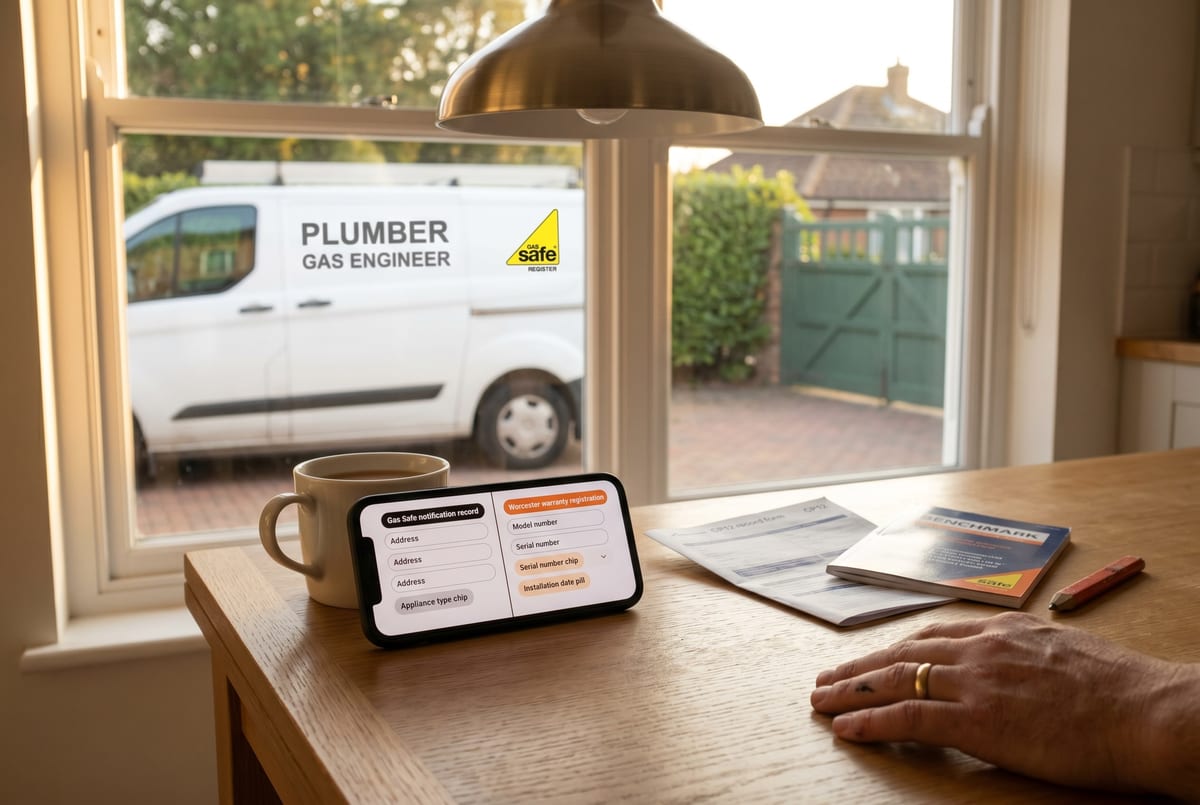
Solved looks like: install closed on the tablet at the door → 09:00-next-morning owner-digest of un-notified jobs lands on your phone with one-tap notify per job. The Gas Safe scheme notification queues with the install address, the work-type, and the commissioning reference; the engine pre-fills the form to the extent the portal allows - you confirm and submit. The manufacturer warranty registration runs in parallel against Worcester Bosch, Vaillant Advance, Baxi Works, Ideal Heating Max, or Viessmann; same pre-fill, same one-tap approve, same audit log. Building Regs Part J / Part L self-certification doubles off the Gas Safe notification under the competent-person scheme. Customer email auto-fires at the end of it with the Building Regs Compliance Certificate, the manufacturer warranty confirmation, and the first annual-service reminder set twelve months out. Every other trade has one paperwork window - only Gas Safe carries two in the same thirty days, and the engine is shaped around closing both reliably. The longer version lives at Grant & Submission Handling.
The closest things we’ve already built
- HC Electricala domestic and EICR electrician in Haverhill, Suffolk. Different trade, same Suffolk trade-chassis: a fast public site, the cert-and-quote engine behind it, the recall annuity, the letting-agent batch billing, the audit-trailed evidence record. The closest live reference for a Gas Safe engineer who wants the website and the back-office wiring done by the same studio. (Named pull-quote and final outcome figures hold until the permission checklist clears - full case study at Hc Electrical.)
- mendbuddyour own multi-channel AI agent for inbound conversations across SMS, WhatsApp, web chat, and inbound + outbound voice. The under-a-boiler line in problem 1 and the photograph-driven quote in problem 2 are gas-engineer-shaped versions of this. See Mendbuddy.
- RepairMinderour software for running an inbound-items repair business. Different trade; same shape as the install-and-service-record pattern in problem 3 - work comes in, gets tracked, deliverable goes out, customer kept in the loop the whole way through. See Repairminder.
If your week’s narrower than the whole of the above
Four sub-audiences whose week looks different enough that they have their own pages:
- Landlord CP12 specialist →if your week is mostly letting-agent retainer work and the August-to-October round is the season that makes the year, this is the page.
- Boiler installer →if you’re Worcester / Vaillant / Baxi / Ideal accredited and the £4k-£5k install tickets are the bulk of the revenue, the photograph-quote + finance + warranty-bridge build is the answer.
- Heat-pump (MCS) installer →if you’re MCS MIS-3005-I certified and BUS grant paperwork plus the fourteen-day MCS certificate window is eating into install profitability, this is the page.
- Commercial catering / COMCAT engineer →if your week is mostly restaurant kitchens, hotels, mobile catering vans, LPG specialism, and CP15 / CP16 / CP17 commercial gas certs, this is the page.
Adjacent trades
- Plumbersif you’re plumbing-and-gas with plumbing as the bigger half of the week, the plumbers hub is the better primary page; we’d pull the CP12 round and the Gas Safe reminder in as add-ons against the plumbing chassis.
- Electriciansthe trade-chassis reference; HC Electrical is the named-build proof of how this shape runs in a Suffolk trade business.
- MCS-registered solar / battery installersif heat-pump is paired with solar PV or battery work, the MCS-installer hub covers the broader MCS scheme overlap.
- Lettings agents and landlord portfoliosthe other side of the CP12 conversation; if you mostly work for one or two agents, the agent-side hub is worth a read.
FAQ
Do I have to bin Commusoft / Joblogic / Klipboard / Gas Engineer Software / Tradify / ServiceM8?
No. Commusoft is heating-specialist and works for 20+ engineer firms; Joblogic is fleet-shaped; Tradify and ServiceM8 work for many one-van engineers. We sit on top of what’s working and replace the bit that doesn’t - usually the missed-call recovery, the photograph-driven quote, the warranty-bridge, the CP12 batch round, the boiler-care service-plan engine. If your job entry and diary are fine in Tradify, we hook into the export and start from there.
Will you notify Gas Safe / register the Worcester warranty on my behalf?
No. Gas Safe scheme notification carries an indemnity that stays with the engineer; manufacturer warranty registration is an installer obligation under the scheme rules. We build the reminder, the pre-filled form to the extent the portal allows, and the audit log. You sign and submit. The build is shaped around closing both windows reliably - not around carrying the indemnity for you.
Can you handle CP12 across multiple letting agents at once?
Yes - that’s the landlord-CP12 spoke at depth. The August-to-October round runs as a tracked batch per agent; the agent-side portal shows the current cert status across the portfolio; tenant-side access scheduling runs from the same record. Letting agents pay 14-30 days post-cert; statutory interest applies from day 31.
Can the heat-pump BUS voucher submission integrate with Ofgem?
The submission goes through the Ofgem installer portal - there’s a sign-off step that stays human. We build the pre-fill and the timing (MCS MIS-3005-I cert within fourteen days, BUS voucher submission within the 3-month validity window, grant-deducted-from-invoice reconciliation). See the heat-pump spoke for the depth.
My business is plumbing-and-gas. Which hub is the right one?
Both. If gas is the bigger half (CP12 round, boiler installs, heat-pump work), this is your primary page. If plumbing’s the bigger half (bathroom installs, leak-detection, lettings property-maintenance plumbing), the plumbers hub is. Either way, the build pulls the other side in as add-ons against the primary chassis.
What does it cost?
Every job is sized to your business - depends on van count, landlord portfolio size, whether the boiler-care service-plan engine is in scope, whether the heat-pump BUS paperwork is in scope, and what’s already on your phone. We talk it through, agree the scope and the price in writing, then build. Send an enquiry and we’ll come back with a sketch. See pricing for how we work.
How long until something’s live?
Most gas-engineer builds we’ve sketched go from scope conversation to a working version you can run a real install + a real annual service through in a few weeks, then a couple more weeks of running live work through it before go-live. The landlord-CP12 batch round and the boiler-care service-plan engine usually ship together because the cashflow case stacks; the warranty-bridge ships separately because the manufacturer-portal integrations move at their own pace.
I’m a one-van engineer - is this overkill?
The whole point of custom is that it’s the size of your business. A one-van engineer might just be problem 1 (the under-a-boiler line) and problem 6 (the thirty-day double window). A five-van firm running CP12 rounds, installs, and heat-pump work might be all six plus the spoke material. We size it to what’s actually hurting.

Tell us what your week looks like
Send an enquiry - what’s your van count, what mix (CP12 round, boiler installs, heat-pump, commercial catering, plumbing-and-gas), how many landlord properties you cover, what accreditation you carry (Worcester / Vaillant / Baxi / Ideal / MCS / COMCAT), where the Sunday-evening admin sits. We’ll come back with a sketch of what we’d build and what it would cost. No calendar, no demo to sit through. Email reply, scoped sketch, you decide.