

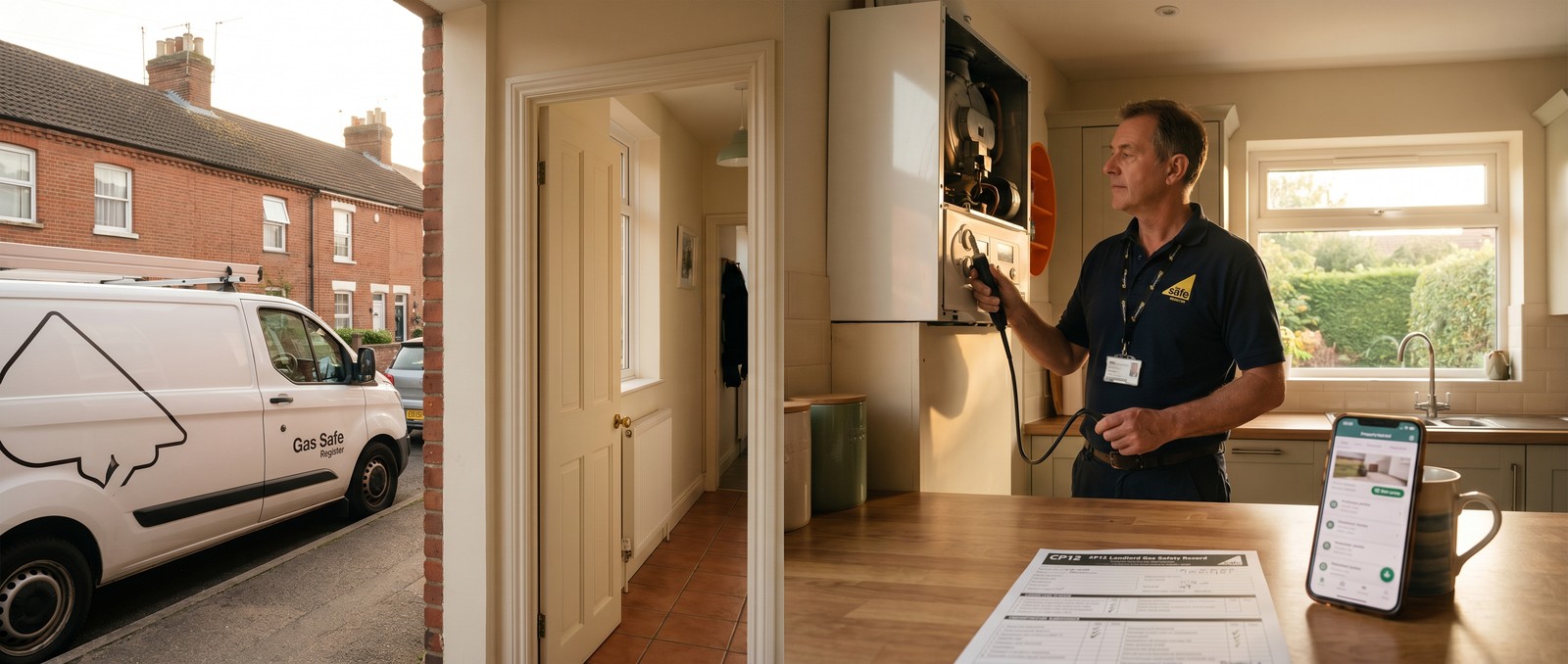
Software for UK landlord-CP12 gas engineers
Twelve from one agent on Monday. Six from another on Tuesday. October’s six weeks away and the diary’s already gone.
You’re a Gas Safe engineer with a landlord book. Most of the year it’s the bread-and-butter recurring revenue you signed up for - a couple of properties a week, the agent pays in fourteen days, the cert lands in the portal, life is fine. Then August arrives. The first wave of “can you do the CP12 before October?” texts hits - twelve from one Suffolk letting agent on Monday, six from another on Tuesday - and the back of an envelope says you’ve got forty-seven properties due before the renewal window closes. The tenant at 14 Coppice Road can’t do Wednesday or Thursday or any time between nine and six. The bigger agent’s bookkeeper holds the October batch because the cost-code on one line doesn’t look right. By November you’ve worked seven Sundays in a row and your December cashflow is still waiting on October’s batch.
This page is for engineers whose week is mostly landlord-CP12 retainer rounds. If you do the occasional CP12 alongside install work or breakdowns, the main gas-engineers page is the better fit. The CP12 round is its own business because the operational cadence is its own thing - and the build is shaped around the August-to-October peak, the three-way comms (tenant / agent / landlord), and the agent-portfolio batch invoice.
What your week actually looks like
- Twelve properties from one Suffolk letting agent landing in your inbox on Monday; six from another on Tuesday; the round-up text says forty-seven due before October.
- Tenant access scheduling on those forty-seven properties - “after 6pm only”, “only Saturdays”, “the dog has to go in the bedroom first” - and a Google Calendar that doesn’t survive a phone change.
- A six-week window where every Gas Safe engineer in the county is doing the same thing, and the parts merchant is out of the diverter valves you keep needing.
- The agent’s bookkeeper holding the monthly batch because one cost-code is wrong on one property.
- “I told the tenant Tuesday. He’s saying no one came.” - a phone call from a property manager about a visit that did happen, with the cert sitting in your van.
- An EHO visit at one of the HMOs the agent didn’t tell you about, wanting the Legionella ACoP L8 risk-assessment evidence alongside the CP12 history.
- A tenant who cancelled the access at the door because “the landlord didn’t say” - agent didn’t tell tenant, tenant didn’t tell landlord, you drove forty minutes for nothing.
- The non-CP12-renewal work - fault calls, the odd boiler swap, the cylinder change - that has to fit around the round and gets bumped into the evening.
This isn’t a job-management software problem. It’s a three-audiences-one-record problem with a seasonal peak stapled on top and a 28th-of-the-month cash cycle running through it.
Example problems we could solve
1. The August-to-October round, scheduled before the season starts
The napkin-diary moment: twelve from one agent Monday, six from another Tuesday, and it’s only the third week of August. You’re working out the diary on a napkin in the van and the parts merchant just rang to say the diverter valves are on a two-week back-order.
Solved looks like: the round runs as a tracked seasonal object. Per agent, the portfolio of properties + CP12-due dates lives in the system year-round; on 1st June an early-warning email goes to the property manager with the August-October access-coordination plan; on 1st July the tenant-access SMS series starts - “Hi, your gas safety check is due before the 27th of October. Pick a slot - Monday 6th 9-11, Wednesday 8th 4-6, Saturday 11th 10-12…” - and the tenant self-books. Multi-property days auto-cluster by postcode (the geographic grouping that turns five separate trips into one round) so a Tuesday morning is six properties on one estate, not six properties across the county. Out-of-hours access slots respect the agent’s tenant handbook. By the time August lands, the diary’s eighty per cent full and August doesn’t have to be the panic month. The round is the entire business in those six weeks, and the build treats the seasonal peak as a planned project rather than an emergency.
2. The agent-portal that holds the cert, the invoice, and the EHO evidence
The cert-already-sent moment: agent asked for last year’s cert again - third time this autumn. You sent it in May. It’s somewhere in their inbox, somewhere on their portal, possibly in a folder no-one shared with the new property manager. You’re the one who looks bad.
Solved looks like: a per-agent portal that holds every CP12 cert + invoice + property-maintenance photo + Legionella ACoP L8 risk-assessment refresh date at one URL, scoped read-only to the agent’s team. Last year’s cert is one search away; the current cert lives there the moment you sign it off; the EHO read-only audit-view is grantable in two clicks when the HMO licensing officer turns up. Agents pay the engineer who is easiest to work with - the engineer whose portal answers the cert question in fifteen seconds is the engineer who keeps the contract on renewal in November. The longer version lives at /solutions/customer-and-third-party-portal; the CP12-specific features are the EHO audit-view grant for HMO inspections and the per-property risk-assessment refresh dates surfaced alongside the cert.
3. Three-way comms - tenant, agent, landlord, on one record
The crossed-wires moment: tenant rang you. Agent emailed you. Landlord rang you on Tuesday. Each thinks they’re the only one you’re talking to; none of them know what the others know. The same conversation lives in three places and you’re the only person reconciling them.
Solved looks like: one record per property, three audiences, three voices. Tenant gets a tradesman-voice SMS for access coordination + the on-the-way ETA + the post-visit “all sorted, the cert’s filed” close. Agent gets a property-manager-friendly portal update with the work-summary + materials line + the current cert state. Landlord gets a Tuesday-evening digest with the photo evidence and the next-action recommendation. Each audience sees what’s relevant to them in their preferred channel - not the whole conversation, but the same underlying truth. The “I told the tenant Tuesday, he’s saying no one came” loop usually breaks at the moment the agent’s bookkeeper queries the batch invoice and you can’t find the access SMS from August; the structured record turns that query into a thirty-second confirmation rather than a Tuesday morning lost on the phone.

4. The monthly batch invoice that gets paid on the 28th
The Friday-afternoon-copy-paste moment: forty property lines copy-pasted into Xero for the agent’s October batch; bookkeeper queries one line on Monday; the whole batch holds for ten days; you miss the 28th and the next month’s payroll run drops you off the agent’s panel. The £20-£40k of November-December revenue from a 200-property book is what makes the year - the agent’s payment date has to be a reliable cashflow event, not a hopeful one.
Solved looks like: invoices that go out as a single per-agent batch on the 1st with the cost-coding the bookkeeper recognises, the per-property breakdown the property manager expects, cert-references and photo-sets baked into each line, and a one-line query workflow that resolves the “this line doesn’t look right” moment as a five-minute self-service exchange. The chase clock starts from the agent’s stated payment date, not the invoice date - day 14 after their date is the first chase; day 30 escalates with the statutory-interest line citing the Late Payment of Commercial Debts (Interest) Act 1998. Same engine pattern as the plumbers/lettings spoke, tuned for the CP12 cert-reference line. The longer version lives at /solutions/invoice-and-dunning-ladder.
The closest things we’ve already built
- HC Electricaldifferent trade, same Suffolk trade-chassis with the EICR-and-letting-agent flow on the electrical side. The closest live reference for how the same agent-portfolio + batch-invoice pattern runs in a Suffolk trade business - the agent portal, the day-31 statutory-interest line, the monthly cash cycle. (Pull-quote held behind the permission checklist; see /case-studies/hc-electrical.)
- mendbuddyour own multi-channel AI agent across SMS, WhatsApp, web chat, and inbound + outbound voice. The tenant-side comms triage in problem 3 and the seasonal-round access SMS in problem 1 are CP12-shaped versions of this. Trained on your access-coordination tone and the agent’s policies. See /case-studies/mendbuddy.
FAQ
Will this submit CP12 records to the Gas Safe scheme on my behalf?
No. Gas Safe scheme notification carries an indemnity that stays with the engineer; the portal doesn’t publish a stable interface. We build the reminder, the audit log, and the pre-filled form to the extent the portal allows. You sign and submit.
Can the system handle an HMO with a Legionella ACoP L8 layer alongside the CP12?
Yes - same record per property, with the L8 risk-assessment refresh dates tracked alongside the CP12 anniversary. EHO audit-view exposes both with one link. The plumbers/lettings spoke carries the L8 side at depth if you’re the plumber doing both.
My agent pays on the 28th. Will the chase respect that?
Yes. Chase clock starts from the agent’s stated payment date, not the invoice date. Day 14 after the agent’s date is the first chase; day 30 escalates with the statutory-interest line.
Will the system speak for me at 9pm when a tenant texts about a smell of gas?
For triage, yes - the agent’s emergency categories (gas smell, no hot water in winter with vulnerable occupant, no heat) escalate straight to you with a one-tap call-back and the National Gas Emergency Service number quoted back to the tenant in the same SMS. Everything else gets a templated “booked in for tomorrow morning” response. The agent doesn’t quote on your behalf; it triages, books, and notifies.
Can the agent-portal handle multiple agents at once?
Yes - each agent gets a scoped read-only view of their own portfolio. The bigger agent never sees the smaller agent’s properties; the EHO read-only grant scopes to a single property when an HMO licensing inspection comes round.
What does it cost?
Every build is scoped per firm - depends on how many agents, how many properties, whether the L8 layer is in scope, and what’s already on your phone. We talk it through, agree the scope and the price in writing. See pricing.
Up to the hub
← UK gas engineers (hub) · Boiler installer (sibling) → · Heat-pump installer (sibling) → · Commercial catering (sibling) → · Plumber lettings (adjacent trade) → · Lettings agents (vertical) →
Tell us about the round
How many properties, how many agents, what your November cashflow looks like today, whether the Legionella layer is in scope. Send an enquiry - we’ll come back with a sketch.