

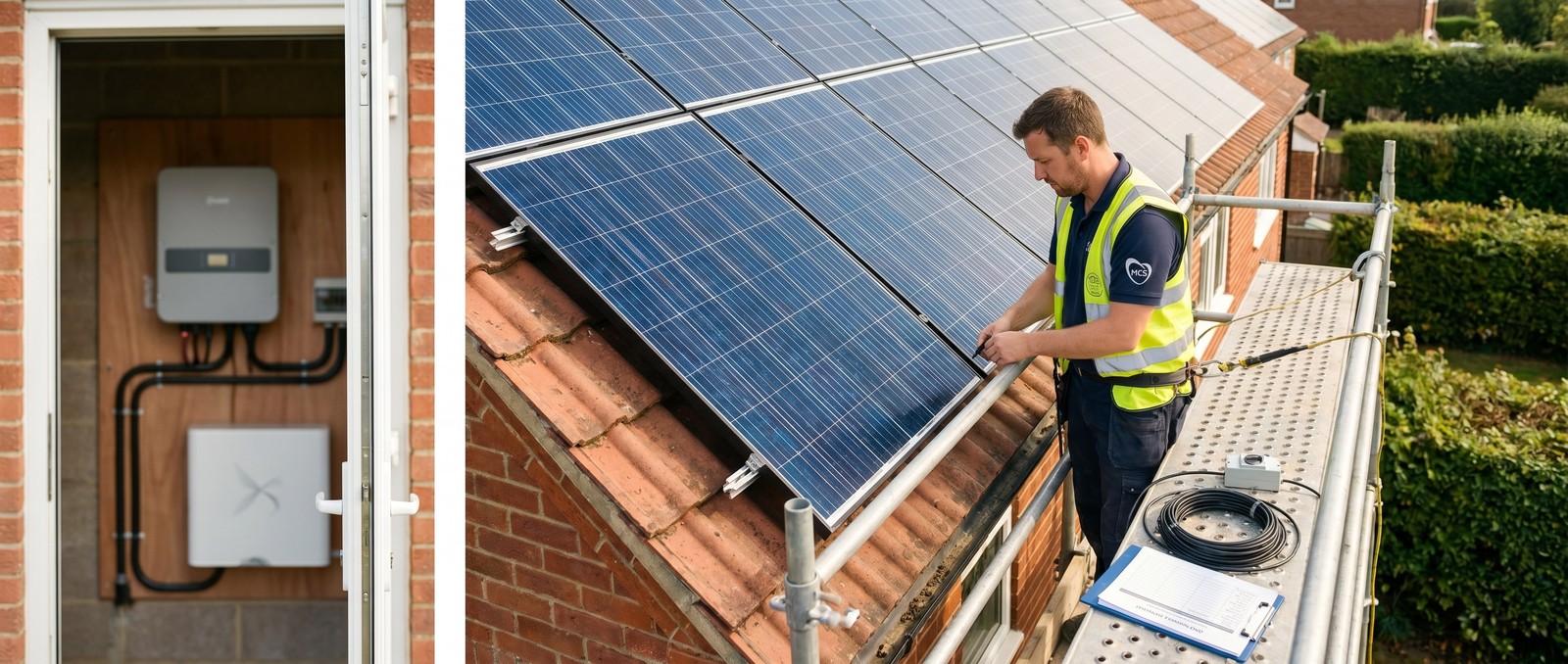
Software for UK solar PV and battery installers
UKPN said twelve weeks on the G99. Customer’s been told eight by sales. Inverter’s not on SSEN’s type-test list. The whole quote-to-commission is a Whitehall of portals.
Solar PV and battery is a different MCS business from heat pumps. The ticket is £4,000-£10,000 on domestic PV alone, £6,000-£12,000 with battery storage bundled, often a quoted-twice conversation as the customer weighs the SEG export tariff against the battery payback. DNO G98 (sub-3.68 kW per phase, notify-only) gives way to G99 (export-capable, battery, larger systems), and G99 is the twelve-week portal-and-paperwork wait that breaks half your sales pipeline. Inverter type-test approval is per-DNO and the lists don’t always match. The Tesla Powerwall, the GivEnergy AIO, the SolarEdge HD-Wave, the Enphase IQ8, the Solis hybrid - each carries a type-test status that may be approved on UKPN and not on SSEN. Battery storage carries the BS PAS 63100 fire-safety standard alongside the updated Approved Document B references. The Smart Export Guarantee handover lives on the customer’s side with her own energy supplier - and it’s the single most under-served piece of the customer journey.
This page is for installers whose week is mostly solar PV + battery. If solar or battery is one part of a mixed MCS portfolio (heat pumps as the primary trade, solar as secondary), the main MCS-installer page is the better fit. Solar + battery is its own business because the DNO process is the dominant constraint, and the inverter-type-test, battery fire-safety and SEG-handover overlays differ enough from the heat-pump regulator stack to be their own buyer-mode.
What your week actually looks like
- A new PV-and-battery enquiry off an Octopus install referral - eight panels, GivEnergy AIO 9.5, single-phase, SEG-eligible, customer wants a date.
- UKPN G99 application for the battery - twelve weeks, customer’s been told eight by sales, you’re the one who keeps having the Tuesday conversation.
- SSEN bouncing your last G99 because the inverter wasn’t on their type-test list - re-spec’d, re-submitted, another six weeks, customer livid.
- A scaffold cost on a Velux-roof-line install nobody mentioned in the sales conversation.
- An inverter firmware mismatch on a job from March - customer’s app says 30% battery, your portal says 80%, two site visits later it turns out to be a firmware version drift you could have caught at the dashboard.
- A battery-fire-safety conversation with a customer who’s read about a garage fire on a Facebook group; the BS PAS 63100 evidence is the answer, but not in five seconds on the doorstep.
- A Tesla Powerwall commissioning portal that wants your Tesla-certified-installer login; the cert is a year out and the re-verification takes twelve days you forgot about.
- An SEG export-tariff handover the customer needs to do with her own energy supplier, not with you - but she’s expecting you to do it.
- A roof survey for a 4 kWp array on a roof that turned out to be the wrong pitch and the wrong aspect; you should have spotted it in the first ten minutes off the photos.
- A SunStore / Midsummer Energy / Krannich panel + inverter + mounting-kit lead-time chain three weeks longer than the customer-comms expected.
This isn’t a job-management software problem. It’s a DNO-list-and-inverter-firmware problem with a customer-side energy-supplier handover stapled to it.
Example problems we could solve
1. The DNO submission with the inverter type-test caught at design
The bounced-submission moment: “Submitted to SSEN. Bounced because the inverter wasn’t type-tested. Six weeks. Submitted to UKPN. Approved in eleven days. Different DNO, different list, same customer, who’s livid.” The inverter-type-test mismatch is the single biggest avoidable delay on solar-and-battery work - and the bounce is almost always rediscoverable at design rather than at submission.
Solved looks like: every install logs DNO region (postcode-to-DNO lookup), inverter make and model, and the proposed system size; the engine cross-checks the inverter against the DNO’s current type-tested list before you submit. Where the inverter isn’t approved on the target DNO, the engine suggests an approved alternative from the same manufacturer or a similar spec, so the design conversation with the customer happens once. Once cleared, the G98 (notify-only) or G99 (full application) renders in the DNO’s preferred format - UKPN portal, SSEN PDF, Northern Powergrid email, Electricity North West portal, SP Energy Networks portal - pre-filled from the install record. Status tracking against the DNO’s stated response window feeds the customer-cascade in problem 3 below, so she’s reading “DNO submission acknowledged, typical wait six-to-eight weeks” rather than hearing nothing for a month. The full grant-and-submission build lives at /solutions/grant-and-submission-handling; the solar-and-battery version is shaped around the type-test pre-flight as the single most valuable thing to catch early.
2. The battery fire-safety pack that assembles itself at handover
The Facebook-group moment: customer’s read about a garage fire on a Facebook group. She wants the fire-safety paperwork. You’ve got it - but it’s spread across the GivEnergy install manual, your own method statement, the BS PAS 63100 references, and the building-control side. She wants it as one document, in plain English, by Friday.
Solved looks like: every battery install carries a structured fire-safety pack that assembles automatically at handover. BS PAS 63100 (battery energy storage systems - fire safety) compliance evidence for the specific install location (garage / external wall / loft / cupboard), Approved Document B references for fire safety in dwellings, proximity-to-habitable-room and proximity-to-escape-route documentation, the manufacturer-specific fire-suppression, venting and spacing requirements (different for GivEnergy AIO, Tesla Powerwall, SolarEdge Energy Hub, Enphase IQ Battery), and the customer-side guidance on what to do in a thermal event - rare, but the customer wants to know. The pack lands as a single PDF in her hands at sign-off, and goes to the building-control body where the install needs notification. Battery fire safety is the fastest-evolving compliance area in MCS work; the standard moves and your install pack moves with it without a rewrite.
3. The Smart Export Guarantee handover the customer can finish on her own
The “I thought you did it” moment: “Customer’s PV is generating. She wants to sign up to a SEG export tariff with her own supplier. She thinks I’m the one who does it. I’m not - but she’s annoyed at me, not at Octopus / OVO / EDF / E.ON / British Gas.” SEG is the customer-side benefit of going solar, and the under-explained handover is the source of half the post-install grievances on Trustpilot.
Solved looks like: the SEG handover lands as a structured final step in the customer’s status cascade. Post-commissioning, the engine identifies her current energy supplier (where she’s told you at quote stage) and pulls the supplier’s SEG tariff structure into a customer-facing summary - “Octopus Outgoing Agile: variable export, half-hourly metering required” vs “OVO Smart Export: fixed pence-per-kWh” vs “EDF Solar Switch: fixed pence-per-kWh + bonus for combined import-export”. A templated walk-through PDF and a customer-side portal page explain who does what - the install was yours, the SEG sign-up is hers, the MCS cert reference she’ll need is right there, the meter-reading or smart-meter half-hourly authorisation is explained in her language. The phone call you keep taking on a Saturday morning - “so do you do the Octopus bit or do I?” - quiets down because the answer is on her phone the whole way through.
4. The inverter firmware + battery health monitor with a service-plan offer on the back
The 30%-vs-80% moment: “Customer rang on a Saturday - battery showing 30% in her app, 80% in mine. Two site visits to find it was a firmware mismatch. £40 on the day.” Inverter and battery firmware drift is the post-install source of small grievances that quietly erode reputation, and you usually find out about it on the customer’s worst day.
Solved looks like: post-install, the engine pulls health data from the inverter and battery cloud APIs where the manufacturer publishes one - SolarEdge Monitoring, GivEnergy Cloud, Enphase Envoy, SMA Sunny Portal, Tesla App. A daily health-check flags firmware mismatches, communications errors, and performance drop against design at your dashboard before the customer rings. A service-plan offer - annual inverter health-check, annual battery capacity test, firmware audit, warranty status review - runs as a recurring direct debit; the engine handles failed-payment recovery, anniversary auto-booking, and the cohort dashboard so the whole book is visible at a glance. The recurring side of the build lives at /solutions/recurring-service-recall; the firmware-and-health-dashboard side is shaped around catching the drift before the customer’s app contradicts hers.
Closest builds we’ve shipped
- HC Electricaloverlap on Part P, commissioning evidence, and the customer-cascade pattern on solar PV / battery / EV cross-installs. The closest live reference for how this Part P + commissioning + status-cascade pattern runs in a Suffolk trade business. (Pull-quote held behind the permission checklist; see /case-studies/hc-electrical.)
- mendbuddythe multi-channel agent platform behind the customer-side SEG handover and the post-install support cadence. Trained on your scope, your supplier-specific SEG tariff library, and your customer-cascade voice. See /case-studies/mendbuddy.
- RepairMindersoftware for running an inbound-items repair business with regulated paperwork attached. Different vertical; same shape as the inverter-and-battery health-monitor flow - operational data in, decision dashboard out, anomalies caught before the customer rings. See /case-studies/repairminder.
FAQ
Will you handle the SEG sign-up on the customer’s behalf?
No. SEG is a contract between the customer and her own energy supplier - Octopus, OVO, EDF, E.ON, British Gas, Good Energy, So Energy, the lot. We build the templated walk-through that makes the sign-up obvious and pull the MCS cert reference into a form she can use; the actual application is hers to submit.
Will the system handle the half-hourly smart-meter authorisation conversation?
For the supplier-specific tariffs that require half-hourly metering (the Octopus Outgoing Agile-style ones), the customer-side guidance walks her through the authorisation against her supplier. The authorisation itself runs through her smart-meter app or her supplier’s portal - the build makes it obvious what she needs to do.
Will you flag inverter type-test mismatches across all five UK DNOs?
Yes. UKPN, SSEN, Northern Powergrid, Electricity North West and SP Energy Networks each publish a type-test list; the engine cross-checks against the proposed design before submission. Where an alternative inverter from the same manufacturer would clear that DNO, the suggestion comes with the bounce flag.
Will the battery fire-safety pack satisfy a building-control sign-off?
The pack captures the BS PAS 63100 and Approved Document B evidence in the building-control body’s preferred format. The actual sign-off stays between you and the LABC inspector or approved inspector; the build makes the evidence pack right, doesn’t replace the inspector’s role.
What about a Tesla Powerwall commissioning login?
Tesla’s commissioning portal requires a Tesla-certified-installer login (your cert + annual re-verification). The compliance calendar tracks your Tesla cert renewal as one of the standing reminders - the commissioning itself runs through Tesla’s portal in the usual way, with the install record carrying the certification reference and renewal date on the install side.
My electrical side is NICEIC / NAPIT - does the build flow handle Part P alongside?
Yes. The electrical commissioning evidence sits alongside the MCS evidence on the same install record - Part P notification, BS 7671 EIC, the test results - and the customer’s handover pack covers both sides as one document. The same posture if your sparky is sub-contracted in: their commissioning sheet drops onto the same install record without you retyping it.
What does it cost?
Every build is scoped per firm - depends on install volume, multi-DNO exposure, battery share of work, whether the inverter health monitoring is in scope, and whether the EV charge-point side is bundled. We talk it through, agree the scope and the price in writing. See pricing.
Up to the hub
← UK MCS installers (main page) · Heat-pump installer (under gas engineers) → · Electricians (adjacent for Part P) → · EV charge-point installer (under electricians) →
Tell us about the solar + battery side
Send an enquiry - what inverter mix you favour, what DNO regions you cover, what aggregator-programme mix, where the SEG handover is breaking, and whether the EV charge-point side is bundled. We’ll come back with a sketch of what we’d build and what it would cost. No calendar, no demo to sit through. Email reply, scoped sketch, you decide.