

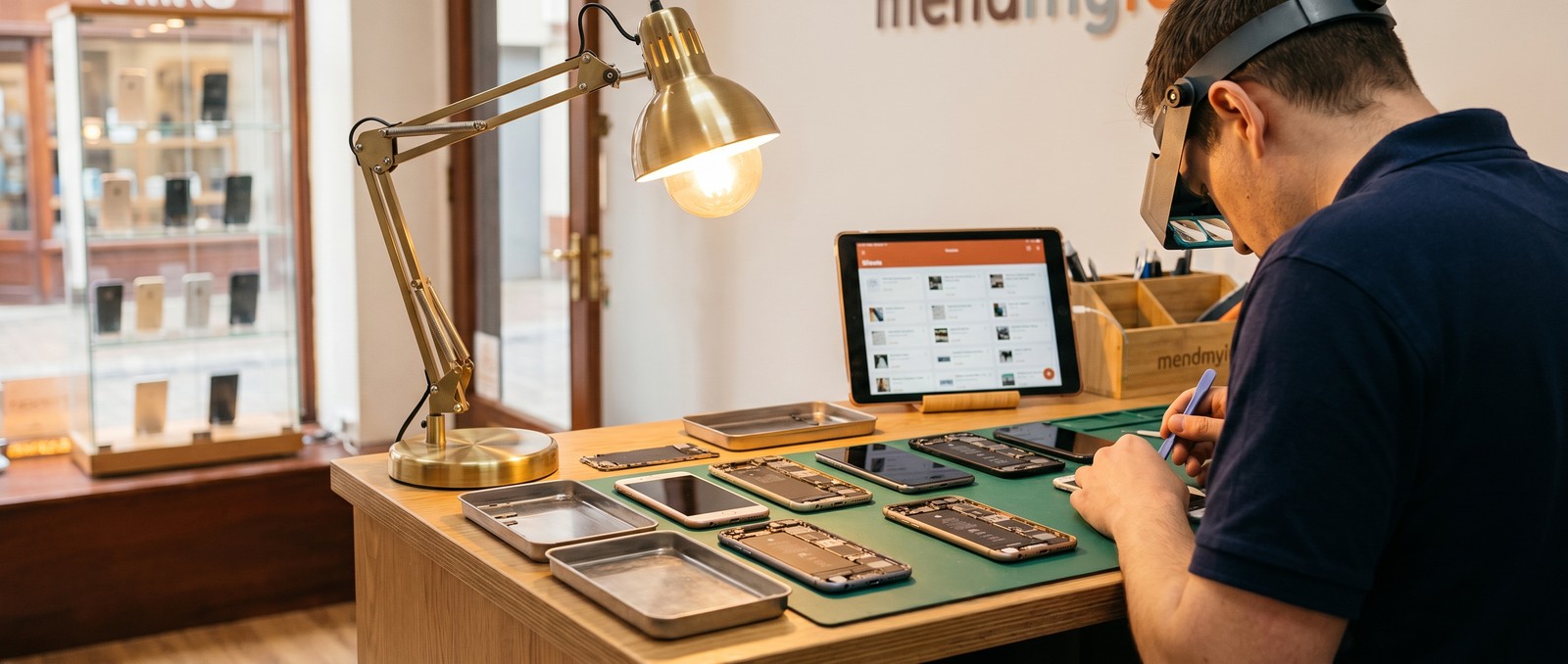
RepairMinder - the workshop platform we built to run our own shop, then ported
A multi-tenant workshop platform for repair shops and any other inbound-items service business: takes a thing in, books it onto a bench, communicates with the customer through the process, hands it back. Built originally for the studio’s own device-repair business - mendmyi - and now running across hundreds of shops, with a native iOS companion for the technician on the bench.
Live: app.repairminder.com · iOS companion app
The brief
mendmyi was running on a spreadsheet, a paper job-bag system, and a phone the bench technician answered with greasy gloves. The wall behind the bench had a row of cubbyholes; each cubbyhole had a phone in a sealed bag with a Post-it note: customer name, fault, “called Tuesday”, “awaiting screen”. The Post-its fell off. The cubbyholes ran out by Tuesday lunchtime in the school-holiday weeks. Customers rang to ask “is my phone ready” because there was no other way for them to find out - which meant the bench technician was answering phones instead of fixing phones, which meant fewer repairs got finished by close, which meant more customers ringing the next day. The cost of not having a system was a queue the shop could see, growing.
We tried two off-the-shelf repair-shop platforms before we built our own. Both had a “how it works” shape from the early 2010s: a desktop UI built for a back-office PC, paper-printed job bags, customer comms over email-from-Outlook. Neither sent the SMS the customer actually wanted, neither put the diagnosis photo on the ticket, neither knew that the parts-supplier APIs now return availability in real time. So we built RepairMinder. mendmyi ran on it first - the bench tech, the front counter, the buyback workflow, the parts-pricing, the customer-side status portal - and once it was solid in production for our own shop, the same engine turned out to be the right shape for any other inbound-items service business with the same operational pattern.
What it actually does
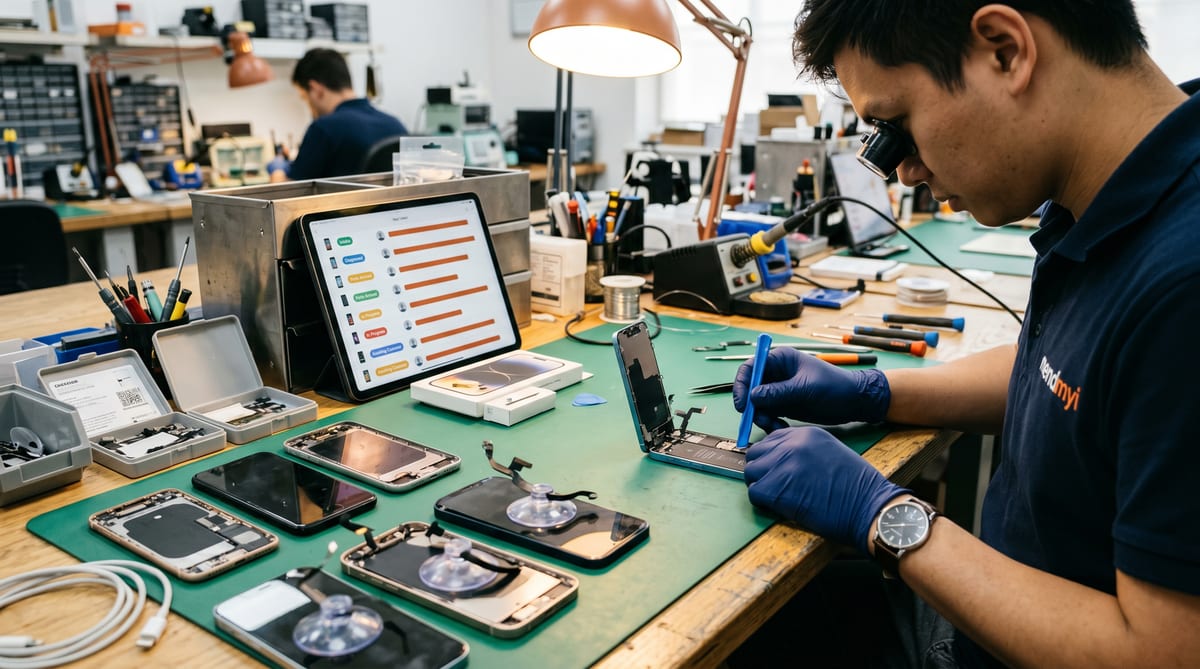
The ticket-and-bench core. Every customer interaction becomes a ticket. Drop-off captures the device, the fault description, the customer’s contact, the agreed price band, and a photo of the existing condition. The ticket lives in the shop view at the counter, the bench view on the technician’s iPad, and the customer view on a per-ticket portal page the customer reaches by SMS link. State transitions - received → diagnosed → quoted → parts on order → repair underway → ready for collection - fire the customer-side message cascade automatically. The “is my phone ready” phone call gets answered before it gets dialled.
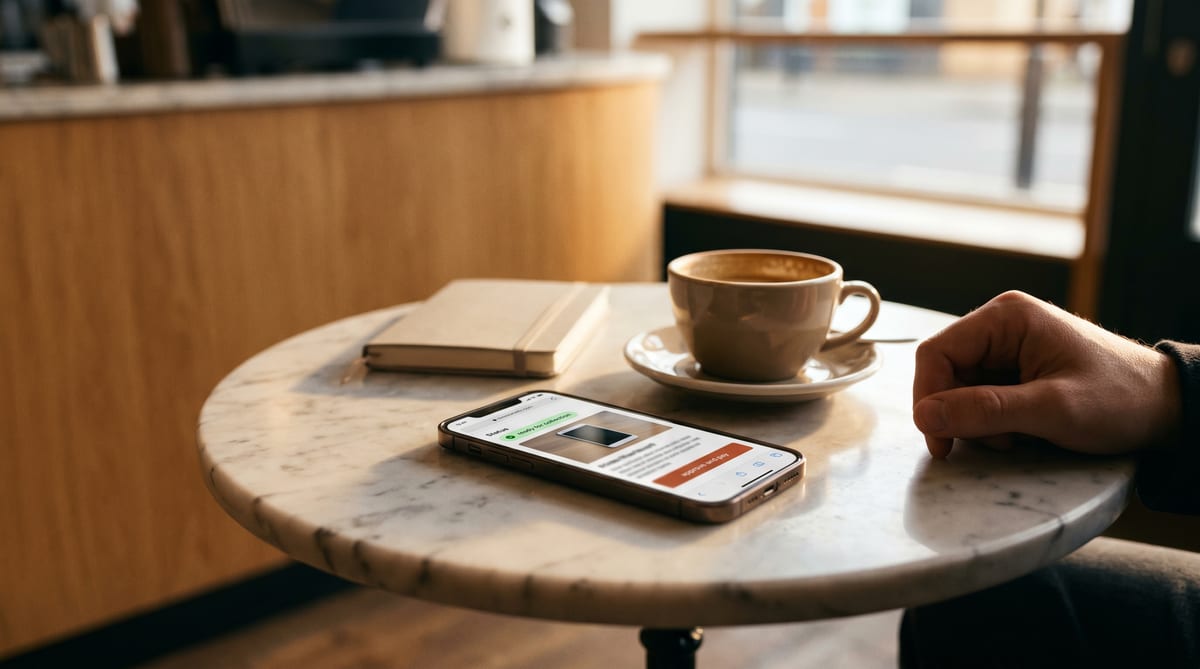
The customer portal at a signed link. A per-ticket URL the customer opens on their phone - no app to download, no password, no account - that shows the live status, photos of the work, the quote when it’s ready (with a one-tap approve / decline), and the “ready for collection” notification with shop opening hours. Same shape we now port to letting-agent portals, third-party-rep portals, syndicate-owner portals; the “no account, signed link” pattern travels.
A native iOS app for the bench. A real Swift app for the technician on the bench - barcode scanning to pull up a ticket without typing, on-the-bench photo capture that writes straight to the ticket record, diagnosis notes against the device’s component tree, parts requisition from the parts catalogue with live supplier-stock check. The iPad on the bench replaces the paper job bag.
The bridge to the shop’s local hardware. A desktop bridge runs as a tray app on the shop’s machine, keeping the receipt-printer, the cash-drawer, the card terminal, and any device-communication tooling online without requiring the cloud platform to know about the LAN. The shop’s PoS hardware stays where it is; the platform talks to it through the bridge.
The recurring-recall annuity. For repair shops it’s screen-protector replacement, battery-health checks, deep-clean services. For independent garages it’s the MOT, the service, the cambelt, the tyre-tread reminder. Every customer carries a per-asset recurring schedule and the -90 / -60 / -30 / -7 nudge cadence fires on the channel the customer prefers, with the previous record attached and a one-tap booking link in the message. The book becomes an annuity rather than a fresh-sales loop.
Multi-shop accounts. Two-to-five-shop regional chains running under one parent: staff move between shops with one login, parts inventory routes per-shop, the customer record follows the customer wherever they walk in. Cross-tenant isolation is enforced at every query so a customer record at one shop can never bleed into another.
The outcome
At mendmyi the bench-to-counter staffing ratio inverted. Before RepairMinder, the bench technician spent more than a quarter of his day answering “is my phone ready” calls; after, the customer-side portal absorbed that volume and the technician finished more repairs by close. The Post-it-on-the-cubbyhole system is in a binder somewhere as a museum piece.
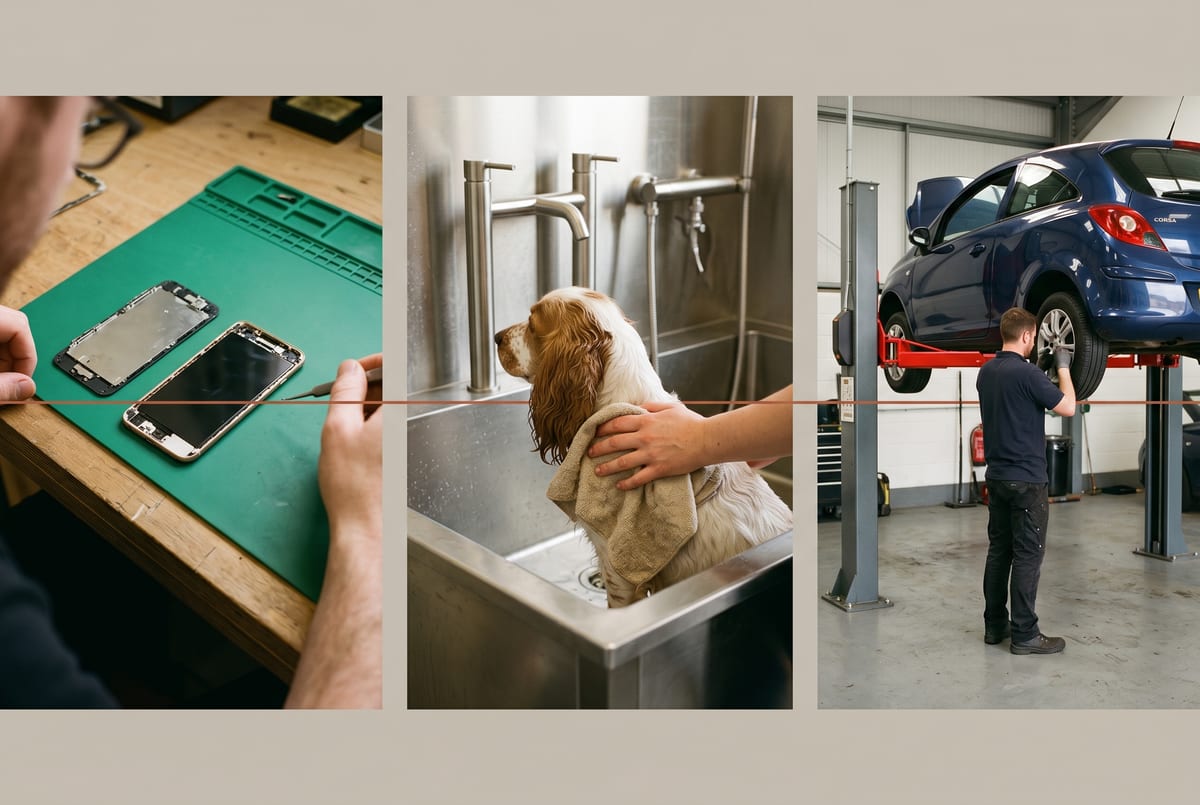
As a multi-tenant platform, RepairMinder now runs at repair shops across the country - independents, two-to-five-shop regional chains, mall-kiosk operators. The shape ports cleanly: relabel the events, swap bench for bay or kennel or storage unit, change the “is my phone ready” to “is my dog OK” or “is my car back on the lift”, and the engine is the same. We’ve already ported it to dog-grooming and pet-boarding intake (pet services), to independent-garage workshop intake with photo-estimate and courtesy-car coordination (independent garages), to funeral-director case-file workflow with the same state-cadence shape and a very different tone (funeral directors), and to self-storage unit-state records (self storage).
RepairMinder appears here as proof of what we’ve built and what we can build for a new client in a similar shape - not as a sign-up-here SaaS from this site. If you want the shape of RepairMinder for your business, scoped to your operational reality (your kind of asset, your customer-side comms tone, your integrations), we’d build you a version.
Which verticals this fits
The reference for any inbound-items service business that takes a thing in, works on it, communicates with the customer, and hands it back:
Inbound-items repair and service
- Device repairprimary; the dogfood vertical, with mendmyi running on it live
- Independent garagesworkshop intake + MOT recall + photo-estimate + bay scheduling
- Pet servicesboarding / grooming intake + photo-update + waitlist + recurring round
Reactive trades with a job ledger
- Trades - job ledgers + photo evidence engine, referenced from electricians, plumbers, gas engineers
Sensitive multi-stakeholder workflows
- Funeral directorscase-file pattern with the same state-cadence and a very different tone
- Self storagemulti-unit asset and access record
- Holiday letscleaner-orchestration and ready-for-arrival state cascade
Which problems this solves
RepairMinder is the live example for the operational platform solutions in the catalogue:
- Booking & Review Loopthe ticket-status cascade
- Multi Channel Comms Threadcustomer-side status thread per customer
- Recurring Service Recallthe MOT / service / battery-check annuity engine
- Customer & Third Party Portalthe per-ticket customer view
- Client Onboarding & Intakethe drop-off / intake capture pattern
- Compliance Evidence Recordthe photo-and-state evidence engine
- Resource & Waitlist Yield Recoverybay / bench scheduling under demand pressure
Want a workshop platform like RepairMinder for your business?
Tell us what your cubbyhole-on-the-wall problem looks like - what comes in, what happens to it, what the customer wants to know in the middle, what gets handed back, and what the per-customer history is worth keeping. We’ll come back with a sketch of what we’d build, what events would fire customer-side, and what would live on the bench app versus the counter view. No demo, no calendar widget - email reply, scoped sketch, you decide.