

The OZEV submission rejected for a photo angle - caught before the customer ever heard “rejected”
Submitted the OZEV on Wednesday, queried Friday on the meter-cut-out photo. Re-photographed Saturday on a site visit, re-submitted Monday, queried Wednesday on the unit number. The customer’s rung three times asking if her grant’s sorted.
OZEV submission rejected because the photo angle was wrong. MCS cert delayed because the design template wasn’t the current version. DNO G99 notification queued for fourteen days because the form had the wrong meter reference. Worcester 30-day warranty registration slipped; the customer claims on the ten-year guarantee three years later and you’re the one carrying it. BUS voucher £7,500 stuck at pending for six months and the customer doesn’t know whether she’s been credited. Sedgwick claim format changed quarterly and your last submission was on the old form. The Tell Us Once family-concierge handover sits half-completed across three notifications because the registrar didn’t always relay every reference.
Every business that submits paperwork to a portal it doesn’t control - and where the portal doesn’t publish a stable API - has the same shape of problem. The submission needs the right photos, in the right format, with the right deadlines. Queries come back weeks later asking why field 47 is blank. The customer-side perception of “is my grant / cert / warranty / claim sorted” depends entirely on something you have minimal visibility into. This is the build that captures the submission artifacts at the moment they exist on site, drafts the submission against the current portal format (templates are config, not hard-coded), tracks the submission through Submitted → Queried → Approved → Paid, keeps the customer informed at each step, and routes queries back to you with the field-47 context already attached - without pretending we are the portal. The shape is sealed against HC Electrical - live OZEV + EVHS grant-portal submission tracker running on the EV-installer side, with the photo-capture-on-site, the state-tracking, and the customer-cadence already in production - and ports cleanly across MCS / DNO / Gas Safe / manufacturer warranty / HMRC Gift Aid / insurer claim / Tell Us Once paperwork.
What gets lost between install complete and grant credited
The paperwork is where the customer-perception risk lives. A few moments - pick the ones that sound like your year:
- EV charge-point installs and the OZEV / EVHS linethe install Tuesday afternoon, the submission Wednesday morning, the query Friday on the meter-cut-out photo. By the time the grant lands you’ve eaten £150 of admin time on a £350 grant administration line and the customer’s rung three times.
- MCS heat-pump and solar installs with the BUS voucher and surveillance regimethe £7,500 BUS voucher stuck at pending for six months; the design template that wasn’t the current version; the annual surveillance window where the cert lapses because the photo evidence isn’t where MCS auditors expected it.
- DNO G98 / G99 notificationsthe meter reference on the wrong line of the form, the connection diagram in the wrong format, the operator-specific portal quirks across UKPN / SSEN / Northern Powergrid / Electricity North West / SP Energy Networks; fourteen-day queues that should be fourteen-minute confirmations.
- Gas Safe scheme notification + manufacturer warranty registrationthe double-paperwork 30-day window where Gas Safe gets done and Worcester / Vaillant / Baxi / Ideal warranty registration slips, the customer claims on the ten-year guarantee three years later and you discover the warranty was never registered.
- Commercial gas CP15 / CP16 / CP17the commercial-catering kitchen-down with the interlock isolator certified Tuesday, the FM-helpdesk wanting the CP15 on their template by Friday, the scheme-side notification on the engineer’s individual login.
- Charity Gift Aid recovery + GASDSthe £8-15k a year the bookkeeper can’t get to: HMRC claims that need the eligibility evidence per donation, the GASDS small-donations claim with the per-donation rules, the audit trail that holds it all together.
- Storm-damage roof claims into the loss-adjuster pipelinethe Sedgwick / Crawford / Davies claim pack assembly with format that changed quarterly, the photo-evidence-pack tagged by stage, the per-claim status the homeowner rings for weekly.
- Vet pet-insurance claimsPetplan / Bought By Many / Agria; modal twelve UK formats; the form that needs the clinical record annotated in their specific shape and the claim that pays out next month if you got it right.
- Funeral directors and Tell Us Oncethe registrar’s reference, the multi-agency handover through DVLA / DWP / HMRC / Passport Office / local authority / pension provider, the sensitive-context customer-side comms that keep the family warm without trespassing.
- Extension specialist Building Regs handoverthe customer’s solicitor wants the compliance pack for the sale; the pack lives across Part A / B / L / F / O / M / P, FENSA, MVHR, Party Wall - currently a Tuesday-afternoon scavenger hunt.
These aren’t problems for a generic project-management tool. They’re the bit between install complete and grant credited / warranty registered / cert filed / claim paid - which is where the customer’s perception of “is this sorted” actually lives.

What solved looks like
1. Capture-on-site of the submission artifacts - the right photos before you leave the customer’s drive
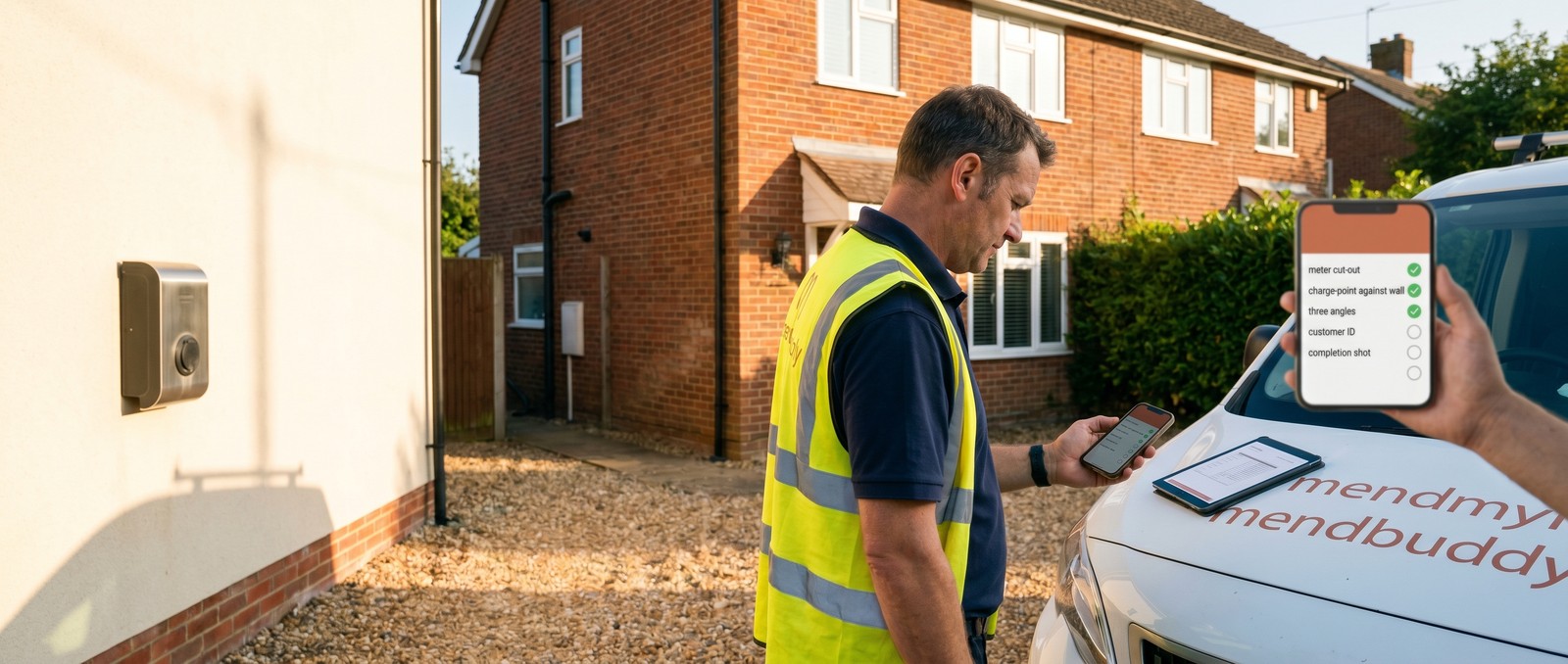
The “I’ll re-shoot Saturday” moment: install complete Tuesday afternoon. You take photos on instinct. Submission goes Wednesday. Queried Friday because the meter-cut-out photo didn’t show the position you needed it to. You re-photograph on Saturday’s site visit, re-submit Monday, queried Wednesday because the address line had the wrong unit number. The grant takes six weeks instead of two.
Solved looks like: the install-completion flow on the engineer’s phone walks through the right photos for this portal - angle, lighting, metadata captured - at the moment the install completes. OZEV wants three angles of the charge point against the wall plus a meter-position shot with the cut-out visible; MCS wants the system-on-the-wall plus the commissioning record; DNO wants the meter position plus the connection diagram; Worcester wants the boiler serial visible in the photo of the system; Gas Safe wants the appliance label readable. The on-site app prompts the right shots before you leave the customer’s drive, with the lighting check and the metadata embedded. The Saturday re-shoot disappears because the Tuesday capture was right the first time.
2. Portal format as config, not hard-coded
The “OZEV changed the form again” moment: every six months the portal layout shifts. Your last successful submission was on the old form. The new form’s queried fields aren’t where they used to be. You discover the format change when the first submission of the quarter gets rejected, and you spend a Wednesday afternoon working out what’s moved.
Solved looks like: the submission template per portal lives as a config, not hard-coded. When OZEV’s format changes, when MCS’s design template updates, when a DNO operator switches their G99 form layout, when Sedgwick changes the loss-adjuster pack shape, when Worcester updates the warranty fields, when HMRC’s Gift Aid Online schema shifts - it’s a one-day config update on the monthly arrangement rather than a rebuild. The customer’s submission renders against the current version of the portal’s format on the day it’s submitted, not against last quarter’s version.
3. Human-in-the-loop sign-off - pre-fill the form, you click submit
The “I’d let the system submit but I don’t trust it” moment: the portal carries your accreditation. The OZEV / MCS / Gas Safe / DNO / HMRC / insurer / Tell Us Once submitter is you - the named accountable person. You wouldn’t let a system file in your name even if you could.
Solved looks like: we don’t pretend to be the portal. Most of them don’t publish stable APIs, and the per-firm submitter still needs to log in and click the submit button under their own accreditation. What we do is pre-fill the submission to the extent the portal allows, draft the supporting pack with the photos and the evidence in the right shape, and run a check-this-before-you-submit surface so you submit-or-edit in 30 seconds rather than 30 minutes. The accreditation stays yours; the admin friction disappears.
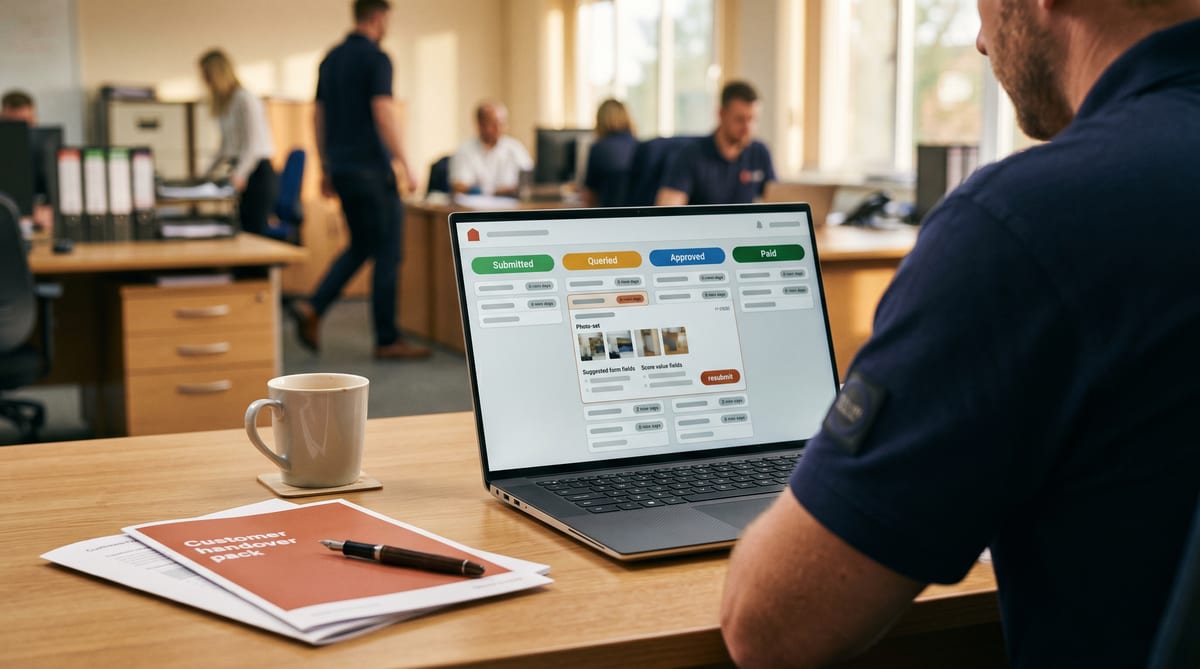
4. Status tracking through Submitted → Queried → Approved → Paid
The “is my grant sorted” moment: the customer rings three times because she doesn’t know whether the OZEV / BUS / claim has been credited. You don’t know either - you submitted six weeks ago and haven’t heard back. You log into the portal once a week to check; you forget the password each time.
Solved looks like: each submission carries a structured state on your dashboard - Submitted, Queried, Approved, Paid - with the days-in-state visible. When the portal queries (“missing meter reference”, “photo doesn’t show what you say it shows”, “applicant address mismatch”, “field 47 is blank”), the query lands as a structured event with the original submission context already attached - the photo set, the form values, the customer record, the install date. You fix-and-re-submit from the same screen; the state moves; the customer hears the right thing at the right time. The Tuesday-afternoon portal-check disappears because the dashboard is the portal-check.
5. Customer-side cadence that stops the “is it sorted” phone call
The “she’s rung three times” moment: the customer doesn’t know whether her grant has been submitted, queried, approved, or paid. She rings on the third week because she’s worried she missed an email. You explain. She rings again on week five because the bank hasn’t shown the credit. You explain again. The grant administration line in your quote becomes the customer-relations line in practice.
Solved looks like: per-stage SMS / email in your voice - “submission filed Wednesday, expect around fourteen working days”, “approved - payment expected in your account in seven days”, “there was a query, we’ve responded - back to track for around seven days”, “credited - see your bank in two to three working days”. The customer-side feel is “they’re handling it”; the operator-side feel is every state captured. Same voice training as Trainable Inbound AI Agent; same channel routing per customer.
6. Submission audit trail - disputes six months later answered from the log
The “I never received the warranty registration” moment: the customer rings three years on with a boiler problem. Worcester says the warranty was never registered. You’re sure you registered it but you can’t find the receipt. You eat the ten-year-guarantee cost as a £4,000 swap-out on goodwill.
Solved looks like: every submission, every response, every photo with its metadata, every form-field value, every state transition - timestamped and logged. The customer claiming the warranty was never registered, the agent claiming the OZEV grant was never submitted, the loss adjuster claiming the claim pack arrived in the wrong format - all answered from the log in under two minutes. We’re not your defence advocate; for contested cases you’d want a solicitor. But the evidence trail (the submission timestamp, the photos with metadata, the portal-response sequence, the customer-confirmation timestamps) is what they’ll ask for first, and the log is what makes the next twelve months of your warranty exposure quietly safer.
How the submission ladder runs, by default
The default trade-shape grant-or-cert cadence (OZEV EV charge-point grant, MCS BUS voucher, DNO G99 notification, Worcester warranty registration) runs:
- Install complete on siteengineer’s phone walks through the right photos for this portal with the angle, lighting, and metadata check. Customer’s ID, install address, install date captured. The submission pack assembles in your dashboard within the hour.
- Pre-flight checkthe submission renders against the current version of the portal format, with the form values pre-filled to the extent the portal allows. You glance, sign off, and submit in 30 seconds. The portal receipt lands in the dashboard.
- Submitted statethe customer-side SMS / email fires: “submission filed, expect ~14 working days”. The days-in-state counter starts.
- Queried state (if it lands)the portal query arrives as a structured event with the original context attached. You fix the field / re-photograph / re-submit from the same screen; the customer hears “there was a query, we’ve responded” in your voice; the state returns to Submitted.
- Approved statecustomer-side SMS / email: “approved - payment expected in your account in 7 days”.
- Paid statecustomer-side SMS / email: “credited - see your bank in 2-3 working days”. The cycle closes; the audit log carries the timestamped sequence for the next decade.
Per-portal tuning lives on top of the default - OZEV runs on the photo-and-customer-ID shape; MCS BUS runs on the design-template + commissioning record + cert-issuance shape; DNO runs on the connection-diagram + meter-position shape with operator-specific quirks; Worcester / Vaillant / Baxi / Ideal warranty runs on the appliance-serial + Gas Safe-cross-reference shape; HMRC Gift Aid runs on the per-donor declaration + eligibility evidence shape (with the HMRC API where the others rely on pre-fill); Sedgwick / Crawford / Davies / insurer-direct runs on the per-claim photo-evidence pack stage-tagged by initial-damage / temporary-repair / defect-detail / during / after; Tell Us Once runs on the registrar-reference + DVLA / DWP / HMRC / Passport Office / local-authority / pension-provider downstream notifications with sensitive-context customer comms throughout.
Who this is for
The shape repeats anywhere paperwork lands on a portal you don’t control - and the customer’s “is it sorted” perception depends on it.
Electricians and EV / MCS installers - electricians, EV installers, solar-PV-and-battery MCS installers, MCS installers (hub), EICR specialists. OZEV / EVHS grant submissions, DNO G98 / G99 notifications across UKPN / SSEN / Northern Powergrid / Electricity North West / SP Energy Networks, MCS BUS voucher tracking and surveillance, cert PDFs on completion. The EV-installer line is where this build is sealed against HC Electrical.
Gas engineers and heat-pump installers - gas engineers, boiler installers, heat-pump installers, landlord-CP12 specialists, commercial-catering gas engineers. Gas Safe scheme notification + manufacturer warranty registration double-paperwork (Worcester / Vaillant / Baxi / Ideal 30-day window), digital Benchmark + Building Regs Part J/L on boiler installs, MCS cert + BUS voucher on heat pumps, CP15 / CP16 / CP17 on commercial catering.
Storm-damage roofers and trades on the insurance pipeline - storm-damage roofers, leak-detection plumbers. Sedgwick / Crawford / Davies / insurer-direct claim pack assembly with quarterly format changes captured as config updates, the per-claim photo-evidence pack stage-tagged, the Submitted → Queried → Approved → Paid state visible to the homeowner.
Vet practices on pet insurance - vet practices. Petplan / Bought By Many / Agria modal twelve UK formats, the per-claim clinical-record annotation in each insurer’s shape, the customer-side “your claim has been submitted / approved / paid” cadence that ends the every-Tuesday phone call.
Charities - Gift Aid recovery + GASDS - charities. HMRC claims with the per-donor declaration and eligibility evidence; GASDS small-donations claim with the per-donation rules; the audit trail that holds the £8-15k a year the bookkeeper currently can’t get to. The HMRC API exists; the structured submission against it pairs with the cadence engine for the donor-side acknowledgement.
Funeral directors - Tell Us Once and the family-concierge baton - funeral directors. The registrar’s reference captured at intake, the family-side guide for the multi-agency handover (DVLA, DWP, HMRC, Passport Office, local authority, pension provider), the sensitive-context SMS / WhatsApp at each downstream notification step. We don’t act for the family; we equip them.
Extension specialists and the Building Regs handover - extension-specialist builders. The compliance pack at handover (Part A / B / L / F / O / M / P, FENSA, MVHR, Party Wall, structural, electrical, gas) collated for the customer’s mortgage / sale solicitor; what was a Tuesday-afternoon scavenger hunt becomes a one-click download.
Same engine; different portal; different format; different customer-side cadence.
The closest thing we’ve already built
HC Electrical - live OZEV + EVHS grant-portal submission tracker running on the EV-installer side. Install-completion flow on the engineer’s phone walks through the OZEV-required photo set with the metadata captured; submission drafts the same evening; the Submitted → Queried → Approved → Paid state visible on the dashboard with the customer-side cadence firing automatically; the Queried-state events route back to the engineer with the original context attached for 90-second fixes. The clearest reference for any installer whose customer-perception depends on a portal you don’t control. (Named pull-quote + final-£ outcome figures hold behind the permission checklist; see Hc Electrical for the build detail.)
mendbuddy is the multi-channel platform that runs the customer-side SMS / email cadence at each submission state. “Submission filed, expect ~14 working days” - “there was a query, we’ve responded” - “approved, payment expected in 7 days” - “credited” - all fire in your voice on the channel the customer reads.
MMI services - the legacy insurance-claims-pipeline modernisation. The insurance-claim pack assembly for storm-damage roofers and the vet pet-insurance claim handling are shape-wise extensions of the same legacy-modernisation pattern: the portal that hasn’t changed in twelve years gets a structured submission layer on top without us having to be the portal.
For high-ticket installs that pair the submission with stage-payment milestones, the submission ladder pairs with Stage Payment & Retention Ledger - the submission state and the stage state run on the same project record. For the customer-side view of submission progress, it pairs with Customer & Third Party Portal - the customer (or the loss adjuster, or the agent) sees the Submitted → Queried → Approved → Paid journey from their own one-tap login.

Tell us what your submission pipeline looks like
What portals you submit to (OZEV, MCS, DNO operator-specific, Gas Safe + manufacturer warranty, HMRC Gift Aid, Sedgwick / Crawford / Davies / direct insurer, Petplan / Bought By Many / Agria, Tell Us Once, your local authority Building Regs), how often things get queried, how long submissions stay in Submitted before paying out, and where the customer-side phone calls hit you. Tell us the most recent submission that got rejected for a reason you’d captured-on-site but submitted-incorrectly, and we’ll come back with a sketch of what we’d build so the next one doesn’t go the same way. No demo, no calendar widget. Email reply, scoped sketch, you decide.
FAQ
Will it work with the OZEV / MCS / DNO / Worcester / HMRC / Sedgwick portals?
Yes for all of those - the engine treats each portal’s format as a config, pre-fills the submission to the extent each portal allows, and runs the check-before-submit surface so you submit-or-edit in 30 seconds. We’re explicit that most of these portals don’t publish stable APIs; the human-in-the-loop submission stays with you, under your accreditation, and the engine takes the admin friction out from under it.
What about portals that do have an API?
Where the portal exposes a working API (HMRC Gift Aid Online does; some DNO operators do for G98 small-installation notifications; some insurers do for structured claim submission), we wire to it directly with the human-confirm step optional. Where the API’s flaky or coverage is partial, we fall back to the pre-fill-and-submit flow. The submitter side stays consistent regardless - your accreditation, your sign-off, our admin layer underneath.
Will it stand up in a disputed warranty or insurance claim?
The submission audit log is what your defence relies on. The submission timestamp, the photos with their metadata, the portal-response sequence, the customer-confirmation timestamps - all logged per submission. We don’t act as your defence advocate (for contested cases you’d want a solicitor) but the evidence trail is what they’ll ask for first, and the log is what makes the next decade of your warranty / accreditation / claim-history exposure quietly safer.
What about insurer-format submissions - are there hundreds of formats?
Modal twelve in the UK. The engine carries each insurer’s structured format (Petplan / Bought By Many / Agria for vet; Sedgwick / Crawford / Davies / direct-claims-handlers for property-and-casualty roof and leak work). When a new format comes in or an existing format changes (quarterly is the norm), it’s a config update on the monthly arrangement rather than a rebuild.
Will it integrate with HMRC for Gift Aid and GASDS?
HMRC Gift Aid Online has a working API for claims; the engine submits structurally with the eligibility evidence (donor declaration, gift amount, date) per claim. GASDS small-donations claims (£2,000 small-donations cap per year, £30-per-donation rules) run on the same engine with the appropriate small-donations logic. The bookkeeper who currently can’t get to the £8-15k a year sees a quarterly batch pre-assembled and one-click submitted.
What about Tell Us Once for funeral directors - does the system act for the family?
No. Tell Us Once is a government service the family uses; the registrar provides the reference at registration. What we build is the family-concierge layer that helps the family complete it - capturing the reference at intake, providing a structured guide for the family’s use, and tracking the downstream notifications (DVLA, DWP, HMRC, Passport Office, local authority, pension provider) with sensitive-context SMS / WhatsApp at each step. We equip the family; we don’t represent them.
What about the Building Regs handover pack for an extension - does it pull from the trades’ own paperwork?
Yes. The compliance pack at handover collates from the engineer / installer / structural / FENSA / MVHR / Party Wall sources - each trade’s paperwork lives on the project record from the moment they’re commissioned, and at handover the pack assembles as a single PDF for the customer’s mortgage / sale solicitor. The Tuesday-afternoon scavenger hunt disappears because the pack assembled itself as the build progressed.
Will the customer-side state SMS actually sound like us?
After the first ten submissions, yes - the voice training is the same shape as Trainable Inbound AI Agent. The first ten fire as send-or-edit drafts; after that the routine state-transition SMS run unattended, and you keep the send-or-edit slot for the edge cases (a submission’s stuck longer than expected, a Queried state escalates, a customer’s flagged a concern between states).
Does this replace our scheme accreditation / our portal logins / our internal compliance work?
No. The OZEV / MCS / Gas Safe / DNO / HMRC / insurer submitter remains the named accountable party - you. We build the software that makes your submissions easier and your tracking continuous; we don’t hold the membership, file under our own login, or act as the scheme-registered submitter. The build sits between your operational record and the portals; the accountability stays where it belongs.
What does it cost?
Every build is scoped per client - depends on the portals you submit to, the customer-side cadence you need, the audit posture your accreditation requires, and the volume of submissions per month. The portal-format-as-config contract sits inside the monthly arrangement, so when OZEV / MCS / DNO / Worcester / HMRC / Sedgwick / Tell Us Once changes a format, that’s a one-day config update rather than a rebuild. We talk it through, agree the scope and the price in writing, then build. See pricing for how we work.