


Software for UK tutors, coaches, music teachers, and nurseries
Fifty pupils on a weekly £30 lesson. Half on GoCardless DD, a third BACS, the rest cash. Sunday-night reconciliation. Plus eight staff DBSs to keep current and an Ofsted inspector who walked in unannounced Tuesday. I qualified to teach, not run the back office.
You’re the independent tutor with thirty pupils across 11+ and GCSE, or the music teacher with forty children all running on different ABRSM exam-grade timelines, or the principal at a five-tutor agency wrangling Tutorful and MyTutor leads alongside your own bookings, or the dance-school owner running a hundred-and-eighty pupils through a term-fee structure with a Christmas show on top, or the manager of a 50-child day nursery balancing 1:4 ratios against a Tuesday morning when one of the two-year-room staff calls in sick, or the chair of a Saturday-morning football club coaching eight under-elevens. The sub-types are different - academic, music, sports, dance, nursery, SEND, wraparound - but the operational shape is genuinely shared: regular sessions on a recurring cadence + a parent paying + a child being the user + DBS-and-safeguarding overlay + Ofsted (or an equivalent body) somewhere upstream.
We build software for tutors, coaches, music teachers, dance schools, sports clubs, and nurseries, scoped per provider. Not a Famly replacement (the EYFS observation surface is mature on the nursery side); not a Tutorbird / MyMusicStaff rip-and-replace; not a Tutorful / MyTutor / Bramble side-step where the leads come from. The layer between the lesson or session you actually deliver and the weekly DD that doesn’t bounce, the DBS that doesn’t lapse, the Ofsted rating that holds on the Tuesday-morning unannounced, the parent channel that’s three separate conversations not one crossed-wires group chat, the July-August cashflow gap that’s planned for in April instead of surviving by accident.
What you spend your week on that you shouldn’t have to
- Fifty pupils on weekly £30 lessons. Half on GoCardless DD, a third on BACS, two parents still paying cash on the doorstep. End-of-month reconciliation is half a Sunday. One DD bounced because mum changed bank; you find out three weeks later when you do the books.
- Term-fee for the dance school is £180 a term. Some parents want PAYG at £18 a class. The skip-a-month-because-of-holiday parent. The sibling-discount-for-the-younger-one parent. The pay-when-the-grandmother-sends-the-money parent. Three chase emails, three drop-off patterns.
- Eight tutors on the agency books. Each needs an enhanced DBS plus the £13/yr Update Service subscription. Three lapsed this year without anyone noticing until a school asked for proof. One is still “DBS in progress” twelve weeks in and the parent of one of his pupils is wondering aloud whether he’s actually been checked.
- KCSiE document for September 2026/27 lands. Two hundred pages. Annual refresher training due for everyone. DSL training for the lead is £350; the Level 1 awareness module for everyone-in-contact is free but you can’t remember which staff did it last year and which didn’t. Next September it restarts.
- Ofsted inspector turns up Tuesday morning. EYFS observations on Tapestry current? Yes. Safeguarding posters up? Yes. First-aid certificates - one expired in August nobody renewed. Rating drops from Outstanding to Good. Three mums asking about ratings on the council website by Friday.
- Two-year-old room is 1:4 ratio with twelve children and three staff. One staff member calls in sick Tuesday morning. You’re now at 1:6, which is non-compliant; four children need to be sent home or moved or covered. Parents furious at the door at 8am.
- 11+ prep is a two-year cycle from Y4 to Y6 entry. £40 an hour weekly across thirty-six weeks of term, plus mocks every half-term, plus the September enrolment surge when the new cohort wants in and you’re full because the previous one hasn’t yet sat the test.
- Aisha’s mum WhatsApps about Wednesday’s lesson on one number. Tom’s dad emails about half-term arrangements. A third parent texts your personal phone about something that may be Saturday or may be next Saturday; by Friday you’ve answered each individually three times.
- ABRSM Grade 3 violin booking opens September for the December exam window. You’ve got twelve pupils across different grades all needing separate exam-fee chases and accompaniment bookings; the theory-grade-5 prerequisite for the grade-six practical means half need theory tutoring on top.
- July-August - pupils disappear. Dance school does the holiday camp for thirty out of two hundred. Tutoring drops to a handful of GCSE-prep. Sports club takes summer off. The cashflow is half normal and the rent / staff costs aren’t.
- SEND child has an EHCP - the local authority funds two hours a week of 1-to-1 tuition, paid 90 days in arrears; you front the cost and chase the invoice every quarter.
These aren’t problems Famly’s next release is going to solve. They’re the layer between the sessions you deliver and the DDs that reconcile themselves, the DBSs that don’t lapse, the Ofsted pack that’s already assembled, the parents who get the right answer on the right channel, the July gap that’s planned for in April. That’s what we’d build.
Example problems we could solve
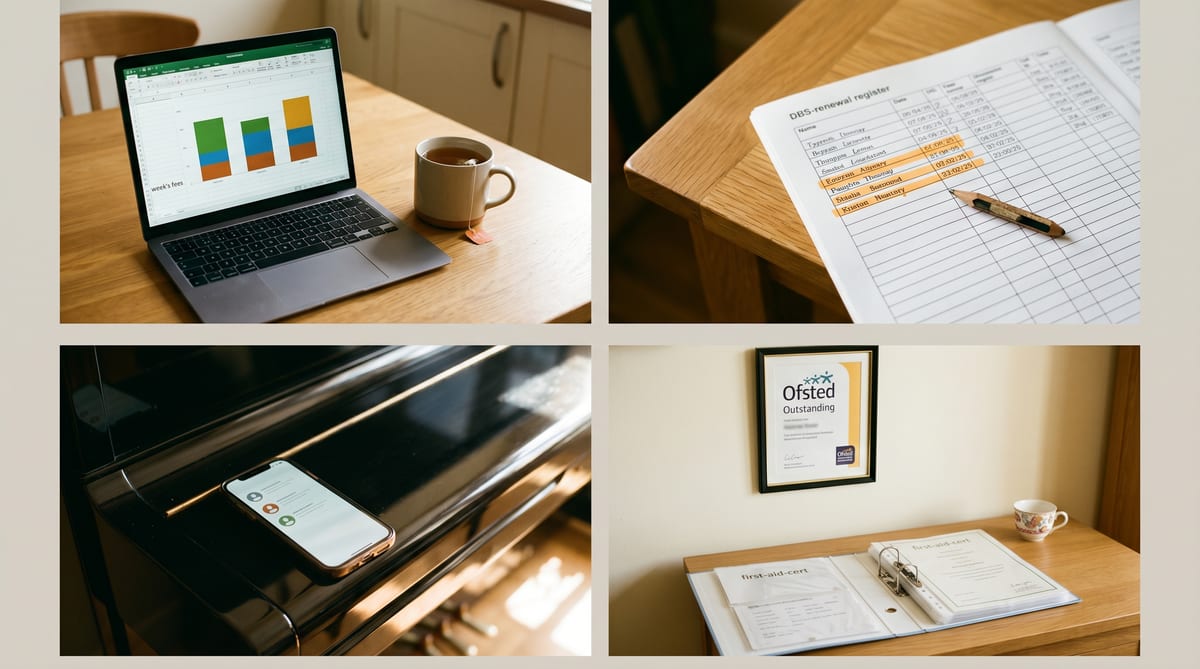
Five things we hear most often from tutors, music teachers, sports coaches, dance schools, and nurseries - with what the solved version looks like in your week. Four are universal across the sector; the fifth applies specifically to Ofsted-regulated childcare settings (nurseries, pre-schools, wraparound clubs) but the underlying evidence-pack engine generalises across. Every build is scoped per provider: a sole tutor typically needs sketches 1 and 4; a dance school typically needs 1 + 4 + 5 in a lighter form; a nursery typically needs all five; a sports club typically needs 1 + 2 + 4 + 5 with the governing-body safeguarding bridge.
1. The 50-pupil DD that bills itself - sibling discount, skip-a-month, holiday suspension, and £18 PAYG class all in one engine
The Sunday-reconciliation moment: fifty pupils, three payment methods, term fees mixed with PAYG, sibling discounts on the younger ones, skip-a-month for the family-in-Italy in October, holiday suspension for the dance school in August. Sunday-night reconciliation is half a day. The tutors-nurseries-specific weight is that the payment reality in this sector is genuinely heterogeneous - every family has slightly different terms (term fee + PAYG + sibling-discounted + LA-funded EHCP at 90-day terms) and the build has to handle the heterogeneity natively, with the DD-failure gentle nudge firing in your voice the moment it lands rather than three weeks later when you do the books.
The full build: Recurring Service Recall - per-pupil structured product + per-family structured relationship + multi-payment-method engine (GoCardless / Stripe / Klarna / BACS / cash) + DD-failure recovery. Referenced across many verticals; the tutors-nurseries version’s vertical-distinct features are the sibling-discount + skip-a-month + holiday-suspension structured modifiers (you set them up once per family, the engine applies them automatically every month) and the parent-balance-across-multiple-pupils single-screen view (the mum paying for one piano lesson and two football sessions and a 11+ tutor sees one balance, not three). The September enrolment surge fires the “now-booking” DD-setup flow at the right cadence so the new cohort doesn’t ghost between the “yes please” and the first lesson.
2. The DBS that doesn’t lapse - and the KCSiE refresher cohort that’s tracked, not assumed
The lapsed-DBS moment: eight staff DBSs across the agency. Three lapsed this year without anyone noticing until a school asked for proof. The September KCSiE document drops again next week and you’re starting another refresher cycle nobody really tracks. The tutors-nurseries-specific weight is that the staff-safeguarding record is the single most-stakes-y operational discipline in this sector - a lapsed DBS at the moment a parent or school asks is the safeguarding incident waiting to happen, and the cost of maintaining it manually is the predictable September panic.
Solved looks like: the staff-safeguarding register as a structured per-staff record across DBS Update Service status, enhanced DBS expiry, KCSiE Level 1 / 2 / 3 completion, Prevent Duty module, paediatric first-aid certificate, sport-specific safeguarding (FA Safeguarding Children for football coaches, equivalent for RFU / Swim England / British Gymnastics / LTA / ECB), and annual refresher cadence. Each staff member has a structured profile; the register shows current state at a glance (green / amber / red per cert); the renewal calendar fires 90 / 30 / 7 days before expiry to the staff member in your voice - “hi Tom, your DBS Update subscription renews on the 14th - £13 to keep current, here’s the renewal link” - and to the principal for awareness. When the September KCSiE document lands, the refresher cadence fires automatically - “this year’s KCSiE has been published; here’s the 12-minute summary of what’s changed, here’s the refresher module link, please complete by 31 October” - with completion tracked per staff member. When a school asks an agency tutor for DBS proof, the structured one-click export lands in the requesting school’s inbox within two minutes, not a 24-hour DBS-Update-Service login chase.
3. The parent channel that’s three conversations not three crossed wires - Aisha’s mum, Tom’s dad, and the class group all separate
The crossed-wires moment: Aisha’s mum WhatsApps on one number, Tom’s dad emails about half-term on another, a third parent texts your personal phone, the class WhatsApp group goes off-topic about a missing PE kit by Wednesday lunchtime. The tutors-nurseries-specific weight is that the parent-communications overhead in this sector is meaningfully larger than other recurring-customer industries - every pupil is a relationship with two-to-four adults, each with their own channel preferences, and the per-family thread becomes the unit of conversation rather than the per-message.
Solved looks like: the parent-comms layer as a per-family structured thread, separate from the class WhatsApp, that captures the cross-channel reality of how families actually talk. Aisha’s mum can WhatsApp, Tom’s dad can email, the agent reads both into the same family thread and replies on the channel each parent prefers in your voice. Routine FAQ (“what time does Wednesday’s lesson finish?”, “is half-term the 18th or the 25th?”, “can Aisha bring her violin home for practice?”) the agent answers from your structured policy; anything that isn’t routine escalates with context to you. Per-family progress updates (the music-teacher recording of last week’s piece, the dance-school costume-drop photo, the nursery learning-journey moment, the football-club end-of-week round-up) auto-post on the right cadence to the right channel. Under-18 pupil direct communication is gated on parental consent state with the safeguarding-aware patterns built in (group-messages-only by default for under-13s, parent-cc’d-on-1-to-1 where the policy requires it, KCSiE-aligned record-keeping throughout).
4. The July-August cashflow gap that’s planned for in April - and the term-cycle that forecasts itself
The annual-surprise moment: July-August dead. Dance school does the camp for thirty out of two hundred, sports club takes summer off, tutoring drops to a handful of GCSE-prep, nursery’s the only continuous business. Cashflow is half normal and rent and staff costs aren’t. You do this every year and you’re still surprised. The tutors-nurseries-specific weight is that this sector’s cashflow has a genuinely predictable term-cycle shape (the July-August gap, the September enrolment surge, the November-December exam push, the Easter-holiday lull) that almost every provider experiences as a surprise every year - and the planning conversation that needs to happen in April for the August reality usually doesn’t happen at all.
Solved looks like: the term-cycle cashflow forecaster as an 18-month projection built directly from the pupil pipeline and the school-term-and-holiday calendar. Every pupil carries a structured recurring-revenue pattern (weekly £30, termly £180, PAYG £18, sibling-discounted £25, EHCP at LA rate at 90-day terms); the system reads the school-term + half-term + bank-holiday calendar for the area; the projection renders monthly across the next 18 months with income (per channel and per pupil-cohort) net of recurring outgoings (staff wages, rent, insurance, governing-body fees, the Tutorbird / Famly subscription, software, vehicle if relevant) and the predictable big bills (the July HMRC payment on account, the September insurance renewal, the December VAT quarter if VAT-registered). The July-August gap surfaces three months ahead - “July cashflow will be -£3,400 vs the running surplus; here’s the gap, here are options” - with the options being things that can actually move the dial (the summer-holiday-camp pricing tier, the summer-tutoring intensive package, the GCSE-resit cohort marketing, the funded-hours-nursery additional sessions on the over-twos). For SEND specialists running on LA EHCP funding at 90-day terms, the forecast shows in-flight invoices and projected receipt dates so the “I’m fronting the cost” reality has a number ahead of it.
5. The Ofsted-five-star rating that holds on the Tuesday-morning unannounced - because the evidence pack was already assembled
The unannounced-Tuesday moment: inspector turns up at 9am; EYFS observations on Tapestry are current; safeguarding posters are up; one first-aid cert expired in August nobody noticed. Rating drops from Outstanding to Good. Three mums ask about the rating on the council website by Friday. Six-month enrolment-recovery curve. The tutors-nurseries-specific weight is that the Ofsted rating is the single most parent-facing thing about a regulated childcare setting - parents read it on the council website before they enquire - with a measurable enrolment-recovery curve when it drops.
The full build: Compliance Evidence Record - Ofsted-readiness live evidence record (EYFS observations + safeguarding + parental consents + accident logs + first-aid certs + staff ratios) + real-time staff-ratio sentinel (under-2 1:3, two-year 1:4, three-to-five 1:8) + inspection-ready pack one-URL-on-demand. Referenced across many verticals; the tutors-nurseries version’s vertical-distinct features are the parent-facing council-website rating that drives enrolment (the rating outcome surfaces in your post-inspection comms cadence with the right tone) and the live staff-ratio sentinel that fires “two-year room down to 1:6, action needed” the moment the sickness-in is logged on Tuesday morning at 7:50am, before the parents arrive at the door.

The closest things we’ve already built
- mendbuddyour multi-channel AI agent platform. Behind the per-family parent-comms thread in sketch 3 (the agent reading WhatsApp / SMS / email per family, answering routine questions in your voice, escalating the unusual ones with context), the gentle DD-bounce nudge in sketch 1, and the DBS-renewal reminder cadence in sketch 2. Voice + WhatsApp + SMS + web chat with the safeguarding-sector tone-training applied (under-13 pupil-direct comms gated on parent consent, KCSiE-aligned record-keeping throughout). See Mendbuddy.
- repairminderour SaaS service-business management software. The customer + asset + job-history + recurring-service-cadence pattern is shape-wise the same as the pupil + family + lesson-log + progression + recurring-DD record; the staff + cert + renewal-calendar pattern (repairminder uses it for technicians with manufacturer certifications) is the same shape as the DBS + KCSiE staff register in sketch 2. See Repairminder.
- mendmyiour founder’s service-business storefront. The intake-to-first-paid-session flow (new pupil → intake form → parental consent → DD setup → first lesson confirmed) is the same shape as the device-repair-and-retail intake-to-first-fix loop. See Mendmyi.
- planpostour own-brand social-media scheduling SaaS. For the parent-facing marketing cadence (Facebook mum-groups for the catchment town, Google Business Profile for “piano teacher near me” / “tutoring near me” / “nursery near me”, the school-calendar-aligned content). See Planpost.
Adjacent verticals
- Pet servicesclosest operational shape (recurring-DD + per-customer-with-asset + photo-update-and-progress + staff-cert + council-rating). The dog-daycare and the pre-school share a remarkable amount of the same operational shape.
- Driving instructorsfor the 17-year-old buyer-with-a-parent-paying dynamic and the DBS-and-safeguarding overlap; many ADIs also do classroom tuition for their pupils’ theory and share the per-family-thread comms shape.
- Clinicsfor the vet-and-physio side which shares the recurring-appointment + cert-of-staff overlay; many sports coaches refer pupils to physios who refer back.
- Equinefor the riding-school dimension which is genuinely a coaching-school with a livery overlay; equine-coaching shares structure with the sports-club and dance-school world.
- Charitiesfor the volunteer-led sports-club + community-tutor + holiday-club work that runs on Charitable Incorporated Organisation status with the same DBS + safeguarding overlay.
FAQ
Will the build work alongside our Tutorbird / Teachworks / MyMusicStaff / Famly / Tapestry / Connect Childcare / Blossom / ClubBuzz / Spond / Bookwhen install?
Yes for all named ones. The existing platform stays as your domain-specific system-of-record (Famly / Tapestry for EYFS observations, MyMusicStaff for the music-exam side, ClubBuzz / Spond for sports-club admin, Tutorbird for tutor scheduling) and the build sits as a layer around it: the unified payments engine, the safeguarding register, the inspection-ready pack, the parent-comms channel, the term-cycle cashflow forecaster. Each integration is scoped at discovery. Where you’re on a paper register and a spreadsheet, we build the underlying system as part of the engagement.
Will the build pull leads from Tutorful / MyTutor / Bramble cleanly?
Yes for the agency-side leads - the per-platform inbound (Tutorful enquiry, MyTutor message, Bramble session-request) feeds the per-family thread in sketch 3 in the same shape as a direct enquiry, so an inbound lead from a marketplace is the same operational object as one from your website. The platforms stay as the marketplace surface; the build adds the comms-and-conversion layer once the lead lands.
Will the staff-safeguarding register handle multi-setting work (a tutor working at three schools, a sports coach at four clubs)?
Yes - the DBS / KCSiE register is per-staff-person, not per-setting, with the “settings they work at” and “governing bodies they’re affiliated to” captured separately. A tutor working at three schools has one structured DBS record that all three settings can verify; a coach affiliated to FA + RFU has both safeguarding-cert records tied to one identity.
Will the parent comms channel respect the family’s existing channel preferences and the safeguarding considerations around minors?
Yes - per-family channel preferences (WhatsApp, email, text) are captured at intake; under-18 pupils’ direct communication is gated on parental consent state with the safeguarding-aware patterns built in (group-messages-only by default for under-13s, parent-cc’d-on-1-to-1 messages where policy requires it, KCSiE-aligned record-keeping throughout).
Will the term-cycle cashflow forecaster handle our mix of term-fee, weekly-DD, PAYG, and LA-funded (EHCP / 15-30 hr free entitlement) revenue?
Yes - each revenue stream is modelled as a structured pipeline against its actual cadence. Term fees land at term-start; weekly DDs land each Monday; PAYG lands when the class is booked; LA EHCP-funded sessions invoice the LA and arrive 90 days later (the chase ladder runs in the background); 15/30-hour free-entitlement funding flows via the council’s monthly return. The forecast aggregates across.
Will the Ofsted-ready evidence pack work for our specific Ofsted requirements (nursery / pre-school / wraparound / after-school)?
Yes - the evidence pack adapts to the registration type (full Early Years Register vs Childcare Register vs voluntary registration) with the right EYFS Statutory Framework records per category. The submission and the inspection conversation stay with you; the assembly is the system’s job.
Will you handle our Ofsted inspection or our DBS-Update verification on our behalf?
No - the inspection stays between you and the Ofsted inspector, the DBS-Update verification stays between you and the Disclosure and Barring Service. What the system does is assemble the evidence + maintain the records + surface the renewal calendar so the inspection is a fifteen-minute walk-through and the DBS conversation is a one-click export.
What does it cost?
Every build is scoped per provider - depends on which sub-type you are (tutor / agency / music / sports / dance / nursery / wraparound / SEND), staff and pupil headcount, current platform mix, and whether the build covers all five sketches above or a subset. We talk it through, agree the price in writing. See pricing.

Tell us what your week looks like
Send an enquiry - what you run (private tutor, tutor agency, music teacher or academy, sports coach or club, dance or drama school, day nursery or pre-school, breakfast / after-school / holiday club, SEND specialist), pupil and staff headcount, your current stack (Tutorbird / Teachworks / MyMusicStaff / Famly / Tapestry / Connect Childcare / Blossom / ClubBuzz / Spond / Bookwhen / Tutorful / MyTutor / Bramble for leads / spreadsheet-and-WhatsApp). Where the operational pain lives - the Sunday DD reconciliation, the lapsed DBS, the Tuesday-morning Ofsted, the parent-comms inbox, the July-August cashflow gap, the September enrolment surge. We’ll come back with a sketch of what we’d build and what it would cost. No calendar, no demo to sit through. Email reply, scoped sketch, you decide.