

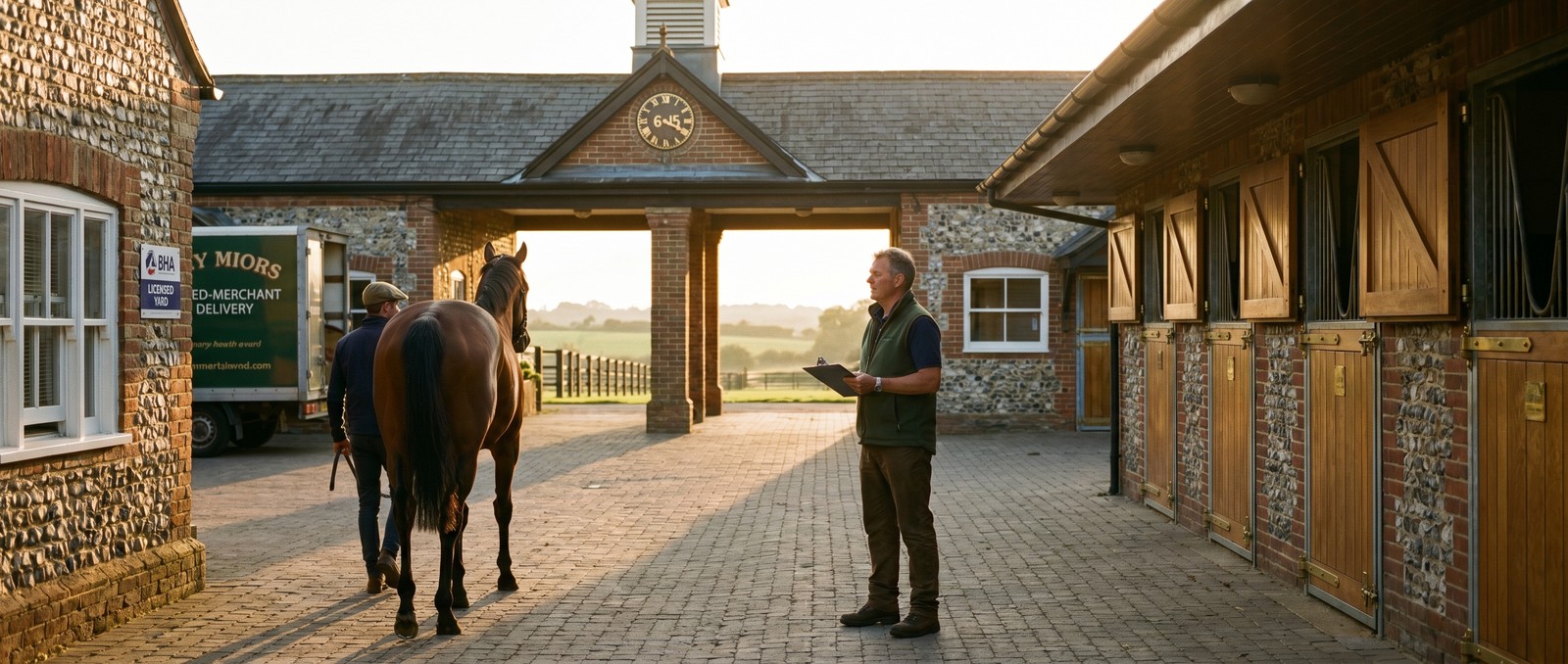
Software for the UK equine sector - Newmarket as the gravity centre
Sunday night, kitchen table off the Heath. Six horses’ worth of vet, farrier, feed, transport, and entry-fee invoices to cross-charge to four owners’ monthly statements, none of which line up. BHA Friday-noon entries closed last week with one mistake that’s costing the syndicate a winner’s share. The covering book in the breeding shed says one thing; the spreadsheet in the office says another.
You’re the yard manager at a 35-horse Newmarket training yard, or the stud manager running covering season at a Thoroughbred breeding operation, or the practice principal at one of the world-class Newmarket equine vet practices (Rossdales, Newmarket Equine Hospital, Equine Veterinary Centre), or the bloodstock agent preparing the sales catalogue for Tatts October, or the syndicate manager fielding race-day WhatsApps from thirty owners across a single afternoon, or the BHS-affiliated riding-school principal running a Saturday’s worth of lessons through a livery yard with twelve horses on the yard list. mmitech HQ is sixteen miles from the heath - Haverhill to Newmarket is a half-hour drive, and the equine cluster is the densest concentration of horse-and-rider operations in the UK with 3,500 horses in training, ~80 trainers, ~60 stud farms, three world-class equine vet practices, ~40 farriers, plus the bloodstock + transport + feed + tack supply chain in a sixteen-mile radius. The geography is the moat.
The software market doesn’t speak the operational language. Equicta and StableSecretary are modern but US-shaped (weak on Weatherbys, no BHA awareness); Equine Office is UK legacy with a 2007 feel; Horse Report is the Weatherbys portal everyone has to use and nobody pretends to enjoy; EquiSec covers the security side at the bigger yards but doesn’t touch the books. Most yards run on the universal underlying stack - paper feed-board in the cab, Excel on the office desk, WhatsApp group for the syndicate, Sunday-night kitchen-table reconciliation. The pain isn’t BHA registration paperwork as such (the processes are stable); the pain is the bills-per-horse model - every horse generates eight or ten income and cost lines a month (livery, feed, bedding, vet, farrier, physio, entries, transport, sales prep, syndicate-share cross-charges), each from a different supplier, each cross-charged to a different combination of owners, all reconciled by hand into a monthly statement that has to be defensible to the syndicate’s accountant.
We build software for the Newmarket equine cluster, scoped per yard / stud / practice. Not a Weatherbys / BHA replacement - you file with both, we read and write to their surfaces, we don’t try to replace them. Not an Equicta / StableSecretary rip-and-replace where you’ve already invested - we layer alongside. The layer between the horses in the yard or the stud or the surgery and the per-owner monthly statement that assembles itself, the BHA Friday-noon entries that don’t get missed, the vet round that texts each yard with ETA, the covering book that’s one source-of-truth across breeding-shed and office, the syndicate race-day comms that doesn’t descend into chaos at 2:45 - and we can be at Rossdales’ car park for a Tuesday-morning conversation, on the heath for a yard walk-through, in the breeding shed at covering season.
What you spend your week on that you shouldn’t have to
- Sunday night, kitchen table. Six horses, four owners, eight invoice categories (livery, feed, bedding, vet, farrier, physio, entries, transport). Each owner’s monthly statement is a cross-charge against the right horses, the right shares, the right race-fee-versus-winnings reconciliation. Excel and prayer.
- Rossdales’ vet rings the yard manager on the way over. Sometimes she answers, sometimes she’s on a horse. By the time you know he’s here, he’s gone to the next yard. Routine scoping morning - six horses booked, three on the wrong ID, vet leaves grumpy.
- Farrier comes every five or six weeks (sometimes four, sometimes seven, depending on growth). You never know who’s due next until he turns up. Lost two yards last year to a younger farrier who texted first.
- New yearling arrives. Passport’s at the previous owner’s, microchip number on a Post-it. You’re on the Central Equine Database on a Sunday at 9pm again. Defra movement record - you always forget to log it within thirty days.
- Friday morning, BHA Horse Report entries due at noon. You’re on second lot. By 11:55 you’re at the keyboard, one mistake costs a £20 re-entry fee, the bigger mistake one year cost a syndicate a winner’s share when the horse went into the wrong race.
- Covering season - sixteen weeks of sleep-deprived chaos. Mares arrive, board, get scanned, get covered, leave. The book’s on paper in the breeding shed and a spreadsheet in the office and neither matches by Friday.
- Thirty owners in a syndicate. Race-day WhatsApp group descends into chaos at 2:30pm when the horse breaks well. End-of-month account - entry fees, prize money, vet bill share, farrier cross-charge - Excel and prayer. Owner rings two months later asking why the vet bill was £400 higher and you root through six WhatsApps and a paper invoice.
- Equine flu vaccination - six months for racing, twelve months for general. Miss the window by a day and your horse can’t run. Bute treatment vs racing - 14-day clearance, trainer wants to run him on day 12, awkward conversation.
- BD / BS / BE competition entries - different deadlines per discipline, different qualifier-then-area-then-regional ladder, different governing-body-membership renewals to track. Riding school’s BHS Approved Centre status renewing in March.
- Lads rota - first lot 6am, second 8am, evening stables 4pm. Annual leave, race days, sickness, work-rider availability. Sunday whiteboard exercise. Apprentice ride-out logging for BHA claiming allowances is its own paper trail.
These aren’t problems Equicta’s next release is going to solve. They’re the layer between the horses you actually train, breed, treat, compete, transport, sell and the bills that cross-charge themselves, the rounds that announce themselves, the covering book that reconciles across breeding-shed and office, the syndicate that’s one structured race-day record not thirty WhatsApps.

Example problems we could solve
Five things we hear most often from yard managers, stud managers, equine vet practice principals, bloodstock agents, syndicate managers, and riding-school principals across the Newmarket cluster - with what the solved version looks like in your week. Every build is scoped per yard / stud / practice: training yards typically need all five; vet practices typically need sketches 2 + 5 plus on-call rota; bloodstock agents typically need sketches 1 + 4 plus the sales-catalogue side; riding schools typically need sketches 1 + 4 plus the BHS-coaching cadence.
1. The per-owner monthly statement that assembles itself - across feed, vet, farrier, physio, entries, transport, syndicate cross-charge
The Sunday-kitchen-table moment: six horses, four owners, eight invoice categories from eight different suppliers, each cross-charged to a different combination of owners. Excel and prayer. The equine-specific weight is that the bills-per-horse model is the deepest operational reality of yard-and-stud life - every horse is a small business unit, every owner is a different payable / receivable relationship, every service event needs the right cross-charge, and the manual Sunday-night reconciliation is the predictable cost of the structure.
Solved looks like: the per-horse / per-owner accounting layer as a structured ledger that captures every cost and revenue line against the horse the moment it lands. Livery + feed + bedding + entries + transport are captured at source (the feed merchant’s invoice, the entry-fee record from Horse Report, the transporter’s job log); vet bills + farrier visits + physio sessions capture from the per-visit job-log on each professional’s side; each line is tagged to the horse, the date, and the owner-allocation rules (sole owner gets 100%, syndicate cross-charges per share, two-up partnership splits the lot 50/50). The monthly statement assembles automatically on the first of each month - “Sarah, here’s the statement for Filly X for May: livery £1,400, feed £210, bedding £85, vet £340, farrier £120, physio £85, race-day entry £85 + transport £180; total £2,505 less her £620 share of the Newmarket third-place prize money = £1,885 net due” - in your voice, with the line-by-line detail the syndicate accountant needs, the Xero side already reconciled, the GoCardless or BACS collection link attached. For syndicate operations, the per-owner share calc runs on the structured shareholding; for partnerships, the split is per-the-agreement; for cross-charged services (the vet bill that needs to split across three syndicate horses), the cross-charge calculation runs automatically.
2. The vet and farrier round that texts each yard with ETA across the heath - and the farrier 5-6 week recall that doesn’t get forgotten
The grumpy-vet moment: Rossdales’ vet rings the yard manager on the way over. Sometimes she answers, sometimes she’s on a horse. By the time you know he’s here, he’s gone to the next yard. Plus the farrier comes every 5-6 weeks and you never know who’s due next until he turns up. The equine-specific weight is that the Newmarket heath has genuinely meaningful geographic density - eighty trainers and sixty stud farms in a sixteen-mile radius - and the vet-and-farrier round is the operational layer that connects them.
Solved looks like: the round coordination layer for any equine professional running a multi-yard round across the Newmarket cluster - vet, farrier, physio, dentist, chiropractor, transporter. Each visit is a structured event with a yard, a horse, a service type, an expected duration, and a position in the day’s round; the route plans itself across the geocoded yards on the heath; each yard gets an ETA SMS as the round progresses - “Hi Sarah at Yard X - vet’s currently at Yard Y, ETA your yard 10:45, the four horses you booked for scoping are Filly A, Filly B, Colt C, Colt D, please have them ready in stable order”. On the farrier side, the 5-6-week recall runs as a structured cadence per horse - last-shod-date + growth profile (some horses need 4 weeks, some 7) → forecast next-due → SMS the yard manager seven days before → confirmation reply books the slot back into the farrier’s round. For race-day cover, the equine vet practice’s on-call rota integrates structurally so the Tuesday on-call vet is the one in the catchment area when the BHA Veterinary Inspection vet pages the practice during scoping morning.
3. The Friday-noon BHA entries that don’t get missed - and the BD / BS / BE competition deadlines for the sport-horse yards
The 11:55-on-second-lot moment: Friday morning, BHA Horse Report entries due at noon. You’re on second lot until 10:30. By 11:55 you’re at the keyboard, one mistake costs £20 a pop, last year a wrong-race entry cost the syndicate a winner’s share. The equine-specific weight is that the BHA Friday-noon cutoff is the single highest-stakes admin moment in a training yard’s week (a missed deadline is a missed race, a wrong entry is a costly mistake, the second-lot reality means the trainer is at the yard not the keyboard until 10:30); for sport-horse yards, the British Dressage / British Showjumping / British Eventing entry cadence carries similar deadline pressure across the qualifier-area-regional ladder.
Solved looks like: the entries layer as a deadline-aware structured workflow across both the BHA Horse Report side and the BD / BS / BE side. Each horse in the yard has a structured campaign profile (current rating or points or affiliation level, distance / discipline preferences, going preferences, owner’s wishes, trainer’s plan, recent runs) that feeds an entry-suggestion view across the week’s fixtures - “these horses are eligible for these races / classes this week; here’s the strongest match for each; here are the secondary options”. The trainer reviews on Sunday or Monday, marks the planned entries, and the Friday-noon submission lands in Horse Report pre-filled (we read and pre-populate from the structured horse-and-race data, you click submit). Pre-submit, the Thursday-noon and Friday-9am reminder SMS / WhatsApp fire - “Filly X is entered for the 3:45 at Yarmouth Saturday, jockey TBC, balance check OK, withdraw deadline 9am tomorrow; reply CHANGE if anything’s moved”. The system flags inconsistencies before submit - “this horse is rated 78 and the race conditions say maximum 75; please double-check” - so the typo doesn’t slip through. For BD / BS / BE entries, the same engine reads the membership renewals, the entry-window opens, the qualifier-then-area-then-regional ladder per horse, and the late-entry-fee deadline cliff per discipline. Post-race / post-class, the winnings reconcile structurally against the horse’s owners via sketch 1.
4. The syndicate Hub that turns thirty WhatsApps at 2:45pm into one structured race-day record - and the monthly statement that’s defensible by 7am the next morning
The 2:30pm-chaos moment: thirty owners in a syndicate. WhatsApp group goes off at 2:30 when the horse breaks well. By 2:45 the group’s so noisy you can’t find the question you needed to answer. End-of-month account - entry fees, prize money, vet bill share, farrier cross-charge - Excel and prayer. The equine-specific weight is that syndicate management is the hybrid operational discipline that combines accounting + fan-engagement + compliance - the WhatsApp-and-Excel reality is the dominant industry pattern because nobody’s built this well.
The full build: Customer & Third Party Portal - per-syndicate operations hub with per-owner shareholding view + per-horse roster + per-month live statement + race-day live-feed. Referenced across many verticals; the equine version’s vertical-distinct features are the prize-money-allocation-on-line-crossing (the moment the result goes official, the share-of-prize-money calc fires and lands in each owner’s statement) and the per-owner GoCardless DD statement on the 1st in the syndicate’s branded format. For livery yards (BHS-affiliated riding schools, mixed sport-horse-and-leisure yards), the same engine runs the per-owner livery billing with the cross-charged shared services (the yard’s vet visit that splits across six horses, the bulk-feed delivery that’s cross-charged per horse-on-the-yard-list) in the same shape.
5. The equine flu vaccination calendar that texts thirty days out - and the bute-clearance window the system knows about before the race
The day-12-bute moment: equine flu - six months for racing, twelve for general. Miss the window by a day and your horse can’t run. Bute treatment - 14-day clearance, trainer wants to run him on day 12, the conversation’s awkward because the system’s in your head. The equine-specific weight is that equine medical-and-clearance compliance is the single most race-day-critical operational discipline - a horse declared and then disqualified for a vaccination lapse is the public-facing failure mode.
The full build: Recurring Service Recall - per-horse medical and clearance record as a structured live calendar across the disciplines that affect race-day eligibility. Referenced across many verticals; the equine version’s vertical-distinct features are the equine-flu vaccination dates (six-month racing window, twelve-month general window) with a 60 / 30 / 14 / 3-day reminder cadence to the trainer and owner, the medication clearance windows (bute, dexamethasone, anti-inflammatories) tracked per-horse from the moment the vet records the treatment so the trainer’s “can we run him next Saturday” conversation has a definitive answer ten seconds before it becomes awkward, and the per-horse audit-trail vault ready for BHA inspection or pre-purchase exam disclosure. For stud-side activity, the breeding-side medical record (mare reproductive workups, stallion semen testing) extends the same shape.

The closest things we’ve already built
- mendbuddyour multi-channel AI agent platform. Behind the per-yard ETA SMS in the vet / farrier round (sketch 2), the syndicate race-day structured-comms layer (sketch 4), the Friday-noon BHA-entries reminder (sketch 3), and the trainer-side flu-vac-due nudge (sketch 5). The voice-and-WhatsApp side handles inbound from yard managers, owners, and the racecourse-vet-rota. See Mendbuddy.
- repairminderour SaaS service-business management software. The customer + asset + job-history + cross-charged-invoice pattern is shape-wise the same as the horse-and-owner-and-service-event ledger that drives sketches 1 and 5: the asset (the horse) carries the structured history, the customer (the owner or syndicate) carries the shareholding and payment relationship, the job-log captures every service event against the horse, and the per-owner statement assembles from the cross-charge rules. See Repairminder.
- mendmyiour founder’s service-business storefront with structured intake and ecommerce. The bloodstock-sales-catalogue side (sales lot register, photo upload, page-entry updates) is the same shape as the device-and-parts storefront; the intake-and-deposit flow for syndicate sign-up is the same shape as the new-customer-to-first-paid flow. See Mendmyi.
- planpostour own-brand social-media scheduling SaaS. For the Newmarket-cluster + Racing Post + Newmarket Journal + Tattersalls-sales + BD / BS / BE competition-calendar content cadence; the seasonal rhythm of the racing calendar (Guineas weekend, Royal Ascot, July Cup, August Sales, October Sales) drives a structured publishing cadence specific to the cluster. See Planpost.
Adjacent verticals
- Pet servicesclosest operational shape for the recurring-DD + customer-with-asset + photo-update + booking-and-comms pattern; the livery side of equine and the boarding side of pet services share remarkable structural overlap.
- Agriculturefor the supply-chain side (the hay merchant supplying the yard, the feed mill, the bedding supplier) and the mixed-farm-with-livery diversification that’s increasingly common in the Newmarket area.
- Clinics (vet sub-page)for the vet-practice side; equine and small-animal vet practices share the on-call rota + practice-management pattern, but equine has the race-day-cover + heath-round + BHA-aware overlay equine vet practices uniquely manage.
- Independent garagesfor the transport-side (the equine transporter’s commercial vehicle stack: MOT, V5 commercial, IPAFFS for live import / export, FEI passport).
- Tutors and nurseriesfor the BHS-affiliated riding-school side which shares the coaching-school + recurring-pupil + structured-progression shape with the sports-club and dance-school world.
FAQ
Will the build work alongside our Equicta / StableSecretary / Equine Office / HorseLinc / Horse Report install?
For Equicta and StableSecretary (the modern alternatives, both US-shaped but with UK installs), we layer alongside - they stay as the yard / stud / practice case-management system-of-record, and the build adds the per-owner statement engine, the BHA Friday-noon workflow, the syndicate comms layer, the vet-and-farrier round coordination, and the flu-vac / bute-clearance compliance calendar. For Equine Office (UK legacy), we layer over the top where the integration surface exists. Horse Report stays as the official Weatherbys submission surface; we read horse and entry data, pre-fill submissions, and let you click submit - we don’t replace it. Where you’re on no system at all (paper feed-board, Excel, WhatsApp), we build the underlying record as part of the engagement.
Will the per-owner statement engine handle our syndicate / partnership / sole-owner mix correctly?
Yes - each owner relationship is captured as a structured object with the right type (sole owner, partnership with split percentages, syndicate with per-share shareholders, lease arrangement, leaseback). The cross-charge logic respects the shareholding for every service event; the statement assembles per-owner per-month with the right detail and the right total.
Will the BHA entries side respect the way we already work with Horse Report?
Yes - the build is designed to make the Friday-noon submission easier, not to replace it. The horse-and-race data is read from Horse Report (you authorise the access); the entry-suggestion view runs against your campaign plan; the submission writes back to Horse Report (your account, your credentials, your authorising click). The reminder cadence runs from Sunday plan-review through Thursday-noon and Friday-9am; the inconsistency-flag checks the entry against the rating and conditions before you click submit.
Will the vet-and-farrier round work for our practice - Rossdales / Newmarket Equine Hospital / Equine Veterinary Centre / a single-vet practice?
Yes - the round coordinator handles any practice with one or many vets running rounds across the heath. The optimiser plans the day’s route per vehicle, the yard-side ETA SMS fires from each vehicle’s progress, the on-call rota integrates structurally. For farriers running a 5-6 week recall round, the same engine optimises the route and the recall cadence.
Will the syndicate hub support the corporate-syndicate side (Limited-Liability syndicates, FCA-aware structures)?
Yes - the hub respects the legal structure the syndicate carries. For unincorporated traditional syndicates, the per-share-per-owner mechanic runs cleanly; for Limited-Liability syndicates, the structured accounting and disclosure rules are honoured; for FCA-aware structures (where the syndicate’s structure may approach a Collective Investment Scheme), the disclosure-and-record-keeping reflects the legal requirement. We don’t make the FCA-accountable judgement (that stays with the named adviser); the system makes the record-keeping audit-clean.
Will you handle our Weatherbys / BHA / Defra / ATCM submissions on our behalf?
No - every submission stays with the named accountable party (the trainer for BHA entries, the stud manager for Weatherbys covering certificates, the keeper for Defra movement records, the stud or trainer for ATCM stallion returns). What the system does is assemble the underlying data as you operate, pre-fill the submission form fields, and one-click-ready the submission for you to review and submit.
Will the build handle the Tattersalls / Goffs / DBS / Arqana sales cycle?
Yes - the bloodstock-sales catalogue layer handles the lot register + photos + page-entry data + final-print deadline tracker + post-sale settlement reconciliation. The catalogue printers’ deadlines (the Park Paddocks cycle, the Goffs cycle, the Arqana cycle) live as structured milestones; the lot record carries the photos, the page-entry copy, the medical evidence, the bloodstock-agent’s commission terms. Post-sale, the settlement reconciles structurally - sale price, commission, vet-of-record, trainer-of-record cross-charges.
You’re sixteen miles from the heath - does that actually matter?
For most builds, no - we ship to clients across the UK and the work is the same. For equine, it’s genuinely useful: we can be at Rossdales’ car park or on the heath for a yard walk-through inside a half-hour, the operational language is fluent on our side, and the “come and see what Tuesday-morning second-lot actually looks like” conversation is a thirty-minute drive rather than a flight. We don’t charge for the geography; it just makes discovery quicker.
What does it cost?
Every build is scoped per yard / stud / practice - depends on horse count, sub-type (training yard vs stud vs vet practice vs farrier vs bloodstock agent vs syndicate manager vs riding school), current platform mix, and whether the build covers all five sketches above or a subset. We talk it through, agree the price in writing. See pricing.

Tell us what your week looks like
Send an enquiry - what you run (training yard, stud farm, equine vet practice, farrier, physio / dentist / chiropractor, bloodstock agent, syndicate manager, equine transporter, livery yard, BHS-affiliated riding school, BD / BS / BE competition rider) and the horse count or staff count. Your current platform (Equicta / StableSecretary / Equine Office / Horse Report / HorseLinc / EquiSec / paper-and-WhatsApp). Where the operational pain lives - the Sunday kitchen-table reconciliation, the vet’s grumpy arrival, the farrier 5-6-week recall, the Friday-noon entries, the covering season chaos, the syndicate WhatsApp at 2:45, the flu-vac window, the bute-clearance conversation. We’ll come back with a sketch of what we’d build and what it would cost. We’re sixteen miles from the heath - happy to come for a yard walk if it’d help. No calendar, no demo to sit through. Email reply, scoped sketch, you decide.