


Software for UK home-care agencies
Saturday 6am. Carer three phones in sick. Six visits on her rota by 11. I’m scrambling at 6:15 - who can drive to Mrs P’s, who knows the hoist, who Mr T trusts after his bath?
You’re the registered manager at a 60-carer home-care agency, or the agency owner running 80 carers across 380 clients in a market town, or the nominated individual at a specialist learning-disability supported-living service. The electronic care-management system - Person Centred Software, Birdie, CareLineLive, Nourish, Access PeoplePlanner - does what the ECM does (the rota, the care plan, the visit log, the MAR sheet, the body map). What it doesn’t do is run the operational shape around it that determines whether the rota holds together on Saturday: the competency-aware sickness cover (who’s trained on Mrs P’s hoist, who Mr T trusts after his bath, who’s done the dementia stage 2, who’s been moving-and-handling RoSPA-recertified this year), the 3am out-of-hours duty line where the daughter rings in pieces (is this clinical, is this safeguarding, is it a wandering-with-dementia event, does this need 999 or the senior on call or the GP-out-of-hours), the LA invoicing reconciliation across Suffolk + Cambridgeshire + Essex + Norfolk with the 15% rejection rate, the retention dashboard that catches the carer who’s about to leave before she leaves. CQC is the wallpaper - every conversation references KLOEs, the inspection that arrived at 8am Wednesday, the Outstanding-vs-Good rating - but the rating moves because of the rota, the retention, and the family’s experience, not because of the inspection-readiness folder.
We make custom software for UK home-care agencies - scoped per provider, sized to the bit between the visit clocked on the carer’s app and the rota holding, the carer staying, the family supported at 3am, the LA invoice paid first time, Saturday 6am not a disaster, the medication-record paper trail one URL when CQC walk in. Not a Person Centred Software / Birdie / CareLineLive / Nourish / Access PeoplePlanner replacement - the ECM is fine at what the ECM does. The bit between the ECM and the operational reality of running an agency - the Saturday rebuild, the 3am duty-line escalation matrix, the carer’s day on her own phone, the LA invoicing that doesn’t bounce, the retention signals nobody has time to track manually - that’s the bit we build. Tell us what your week looks like and we’ll come back with a sketch.
What you spend your week on that you shouldn’t have to
- Saturday 6am - carer three phones in sick. Six visits on her rota between 7 and 11. The rebuild needs to know who’s free, who’s trained on the hoist, who Mr T trusts after his bath, who’s been moving-and-handling RoSPA-recertified inside the last year. Currently I’m doing it on my phone in bed.
- 3am Sunday - daughter rings the out-of-hours duty line in pieces. Mum’s wandering, has fallen, is bleeding from a cut on her arm, the GP-out-of-hours number she’s been given doesn’t pick up. The on-call manager has to triage clinical-vs-not in thirty seconds - 999, the senior on call, the GP-OOH, or “breathe, we’re sending someone, here’s what to do until they arrive”.
- Birdie / Person Centred Software alerts at 9:15 for an 8:45 visit no-show - half are signal glitches, half are real, the on-call manager gets ten a day and has to triage every one.
- Family enquiry Saturday evening - “my mum’s just been discharged from hospital, we need someone in by Monday” - Monday morning they’ve already booked with the agency three doors down that answered out-of-hours.
- 80 carers, 30% industry turnover means I’m onboarding 24 a year - DBS in progress, Care Certificate not signed off, the new starter’s eight weeks in and considering leaving because two consecutive Saturdays were six-visit days.
- Suffolk County Council brokerage - visits uploaded Friday, 15% rejected for “duration mismatch” because the care plan said 30 minutes and the ECM logged 45. I re-submit, dispute, eat the cost on the third re-submission. Multiplied across Suffolk + Cambridgeshire + Essex + Norfolk, Friday afternoon is just LA admin.
- Mrs P’s MAR sheet - week three, dose marked refused by carer Tuesday; family insist it was given; pharmacy audit logs the discrepancy; CQC Regulation 12 (safe care and treatment) investigation territory. The medication-record paper trail across the offline-sync gap is the single most-asked-about evidence at inspection.
- Live-in care placement Sunday - by Friday the client wants “someone different”. Replacement carer deployed; original carer’s belongings still at the property; her next placement starts Monday morning two counties away.
- Care-plan reviews - 380 clients × quarterly is 1,520 reviews a year; manager + four seniors is sixty per week to keep up; we’re always behind.
- Sponsor licence Home Office audit - half a day of admin per audit, evidence of role advertising at threshold salary, the post-February-2024 visa-restriction context making it the second-most-stressful annual cycle after CQC. Three carers on Friday WhatsApp asking about overtime, holiday balances, the mileage rate, when the new uniform’s arriving - communications that should be one-tap on a carer app.
These aren’t problems for a generic CRM. They’re the bit between the ECM tracking the visits and the rota holding together, the carers staying, the families supported, the LA paid first time, the registered manager home for tea on Friday. That’s the bit we build.
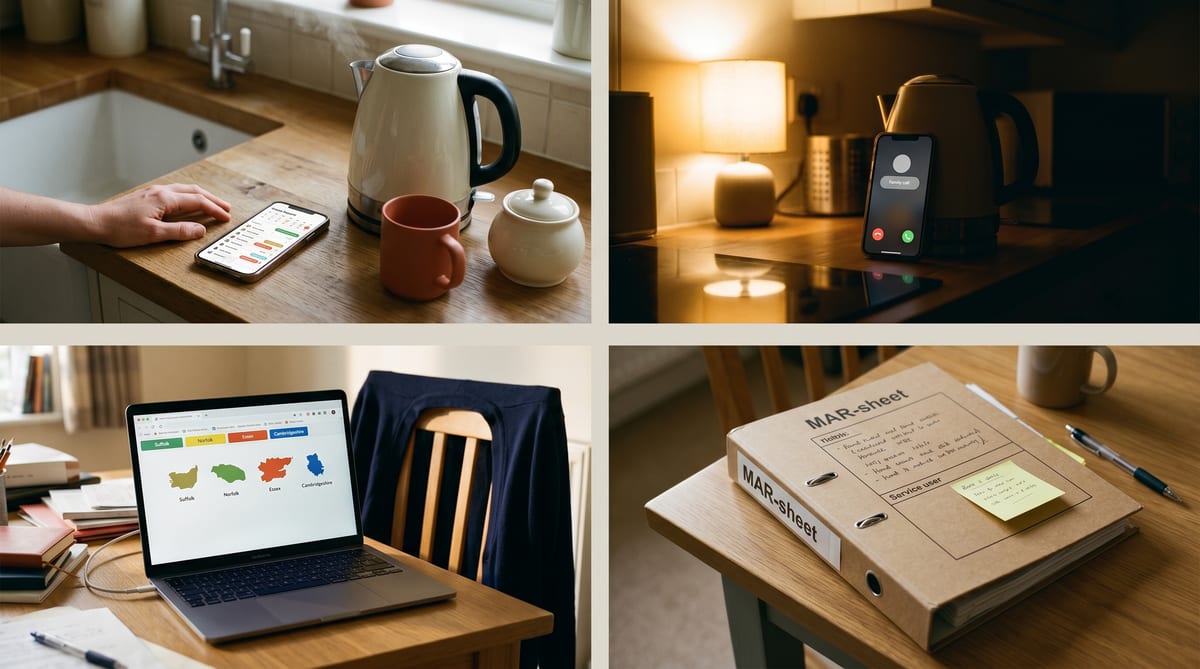
Example problems we could solve
Five things we hear most often from home-care agencies - with what the solved version looks like in your week. Every build is scoped per provider: a 20-carer specialist supported-living service probably needs the first three; an 80-carer multi-LA mainstream agency might want all five. None of it means binning the ECM - it stays your system of record on visits + MAR + care plan + body map; we add the layer around it.
1. The 6:15 Saturday rebuild - competency-aware sickness cover
The hoist-and-trust moment: Saturday 6am, carer three phones in sick. Six visits on her rota by 11. I need to know who’s free, who’s trained on Mrs P’s hoist (specific model, not just generic moving-and-handling), who Mr T trusts after his bath, who’s done the dementia stage 2, who’s been RoSPA-recertified this year. The ECM says here’s who’s available - it doesn’t know the rest. The rebuild is ninety minutes on the phone in bed, with the senior on-call ringing carers in order of who picks up not who’s the right fit. Mrs P gets a stranger she’s never met, who handles the hoist competently but doesn’t know she doesn’t like the kitchen light on first thing.
Solved looks like: the rota carries every carer’s competency profile as a structured object - moving-and-handling training current (with the renewal date and the RoSPA / Skills for Care reference), hoist-equipment-specific competency per model, dementia training stage 1 / 2 / 3 with dates, end-of-life-care training, mental capacity assessment training (MCA), medication competency by client where PRN judgement applies, the named-client trust signals (Mr T’s “familiar face after bath” preference, Mrs P’s “male carers only after 9pm” preference, Mrs K’s “don’t switch the kitchen light on first thing” note). When a sickness fires (carer rings in, ECM no-show flags, WhatsApp absence), the rebuild engine surfaces candidate cover for each visit ranked by competency match + geography + on-shift status + recent-overtime balance + WTR-safe-hours - “for Mrs P 8:30 hoist visit: Sarah (trained on that hoist model, 4 miles, on-shift, 32 hours this week); Tina (trained, 7 miles, would push her to 49 hours this week - flag); senior on-call (always trained, on-call rate)” - with one-tap deployment to each candidate carer who confirms or declines on WhatsApp. The home-care-specific moment: the rota is not a list of names and slots, it’s a competency-and-trust matrix, and the build is shaped around making the Saturday rebuild a five-minute exercise in the kitchen rather than ninety minutes in bed.
2. The 3am duty line - and the clinical-vs-not escalation matrix that triages in thirty seconds
The 3am-Sunday moment: the daughter rings the out-of-hours duty line in pieces. Mum’s wandering, has fallen, is bleeding from a cut on her arm, the GP-out-of-hours number she’s been given doesn’t pick up. The on-call manager has thirty seconds to triage clinical-vs-not - is this 999, the senior on call, the GP-OOH, or “breathe, we’re sending someone, here’s what to do until they arrive”. Get it wrong toward 999 and the family loses trust the next time mum needs reassurance; get it wrong away from 999 and a fall with anticoagulant bleed becomes a hospital admission that didn’t need to happen. The same line also fields the family enquiry on Saturday evening (“mum’s just been discharged from hospital, we need someone in by Monday”) - and the agency three doors down who answered at 7pm on Saturday wins the placement Monday morning.
Solved looks like: the out-of-hours duty line answers in your agency’s voice within sixty seconds across voice + WhatsApp + SMS + web chat, trained on your service’s escalation matrix (clinical / safeguarding / wandering / fall / refusal-of-care / family-distress / new-enquiry) with explicit thresholds (your service’s clinical team configures these) - “a fall with bleeding and a known anticoagulant prescription escalates to the senior on call within sixty seconds and the on-call senior decides on 999”, “a wandering-with-dementia event with the resident accounted-for at a known location is the wandering-protocol response, the senior is notified and a carer dispatched”, “a new-enquiry from a recently-discharged-family-member is the same-evening assessment-visit booking confirmed on the call with the registered manager prompted to call back inside the hour”. The agent captures the structured facts (who, when, where, what’s happening, what the family’s already done, who’s been called) in your ECM’s incident log; the senior on call gets the structured handover (not a sixty-second voicemail) and can pick up the conversation already up to speed. The line where helpful triage becomes clinical decision stays clearly on the human side - 999 is suggested, not dispatched; safeguarding-referral drafts itself, the registered manager confirms. The home-care-specific moment: the 3am duty line is the single highest-stakes operational moment in the agency, the family’s trust in the service is made or broken there, and the escalation matrix decides whether the agency runs at the right level of clinical caution rather than defaulting to “call 999” every time. The longer version lives at Trainable Inbound AI Agent; the home-care version is anchored on the clinical-vs-not escalation matrix, your service’s named-protocols, and the structured incident handover to the senior on call.
3. The carer’s day in her pocket - rota, offline MAR, safeguarding flag, mileage, support
The offline-MAR moment: Carer says she gave the morning dose at 9:08 - she did, just didn’t have signal at Mrs P’s flat. By the time she’s back in the car the offline MAR isn’t synced. Family check the live MAR an hour later, see a missed dose, ring the office. By the time we’ve reconciled it, the manager’s lost an afternoon and the family’s trust in the medication-record paper trail has taken a knock. The medication-record paper trail across the offline-sync gap is the single most-asked-about evidence at CQC inspection - and it’s the one that breaks most.
Solved looks like: the carer’s app sits alongside the ECM (Person Centred Software / Birdie / CareLineLive / Nourish / Access PeoplePlanner) and covers the operational layer the ECM doesn’t quite reach. Today’s rota in her pocket with travel-time auto-calculated between visits + mileage logged + reimbursement transparent; the MAR for each visit captures offline-first so the morning round in a low-signal flat doesn’t lose the dose record - sync when she’s back on signal with the timestamp preserved against the actual moment of administration, not the moment of upload, and the body map / PRN observation / refusal note captured the same way; the safeguarding-flag one-tap with a structured prompt for the what / when / who / what next the LA referral needs; the supervision-and-one-to-one cadence visible to her (next 1:1 booked, her exit-interview-style learning prompts ahead of it); the “three carers asking about overtime / holiday balance / mileage rate / new uniform” questions answered by the agent trained on your handbook; the “I’m running ten minutes late to the next visit” nudge to the next client’s family + your office. The home-care-specific moment: the carer’s day is currently spread across the ECM app, WhatsApp, a paper diary, and the office phone - and the carer is the front line of the care quality, the family experience, and the retention rate. The build is shaped around making her day legible to her and to you, not just to the audit trail; the offline-first MAR sync is what stops the Friday-evening reconciliation losing the family’s trust on Saturday.
4. LA invoicing that doesn’t get 15% rejected
The duration-mismatch moment: Suffolk County Council - visits uploaded Friday, 15% rejected this week for “duration mismatch”. The ECM logged 45 minutes, the care plan said 30. I re-submit, dispute, eat the cost on the third re-submission. Multiplied across Suffolk + West Suffolk + Cambridgeshire + Essex + Norfolk - Friday afternoon is gone before it starts, and the cashflow gap between visit delivered and invoice paid runs 6-12 weeks longer than it should. LA invoicing is the cashflow spine of the agency; the 15% rejection rate is the avoidable cost that eats Fridays.
Solved looks like: the LA invoicing loop closes the gap that currently runs as a series of separate exports and re-submissions. Visit-by-visit reconciliation runs before submission - care plan time vs ECM logged time vs banded-hours-allowed-by-the-LA - with the mismatches flagged for resolution before the batch ships. Where the variance is legitimate (the visit ran over because the client was unwell, the care plan needs updating), the system drafts the care-plan-amendment note for the senior to approve in two minutes; where the variance is a banding rule (LA only pays in 30-minute increments above the plan), the invoice line auto-aligns to what the LA actually pays. Each LA’s portal format (Suffolk’s CRM API, Cambridgeshire’s CSV upload, Essex’s web form, Norfolk’s email schedule) renders correctly first time; rejection feedback lands in a triage queue with the structured reason coded so the next week’s submission doesn’t repeat the mistake. Self-funded top-up and direct-payment invoicing flow through the same loop on the customer side. Xero reconciles against the BACS landing per-LA + per-self-funder. NHS Continuing Healthcare invoicing runs alongside with the CHC-specific evidence (the fast-track decision, the multidisciplinary review trail) attached. The home-care-specific moment: the build is shaped around getting the invoice right before it’s submitted rather than chasing it through a dispute - so Friday afternoon stops being LA admin.
5. The retention dashboard that catches the carer who’s about to leave
The eight-week-in moment: Carer’s been with us eight weeks. Two consecutive Saturday six-visit days. Mileage burden on her own car. The last 1:1 didn’t happen. She hands her notice in Friday. We knew she was struggling, didn’t act. Replacement costs us four weeks of recruitment + DBS + Care Certificate + double-staffing while she’s not yet a solo carer. The 30% industry turnover rate is the most consequential operational number in the agency; individual leavers are predictable a fortnight in advance if anyone’s looking at the signals.
Solved looks like: the retention dashboard surfaces the carer-side signals the manager rarely has time to track manually - consecutive heavy-shift weeks, mileage burden vs her contractual area, overtime-vs-baseline ratio, sickness pattern, supervision-and-one-to-one cadence, last-time-she-had-her-named-clients (continuity matters to carers too), exit-interview-learning from previous leavers cross-referenced. A “someone’s flagging” signal fires when several risk factors cluster - “Sarah: 3 consecutive 6-visit Saturdays, mileage 40% over baseline, last 1:1 was 7 weeks ago, supervision overdue, asked-about-flexible-hours last fortnight” - with a structured prompt for the senior to do the right conversation that week, not the exit interview six weeks later. On the recruitment side, the same dashboard tracks the new starter through DBS-in-progress, Care Certificate stage, first-week buddy-shifts, week-4 check-in, week-8 supervision - the moments that determine whether a new starter sticks or churns. Sponsor-licence-aware overseas recruits get a parallel track with the SMS evidence (sponsorship-management-system entries, attendance + payment + visa-state) assembling alongside the same retention signals. The home-care-specific moment: the build is shaped around making the leaving-signals visible to the registered manager before they become a Friday-night resignation - and the recruitment side is paced to match what the agency can actually onboard rather than what the Home Office threshold allows.

The closest things we’ve already built
- mendbuddyour own multi-channel AI agent platform for inbound conversations across voice, SMS, WhatsApp, web chat, Facebook Messenger and inbound + outbound voice. The 3am duty line in problem 2, the Saturday-evening family-enquiry triage at the same channel, and the carer-side comms triage in problem 3 are home-care-shaped versions of this - trained on your scope, your funding mix, your service’s escalation matrix, and your care-side voice. See Mendbuddy.
- pharmaceutical-analytics.coma custom analytics dashboard we built for an analytics consultancy. The registered-manager KPI surface (turnover rate by team + by length-of-service, LA-invoicing rejection rate by council + by reason, banked-vs-agency hours mix, MAR-paper-trail completeness, KLOEs evidence-readiness by domain, sponsor-licence audit-readiness) is the same shape: operational data captured at every visit and carer-touchpoint, decision dashboard for the registered manager and the nominated individual. See Pharmaceutical Analytics.
- repairminderour SaaS for running an inbound-items repair business. The field-worker-with-job-ledger pattern (the technician arrives, does the work, captures evidence on her phone offline-first, the customer sees the status update) ports almost directly onto the carer-with-visit-record pattern in problem 3 - different domain, same operational shape, particularly the offline-first capture and the multi-stakeholder visibility. See Repairminder.
- mmi-servicesa legacy insurance-claims surface we’re modernising (older PHP stack, lifting onto a current platform without rip-and-replace). The reference when a long-standing care agency has built routines around an older internal tool the registered manager doesn’t want to migrate - same operational shape, lifted into a current platform without losing the muscle-memory the team’s built. See Mmi Services.
Adjacent verticals
- Clinicsfor primary-care clinics with a domiciliary-visit element (physio / podiatry / community-nursing); the clinical-vs-not escalation matrix and the offline-first visit-record pattern transfer directly.
- Charitiesfor the charity providing CQC-regulated home care alongside its main mission (some larger health-and-social-care charities); the trustee-pack and grant-pipeline patterns sit on top of the operational spine here.
- Recruiters + HRfor the care-temp specialist whose placements run through DBS + safeguarding-checks + Care Certificate + sponsor-licence-aware overseas recruitment.
- Pet servicesfor domiciliary pet-care providers (in-home pet sitting, dog walking, in-home grooming); same in-home operational rhythm in a different domain.
FAQ
Will the rota engine work with Person Centred Software / Birdie / CareLineLive / Nourish / Access PeoplePlanner?
Yes for all the named ones. Each exposes APIs or webhooks for rota events, visit completions, carer availability; the competency-aware rebuild engine sits on top, reads the rota state, surfaces the candidate cover, and writes the deployment back. The ECM stays your system of record on the visit-and-MAR side; we add the layer that makes the Saturday rebuild a five-minute exercise.
Will the carer’s app replace the ECM’s own app?
No. The ECM app stays the system of record for visit clock-in / out and MAR captures (it’s the system the LA, the family, and CQC look at). The carer’s app from problem 3 sits alongside, handling the operational layer the ECM doesn’t quite reach - today’s rota with travel-time and mileage, offline-first MAR sync, safeguarding flag, supervision visibility, the carer-side comms triage, the next-client-running-late nudge.
Will the LA invoicing engine work with Suffolk / Cambridgeshire / Essex / Norfolk / Cambridge City / Peterborough - and with NHS Continuing Healthcare?
Yes for all the East-of-England LAs and the rest of the country, and for NHS-CHC invoicing alongside. Each council’s brokerage portal has its own format (some API, some CSV, some web form, some email schedule); the invoicing engine renders the per-LA format from the same structured visit data. NHS-CHC invoicing runs on the same loop with the CHC-specific evidence (fast-track decision, multidisciplinary review trail, the named DST outcomes) attached. As new LAs come into scope (a new contract win, a placement-rate change), the format adds to the library.
Does the system handle the CQC KLOEs evidence side - and the Single Assessment Framework where it’s commenced?
The evidence trail (visit records, MAR sheets, care plan reviews, supervision logs, training records - moving-and-handling RoSPA-aligned, dementia stage 1/2/3, mental capacity assessment, safeguarding - DBS state, safeguarding alerts, complaints) assembles itself in the background of the operational work. When inspection arrives at 8am Wednesday, the KLOEs (or SAF Quality Statements where applicable) by-evidence folder is one URL. The inspection itself is yours to run - registered manager, nominated individual, named-roles accountability; what the system does is make the evidence the side-effect of working, not a Friday-night archaeology project.
Will the 3am duty-line agent give clinical advice?
No. The agent triages, captures the structured facts of the call (who, when, where, what’s happening, what the family’s already done, who’s been called), suggests the escalation level against your service’s named protocols, and notifies the senior on call with a structured handover. Clinical decisions - 999 dispatch, GP-OOH consult, anticoagulant-aware fall management - stay with the named clinically-accountable person (your senior, your registered manager, or the NHS triage line the agent connects to). The line between helpful triage and clinical advice stays clearly on the human side.
Will the carer-retention dashboard meet UK GDPR / employee-data rules?
Yes. The retention signals are operational-and-employment-context data the agency is already processing as employer (rota, mileage, supervision cadence, sickness pattern); we configure access scopes so only the registered manager and the senior team see individual-named patterns, with the aggregated team-level view available more widely. The carer can request her own data any time, and the SAR response is a one-click export.
Will you handle the sponsor-licence / Home Office audit side for our international recruits?
No. Sponsor-licence accountability stays with the named compliance officer; what the system does is make the audit-evidence (role advertising at threshold salary, qualification verification, sponsorship-management-system entries, attendance + payment + visa-state tracking per sponsored worker, the post-February-2024 visa-restriction context) one URL ready when the Home Office audit lands. The audit itself is yours to handle.
What does it cost?
Every build is scoped per provider - depends on carer count, client count, LA mix, ECM stack (Person Centred Software / Birdie / CareLineLive / Nourish / Access PeoplePlanner / other), how many of the five sketches above are in scope, whether the sponsor-licence audit evidence is part of the brief. We talk it through, agree the scope and the price in writing, then build. Send an enquiry and we’ll come back with a sketch. See pricing for how we work.
How long until something’s live?
The 3am duty-line agent and the competency-aware rota rebuild typically go from scope conversation to a working version inside a few weeks, with a couple more weeks of running real out-of-hours calls and real Saturday rebuilds through them before go-live. The carer’s app and the LA invoicing engine ship together inside a couple of months - the LA-by-LA format library builds out as each council’s specifics confirm. The retention dashboard slots in alongside as the operational data starts landing.

Tell us what your week looks like
What service you run (domiciliary / supported living / live-in / specialist / small care home), carer + client count, LA-funded / NHS-CHC / self-funded mix, ECM stack (Person Centred Software / Birdie / CareLineLive / Nourish / Access PeoplePlanner / other), where the operational pain lives - the 6:15 Saturday rebuild, the 3am duty-line escalation matrix, the offline-MAR reconciliation gap, the 15% LA rejection rate, the eight-week-in carer who’s flagging, the family enquiry that goes elsewhere out-of-hours. Send an enquiry - what you do, what’s slowing you down, what you’ve already tried. We’ll come back with a sketch of what we’d build and what it would cost. No calendar, no demo to sit through. Email reply, scoped sketch, you decide.