


Software for UK personal trainers
Rigid time blocks, fixed prices, no automation - and I’m still doing the rebooking by WhatsApp on a Sunday night.
Personal training is a roster business, not a membership business. Your customers buy a pack of sessions, a transformation programme, a hybrid in-person-plus-online package, or a coaching subscription - and the diary is the product. Last-minute cancellations, no-shows, double-bookings, the endless back-and-forth to set a time. The £60 session that gets bumped costs you twice - once when it doesn’t run, again when the rebooking eats a Sunday evening you’d promised to your own family. The packs you sold in January are running down without anyone noticing, the transformation client who went quiet at week six is going to ask for a refund at week ten, and the inbound DM at 21:00 Sunday on Instagram asking “can you help me lose 20kg in 8 weeks” is going to eat a forty-minute Tuesday discovery call that’s never going to convert because the qualification line is wrong.
This page is for solo PTs, small PT studios with up to ten trainers, and hybrid in-person-plus-online coaches whose work doesn’t fit the membership-and-class shape on the main gym-fitness page. If you run a gym with a member base and class timetable, the hub is the better page; if your business is mostly online coaching with a small in-person book, the same shape still applies - most of the build is the same, just tilted toward content-delivery rather than diary-management.
What your week actually looks like
- Three rebookings on a Sunday evening because a Friday client got the flu and the WhatsApp cascade is still your job; the “can we do Wednesday at 06:30 instead” thread eats forty-five minutes you’d promised the kids.
- A 06:00 session that didn’t pay because the pack ran out at session 9 and you didn’t notice until session 11; the awkward “how would you like to renew” conversation lives in your dread folder.
- A new client’s PARQ ticked on day one that hasn’t been refreshed in fourteen months - and her physio said no deadlifts in June which you only found out about last week.
- A client on a twelve-week transformation programme who’s gone quiet at week six; you keep meaning to check on her; the refund email lands at week ten and you should have caught it at week six on adherence signals you weren’t tracking.
- The same DM thread, on Instagram, on TikTok, on WhatsApp, on email - same five qualification questions every prospect asks, same five answers from you, eating the Tuesday-morning slot you should be training in.
- A floor-rent invoice from the gym you train out of, plus a cut to the gym for the in-house clients they book to you, plus a Stripe fee on your card payments - and a Sunday-evening reconciliation across three systems that’s bookkeeping-as-personal-time.
- Online coaching clients on Trainerize or TrueCoach who’d love a custom-branded app they can show their friends; “the workouts are great, the app is fine, it’s just not yours” is the review you don’t get because they don’t think to write it.
- IR35 / employment-status questions every time a gym tries to put you on rota at the deemed-employed threshold instead of the PT-renting arrangement that’s actually in place.
- Sales calls that go nowhere because the qualification isn’t tight enough - you’re spending Tuesday mornings on people who were never going to buy, and saying no to the genuine prospect whose enquiry landed at 21:00 Sunday because by Tuesday the agent above the qualification line has moved on.
- REPs Level 3 expiry in June, CIMSPA dual-reg in March, professional indemnity + public liability cover renewal in November, current first-aid cert lapses in August - the regulatory wallpaper that lives on a Google Calendar with the wrong notifications turned on.
The shape is roster-based, not membership-based. Most gym software is built for the membership flow. That’s the gap.
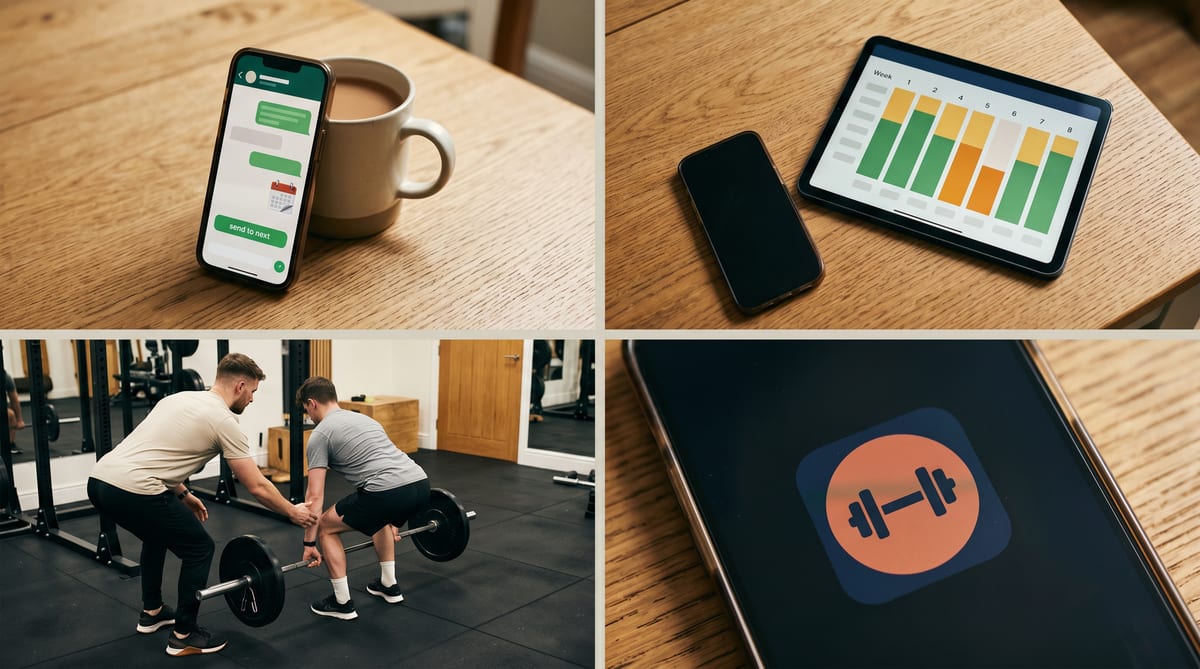
Example problems we could solve
Six things we hear most often from solo PTs and small PT studios - with what the solved version looks like in your week. Every build is scoped per coach or studio: a solo PT renting floor space probably needs the first three; a small studio with five trainers and an online-coaching arm might want all six.
1. Pack-based booking that knows when the sessions are about to run out
The session-11-after-a-10-pack moment: sold a 10-pack in January. By session 7 she’s booking weekly without thinking about it. Session 11 happens, nobody invoiced for it, awkward conversation in week 12 about whether sessions 9 and 10 actually happened or whether she’s already onto the next pack. The pack-renewal conversation is the moment of biggest revenue leakage in a PT business - most coaches lose 1-2 sessions per pack to the ambiguity, and the renewal prompt that would fire at session 8 of 10 never fires because nothing’s automating the ledger.
Solved looks like: the pack as a first-class object in your diary. Every session booked draws down from the pack ledger; at session 8 of 10 the client gets a friendly “two sessions left - want to renew? Same pack or shall we look at a 20-pack at a slightly better rate?” SMS with a one-tap Stripe link; at session 10 the auto-renew kicks in if she opted into it at sign-up. Late cancellations and no-shows charge or don’t charge per your policy - and the policy is stored alongside, so the conversation is “this is what we agreed at sign-up”, not “this is me improvising on a Tuesday”. The system handles the awkwardness so you don’t. For monthly-retainer-style coaching, the same engine handles the subscription side: GoCardless DD for the monthly fee, failed-DD recovery with a one-tap Instant Bank Pay restore, the structured renewal-conversation prompt at month 12 rather than the “oh, has it been a year already” surprise on month 14.
2. The branded coaching app, with online and in-person under one roof
The Trainerize-and-Stripe-and-website moment: Trainerize is fine for the workouts. Your website is fine for the bookings. Stripe is fine for the money. None of them are yours; your logo on the App Store would help a lot. Online clients open Trainerize for the workouts, your booking page for the diary, and a separate Stripe link for the payment; in-person clients have a different three-app shape. The one app, your brand answer doesn’t exist on the shelf for a coach who’s hybrid.
Solved looks like: an iOS-first (Android where it earns it) coaching app branded as you - your workout library, your check-in cadence, your booking diary, your payment status, your nutrition tracking, your in-app messaging. Online clients get the workouts and the check-ins; in-person clients get the diary and the pack drawdown; hybrid clients get both. The app store icon is yours, the splash is yours, the App Store listing is yours. Same iOS / Android stack we shipped for Storytimebaker - full mobile-app-plus-server build, scoped to a coach not a chain. The app sits on top of your existing tools (Trainerize for the workout-delivery layer where you like it, Stripe / GoCardless for the money, Cal.com-style booking surface for the diary) so you don’t lose what’s working - you just wrap them in your brand and your single sign-on.
3. The trained agent that qualifies enquiries while you’re with a client
DMs land on Instagram, TikTok, WhatsApp and email - same five questions every time, eating the slot you should be training in. The PT-specific weight is the ideal-client-profile qualification: the agent has to refuse the “I want to lose 20kg in 8 weeks” enquiry as politely as it takes the genuine prospect, because mis-qualified discovery calls cost you more in Tuesday-morning time than the missed ones do in unconverted revenue. A free agent on the wrong side of the qualification line is a coach burning forty-minute discovery calls on people who were never going to buy.
The full build: /solutions/trainable-inbound-ai-agent - trainable AI agent across Instagram, TikTok, WhatsApp, web chat and missed-call SMS. Referenced across 25+ verticals; the PT version’s distinct features are the ideal-client-profile-as-a-qualification-line (the agent qualifies serious enquiries against your written ICP - sustainable timeline, realistic budget, no contraindicated clinical-population factors - and politely deflects the rest), the scope-of-practice line (the agent doesn’t quote programmes for clients whose stated goals sit outside what your insurance covers and your registration permits), and the fifteen-minute discovery call booked before the prospect’s bounced rather than a forty-minute one wasted on the wrong fit.
4. PARQ + scope-of-practice as a workflow that protects you
The deadlift-after-physio-no moment: took on a new client. Didn’t refresh the PARQ. Six months later he tells you his physio said no deadlifts in June. You’ve been deadlifting for six months. The professional indemnity claim that lands a year later asks for the PARQ refresh that didn’t happen, the scope-of-practice notes that didn’t get updated, and the “why did the coach continue with a contraindicated exercise” answer that lives nowhere. The line between I’m a coach and I’m playing physio is the one your registration body cares about - REPs and CIMSPA both have written scope-of-practice limits - and the audit trail is what protects you when the boundary gets tested.
Solved looks like: PARQ + readiness questionnaire on the client’s phone before the first session - branching to flag clinical-population issues (pre/post-natal, over-50s, lower-back history, hypertension, cardiac history). Annual re-tick that auto-prompts. Per-client scope-of-practice notes (“doctor-cleared for resistance, no overhead loading, no deadlifts per physio June 2026”) visible to you in-session. Insurance evidence stored alongside (PT-professional-indemnity certificate currency, current first-aid, current safeguarding cert if any clients are under 18). REPs / CIMSPA registration evidence with renewal-chase nudges firing two weeks before lapse. The line between I’m a coach and I’m playing physio stays clearly on the coach side, and the audit trail says so when the question gets asked.
5. The transformation-programme check-in cadence with adherence-as-early-signal
The week-10-refund-email moment: twelve-week transformation, client goes quiet at week six, drops off at week eight, asks for a refund at week ten. You should have caught it at week six on the adherence signals - declining session attendance, two weeks since the last check-in photo, weight-tracking gone fortnightly when it was weekly, energy-rating answers trending down. You didn’t catch it because days-since-last-check-in wasn’t the right signal; the delta against her own pattern was, and nothing was tracking the delta.
Solved looks like: a check-in cadence per programme - weekly weigh-in / photo prompt, every-other-week measurement, a coach-side at-risk score that tracks adherence, response latency, and energy-rating answers. Adherence-frequency-delta (her weekly check-in dropping to fortnightly is the strongest early signal, not the days-since-last-photo threshold). When a client drops below threshold, you get a Monday-morning “these three clients need a phone call this week” digest on your phone. The client gets a softer, automated touchpoint first - “hey, two weeks since the last check-in - everything alright?” in your voice, not a transactional template. By the time the refund email lands, you’ve either rescued the relationship or you’ve already had the harder conversation on your terms in week six rather than the unwinnable one in week ten. The pattern is the structural cousin of the gym-side lapsed-member cadence tilted from membership-churn to programme-adherence - same signal-delta-not-threshold logic.
6. Floor rent, in-house cut, and the bookkeeping the gym manager won’t help with
The Sunday-evening-three-systems moment: you pay floor rent to the gym. They take a cut of any in-house clients they book through them. Stripe takes their fee on card payments and GoCardless takes theirs on the monthly retainers. HMRC wants the rest. Sunday reconciliation is half the night across three systems and a partner-tracking sheet that’s two months behind. Self-assessment in January is a forensic-archaeology weekend.
Solved looks like: a thin bookkeeping layer on top of Stripe + GoCardless + your gym’s monthly statement - every session tagged in-house vs external, every payment net of card fees and rent, every month a one-tap export to Xero / FreeAgent / QuickBooks. Where your gym uses a partner-tracking sheet, we map to it; where they don’t, the export goes to your accountant in the format they prefer. CIS reverse-charge if you’re sub-contracting any sessions; VAT-registered handling if you’re over threshold and on the flat-rate scheme. Bookkeeping stops being the Sunday-night problem and becomes a Tuesday-morning glance at a dashboard. Self-assessment in January is a single export, not a weekend.

The closest things we’ve already built
- Iron Institute24/7 independent gym we’re mid-build on. The diary, access, billing and member-app patterns are the heavier sibling of the PT spoke; the moving parts overlap substantially - the diary engine that drives a 24/7 gym’s class-booking is the same engine that drives a PT studio’s pack-based booking, with the multi-tenancy mode tuned to coach-roster rather than member-base. (Named pull-quote and final outcome figures hold until the permission checklist clears - full case study at /case-studies/iron-institute.)
- Storytimebakerour consumer iOS / Android app + backend. Proof we ship a full mobile stack from a client’s brand - the closest reference for the branded coaching app in problem 2. Built end-to-end as a brand-led app, not a vendor-built skin. See /case-studies/storytimebaker.
- mendbuddyour own multi-channel AI agent platform powering the inbound-qualification flow in problem 3. SMS + WhatsApp + Facebook DM + Instagram + web chat + inbound + outbound voice. Trained on your ICP, your scope-of-practice line, and your discovery-call script. See /case-studies/mendbuddy.
A named personal-trainer case study is not yet in the portfolio. When one lands and clears the permission checklist, it gets added here.
FAQ
Will this replace Trainerize / TrueCoach / PT Distinction / TeamBuildr?
For online coaching, often it lives alongside. Trainerize is good at the workout-delivery layer; what’s missing is the coach-side qualification, the branded app the App Store sees, the pack-drawdown ledger that knows when the sessions are running out, the cross-channel agent that triages the 21:00 Sunday DM. We sit on top and replace what doesn’t fit. The point is your data, your brand - when the build is done, the App Store listing reads your name, not the vendor’s.
I’m a solo PT renting floor space - is this overkill?
The solo build is leaner - usually the pack-drawdown booking, the qualification agent, and the bookkeeping layer. The branded app comes in when you’re at the point of building a roster around you. We scope to where you are now, with the build shape that can grow with you. A solo PT with 30 active clients on packs doesn’t need a £20k app build; she needs the pack ledger and the qualification agent live in a few weeks.
Will you build me a website too?
Yes - bespoke PT websites are a familiar shape. The site and the back-end share a single source of truth so your service pages, your booking surface, your pricing, your testimonials and your case studies all stay in sync without you copy-pasting. The same studio that runs the back-end runs the front; when the booking flow changes, the website’s booking page changes with it.
My PT studio rents to four other coaches. Can the system handle multiple coaches?
Yes - the roster is a first-class object. Each coach has their own diary, pack ledger, content library, and payout split; the studio sees aggregate numbers; clients see only their coach. Same engine, different multi-tenancy mode. The payout-split-after-floor-rent-and-card-fees is the bookkeeping layer in problem 6, scaled up to handle the studio-to-coach split alongside the gym-to-studio rent.
What about REPs / CIMSPA + insurance + first-aid renewal chasing?
All structured. Coach-side registration (REPs Level 2 / 3 / 4, CIMSPA Practitioner / Advanced Practitioner / Specialist) is a structured record with renewal-chase nudges firing two weeks before lapse. Same shape for professional indemnity, public liability, current first-aid, safeguarding cert (where any clients are under 18). The renewal calendar lives in one place; the lapse never happens by surprise.
Will the qualification agent reject the wrong prospect convincingly?
The agent is trained on your written ICP - sustainable timeline, realistic budget, no contraindicated clinical-population factors, no scope-of-practice red flags. The “lose 20kg in 8 weeks” enquiry gets a polite “I’m not the right fit for that timeline, here’s why, here’s what a sustainable equivalent looks like” reply rather than a forty-minute discovery call that was never going to convert. The genuine “I’d like to start training, I’ve not done resistance work before, I’ve got a knee history my GP knows about” enquiry gets the discovery call booked into your fifteen-minute window. The line between helpful triage and committing the coach to a programme she shouldn’t take on stays clearly on the human side.
What does it cost?
Every build is scoped per coach or studio - depends on roster size, whether the branded app is in scope, what bookkeeping integration you need, whether the qualification agent is multi-channel or single-channel. Solo PT scopes start smaller than studio scopes. See pricing for how we work.
How long until something’s live?
The pack-booking and qualification agent can be live in a few weeks. The branded app is its own scope - typically a few months of build plus App Store review. The bookkeeping layer goes live faster than either if you’ve already got Stripe + Xero or similar wired up. The PARQ + scope-of-practice workflow slots in alongside the pack-booking without its own separate build cycle.
Up to the hub
← UK independent gyms (main page) · Hospitality (sibling vertical) → · Device repair (sibling vertical) →
Tell us about your roster
How many clients, what packs you sell, how much is online vs in-person, what venues you train out of, what your current qualification line looks like, where the Sunday-evening rebooking thread sits. Send an enquiry - we’ll sketch what we’d build and what it would cost. No calendar widget, no demo to sit through. Email reply, scoped sketch, you decide.