


Software for UK independent hospitality
Wedding enquiry at ten on a Saturday night. By Sunday lunchtime they’d toured two competitors and we never made the shortlist.
You’re the owner-operator of a gastropub-with-rooms in a market town, or the events manager at a country-house wedding venue, or the front-of-house at a sixty-cover restaurant that does eight weddings a year, or the husband-and-wife team behind a four-room B&B above a tea shop. Saturday evening the wedding enquiry comes in via the website - a real one, a bride whose Pinterest screenshots came with it. You’re plating up. Sunday lunchtime you open the laptop and reply - and the bride who got a reply at 22:15 from your competitor is already booked in for a Tuesday tour and you never make her shortlist. Eleven covers no-showed at the pub at the same time; the kitchen prepped for sixty and served forty-three; the rota cost was thirty-eight per cent of revenue against a wet Saturday’s reality. The Booking.com calendar said four rooms left and Expedia said six and you had two; the channel manager will sort it tomorrow, probably. The Sunday afternoon reconciliation across three card terminals is your other Sunday afternoon. Allergen reconfirmation for the coeliac wife at table 14 turns into a server running to the kitchen mid-rush. A Trustpilot one-star lands at 8am after a card-machine drama on Saturday night and you don’t know whether to reply.
We make custom software for UK independent hospitality operators - scoped per venue, sized to the bit between enquiry came in on Saturday night and deposit cleared, run-of-show signed, covers filled, allergen reconfirmation lodged, reviews coming in clean, OTA inventory in sync, the Sunday reconciliation already done. Not a SevenRooms / OpenTable / ResDiary / Mews / eviivo / Cloudbeds replacement - they handle the booking and PMS layer for what they’re for. Not a Square / Zettle / Dojo / Lightspeed / Tevalis replacement - the till sits where it sits. The bit between the best-in-class tools - the midnight first-reply that wins the £6,000 wedding booking, the waitlist muscle that fills the eleven Saturday no-shows, the channel-sync monitor that catches the OTA drift before two angry guests arrive in the carpark, the allergen reconfirmation thread that’s a first-class step under Natasha’s Law instead of a server’s memory, the review-triage that turns Sunday-morning panic into a Monday response on your terms - that’s the bit we build. Tell us what your venue’s week looks like and we’ll come back with a sketch.
What you spend your week on that you shouldn’t have to
- A Saturday-evening wedding enquiry that needs a reply inside fifteen minutes if you want a tour booked - and Sunday-lunchtime is too late, because the bride who got the 22:15 reply has toured the competition by Tuesday.
- A Saturday-lunch run that’s eleven no-shows by 9pm - the kitchen prepped for sixty, the rota costed against the no-show, and a waitlist of three people who’d kill for the table that never got the call-up.
- A wedding deposit ladder - 50% on signing, 25% at six months, balance fourteen days before - that lives in your head and your bookkeeper’s hopes, and a snag of a stage payment that gets quietly forgotten until the eight-weeks-out cancellation.
- Booking.com / Expedia / Airbnb sync drift on a bank holiday Friday - the OTA channel manager says four rooms left, your direct site says six, the eviivo dashboard hasn’t reconciled - and two angry guests are waiting in the carpark.
- A run-of-show pack for a Saturday wedding - florist, cake, band, photographer, ceremony, breakfast, speeches, first dance - that exists as a Google Doc, a printed PDF, and three contradictory WhatsApps from the bride.
- Three card terminals on three sites, three daily reconciliations into Xero or QuickBooks, the 2024 Allocation of Tips Act tronc policy that needs written policy alongside the calculation, and a Sunday-afternoon spreadsheet for the variance you can’t quite explain.
- An allergen question at table 14 mid-rush - a server running to the kitchen, a coeliac wife with thinner patience than the kitchen has time, and a Natasha’s Law allergen labelling trail that’s currently a Post-it on the prep fridge.
- A Trustpilot one-star at 08:15 Sunday morning after a card-machine drama on Saturday night - three months of clean fives eclipsed by one bad night, and a response template you don’t trust.
- A Mother’s Day / summer-wedding-season / Christmas-party / Burns Night / NYE content cadence that’s five Instagram posts you’ve been meaning to write all month while your competitor down the road posts twice a day.
- A Premises Licence designated premises supervisor change you haven’t notified to the local authority, a 5-rated food hygiene last September that’s due a re-inspection, public liability evidence three months out from renewal - the regulatory wallpaper that nobody’s calendar owns until something goes wrong.
These aren’t problems for ResDiary alone, or Mews alone, or Square alone, or your eviivo channel manager alone - they’re the bit between the best-in-class tools. That’s the bit we build.
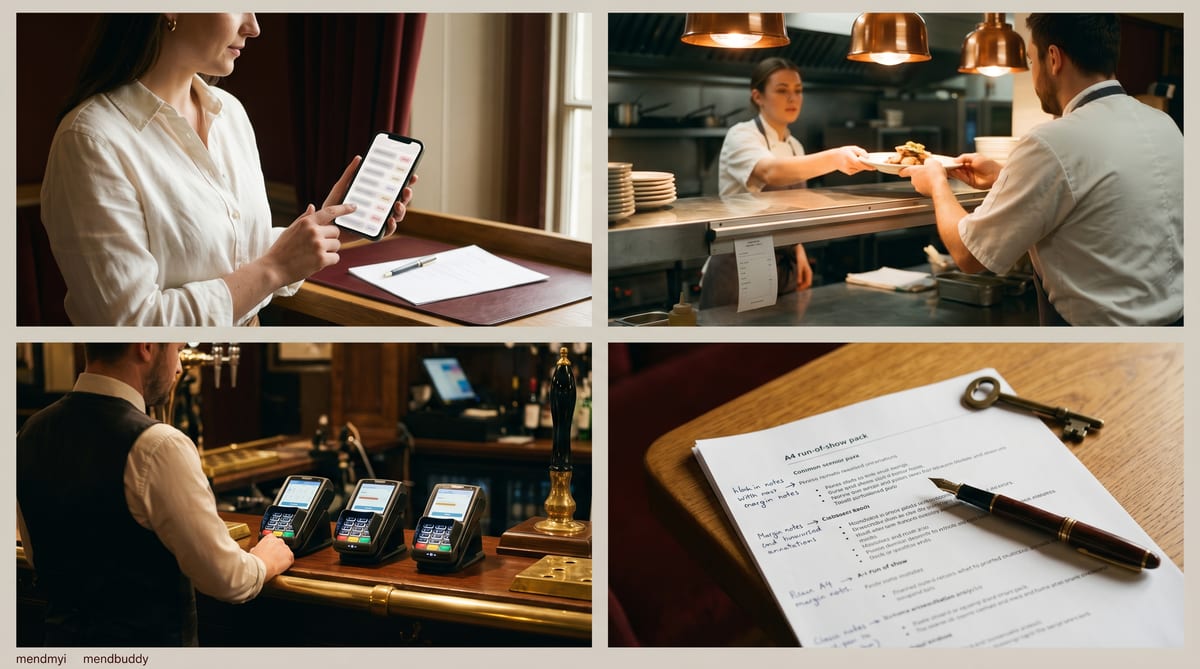
Example problems we could solve
Six things we hear most often from hospitality operators - with what the solved version looks like in your week. Three are universal across the trade (the midnight first-reply, the waitlist muscle, the multi-channel comms thread); three are sub-segment-specific where the venue / restaurant / B&B mode genuinely earns the slot. Every build is scoped per operator: a four-room B&B above a tea shop probably needs the first two; a country-house wedding venue with twenty weddings a year and ten function lunches alongside might want all six. None of it means binning ResDiary / OpenTable / SevenRooms / Mews / eviivo / Cloudbeds where they’re working.
1. The midnight DM that wins the £6,000 wedding before breakfast
The 22:15-Saturday moment: the wedding enquiry comes in Saturday at 22:15 - a real bride, four other venues messaged at the same time, the Hitched portal feed and the form on your site and a Facebook DM all landing within the same fifteen-minute window. By Sunday lunchtime when you open the laptop she’s already had a reply from one competitor at 22:38 (“date’s available, can we book you in for a tour Tuesday at 14:00 or Wednesday at 18:00?”), toured them Tuesday, and you never make her shortlist. In venue-led wedding work the first-reply auction is brutal - the venue that replies first with date-available + next-two-tour-slots is the venue that books, and the £6,000 booking has gone before the laptop’s open. Sub-15-min first-reply is THE differentiator against the multi-day chase cadence most trades run on. This isn’t a nice-to-have responsiveness signal - it’s the difference between booking the wedding and getting the “thanks for getting back to me, we’ve already toured somewhere else” on Monday morning.
Solved looks like: every inbound enquiry - Hitched / Bridebook / DesignMyNight portal feed, your direct site enquiry form, Facebook DM, Instagram DM, missed-call SMS, the WhatsApp number on the brochure - lands on a unified agent surface that acknowledges within sixty seconds in your venue’s voice. The agent is trained on your brochure, your tour-slot rules, your date-availability calendar, your wedding minimums, your in-house catering options, and your venue manager’s actual phrasing - so the 22:38 reply reads like Sarah-the-events-manager wrote it, not a sales template. The cascade runs: 22:38 acknowledge with date-confirmed + next two tour slots → 11:00 Sunday morning warmer follow-up if no response → fortnight-of-light-nudges for the brides who said “need to think” → tour booking auto-pulls deposit-ladder paperwork once the slot lands. Tour-booked, brochure auto-sent, then the agent quietly hands off to a human for the actual quote. The longer version lives at Trainable Inbound AI Agent; the hospitality version’s anchor is the first-reply-wins-the-£6,000-booking pattern, with the venue’s tour-script and tour-slot calendar wired in from day one.
2. Cover-yield recovery - the waitlist that actually fills the no-show seats
The Saturday-eleven-no-shows moment: Saturday 60 covers booked, eleven no-shows by 9pm. The kitchen prepped for sixty, the rota costed against the no-show that didn’t happen, three people on the waitlist would have killed for the table - and the waitlist on ResDiary or OpenTable sits as a backup CRM list nobody actually calls. By close-of-business you’ve served forty-three covers, the food cost on the prep that didn’t sell is on the books, and the waitlisters who didn’t get the slot have gone elsewhere and won’t come back. Cover-yield recovery is the single highest-ROI bit of restaurant + gastropub operations, and it’s the one nobody’s automated because “the waitlist will call themselves” is the lie everyone tells themselves on a Tuesday.
Solved looks like: the waitlist becomes a live time-sensitive queue, not a CRM list. Booking made → 48h + 24h reminder cascade on the channel the diner chose (SMS by default, WhatsApp where she’s opted in). No-show window opens thirty minutes before the slot; if the seat doesn’t fill organically, the first person on the waitlist gets an SMS or WhatsApp with a 90-second response window - “the 19:30 four-top is open, reply YES to grab it, otherwise we’ll pass to the next” - and the cascade walks through the queue until the slot fills or the kitchen closes. Card-on-file no-show fees per your policy where you’ve opted in, with the policy stored alongside the booking so the conversation is on a paper trail and not a Trustpilot war. ResDiary / OpenTable / SevenRooms stays the booking surface; we add the muscle that fills the seats. The same engine works for the gastropub’s Wednesday-quiz waitlist, the wedding venue’s tour-slot waitlist, and the small hotel’s function-room dry-hire enquiry pipeline.
3. The booking-and-comms loop with allergen reconfirmation as a first-class step
The Natasha’s-Law-mid-rush moment: email enquiry Tuesday for Saturday dinner; voicemail on the pub phone Wednesday; WhatsApp on the venue mobile Thursday - none of it in OpenTable. At the booking-confirmation step a coeliac wife discloses the allergy in the WhatsApp thread and it lands nowhere. Saturday she sits down, the server takes the order, runs to the kitchen, the kitchen’s mid-rush, and the allergen reconfirmation - the thing Natasha’s Law was written to make non-optional - happens verbally between a server and a sous-chef while the wife’s patience runs out. Natasha’s Law + the 2024 PPDS labelling regime put the legal weight on traceable allergen reconfirmation, and the booking-confirmation thread is the moment that traceability should be locked in - not on a Post-it on the prep fridge.
Solved looks like: the booking-to-review cascade sitting in front of ResDiary / OpenTable / SevenRooms / your direct widget. 48h + 24h reminder, with the do any of you have allergies we should know about? step structured rather than free-text so the kitchen sees “coeliac wife, table 14, no shared fryer for the chips” before service. Arrival-day allergen-reconfirmation prompt to both the kitchen and the table at the same time - server gets the structured note on the till; the diner gets a friendly “we’ve got your allergen note for table 14, here’s how we’re handling it” at sit-down. Post-departure ninety-minute review prompt routed to Google or TripAdvisor with negative-sentiment intercept - anything below a four routes back to the venue manager privately before it lands public. The hospitality-specific moment: the cascade treats allergens as part of the booking object, not a server’s memory. The longer version lives at Booking & Review Loop.
4. The wedding deposit ladder that doesn’t end in lawyer letters
The eight-weeks-out-pull moment: £20k wedding booked twelve months out, £4k deposit on signing, £5k at six months, balance fourteen days before. Eight weeks out the family rings - family reasons, can we have the deposit back - your contract says non-refundable, your lawyer says you’re right, the family stages a one-star Google campaign and the £5k second stage is unpaid and lawyered. By the time the venue’s empty on the Saturday the wedding was meant to happen, you’re down the £14k revenue and the £8k cost of holding the date and the £900 in legal fees you didn’t budget for.
Solved looks like: the stage-payment ladder as a first-class object alongside the contract. Deposit on signing fires an automatic Stripe / GoCardless link; second stage at six months fires automatically with a fourteen-days-before reminder, a softer seven-days-before nudge, and a phone-task to the venue manager if neither moves; balance fourteen days before fires with photo-evidence of the venue setup so the family see what they’ve paid for. Cancellation and refund wording is built into the contract template - Consumer Contracts Regulations 2013, statutory cooling-off, force-majeure clauses for the Hidden-Burnley-style 2020 territory we all hope not to revisit - so the conversation when it happens is on a paper trail. Your lawyer becomes a fallback rather than a default. The same engine handles the corporate function-room dry-hire deposit, the festive-party-night chasing, and the catering-only event deposit for the hotel function suite.
5. Multi-POS reconciliation + OTA inventory monitor - ending the Sunday afternoon
The Sunday-afternoon-three-tabs moment: three card terminals across two sites, three daily reconciliations into Xero, the 2024 Allocation of Tips Act tronc policy that needs written policy alongside the calculation and a fair-distribution audit log per pay run. Sunday afternoon - the Dojo total says £4,840, the bank statement says £4,712, the tip jar in the till is anyone’s guess. For B&B and small-hotel operators the same Sunday-afternoon overlap is OTA inventory - Booking.com says four rooms left, Expedia says six, the eviivo channel manager hasn’t sync’d since Friday, and a bank holiday weekend’s about to land with two angry guests in the carpark and no available room.
Solved looks like: a reconciliation layer that pulls Square + Zettle + Dojo + EPOS Now + Lightspeed + Tevalis daily, runs them against your Xero or QuickBooks rules, calculates the tronc / tip pool under the 2024 Allocation of Tips Act with the written policy stored alongside the calculation, flags variances before close-of-business, and assembles supplier-statement reconciliation against Brakes / Bidfood / Adnams / your local butcher. Multi-site rolls up into a group view - covers, revenue, labour percent, reviews, food-cost-on-prep-that-didn’t-sell - on one dashboard for the operator who’s tired of being the IT department. For B&B and hotel operators, the OTA inventory monitor sits alongside: Booking.com vs Expedia vs Airbnb vs your direct site vs your PMS, sync’d every fifteen minutes, with a “channel drift detected” flag and a one-tap rebalance before SiteMinder slip becomes an overbooking on a bank holiday Friday. By Monday morning your accountant has the day done; by Saturday morning the carpark conversation never happens.
6. Review triage and the regulatory-wallpaper calendar that nobody opens
The 08:15-Sunday-one-star moment: Sunday morning, 08:15, Trustpilot one-star drops after a card-machine drama on Saturday’s eight-way split for the Hen-do at table 22. Three months of clean fives eclipsed. The response you draft at 09:00 reads as defensive even to you; the one you draft at 14:00 reads as too late. Underneath, the regulatory wallpaper is the slower attrition - Premises Licence designated-premises-supervisor change you haven’t notified to the local authority, food hygiene rating last inspected September 2024 due a re-inspection, allergen labelling under Natasha’s Law that’s a Post-it on the prep fridge rather than a structured record, public liability evidence three months from lapse, and the PPL PRS music licence renewal that nobody owns until the licensing officer turns up.
Solved looks like: an incoming-review monitor across Google, Trustpilot, TripAdvisor, Yelp, and the OTA-side review streams. Sentiment-tagged, manager-routed, draft-response template that respects your tone of voice - sent only when you approve, not auto-fired. For positives, a one-tap thanks. For negatives, the system pulls the matching booking from your PMS or POS so you can identify which eight-way split, decide whether soft outreach is warranted, and respond from a position of context rather than panic. Saturday-night incident → Monday-morning response on your terms, not Sunday morning on theirs. Alongside it, the regulatory-wallpaper calendar that the venue manager actually opens - Premises Licence DPS-change notifications, food hygiene re-inspection windows, Natasha’s Law allergen-labelling refresh per menu change, allergen-training annual refresh per staff member, public liability + employers’ liability + buildings cover renewal calendar, PPL PRS renewal, fire-risk-assessment refresh under the Fire Safety Order, TEN (Temporary Event Notice) deadlines for one-off out-of-licence events. The compliance evidence assembles itself per renewal date; the venue manager opens it once a week, not once a year when the licensing officer rings.
The closest things we’ve already built
- A private-hire event venue we’ve built end-to-end - the public site, the inbound enquiry pipeline, the tour-to-deposit funnel, the run-of-show portal. The fifteen-minute enquiry pipeline in problem 1 is the conversion-driving offer the venue runs today. The closest reference for any UK venue (wedding, event, private-hire) that wants the website and the back-office pipeline built by the same studio.
- mendbuddy - our own multi-channel AI agent platform behind the fifteen-minute first-reply pattern. SMS + WhatsApp + Facebook DM + Instagram + web chat + inbound + outbound voice. Trained on your venue’s brochure, your tour-script, your wedding minimums, and your venue manager’s actual voice. The midnight DM in problem 1 and the booking-comms loop in problem 3 are hospitality-shaped versions of this. See Mendbuddy.
- planpost - our own social-media scheduling SaaS. Used as the layer behind seasonal hospitality content cadences (Mother’s Day, summer-wedding season, Christmas-party season, Burns Night, NYE, a quiet Tuesday-in-February campaign that always works). AI-drafted posts you approve on your phone in sixty seconds, scheduled to Instagram + Facebook + Google Business Profile + TikTok where it earns its place. See Planpost.
If your week’s narrower than the whole of the above
One sub-audience whose week looks different enough that it has its own page:
- Wedding and private-hire event venues → - if your business is mostly weddings and private-hire events on twelve-to-eighteen-month lead times with £8k-£40k tickets, the run-of-show portal, the preferred-supplier audit layer, the stage-payment ladder and the Approved-Premises-civil-ceremony paperwork move to the front. The studio’s end-to-end venue build is the direct anchor for this shape.
Restaurants, gastropubs, B&Bs, small hotels, and micro-event / supper-club operators share most of the hub above; the cover-yield / OTA-sync / multi-POS / Natasha’s Law allergen layer covers ninety per cent of what differs between them. We scope the rest in the discovery conversation.
Adjacent verticals
- Wedding suppliersthe other side of every wedding-venue conversation. Photographers, florists, cake makers, bands. The same first-reply-wins pattern, the same supplier-relationship economics - useful sibling read if you run a venue with a preferred-supplier list.
- Gym & fitnessthe same waitlist + no-show + class-reminder pattern lives behind the gym build; cross-pollination on the same inbound stack. The gym-side at-risk-member detection is the structural cousin of the hospitality lapsed-customer cadence.
- Pet servicesboarding intake and recurring-service ledgers share the operational backbone of the booking-and-review loop, with the same multi-stakeholder thread (owner / vet / boarding facility).
- Holiday letsthe OTA-sync monitor and the channel-manager reconciliation that sits inside the B&B / small-hotel side of this page is the whole job for a holiday-let operator. If your business is mostly holiday lets with the occasional restaurant cover, that’s the better page.
FAQ
Will this replace ResDiary / OpenTable / SevenRooms / Mews / eviivo / Cloudbeds / Square / Dojo?
Usually no, where they’re working. We sit on top and replace the bit between them - the enquiry pipeline, the waitlist muscle, the channel-sync monitor, the multi-POS reconciliation, the allergen-reconfirmation thread, the review-triage layer, the regulatory calendar. If your booking layer is fine in ResDiary and your PMS is fine in Mews, we don’t ask you to migrate. The point is your data, your stack - when the build is done, it sits in your accounts, not in a vendor’s per-cover-per-month creep.
Can you handle the 2024 Allocation of Tips Act tronc rules?
Yes. Written policy stored alongside the tronc calculation, fair-distribution rules respected, audit log per pay run. Service charge vs tip handling distinct per the Act’s tests; agency-staff and direct-employee distributions handled separately. Your accountant gets the data in the shape they need, and the written-policy requirement is met as a side-effect of running payroll through the system rather than a yearly compliance scramble.
Does the allergen-reconfirmation layer meet Natasha’s Law and the 2024 PPDS labelling regime?
The audit trail (booking-side allergen disclosure, kitchen-side reconfirmation at sit-down, table-side acknowledgement) is the evidence layer an Environmental Health Officer or a coroner’s inquest would ask for. PPDS labelling for pre-packed-for-direct-sale items renders against the structured allergen field per menu line, so the label that goes on the wrap matches the database that drives the reconfirmation flow. Accountability for the food itself stays with the head chef and the proprietor; what the system does is make the trail assemble itself.
Do you do calendar widgets / “book a tour” / “book a call” on the marketing site?
For your venue’s customers, yes - that’s the whole point of problems 1 and 2. For prospects coming to us (mmitech.co.uk) for a build, no - we run enquiry-form only on our own site. Different surfaces, different patterns; we’re not in the book a demo business for our own work.
My wedding deposit policy lives in my head. Can the system handle the staged-payment ladder?
Yes. 50% on signing, 25% at six months, balance fourteen days before is the default template - tuned to whatever your contract says. Statutory wording on cancellation rights is built into the contract template so you’re not improvising it; cancellation conversations land on a paper trail, with your lawyer as a fallback rather than a default.
What about the Premises Licence + DPS change + TEN deadlines + food hygiene re-inspection schedule?
The regulatory-wallpaper calendar in problem 6 lives as a structured operational layer alongside the day-to-day. Renewal dates for every licence and every supervisor’s qualification live on the same calendar - so the “have we still got the Premises Licence DPS notification in” question never blocks a one-off event again. Accountability for each licence stays with the named licence-holder; what the system does is make the deadlines explicit before they become a licensing-officer phone call.
What does it cost?
Every build is scoped per operator - depends on number of sites, which booking / PMS / POS layer you’re on, whether the wedding pipeline or just the cover-yield layer is in scope, whether the OTA-sync monitor is needed. Sized to your business; we agree the scope and the price in writing, then build. See pricing for how we work.
How long until something’s live?
The enquiry pipeline can be live in a few weeks - that’s the conversion-driving offer and the fastest payback. The waitlist + allergen-reconfirmation layer ships alongside in the same window. The multi-POS reconciliation and the OTA-sync monitor typically run a little longer because the integrations take longer to wire than the SMS flows. The review-triage layer and the regulatory calendar slot in alongside without their own separate build cycle.
My B&B is two rooms above a tea shop - is this overkill?
The B&B scope is leaner - usually the OTA-sync monitor and the review-triage layer, plus the enquiry pipeline if you take wedding lunches or function bookings. A small hotel with twelve rooms and a function suite gets all six. We scope to where you are.

Tell us what your week looks like
Send an enquiry - what kind of venue (restaurant / gastropub / wet-led pub / B&B / small hotel / country-house wedding venue / private-hire / micro-event / supper-club), what booking and PMS layer you’re on, what tonight’s no-show count looks like, what the wedding pipeline looks like, where the OTA sync is drifting, what the regulatory calendar is missing. We’ll come back with a sketch of what we’d build and what it would cost. No calendar widget, no demo to sit through. Email reply, scoped sketch, you decide.