


Software for UK device-repair shops
It’s 11am Tuesday and the same customer’s rung four times to ask if his iPhone screen is ready. The drawer marked “iPhone X screens” doesn’t contain any. RepairDesk costs ninety quid a month in dollars and thinks Haverhill is in New Hampshire.
You’re the owner of a phone-only walk-in on a market-town high street, or the principal of a phone-plus-computer hybrid with two techs and a back-room refurb pile, or the husband-and-wife running an Apple-only specialist alongside a mobile / on-site repair van, or the manager of a two-site chain that does board-level work on the side. Tuesday morning the same customer’s rung four times. The Mobile Sentrix order that’s been out for delivery for a week has the customer convinced you’ve stolen his device. An iPhone brought in for repair has Activation Lock you didn’t spot until the tech wasted thirty minutes on it. The drawer marked iPhone X screens contains an iPhone XR screen, two iPhone 11s, and a Galaxy A52. The refurb 11 in the back-room is worth more than your stock list says - the only person who knows what’s in it is the tech who’s on holiday. The same five questions land on Facebook Marketplace, on WhatsApp Business, on Instagram DM, on the missed-call SMS - do you do iPhone screens, how much, how long, do I need an appointment, do you take Apple Pay. RepairShopr’s price keeps inching up; the integrations are getting worse.
We make custom software for UK device-repair shops - scoped per shop, sized to the bit between drop-off and paid, picked up, reviewed. We run a repair shop. mendmyi is the founder’s own UK shop; repairminder is the SaaS we wrote to run it; mendbuddy is the agent answering the Marketplace DMs while the tech’s head-down on a logic board. Not a Square / SumUp / Stripe Terminal / Zettle replacement - the counter sits where it sits. Not an Activation Lock / IMEI lookup vendor replacement - the paid lookup APIs work where they work. The bit between the counter and the bench and the back-room refurb pile - the status-SMS that stops the is-it-ready calls before they start, the deposit gate on the £180 OLED before the customer ghosts, the Activation Lock check at intake before the tech wastes thirty minutes, the parts drawer that knows what’s actually in it, the trained agent that handles the price-question DMs, the refurb pile that lists itself across eBay / Back Market / Marketplace - that’s the bit we build. Tell us what your shop looks like and we’ll come back with a sketch.
What you spend your week on that you shouldn’t have to
- The same customer ringing four times before lunch to ask if his iPhone screen is ready, on a Tuesday you hadn’t even taken the back off - multiply by twenty drop-offs a week and your tech’s losing forty minutes a day to the is-it-ready call before he’s touched a screwdriver.
- A £180 OLED ordered for a customer who took the diagnostic and ghosted before you knew the part had arrived - the bloke over the road did the same screen for £55 and you’re a couple of hundred quid down because you’d already paid Mobile Sentrix.
- An iPhone brought in “no Apple ID, said it was hers” - Activation Lock says otherwise. Thirty minutes of bench time wasted, a customer the police might want to know about, and the audit trail’s a Post-it on the till.
- Three drawers labelled iPhone X screens and none of them contain iPhone X screens - year-end stocktake is a Friday night you’ll never get back, and the £90,000 VAT threshold is invisible until your accountant emails you in February.
- A Mobile Sentrix / Mobile Defenders / Witrigs / MMobile / iFixit Pro order that’s been out for delivery for a week - the customer thinks you’ve nicked the device, the tech can’t progress the ticket, and you’re refunding fifteen quid in goodwill before anyone’s apologised properly.
- A water-damage diagnostic dispute that cost you a one-star Google review on a £40 transaction - the T&Cs you tried to put in front of her at intake are buried in a PDF on the shop laptop nobody’s looked at since 2024.
- The refurb pile in the back-room is worth more than your stock list says - there’s a refurb 11 that’d sell tomorrow if you could remember to list it, and the only person who knows what’s in the cabinet is the tech who’s on holiday until Tuesday.
- The same five questions every week on Facebook Marketplace, WhatsApp Business, Instagram DM, and the missed-call SMS - same answers, four platforms, two hundred messages, none of it converting to a quote because you’re typing the same paragraph at 9pm.
- A RepairShopr / RepairDesk / RepairQ / MyGadgetRepairs / CellSmart POS subscription that keeps inching up while the integrations get worse - the US-shaped tax model thinks Haverhill is in New Hampshire and the bookkeeping export doesn’t tag parts COGS by supplier.
- An Apple Independent Repair Provider audit, a WEEE disposal contract, an ICO registration, a National Mobile Phone Crime Unit-watched IMEI register that needs to exist before the police visit - the regulatory wallpaper that nobody’s calendar owns until something goes wrong.
These aren’t problems an off-the-shelf US repair-shop tool is going to solve. They’re the bit between device on bench and cash in till, customer happy, Google review live. That’s the bit we build - for ourselves, and for any UK repair shop that wants the same shape.
Example problems we could solve
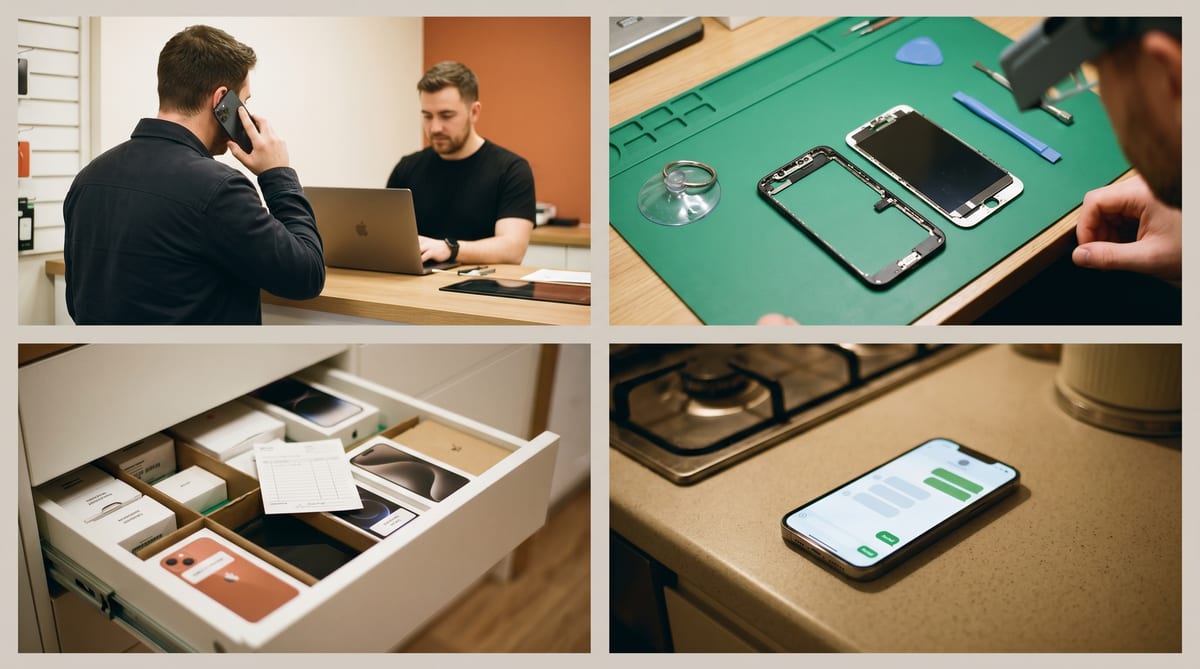
Six things we hear most often from UK device-repair shops - with what the solved version looks like in your week. Three are universal across the trade (the status-SMS cascade, the deposit-gated quote, the trained inbound agent); three are sub-segment-specific where the Activation Lock workflow, the parts drawer, or the refurb resale bridge genuinely earns its place. Every build is scoped per shop: a single-tech walk-in probably needs the first three; a phone-plus-computer hybrid with serious refurb volume might want all six. None of it means binning RepairDesk / RepairShopr / RepairQ on day one - most shops subscribe to repairminder as the direct replacement, and we layer the bespoke bits on top where the bespoke earns it.
1. The status-SMS cascade that stops the is-it-ready calls before they happen
The four-calls-before-lunch moment: same customer, same iPhone screen, four calls before midday - and you hadn’t taken the back off because the tech was on a water-damage diagnostic that ran an hour over. The device-repair-specific weight is that is-it-ready is the single highest-volume FAQ in any service-counter business; left alone it scales linearly with ticket count, and a shop doing twenty drop-offs a week is losing the equivalent of a half-day of bench time to the question alone. The customer isn’t being difficult - she’s anxious about being without her phone and there’s no signal in the absence of one.
The full build: Booking & Review Loop - the ticket-status SMS cascade (received → diagnosed → quoted → parts-ordered → on-the-bench → ready-for-collection) with the ninety-minute post-collection Google review prompt. Runs natively in repairminder today, in production at mendmyi. Referenced across fourteen verticals; the device-repair version’s vertical-distinct features are the parts-arrival auto-update (the moment Mobile Sentrix’s tracking flips, the customer knows before she rings), the on-the-bench status that triggers the moment the tech opens the device, and the ready-for-collection SMS that doesn’t fire until the QC photo’s logged so the customer doesn’t drive twenty minutes for a phone that isn’t actually finished.
2. Quote with one-tap accept and a deposit-gate on parts over £X
The £180-OLED-ghost moment: quoted £85 for a 12 Pro screen, customer said “I’ll think about it”, you ordered the OLED on a hunch because the supplier was about to close for stock-take. She never came back. The bloke over the road did the same screen for £55 because his supplier had a clearance batch you didn’t see. You’re £180 down on a part that’ll sit in the drawer until the next 12 Pro walks in. The device-repair-specific weight is that the configurable deposit threshold - parts above £100 (or whatever you set per category) require a one-tap deposit before the part-order fires - is what turns a ghosting risk into a held commitment, without making the £35 walk-in screen feel friction-y.
The full build: Quote & Chase Ladder - every quote becomes a tracked object with a nudge ladder on top. Referenced across fourteen verticals; the device-repair version’s vertical-distinct features are the threshold-deposit gate (configurable per part category, integrated with your Square / SumUp / Stripe Terminal / Zettle so the customer pays once and the deposit credits against the final invoice), the +24h and +72h fast-cadence nudges tuned to the customer-rang-three-shops decision window (decisions in device repair happen inside a 72-hour window or they don’t happen at all), and the “the part’s arrived, here’s when we can fit you in” auto-conversion the moment the supplier’s tracking flips.
3. The trained agent that handles the inbound DMs across all four channels
The same-five-questions-on-four-platforms moment: Facebook Marketplace at 9pm, WhatsApp Business at 10:30, Instagram DM at midnight, missed-call SMS in the morning - do you do iPhone screens, how much, how long, do I need an appointment, do you take Apple Pay. You’ve answered them a hundred times. The device-repair-specific weight is that roughly 40% of inbound on a busy shop is price questions, not quote requests - the agent’s trained on your own live pricing sheet (the one you actually update, not a brochure PDF from 2024) plus the IMEI / Activation Lock context your bench needs before any genuine diagnosis enquiry gets a human reply.
The full build: Trainable Inbound AI Agent - multi-channel AI agent across Marketplace / WhatsApp / Instagram / SMS / voice / web chat. This is mendbuddy’s own native vertical - it runs at mendmyi today on Marketplace + WhatsApp + the shop mobile, in the shop’s actual voice. Referenced across twenty-five-plus verticals; the device-repair version’s vertical-distinct features are the price-question deflection (the agent answers from your live sheet, escalates pricing exceptions to you, learns the answer you reply with the next time), the IMEI / Activation Lock pre-screen on inbound diagnostic enquiries (the customer can paste the IMEI and the agent flags the iCloud / carrier-lock state before the conversation reaches the bench), and the “the screen’s a same-day if you can drop it before 11am” slot-aware reply that pulls from the bench’s actual capacity, not a generic “we’ll be in touch”.
4. Activation Lock + IMEI check at intake, before the tech opens the device
The customer-said-it-was-hers moment: an iPhone arrives at the counter, no Apple ID known, the customer says “it was a gift”. Tech opens the screen, gets the Activation Lock prompt, thirty minutes already gone before anyone noticed. Two weeks later the police visit because the IMEI matched a phone reported stolen in March and there’s no proof of ID-on-intake on file. The device-repair-specific weight is that compliance discipline is a feature when the police visit happens - the audit trail is what keeps the shop trading, and the moment the IMEI lookup fails is the moment you find out whether your intake flow has been disciplined or just paperwork.
Solved looks like: the IMEI scanned at intake (camera at the counter, or typed) → an automated check against Activation Lock status, iCloud activation status, and the carrier-lock state via the paid lookup providers that actually return reliable data in 2026 → flagged on the ticket before the tech opens the device, with a clear screen showing “locked to iCloud - needs owner’s Apple ID before any reflash” or “carrier-locked to O2 - networking needs a network-unlock before resale”. For high-risk shops (the second-hand handset cohort, the mobile / on-site repair van that takes devices off-premise), the same flow ID-captures the customer at the counter (photo of driver’s licence / passport, signed, stored against the ticket) and cross-references the IMEI against the CheckMEND / Recipero stolen-device registers. Per-ticket T&Cs lock at intake, with the customer’s signature on the device, so the “I never signed that” dispute on the water-damage diagnostic never gets traction. When the National Mobile Phone Crime Unit calls, the audit trail is a one-URL pull. The device-repair-specific moment: the audit trail isn’t paperwork - it’s what keeps the shop trading on the day a police visit happens.
5. Parts management that knows what’s in the drawer - and the wholesaler statement that reconciles itself
The three-drawers-labelled-iPhone-X-screens moment: Friday afternoon, you went to grab an iPhone X screen and there are three drawers labelled iPhone X screens and none of them contain an iPhone X screen. They contain two iPhone XRs, a Galaxy A52, and the cracked aftermarket LCD you should have binned in March. The £1,400 Friday parts-run cost you £1,400 and you’ve only invoiced £300 of it back against the customers it was ordered for - the rest sits in a drawer until the next walk-in happens to match. Year-end stocktake is a Friday night you’ll never get back. The device-repair-specific weight is that parts in a repair shop is a working-capital category dressed as a logistics one - the £90,000 VAT threshold is invisible until you’re already over it, and a 5-week-old aftermarket LCD that won’t pass QC is a sunk cost that nobody’s tracking against the supplier who supplied it.
Solved looks like: parts inventory as a first-class object in the workshop layer - SKU per part, supplier, cost basis, on-order status, drawer location. Receive into stock with a barcode scan at the back-door when the courier arrives; deplete on use the moment the tech logs the part against the ticket; re-order point per SKU fires an auto-PO email to your usual supplier (Mobile Sentrix / Mobile Defenders / Witrigs / MMobile / iFixit Pro). The refurb pile lives in the same store with its own status - for sale, promised to customer X, needs a logic-board reflow to be working - so the back-room asset is on the books, not in the tech-who’s-on-holiday’s head. Wholesaler statements reconcile against the job-tagged purchases - the credit note for the wrong-side digitiser that came back unopened flags as unmatched until it lands back as a confirmed credit, so the £180 of credit-note money doesn’t sit lost on a printed sheet. Year-end COGS-by-supplier exports to Xero / QuickBooks / FreeAgent with VAT and parts margin properly tagged; the £90,000 VAT threshold becomes visible sixty days before you cross it, not on the day your accountant emails you. The device-repair-specific moment: parts are the second-biggest cost line in the business and the one with the thinnest discipline - the build is shaped around catching the drift the moment it happens, not retro-finding it on a Sunday afternoon when the cash has already left.
6. The refurb pile that lists itself across eBay UK / Back Market / Facebook Marketplace
The refurb-11-in-the-back moment: “I know the refurb 11’s in the back somewhere. I’d sell it tomorrow if I could remember to list it.” The refurb pile in the back-room is worth four-figures of working capital sitting idle because the listing job is a Sunday-evening thing that always loses to a Monday-morning ticket. The device-repair-specific weight is that refurb revenue is the second margin a repair shop can earn - a graded second-hand handset with a documented repair history can sell at a meaningful premium over a stock CEX listing if the audit trail’s there, but the listing-then-relist-on-sale-then-tag-back-to-Xero job is exactly the kind of busywork that doesn’t get done.
Solved looks like: refurb stock tagged for sale in the workshop layer auto-lists across eBay UK + Back Market + Facebook Marketplace, with photos drawn from the intake-and-QC flow and pricing from your stored cost-plus-margin formula per grade. A sale on one channel de-lists from the others within sixty seconds so you don’t accidentally double-sell; revenue and channel-fee splits tag back into bookkeeping with the correct VAT treatment (margin scheme where it applies); the device’s history (what was repaired, what was replaced, current condition grade) follows the listing so the buyer can see the audit trail that justifies the premium. The same engine handles the “return to stock as refurb” path when a customer ghosts on a quoted job - the OLED you ordered for the £180 quote in problem 2 doesn’t sit in a drawer, it grades into refurb and lists itself within forty-eight hours. The device-repair-specific moment: refurb is the second margin most shops know they’re leaving on the table; the build is shaped around making the listing-then-de-list-on-sale-then-tag-back-to-the-books a system job, not a Sunday-evening one.
The closest things we’ve already built
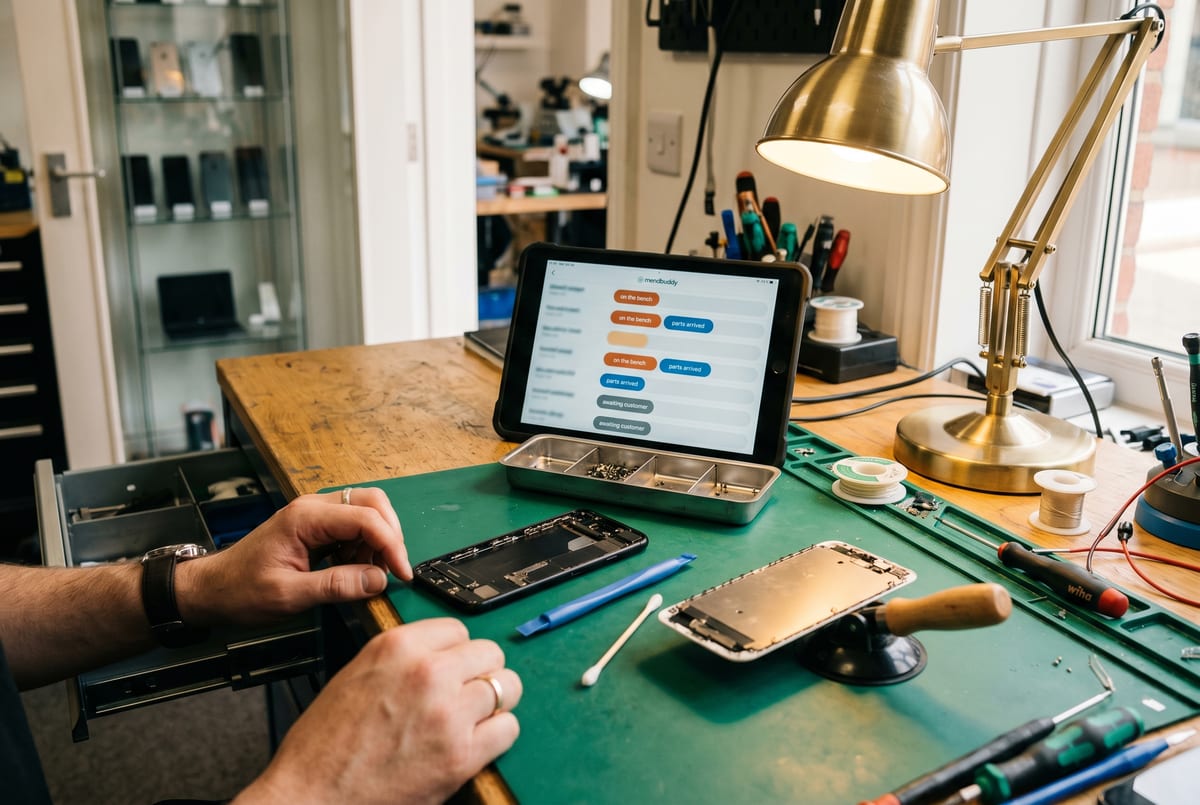
- mendmyithe founder’s own UK device-repair business. The storefront, the retail counter, the workshop ticket-to-collection flow, the multi-channel inbound - all on the mmitech build, dogfooded daily on the same shop that’s been trading since 2019. The closest thing we have to dogfood proof: we run the same software we’d build for you. See Mendmyi.
- repairminderour SaaS for repair-shop operations. Tickets, status SMS, parts inventory, customer portal, native iOS tech app, multi-channel inbound. The reference for “can I just subscribe to the thing rather than commission a bespoke build?” - yes, and the bespoke layers sit on the same backbone when you outgrow the subscription shape. See Repairminder.
- mendbuddyour multi-channel AI agent platform behind the trained-inbound flow in problem 3. Trained on your own pricing and FAQ; runs on Marketplace + WhatsApp + Instagram + missed-call SMS + voice + web chat. Built originally to answer the price-question DMs at mendmyi while the tech was head-down; now it runs across twenty-five-plus verticals. See Mendbuddy.
- planpostour social-media scheduling SaaS. Used for the model-specific weekly cadence (“iPhone 15 screens - same-day in Haverhill”) that drives local-SEO for repair shops on Google Business Profile, Instagram, Facebook, and TikTok where it earns its place. See Planpost.
If your shop’s narrower than the whole of the above
Most of the shop types we work with - phone-only walk-in, phone + tablet, phone + computer hybrid, computer / IT repair, gaming-console specialist, Apple-only specialist, mobile / on-site service, mail-in / postal - share most of the hub above. The bits that genuinely differ scope in discovery: an Apple-only shop running Apple’s Independent Repair Provider programme needs the GSX-diagnostic and genuine-parts audit-trail wired in; a mail-in / postal shop needs the inbound courier-label and the return-label workflow where the device-on-bench flow normally lives; a mobile / on-site repair van needs the ID-capture and the stripe-terminal-on-the-doorstep flow where the counter flow normally lives. None of these warrant their own page yet - they’re a discovery conversation, not a separate buyer.
Adjacent verticals
- Independent garagesclosest operational shape (intake → diagnose → quote → parts-order → on-the-bay → ready-for-collection) ported to vehicles instead of devices; the repairminder pattern is the same backbone on the garage side, with the MOT recall and the wholesaler-parts integrations layered on.
- Trades (the umbrella)same paper-diary-plus-WhatsApp starting point, same owner-on-the-tools-plus-paperwork buyer shape; the reactive-job-with-status-comms loop is structurally identical.
- Pet servicesboarding intake and recurring-service ledgers share the same operational shape (drop-off → status → collection) as a repair shop, with the photo-update-on-Bertie expectation in the same slot as the QC-photo-on-the-repair we ship.
- E-commerceif your shop sells parts and accessories alongside repair, the e-commerce hub covers the retail-stack side of the same business (Shopify / WooCommerce / BigCommerce integration with the workshop ticket layer).
FAQ
Will this replace RepairDesk / RepairShopr / RepairQ / MyGadgetRepairs / CellSmart POS?
Often yes - repairminder is the direct replacement, built in pounds, with VAT and postcodes, by people who run a shop. Where the existing tool’s doing things repairminder doesn’t yet do, we build the gap as a bespoke layer on top - that’s how repairminder got built in the first place. We don’t ask you to rip out anything that’s working until we’ve shown you what the replacement looks like in your shop.
Can I just subscribe to repairminder, or do I have to commission a bespoke build?
Either. Most single-shop independents take the SaaS subscription as it is. Multi-location chains, shops with unusual workflows, and shops at a scale where the per-seat creep would kick in commission bespoke layers on top of the same repairminder backbone. The data lives in your account; switching between subscription and bespoke is a configuration decision, not a migration.
Do you integrate with Square / SumUp / Stripe Terminal / Zettle?
Yes, all four. Square is the most common at the counter; SumUp and Zettle live in the smaller shops; Stripe Terminal is the choice when the bespoke build wants the same API surface as the online flow. The threshold-deposit gate in problem 2 runs through whichever you’re on.
Will the Activation Lock / IMEI check work with the lookup providers I’m already paying for?
Yes for the paid providers that actually return reliable data in 2026 (we confirm against your subscription in discovery). Where the shop’s running on free-tier lookups that are unreliable, we typically recommend moving to a paid provider before the build lands - the audit-trail value is in the reliability, not the cost.
Apple IRP - should I join?
If you’re Apple-specialist with sustained Apple volume, the Independent Repair Provider programme is worth it for the genuine-parts access, the GSX diagnostics, and the audit access. For mixed shops it’s overkill. We build the workflow either way; the IRP question stays yours, and where you do join, the audit-evidence pack assembles itself as you operate rather than as a quarterly compliance scramble.
Will the refurb resale bridge handle the VAT margin scheme?
Yes - the channel-fee splits and the second-hand margin scheme are first-class objects in the bookkeeping export. Where the shop’s not on the margin scheme (some are, some aren’t, depending on the proportion of new-vs-used stock), the standard VAT treatment applies. We confirm against your accountant’s setup in discovery.
My shop is the only one on the high street. Is repairminder overkill?
Probably not. The whole point of repairminder is that it’s lean enough for a one-tech shop and scales to a chain. We built it for ourselves, and we don’t have a chain. The bespoke layers are what shops graduate into; the subscription is what shops start on.
Will you handle WEEE disposal / ICO registration / the Apple IRP audit / the NMPCU IMEI register on my behalf?
We build the calendar, the audit log, and (where the portal allows) a pre-filled form. The actual filing, the disposal, and the responses to a Police visit stay with the shop - the indemnity sits with the licensed person. What the system does is make the audit pack assemble itself as you operate, so the visit is a one-URL pull rather than a three-evening folder-hunt.
What does it cost?
Every build is scoped per shop. repairminder is our own SaaS - if you’d rather subscribe than commission a bespoke build, the case-study page covers what it is and how to come at it (Repairminder). Bespoke builds are scoped to your shop, your channel mix, and what’s getting replaced. We talk it through, agree price in writing, then build. See pricing for how we work.
How long until something’s live?
The repairminder subscription is live the day you sign up. Bespoke layers go from scope conversation to working staging in a few weeks, then a couple more weeks of running real tickets through it before go-live. The Activation Lock check and the refurb resale bridge are the longest scopes; the status-SMS flow and the trained inbound agent are the shortest.
Tell us what your shop looks like
Send an enquiry - how many techs, what mix (phone, computer, console, Apple-only, mobile, mail-in), how many drop-offs a week, what software you’re paying too much for today, where the operational pain lives (the is-it-ready call, the ghosted £180 OLED, the Activation Lock surprise, the three drawers labelled iPhone X screens, the refurb 11 in the back). We’ll come back with a sketch of what we’d build, or whether repairminder out of the box is the better fit. No calendar, no demo to sit through. Email reply, scoped sketch, you decide.