


The day-of-the-service loop that stops the “is he coming” phone call
Booking confirmed Tuesday. Customer took the morning off Wednesday. I was thirty minutes late on a job that overran. By 09:45 she was ringing me from her desk, fuming. By 10:30 there was a one-star Google review sitting on the page before I’d even said hello.
Most UK SMEs don’t lose customers on the workmanship. They lose them on the thirty minutes between “running late” and “customer’s writing the review”. The booking’s in the diary, the job’s done well, the invoice goes out - and somewhere in the middle of that the customer wonders if you’re coming, wonders if she’s been forgotten, wonders if the next plumber on Google would have rung by now. Close that gap on the channel the booking came in on, and the same customer leaves a five-star review without you typing an SMS yourself.
This is the operational loop after a booking is in the diary and before the invoice gets paid. Confirmation → 24-hour reminder → en-route ETA the morning of (fired when your calendar event flips to travelling) → arrived → completed → ninety-minute review prompt with negative-sentiment routing to your inbox before it hits the public Google page. Every step runs on the channel the customer placed the booking on - SMS, WhatsApp, email, or the customer-facing app - and every step writes to the same job record so the “what was agreed” answer is searchable. The shape is sealed against RepairMinder - our own workshop-platform’s ticket-status cascade running at the founder’s UK device-repair business and dozens of other repair shops - and ports cleanly across reactive trades, field-service installs, hospitality cover bookings, holiday-let guest arrivals, clinic appointments, garage workshop-bay scheduling, pet-services photo-update obligations, and e-commerce despatch.
What gets lost between booking confirmed and review left
Every business loses the same thirty minutes in a slightly different costume. A few moments - pick the ones that sound like your week:
- Reactive tradesleaving the first job at 09:50, arriving at the second at 10:18, the second customer’s already rung your phone twice, the third’s about to ring; by 6pm you’ve forgotten to ask any of them for a Google review.
- High-ticket installs and multi-week cascadesthe £6,800 heat-pump install that runs survey-booked → DNO-G99-submitted → DNO-G99-approved → scaffold-up → install-day-1 → install-day-N → commissioning → MCS-cert-issued → BUS-grant-paid across eight weeks, and the customer rings every other day because nobody’s told her what week 4 is supposed to look like.
- HospitalityTuesday-night confirmed-12-showed-9-three-tap-water, the no-show pattern that costs you the covers without you having a way to tighten it without insulting the regulars.
- Holiday letsthe guest checking in at 16:00 who doesn’t have the key code, the parking notes, or the bin-day calendar; the cleaner who didn’t know the changeover was at 11:00; the four-star review that should have been five.
- Device repair and inbound-items service“where’s my phone” is the highest-volume FAQ in the trade; the customer who left her phone at 10am wants to know whether it’s fixed at 4pm and would rather not ring the bench.
- Independent garagesthe workshop-bay-scheduling moment: the courtesy car wasn’t ready, the parts hadn’t arrived, the bay was double-booked because nobody told the front desk the morning MOT slot had overrun. The customer’s standing at the counter waiting on someone to ring her a taxi.
- Pet servicesthe owner dropped the dog at 8am and is at her desk worrying by 11am whether he’s settled; the photo-update WhatsApp obligation that you currently do manually after thirty dogs through the door.
- Clinics and driving instructors“hi Sarah, your appointment tomorrow 14:30, reply Y to confirm or N to reschedule” converts at materially higher rates than email-only, and the reschedule reply needs to land in the diary without you typing back.
- E-commerce despatchorder placed Tuesday, packed Wednesday, carrier-scanned Thursday, out-for-delivery Friday morning, customer at work; the failed-delivery scan and the re-delivery question need to land on her phone before the courier card lands on the doormat.
- Wedding venues and hospitality bookingsthe cover-booking with reminder, no-show recovery and post-meal review timing; the wedding-day tour-confirmation cadence that runs over months.
These aren’t problems for a generic reminder-bot or a calendar-side default. They’re the bit between the booking and the review, which is where the public-page rating actually lives.

What solved looks like
1. Every booking is a structured event stream, not a calendar event with hope on top
The “did I confirm her or not” moment: the booking went in the diary on Friday from a phone call you took on the ladder. There’s a name and a postcode and the word Tuesday and that’s it. You don’t remember what you quoted, what time you said, whether you sent her the here’s what to expect SMS, whether she replied. By Sunday evening the diary’s a Picasso and the “have I forgotten to confirm someone” anxiety eats the football.
Solved looks like: every booking writes to a structured event stream the moment it lands - customer, contact preferences, service type, agreed price, agreed time, agreed scope, agreed access notes. Each downstream comm (confirmation, reminder, en-route, completed, review prompt) writes back to the same stream as it fires. The Sunday-evening “have I missed anyone” check becomes one screen - every active booking with its current event-stream state and the next thing it’s waiting on.
2. Per-vertical event sequences, not one-size-fits-all
The “the cascade doesn’t fit this job” moment: a generic booking reminder fires twenty-four hours before every appointment. Useless to the heat-pump install (eight weeks of unknown silence), aggressive to the regular dental patient (she’s been coming for ten years and doesn’t need reminding), wrong-channel for the WhatsApp-first pet-services owner, and missing the Sale of Goods Act vacate notice on the storage unit you’re emptying tomorrow.
Solved looks like: the event sequence is per vertical and tunable. A reactive trade’s day-of-loop: 24h reminder → en-route SMS the morning of → arrived → done + review prompt at +90 minutes. A heat-pump install’s: survey-booked → DNO-G99-submitted → DNO-G99-approved → install-week-confirmed → scaffold-up → install-day-1 → commissioning → MCS-cert-issued → BUS-grant-paid across the customer-facing journey, with the Grant & Submission Handling cadence as the trigger for the grant-side steps. A holiday-let guest arrival: booking-confirmed → 2-weeks-out info pack → 24h-out key code → arrival-day check-in → post-stay review prompt. A garage workshop-bay: bay-allocated → parts-on-order → vehicle-in → diagnosis-quoted → repair-underway → MOT-passed → ready-for-collection → courtesy-car-returned. Same engine; different sequence; the customer’s experience is they always knew what was happening with their booking.
3. The en-route trigger fires automatically, not by your remembering to tap it
The “I’ll text her when I’m in the van” moment: you mean to. You don’t. You’re under the next sink, you’re loading the van, the customer’s sitting at her desk wondering if she should ring the next plumber on Google. The SMS would have taken eight seconds - but the eight seconds at 09:50 is what gets lost between jobs.
Solved looks like: for trades and field-services, the most common trigger is the calendar status flip. When your job event in Google Calendar / Outlook / your job-management app flips from not started to travelling - a one-tap from your phone on the way to the van, or a geofence trigger if you’ve opted in - the en-route SMS fires automatically. The customer-facing wording’s in your voice (“Riki here, on my way, ETA 10:25, A14 is clear, see you shortly”), the live ETA window updates as you drive, and downstream customers’ ETAs adjust as a job slips. The customer never wonders if you’re coming. For multi-stop rounds (pet-services walks, courier-style trade rounds, agriculture supply runs), the route-optimiser updates every downstream ETA the moment one stop overruns.
4. Multi-channel routing per customer, on the channel the booking came in on
The “she doesn’t read email” moment: the domestic customer doesn’t read email; the letting agent’s bookkeeper reads nothing but email; the pet-services owner only opens WhatsApp; the elderly relative wants a phone call; the e-commerce customer wants the carrier-status link. One channel for everyone annoys everyone.
Solved looks like: channel routing per customer-type and per cadence step. SMS where the booking came in on a phone number; WhatsApp where the customer’s already on it (and you’ve got their soft-opt-in for service messages); email last because response-time-expectations on email are slower; in-app push for the verticals where you’ve shipped a customer-facing app (gym member apps, holiday-let portals, repair-shop customer view, equine syndicate accounts). The customer-record carries the preference; you don’t keep it in your head.
5. Ninety-minute review prompt, with negative-sentiment routing before it hits the public page
The “she left a one-star before I could ring her back” moment: the job finished at 11:55. The customer’s at her desk by 13:00 and texts a complaint at 13:30. By 14:00 the Google review’s up; by the time you’ve replied to it on the public page, three new customers searching for a plumber have seen the one-star result and rung the next sparky on the list.
Solved looks like: ninety minutes after the job’s marked done, the review prompt fires with the Google / Trustpilot / Yelp / Airbnb / Booking.com / TripAdvisor / Hitched / Bridebook / PetsApp / Top10Salons / Trustist link pre-filled. The customer’s reply is read by the same trained agent that runs the Trainable Inbound AI Agent - positive replies go straight through to the public page with a thank-you; negative or ambivalent replies route to your inbox with a “this looks like a concern - want to handle it before it goes public?” tag; ambiguous replies hold pending your sign-off. The public-page link doesn’t activate until you’ve had a chance to address the issue. The customer who’d have left one-star gets a phone call from you the same afternoon; she leaves five-star a week later.
6. The dashboard answers the Saturday-night “did I forget anything” question
The “have I sent the cleaner the access code” moment: Saturday night. Six bookings in the week ahead. You think the cleaner knows the Friday changeover’s at 11am, you think the customer’s got the key code, you think the heat-pump customer knows that next week’s the DNO-G99 wait - but you can’t quite remember which one of those you confirmed and which one’s still in your head.
Solved looks like: every active booking with its current event-stream state and the next thing it’s waiting on. The Saturday-night “have I forgotten anything” anxiety becomes one screen - eleven bookings in the next two weeks, eight on track with the next comm queued, two waiting on the customer’s reply, one flagged because the heat-pump customer hasn’t acknowledged the install-week-confirmed SMS and the cascade’s about to pause until she does. Total time on the dashboard: six minutes. You go and watch the football.
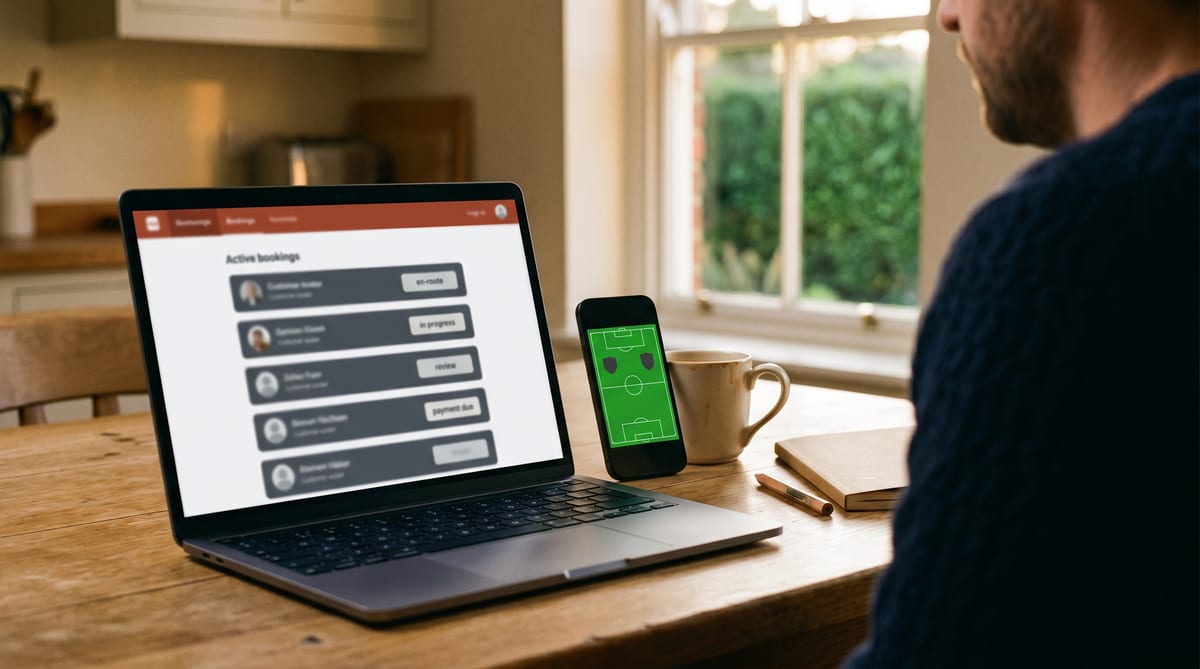
How the day-of-the-service cascade runs, by default
The default trade-shape day-of cadence runs:
- Booking-confirmed momentthe structured event lands on the customer record. Confirmation SMS / WhatsApp / email in your voice, with the agreed time, the agreed scope, the agreed price band, and the access notes.
- +24h beforereminder in the customer’s preferred channel. “Hi Sarah, quick reminder you’re booked in for the bathroom-tap swap tomorrow 09:30-11:00, reply if anything’s changed.”
- The morning of, when the calendar event flips to travellingen-route SMS in your voice with the live ETA window. “Riki here, on my way, ETA 09:35, A14 is clear, see you shortly.”
- Arrivedthe event marks itself when the geofence trips, or by a one-tap on your phone.
- Completedthe event marks itself when you mark the job done in your job-management app or by a one-tap on your phone. The done-event fires the Invoice & Dunning Ladder cascade - invoice raised, photos attached, the day-0 chase clock starts on the work you actually finished, not on the Friday-afternoon admin pile.
- +90 minutes after donereview prompt with the public-page link pre-filled. Negative-sentiment replies route to your inbox first; positive replies post through.
Per-vertical tuning lives on top - the heat-pump install runs the 8-12 week customer-facing cascade with the grant-side steps queued from Grant & Submission Handling, the hospitality cover-booking cadence runs the no-show-recovery loop without insulting the regulars, the holiday-let arrival cascade runs the key-code-at-24h-and-WiFi-at-arrival loop, the device-repair ticket cascade runs the received → diagnosed → quoted → parts-on-order → underway → ready-for-collection sequence, the garage workshop-bay cascade runs the parts-and-bay-and-courtesy-car coordination, the pet-services photo-update obligation fires the structured settling in nicely WhatsApp at 10:30, the clinic appointment cascade runs the WhatsApp confirm-or-reschedule reply parser, the e-commerce despatch cascade runs the carrier-scan-to-doorstep sequence.
Who this is for
The shape repeats across every UK SME that takes bookings or runs jobs to a customer-facing diary.
Reactive trades - plumbers, electricians, gas engineers, roofers, decorators, locksmiths, landscapers, builders, MCS installers. The trade-day-of loop - confirmation, 24h reminder, en-route ETA, arrived, done, ninety-minute review prompt - with per-trade tuning on the ETA-anxiety window (a leak emergency runs at hour cadence; a planned bathroom-fit runs at fortnight cadence) and per-trade channel routing.
Field-service installs and multi-week cascades - heat-pump installers, solar PV and battery installers, boiler installers, EV-installer electricians. The 8-12 week install cascade with the customer-facing journey running survey → DNO / OZEV / MCS submission → install-week → commissioning → cert-issued → grant-paid, paired with Grant & Submission Handling for the submission-side steps.
Hospitality - pubs and restaurants, wedding venues. The cover-booking loop, the no-show recovery cadence, the post-meal review timing; for venues the long-form tour-and-deposit-and-final-balance cascade that runs over 12-18 months.
Holiday lets - holiday-let owners. The guest pre-arrival cascade (key code at 24h, parking notes at 4pm, WiFi password at check-in, bin-day calendar inside), the cleaner-confirmation loop on a separate WhatsApp thread, the post-stay review prompt with five-star calibration.
Device repair and inbound-items service - device repair shops. The ticket-status cascade - received, diagnosed, quoted, parts-on-order, underway, ready-for-collection - running on the channel the customer left the device on. Closes the “where’s my phone” phone-call slot to a five-minute self-service exchange.
Independent garages - independent garages. The workshop-bay-scheduling moment - bay-allocated, parts-on-order, vehicle-in, diagnosis-quoted, repair-underway, MOT-passed, ready-for-collection, courtesy-car-returned - with the customer-facing cadence that tells her what’s happening to her car without her having to ring the front desk.
Clinics and driving instructors - dental practices, vet practices, aesthetic clinics, private GP, driving instructors. The WhatsApp-first reminder with the reply-Y-or-N reschedule parser, the post-appointment review prompt, the per-pupil progression nudge to the parent paying for the lessons via the Customer & Third Party Portal view.
Pet services - pet services. The photo-update WhatsApp obligation that owners expect from a premium service, fired structured at the right time rather than manually after thirty dogs through the door.
E-commerce - e-commerce shops. The carrier-side cascade - order received, packed, carrier-scanned, out-for-delivery, delivered - with the courier-window timing (Royal Mail, DPD, Evri, Yodel) and the failed-delivery-scan re-delivery option on the customer’s phone before the courier card lands.
Same engine; different sequence; different channel mix; different review-platform link.
The closest thing we’ve already built
RepairMinder - our own workshop-platform running the ticket-status cascade at repair shops across the UK. Received → diagnosed → quoted → parts on order → repair underway → ready for collection - every step writes to the customer-facing thread on the channel she left the device on, the “where’s my phone” phone call vanishes, and the ninety-minute review prompt fires the moment the ticket closes. The clearest reference for any field-service or inbound-items business that wants the same shape ported.
mendbuddy is the multi-channel platform behind the SMS / WhatsApp / voice transport layer for the cascade - particularly where you want the inbound reply (the “is he running late” question, the “can I reschedule” request) parsed by an AI agent rather than landing as a raw text on your phone.
mendmyi - the founder’s own UK device-repair business runs the exact ticket-status loop on the platform; live proof in production, with every customer interaction captured back to the per-ticket record.
HC Electrical - live trade-day-of cascade running on the EICR + EV-installer side. Calendar-event-flips-to-travelling fires the en-route SMS; ninety-minute review prompt with negative-sentiment routing has materially shifted the public-page rating. (Named pull-quote + final-£ outcome figures hold behind the permission checklist; see Hc Electrical for the build detail.)
The done-event hand-off feeds the Invoice & Dunning Ladder so the invoice fires before you’ve left the customer’s drive; the anniversary-side hand-off to Recurring Service Recall sets the next-due date the moment the job’s marked done; the third-party-status view for the agent / property manager / parent / syndicate owner uses the Customer & Third Party Portal read-only surface.
Tell us what your day-of looks like
How many bookings you handle a week, what’s currently chasing them (you, your partner, your front-desk, nobody), where the “is he coming” phone call hits you in the day, what your current review volume looks like on the public page. Tell us the last job that earned a one-star review for a reason that wasn’t the workmanship and we’ll come back with a sketch of what we’d build so the next one doesn’t go the same way. No demo, no calendar widget. Email reply, scoped sketch, you decide.
FAQ
Will it work with our existing booking / job-management system (ServiceM8, Tradify, Powered Now, Commusoft, Joblogic, Cliniko, Dentally, Pabau, Cal.com, Calendly, Eventbrite, Booking.com, Sykes, Airbnb, Google Calendar, Outlook)?
Yes for all of those, and yes for the ones we haven’t named. The event-stream reads bookings from the booking system you’re already on (or, where the booking lives in plain Google Calendar / Outlook, from the calendar’s own integration) and fires the customer-side comms off the back of it. We don’t replace your scheduler; we wire the customer-facing comms on top.
Can the en-route SMS fire automatically, or do I have to tap it?
Both options. The most common is the calendar status flip - one-tap from your phone toggles the event from not started to travelling and the SMS fires. For geofence triggers, the mobile-app side fires the SMS when you drive within a set distance of the customer’s postcode. For trades who prefer explicit confirmation, a one-tap “on my way” button in the dashboard works the same way. Tune to your preference; the customer never sees the difference.
How does the negative-sentiment routing actually work - does the customer know you’re intercepting?
The customer’s reply to the review prompt is read by the agent before the link to the public page activates. Positive replies go straight through with a thank-you. Negative or ambivalent replies route to your inbox with a tagged summary so you can ring the customer, address the concern, and then invite them to leave a review - by which point the conversation’s recovered. We’re explicit that this isn’t review-suppression: the customer can leave whatever review they want on the public page directly. What it stops is the one-star reflex on the morning of, before you’ve had a chance to know there was a problem.
Will it integrate with our review platform (Google Business Profile, Trustpilot, Trustist, Yelp, Airbnb, Booking.com, TripAdvisor, Hitched, Bridebook, PetsApp, Top10Salons)?
Yes for all of those. The review-prompt link routes to whichever platform you want surfaced for that vertical (Google Business Profile is the default for most local SMEs; Airbnb / Booking.com for holiday lets; PetsApp for the pet-services-side; Trustpilot / Trustist for the longer e-commerce experience). The negative-sentiment intercept catches the reply regardless of which platform the link points at.
What about customers who don’t want to be reminded - the regulars who turn up every Tuesday at 10?
Per-customer preference is part of the record. A regular can be set to minimal-comms (booking confirmation only, no reminder, no review prompt), full-cascade (every step), or anywhere in between. The system respects per-customer preference; you set it at first booking or migrate it in bulk from an existing tag.
Will it work for businesses with multiple staff / multiple vans / multiple bays?
Yes. Each booking’s assigned to a staff member / vehicle / bay; the en-route SMS fires in their voice (the voice training is per-staff where you want it, per-company where you don’t, with the same training mechanic as Trainable Inbound AI Agent). The dashboard groups bookings by staff / bay for the “who’s behind today” view.
What if a job’s cancelled or rescheduled mid-cascade?
The cascade re-runs from the new event state. A cancellation fires a “sorry to miss you, here’s how to rebook” comm and closes the event stream. A reschedule moves the future cascade events to the new date. The audit trail keeps the original booking’s history for the “what was agreed” search.
Does it replace our diary / our review platform / our job-management software?
No. It sits on top. The event-stream reads from your existing diary and writes the customer-side cascade out; the review prompt routes to whichever public-page platform you’ve already chosen; the job-management app stays where it is. The cascade runs in the gap those tools don’t fill - between the booking and the review, on the channel the customer came in on.
What does it cost?
Per-client, scoped after the discovery call. No per-SMS surge billing, no per-booking fees, no tiered seat pricing if your bookings double in a quarter. We talk through your booking volume, your channel mix, your vertical-specific cascade needs, then we agree the scope and the price in writing. See pricing.