


Software for UK wedding venues and private-hire event venues
The bride who replies fastest is the one who gets the booking. We need to be in her inbox before she’s had breakfast.
Wedding venues are a different business. The ticket is £8,000 on the small end and £40,000+ on the bigger weddings, with bookings that lead twelve to eighteen months - sometimes longer. The customer isn’t just the bride; it’s the bride, the groom, sometimes a wedding planner, often the mother of the bride, the photographer, the florist, the cake maker, the band, the registrar, the supplier-list cousin. The deliverable isn’t a meal - it’s the day. And the day exists, before it exists, as a run-of-show document that everyone agrees on by Wednesday and disagrees on by Friday. Underneath all that, the midnight first-reply auction at 22:15 on Saturday decides whether the £6,000 small-wedding booking or the £25,000 country-house weekend lands at your venue or at one of the three Hitched competitors the bride messaged at the same time.
This page is for venues whose business is mostly weddings and private-hire events. If your business is restaurant covers with the occasional wedding lunch, the main hospitality page is the better fit. The closest live reference behind this hub is a private-hire event venue the studio has built end-to-end - public site, inbound enquiry pipeline, tour-to-deposit funnel, run-of-show portal - with the enquiry-to-tour-to-deposit shape running today.
What your week actually looks like
- A Saturday-night enquiry at 22:15 from a bride who’s also messaging three other venues at the same fifteen-minute window; the venue that replies first with date-confirmed + next-two-tour-slots is the venue she books.
- A tour booking that needs a brochure auto-sent, a tour slot held without anyone touching the calendar, and a “looking forward to meeting you Tuesday” note in your voice without you actually writing it Sunday evening.
- A £20,000 wedding contract that’s £4,000 deposit on signing, £5,000 at six months, balance fourteen days before - and a stage-payment ladder that lives in your bookkeeper’s head and your Google Calendar’s hopes.
- A run-of-show pack - florist arrival, cake delivery, hair-and-makeup, photographer call, ceremony, drinks reception, breakfast, speeches, cake cut, first dance, band sound-check, carriages - built in a Google Doc, printed on Friday, contradicting the bride’s latest WhatsApp by Saturday morning, and printed again at 23:00 the night before.
- A preferred-supplier list that’s a Word doc gone stale; the “preferred” photographer who turned up drunk last summer; the new florist who hasn’t been audited but everyone loves; the commission relationship with the cake-maker that nobody’s quite declared since the CMA wrote to wedding venues about transparent referrals.
- A wedding eight weeks out that pulls because of “family reasons”; the contract says non-refundable; the lawyer says you’re right; the family stages a one-star Google campaign anyway and the £5k second-stage payment is unpaid.
- Three venue tours on a Saturday morning, two of whom Mum is driving and Mum doesn’t know about the parking layout, the disabled-access route, or the registrar-paperwork timeline for the Approved Premises civil ceremony.
- An exclusive-use weekend with a £400-an-hour overrun charge nobody wants to invoke at 23:30 in front of the band - but the contract says it kicks in at 23:00 and the build-down team are on the clock.
- Civil-registrar paperwork for an Approved Premises ceremony that needs to be queued six weeks out and frequently isn’t; PPL PRS music licence renewal you haven’t owned since the events manager before this one left; fire-risk-assessment refresh on the marquee that goes up in May.
- A drone photographer who hasn’t shown evidence of a CAA A2 CofC and a third-party public liability cover; a £8k cake-maker who’s never been asked for evidence of food hygiene rating; a band who plug in at sound-check and you don’t quite know whether the PAT testing’s current.
The shape is long-lead, high-emotion, multi-stakeholder, contract-paced. Most hospitality software is built for nightly covers and shift-by-shift rotas. That’s the gap.
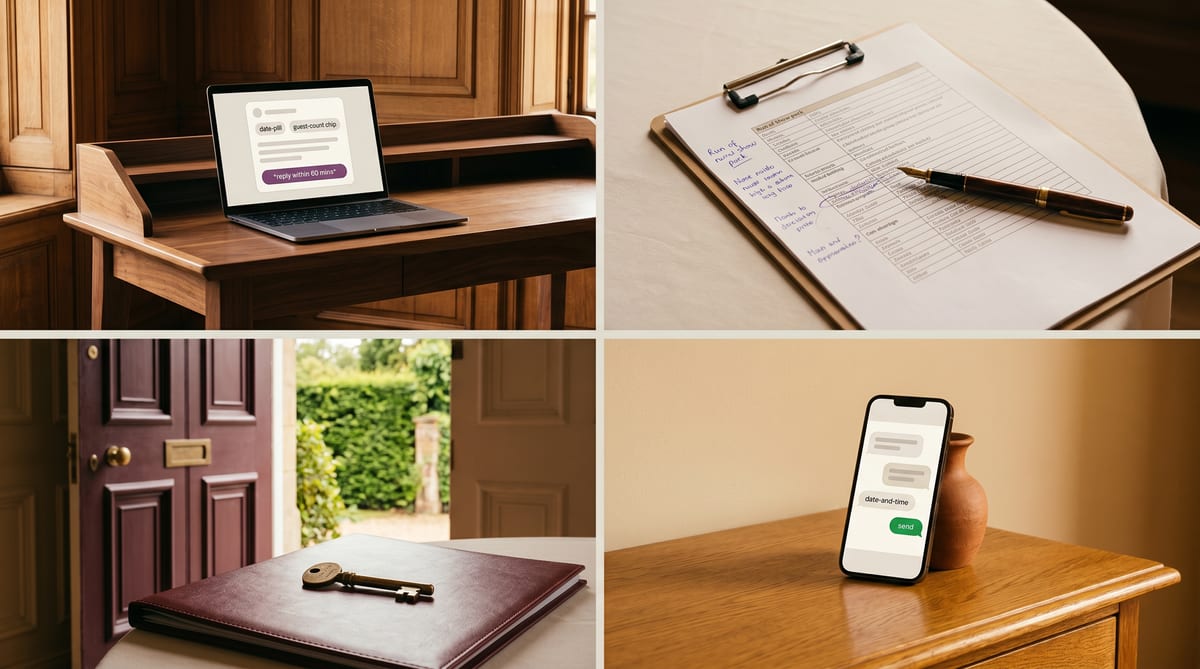
Example problems we could solve
Six things we hear most often from venue operators - with what the solved version looks like in your week. Every build is scoped per venue: a barn venue doing eight weddings a year probably needs the first three; a country-house hotel doing thirty weddings + sixty function bookings + the occasional micro-wedding might want all six.
1. The midnight DM that wins the £6,000 booking before breakfast
The 22:15-Saturday moment: the bride’s enquiry comes in Saturday at 22:15 - a real enquiry, four venues messaged at the same time. By Sunday lunchtime when you open the laptop she’s already had a reply from one competitor at 22:38 (“date’s available, can we book you in for a tour Tuesday at 14:00 or Wednesday at 18:00?”), toured them Tuesday, and you never make her shortlist. The £6,000-£40,000 booking has walked before your laptop opened. The venue-specific weight is that the fifteen-minute first-reply window with the next-two-tour-slots offer is THE differentiator against the trades’ multi-day chase cadence - this is a first-reply-wins market, not a best-relationship-wins one, and Monday morning is too late.
Solved looks like: every inbound enquiry - Hitched / Bridebook / DesignMyNight portal feed, your direct site enquiry form, Facebook DM, Instagram DM, missed-call SMS, the WhatsApp number on the brochure - lands on a unified agent surface that acknowledges within sixty seconds in your venue’s voice. The agent is trained on your brochure, your tour-script, your wedding minimums, your in-house catering options, your date-availability calendar, and your events manager’s actual phrasing - so the 22:38 reply reads like Sarah-the-events-manager wrote it, not a sales template. The cascade runs: 22:38 acknowledge with date-confirmed + next-two-tour-slots → 11:00 Sunday morning warmer follow-up if no response → fortnight-of-light-nudges for brides who said “need to think about it with my mum” → tour booking auto-pulls deposit-ladder paperwork once the slot lands. The longer version lives at /solutions/trainable-inbound-ai-agent; the wedding-venue version’s distinct feature is the fortnight cadence behind the initial reply, the supplier-recommendation prompt for brides who haven’t picked a photographer yet, and the registrar-paperwork-timeline prompt for the Approved-Premises civil-ceremony brides who’ve never been asked to think about a six-weeks-out council deadline.
2. The stage-payment ladder that doesn’t end in lawyer letters
The eight-weeks-out-pull moment: £20k wedding, £4k deposit on signing, £5k at six months, balance fourteen days before. Eight weeks out the family rings - family reasons, can we have the deposit back - your contract says non-refundable, your lawyer says you’re right, the family stages a one-star Google review campaign and the £5k second-stage payment is unpaid and lawyered. By the Saturday the wedding was meant to happen, you’re down £14k revenue, £8k cost of holding the date, and £900 in legal fees.
Solved looks like: the stage-payment ladder as a first-class object alongside the contract. 50% / 25% / 25% as the default; tuned per your terms. Each payment stage triggers automatically - invoice generated, Stripe / GoCardless link, SMS reminder fourteen days before, a softer one seven days before, a phone-task to the venue manager if the second one doesn’t move. Cancellation and refund wording is built into the contract template (Consumer Contracts Regulations 2013 distance-selling, statutory cooling-off, force-majeure clauses) so the conversation, when it happens, is on a paper trail. The lawyer becomes a fallback rather than a default. The same engine handles the corporate function-room dry-hire deposit ladder and the catering-only event deposit.
3. The run-of-show pack that lives in one place
The Wednesday-vs-Friday moment: florist Sunday, cake Friday, hair-and-makeup Saturday morning, photographer Saturday all day. Bride changed the timeline three times. Run-of-show is a Google Doc by Wednesday, a printed PDF by Friday, and they disagree by Saturday morning. On the day, the band don’t know the ceremony’s pushed twenty minutes, the cake-maker arrives during the speeches, and the second-line photographer’s missed the first dance because nobody told her the schedule moved.
Solved looks like: a run-of-show engine that’s the source of truth for the wedding day. Timeline builder (arrival, ceremony, drinks reception, breakfast, speeches, cake, first dance, band, carriages); supplier ETAs (florist set-up window, cake delivery, hair-and-makeup, photographer arrival, band sound-check); service-team rota; bride / planner approval workflow; the printed pack at Friday’s close. WhatsApp distribution to all suppliers in one go on the morning of, with the version-stamp so they can see which timeline they’re working from. Day-of, a live update channel - “florist running 20 minutes late, ceremony pushed to 14:20” - so the band knows before the band’s playing. The bride sees one version, the suppliers see one version, the team sees one version, in their preferred format.
4. The preferred-supplier CRM that earns commission cleanly and protects reputation
The drunk-photographer moment: “our preferred photographer turned up drunk to a wedding. Now we’re being asked why we ‘preferred’ him. The list is a Word doc from 2022.” The preferred-supplier list is a secondary revenue stream - most country-house venues earn 10-20% of total revenue from supplier-referral commission - but the preferred-supplier-as-an-implicit-endorsement problem is real, and the CMA wrote to wedding venues about transparency in supplier referrals in 2024.
Solved looks like: the preferred-supplier list as a structured object - per supplier, the rating from the venue, the last-used date, the number of weddings shared, the public-liability evidence + £5-10m cover state, the food-hygiene rating for caterers, the CAA A2 CofC evidence for drone photographers, the PAT-test currency for bands, the commission terms (where they exist and where they’re declared per Competition and Markets Authority guidance on wedding-supplier referrals). Couple-facing portal: the bride sees who you trust and why. Operator-facing dashboard: which suppliers are bringing you weddings, which are bringing you complaints, which haven’t been used in eighteen months and should be re-auditioned. Insurance and accreditation expiry dates fire renewal-chase nudges automatically. The annual supplier review becomes a real thing rather than a New-Year resolution that doesn’t happen. Commission relationships are declared transparently to couples at the point of recommendation, so the CMA conversation doesn’t become an Office of Fair Trading-shaped problem.
5. Exclusive-use overrun, registrar paperwork, and the operational compliance calendar
The 23:30-Saturday moment: the band’s still going, the carriages haven’t arrived, and the contract says the £400/hour overrun kicked in at 23:00. Invoking it at 23:30 in front of the band’s awkward; not invoking it costs you £1,200 by the time the marquee’s cleared at 01:00. Underneath, the operational compliance is the slower attrition - Premises Licence for civil ceremony status (Approved Premises register), council registrar paperwork queued six weeks out per ceremony, PPL PRS music-licensing renewal, premises licence renewal cycle, DPS changes, fire-risk-assessment refresh under the Fire Safety Order, public liability evidence + £5-10m cover, TEN (Temporary Event Notice) deadlines for one-off out-of-licence events, the food hygiene rating that’s due a re-inspection because last May’s came in at a 4 and the head chef’s left since.
Solved looks like: an operational compliance calendar that the venue manager actually opens. Approved-Premises civil-ceremony registrar paperwork queued six weeks out per booking (the council portal doesn’t publish a stable API, so the system builds the reminder + pack-assembly layer rather than the submission), music-licensing PPL PRS renewals, premises-licence renewal, DPS changes, fire-risk-assessment refresh under the Fire Safety Order, public liability + employers’ liability renewal calendar, drone-photographer CAA A2 CofC checks at booking, TEN deadlines for one-off events outside the standard licence, food-hygiene re-inspection schedule. Alongside it, a softer operational layer for the day itself: a pre-set overrun-charge SMS template that fires at 23:00 if the build-down team haven’t tagged the marquee as cleared (so the £400-an-hour conversation happens by text at 23:00, not by argument at 23:30), a build-down checklist, a deposit-return audit log for next-week’s accounting.
6. The post-wedding review-and-referral cadence
The honeymoon-forgotten moment: couple loved the wedding. You forgot to ask them for a Hitched review at handover. Three months later they’re on their honeymoon and you’re not in their thoughts. The next bride is looking at the same Hitched page and you’ve got eighteen reviews to your competitor’s eighty-five. Six months later the bride’s friend who saw the wedding gets engaged and considers four venues - you weren’t one of them because the referral cadence never fired.
Solved looks like: a post-wedding cadence that captures the warmth while it’s there. 48-hour SMS - “how was it?” - positive triages to Hitched + Bridebook + Google + The Knot; negative triages to the venue manager for soft outreach. Photo-permission consent capture (UK GDPR Art. 9 territory if any sensitive imagery - we keep the legal basis clean and the consent ledger PECR-compliant). A six-month-out referral nudge for the recently-married - “who else is engaged in your circle?” - with a small thank-you incentive where your contract permits. A twelve-month-out anniversary nudge that’s not a sales pitch - a “happy anniversary, here’s the photographer’s gallery again” - that reminds the couple you exist before the next friend gets engaged. The wedding-supplier ecosystem runs on referrals; this is the muscle that turns one wedding into the next two.
The closest things we’ve already built
- A private-hire event venue we’ve built end-to-end - built and run by the studio. The fifteen-minute enquiry pipeline in problem 1 is the conversion-driving offer the venue runs today. The closest live reference for a UK venue that wants the website and the back-office pipeline by the same studio - public site, enquiry pipeline, tour-to-deposit funnel, run-of-show portal, all one build.
- mendbuddy - our own multi-channel AI agent platform behind the fifteen-minute first-reply pattern and the post-wedding cadence. SMS + WhatsApp + Facebook DM + Instagram + web chat + inbound + outbound voice. Trained on your venue’s brochure, your tour-script, your wedding minimums, and your venue manager’s actual voice. See /case-studies/mendbuddy.
- planpost - our own social-media scheduling SaaS. Used as the social-media cadence behind seasonal venue marketing (open-house events, off-season promotion, Valentine’s, Christmas-party season, the real-wedding gallery cadence that drives Hitched-side traffic). See /case-studies/planpost.
FAQ
Will this replace Iris Works / Tave / HoneyBook / Aisle Planner?
Where they’re working, no. The wedding-CRM tools handle the matter-lifecycle fine; what’s missing is the fifteen-minute first-reply against the Hitched midnight enquiry, the run-of-show portal that’s the day-of source-of-truth, the preferred-supplier audit layer with the CMA-compliant commission disclosure, and the operational compliance calendar. We sit on top and replace what doesn’t fit. The point is your data, your stack - when the build is done, it sits in your accounts, not in a per-couple-per-month vendor’s.
My venue is Approved Premises for civil ceremonies. Will the registrar paperwork flow integrate with the council?
The council registrar portals don’t publish stable APIs, so what we build is the reminder and pack-assembly layer - you still upload to the council, but the system makes sure the six-weeks-out deadline never gets missed and the pack is ready a fortnight ahead. The Approved Premises status renewal also lives on the same calendar, so the underlying licence doesn’t lapse without the events manager noticing.
Will the AI agent commit us to anything?
No. The agent qualifies and books tours; it doesn’t quote final figures, doesn’t sign contracts, doesn’t release dates. Anything that needs a signature or a contractual commitment lands in front of a human. The line between helpful triage and committing the venue stays clearly on the human side.
What about the commission relationship with preferred suppliers - is that declarable?
Yes. Competition and Markets Authority guidance on wedding-supplier referrals is clear that commission relationships should be transparent to couples. The supplier CRM has commission terms as a first-class field, and the couple-facing portal surfaces the disclosure language where commercials apply. We don’t fudge that - the regulatory environment around supplier-referral transparency is tightening, and the build is shaped around staying ahead of it rather than getting written-to.
My exclusive-use weekend overruns happen on the night - can the £400/hour conversation be less awkward?
The contract clause stays where it is. What changes is the moment of invocation: the system fires an SMS at the contracted hour with the templated “the build-down period started at 23:00 - overrun charges apply per the contract from now” message, so the £400/hour starts as a paper-trail text rather than a 23:30 face-to-face argument in front of the band. The venue manager keeps the discretion to waive; the difference is the conversation lands on a paper trail rather than a “he said / she said” on Sunday morning.
Will the run-of-show portal integrate with the band’s / florist’s / photographer’s own scheduling?
The portal pushes the run-of-show to each supplier on the channel they prefer (WhatsApp by default) with a version-stamp so they can see which timeline they’re working from. Most wedding suppliers don’t run their own scheduling tools that expose APIs - the integration is humans-in-WhatsApp by design, not enterprise systems-talking-to-systems. The version-stamp is what makes the “which timeline are we on” conversation go away.
What does it cost?
Every build is scoped per venue - depends on weddings per year, whether the run-of-show portal is in scope, whether the preferred-supplier CRM ships alongside, how many integrations need wiring, whether multi-site (a country-house hotel running multiple wedding suites) is part of the brief. We talk it through, agree price in writing. See pricing.
How long until something’s live?
The enquiry pipeline can be live in a few weeks - the conversion-driving offer and the fastest payback. The run-of-show engine and the preferred-supplier CRM typically run a little longer; the compliance calendar slots in alongside without needing a separate build.
Up to the hub
← UK independent hospitality (main page) · Wedding suppliers (sibling vertical) → · Hospitality FAQs →
Tell us about the weddings you take
How many a year, what the lead-time looks like, what your enquiry conversion is today, what the run-of-show pack lives in, what your preferred-supplier list looks like, whether you’re Approved Premises for civil ceremonies. Send an enquiry - we’ll sketch what we’d build and what it would cost. No calendar widget, no demo to sit through. Email reply, scoped sketch, you decide.