


Software for UK consultants, advisers, and boutique agencies
Quoted a £15k website. Delivered in 65 hours over six weeks. Was it profitable? I don’t know - we just feel the bank balance.
You’re a principal consultant working three retainer clients and two project clients, or the founder of a six-person creative agency, or the operations lead at an eight-person strategy consultancy. The tooling stack is the universal mix - HubSpot or Pipedrive on the pipeline, PandaDoc or Better Proposals or Qwilr or DocuSign on the proposals, Harvest or Toggl or Float on time-tracking, Notion or ClickUp on the project work, Slack for the team and the client channels, Xero on the books. None of them is designed to be the source of truth on whether the work is profitable. Proposals go out and the “looks great, let me think” turns into three weeks of silence - opened, read three times, then nothing. The Friday-afternoon timesheet is half-empty because nobody remembers to start the timer, and the £400 of billable that didn’t get logged is straight margin gone. The retained client who “just had a quick question, can you take a look” is over-running her hours and you don’t notice until month-end. The project that was supposed to come in at sixty hours took ninety-five, and you’re not sure if it cleared cost.
We make custom software for UK consultants, advisers, and boutique agencies - scoped per firm, sized to the bit between the proposal sent on Tuesday and the project delivered, the time captured, the invoice paid, the retainer’s actual margin visible, the client communications in one place rather than across Slack + email + the portal. Not a Harvest replacement - Harvest is fine when people remember to log. Not a HubSpot replacement - the pipeline part works. The bit between the tools - the proposal that goes silent without a chase ladder, the time entry that’s a behaviour-problem no tool fixes, the retainer scope conversation that’s awkward only because it happens at month-end rather than the moment scope’s drifting - that’s the bit we build. Margin leakage is the entire business problem in this trade; the levers that move it are the proposal-follow-up cadence, the time-capture behaviour, the retainer-scope visibility, and the project-profitability dashboard nobody currently has. Tell us where Friday afternoon goes and where the margin actually sits, and we’ll come back with a sketch.
What you spend your week on that you shouldn’t have to
- Proposal sent Tuesday on Better Proposals - opened, read three times notification Thursday - then silence. Followed up twice, no reply. The next-best proposal is the one with the chase cadence built in.
- Friday afternoon - Harvest timesheet half-empty. You know you did the work; you just didn’t log it. Four hundred pounds of billable, gone.
- Retained client “just a quick question” on Slack at 4pm Wednesday - turns into a forty-minute call you didn’t bill, didn’t log, didn’t notice. By month-end she’s £600 over her scope and you have a difficult email to write.
- Quoted a £15k website, delivered in sixty-five hours over six weeks, no clean answer to was it profitable. The bank balance feels OK; the project margin is invisible.
- Client comms across Slack channel + email + the project-tracker portal + the WhatsApp number she texts after 6 - single source of truth on what did we say last week is a fifteen-minute search across four tools at midnight.
- New client onboarding - Sales sold the dream, Delivery’s now learning “scope creep” is the word for the dream not matching the SOW. There’s a Notion template; half the team uses it, half don’t.
- Project resourcing - Float looks great Monday morning; by Wednesday it’s out of date because two projects shifted scope and one client said “could we push to next week”.
- Subscription cost-stack - HubSpot + PandaDoc + Harvest + Slack + Notion + Looker Studio + AgencyAnalytics + Adobe + Calendly + Loom - £400+/user/month before you’ve billed a fee.
- IR35-aware contractor engagement - the fractional senior strategist you bring in for the four-month engagement, the SDS, the day-rate vs fixed-fee structure, the umbrella vs Ltd routing - currently lives in your head and your accountant’s.
- Proposal pricing - “how did we get to £15k” on the website project - current rate-card is three versions out of date because nobody owns it.
These aren’t problems a CRM solves. They’re the bit between the work being done and the work being billed, the margin visible, the retainer healthy, the client conversation single-thread, the firm profitable at year-end. That’s the bit we build.
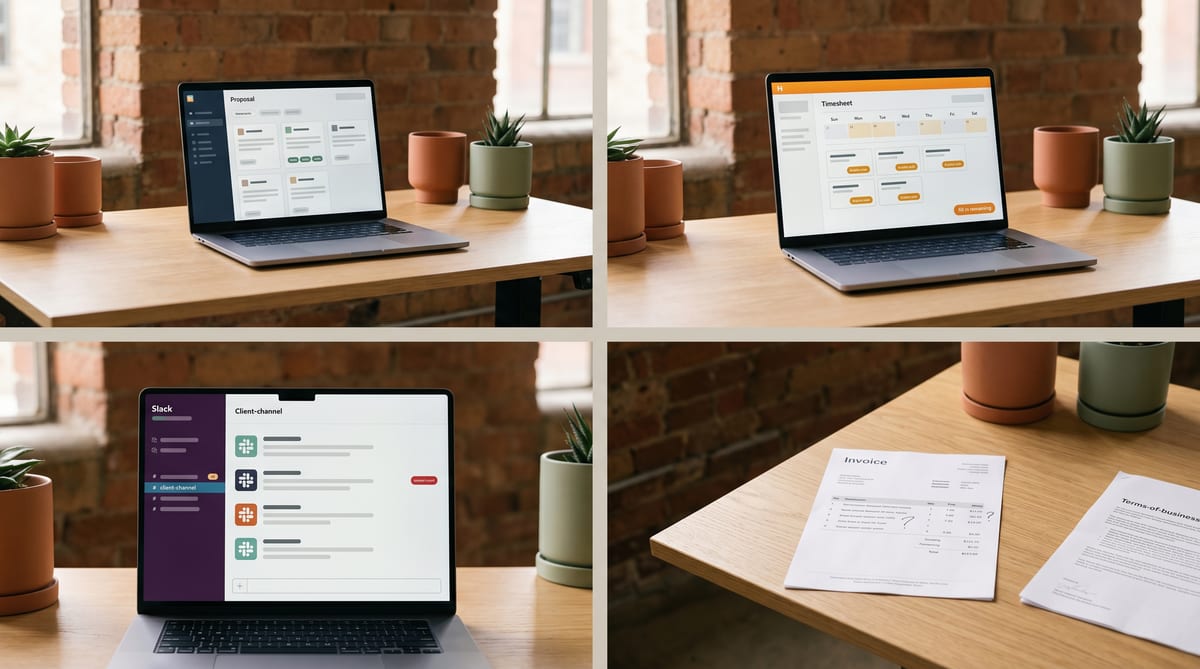
Example problems we could solve
Five things we hear most often from consultants and boutique agencies - with what the solved version looks like in your week. All five are universal across consultancy + agency + advisory work, and every build is scoped per firm: a solo principal probably needs the first three; a ten-person agency running multiple project + retainer clients might want all five. None of it means binning Harvest, HubSpot, PandaDoc, or whatever else is already working.
1. The proposal that doesn’t go silent on Thursday
The opened-read-silent moment: Better Proposals shows opened, read three times on Thursday. Then nothing. Followed up next Wednesday - silence. The Wednesday after - apology and “gone with someone else”. They didn’t decide against us; we just stopped showing up in their inbox at the moment they were going to decide. A measurable chunk of professional-services revenue is lost not to no but to I never got back to it - and the cadence to fix that has to stay in the prospect’s view as expertise, not as pressure.
Solved looks like: every proposal becomes a tracked object the moment it leaves the tool - PandaDoc, Qwilr, Better Proposals, DocuSign, the value-as-a-one-liner-in-a-Notion-doc all flow into the same chase layer. The nudge ladder runs in your voice (not a sales-voice template) and reads urgency off the original brief - a tactical sprint quote nudges over days; a six-figure strategic engagement nudges over a fortnight. The opened-read-silent signal triggers a specific cadence at +24h, +72h, +7d, +14d, each landing on the channel the prospect actually replies on (email primary, WhatsApp where she’s opted in, LinkedIn DM as a last resort). At +10 days the soft-close lands - “is this still on your roadmap or shall I park it” - which turns silence into a structured archive rather than a question mark cluttering your pipeline. The longer version lives at Quote & Chase Ladder; the professional-services version is anchored on the opened-read-silent trigger, the B2B-calibrated nudge tone, and the park it soft-close that respects the prospect’s pace.
2. Time-to-bill - the timesheet that’s already done by Friday morning
The half-empty-Harvest moment: Friday afternoon, Harvest’s half-empty. You did the work Wednesday; you forgot to log it. £400 of billable is now reconciliation-by-memory on Sunday. The team’s no better - they’ve cycled through Toggl, Float, ClickUp time-tracking, and the data quality is always the bottleneck. Time-not-captured is the single biggest source of margin leakage in consultancy and agency work, and no tool fixes a behaviour problem on its own.
Solved looks like: time capture moves from a behaviour-the-team-keeps-forgetting to a data-stream-that-confirms-itself. Calendar events tagged against clients or projects become draft time entries automatically (the team confirms or edits, doesn’t enter from scratch). Slack channel activity per client surfaces “this conversation looked like 45 minutes of work with Sarah on Wednesday - yes / adjust / no”. Notion or ClickUp task closures auto-suggest time entries against the project they belong to. Loom video durations on internal recordings about a client surface as draft entries. The Friday-afternoon scramble becomes a Friday-morning two-minute review. Where the team works in Harvest or Toggl or Float natively, that stays the system of record and we feed the draft entries in; where they don’t, the draft-and-confirm flow lives standalone. For the IR35-aware side, the contractor engagements (fractional CFO, embedded senior strategist on a four-month) get the same flow with the per-contract day-rate / hourly / fixed-fee mode reflected in how the time becomes billable. Time entry is a confirmation rather than a re-creation.
3. The retainer that doesn’t quietly run over
The Sarah-at-twenty-four-hours moment: Sarah’s on a £2k/month retainer for fractional CMO work - assumed twelve hours. By month three she’s emailing daily, Slacking at 4pm, “could you join this call quickly”. By month-end she’s at twenty-four hours. You’re £600 in the red and the difficult email - “we need to adjust your retainer or rethink the scope” - is the one you keep avoiding. Retainer scope creep is the second-biggest margin-leakage source after time-not-captured, and the conversation that prevents it is awkward only because it happens at month-end rather than the moment scope’s drifting.
Solved looks like: every retainer lives as a structured object - included hours per month, included services (deliverables and channels, not just a number), the hourly-equivalent that triggers a scope conversation, the SOW reference. As the time-to-bill flow (problem 2) captures work against the client, the retainer dashboard shows real-time consumption vs scope by week. The client sees her own view (“we’re at sixteen of the twelve included this month - here’s what’s been driving it”) and isn’t surprised at month-end. You see your view per retainer, so the early warning fires at twelve / sixteen / twenty hours and the scope conversation happens before it gets uncomfortable. Out-of-scope work surfaces with a one-tap “this is out of scope, do you want to approve at the hourly rate or push it to next month’s retainer” prompt that lands in the client’s inbox in your voice - not in a confrontation, not at month-end. Fixed-fee, T&M, and hybrid (fixed base + T&M overage) all sit in the same model with the threshold rule per contract. The conversation is early and structured rather than late and uncomfortable.
4. Was the project profitable? - the dashboard that answers
The website-project moment: quoted £15k website. Sixty-five hours estimated; actual sixty-five-ish, but we’re not sure. Add the contractor time (the senior dev brought in for a fortnight), add the project-management hours that weren’t captured, add the rework after client feedback. Was it profitable? You don’t know - you feel the bank balance. Project profitability invisibility is what makes the feel the bank balance run-the-firm-by-instinct loop, and at year-end it’s how three losing projects show up in the P&L as a surprise.
Solved looks like: every project carries a structured profitability object - the quoted fee, the estimated hours, the estimated cost (your team’s blended rate + any contractor / outsourced cost + tooling / overhead allocation), the actual hours captured (from problem 2), the actual contractor costs invoiced in. The dashboard shows live margin per project - “website project for X: quoted £15k, estimated 65hr internal + 20hr contractor, actuals 78hr internal + 24hr contractor + £1,400 contractor invoice; current margin 28%” - with the projection updating as time logs and contractor bills land. At project close, the post-mortem view surfaces the variance - where the estimate was off, where scope crept, where rework hit - so the next quote learns from the last. On the firm-wide view, the principal sees margin distribution across active projects + retainer clients, with the underwater ones flagged before they become end-of-year write-offs. The answer to “was it profitable” becomes a one-screen check rather than a forensic exercise.
5. The client thread that’s actually one thread
The midnight-search moment: each client gets a shared Slack channel. Plus email. Plus the project-portal in Notion. Plus the WhatsApp she texts after 6pm. “What did we agree last week about the launch date” is a fifteen-minute search across four tools at midnight. Client comms fragmentation is the source of half the “what did we agree” anxiety, and the multi-channel reality isn’t going away - clients use whatever channel they prefer and they won’t migrate to your portal because you asked nicely.
Solved looks like: every client conversation lives as one structured thread, surfaced through the channels the client actually uses (her Slack, your email, her WhatsApp, the project-portal she might-or-might-not-log-into). Each inbound - wherever it lands - writes to the thread with the channel of origin tagged; outbound from your side writes the same way. The thread is searchable as one record per client per project, with deliverables, decisions, scope changes, and date-stamps as structured events extracted from the conversation. When a new team-member joins the project, the here’s everything that happened on this engagement hand-off is one URL rather than a Slack-trawl. The decision audit (“we agreed week three to push the launch to October”) is searchable in two clicks. For agencies running multi-client weekly reporting, the per-client thread feeds the report - what was delivered, what was approved, what’s in flight - without re-typing into the reporting dashboard every Friday. The fragmentation becomes invisible to you while staying compatible with the channels the client uses.

The closest things we’ve already built
- mendbuddyour own multi-channel AI agent platform for inbound conversations across voice, SMS, WhatsApp, web chat, Facebook Messenger, Instagram and inbound + outbound voice. The proposal-follow-up cadence in problem 1, the retainer-scope conversation prompts in problem 3, and the client-thread channel-routing in problem 5 are professional-services-shaped versions of this - trained on your firm’s scope of service, your proposal voice, and your retainer template. See Mendbuddy.
- pharmaceutical-analytics.coma custom analytics dashboard we built for an analytics consultancy. The project profitability dashboard in problem 4 and the firm-wide retainer-health view share the exact same shape: operational data captured at every project touchpoint, decision dashboard for the principal. The fit is closer here than for any other vertical we cover because the buyer is the same shape - a small-firm professional-services principal who needs the answer, not the spreadsheet. See Pharmaceutical Analytics.
- mendmyiour founder’s service-business storefront with structured intake + payment + status-comms. The proposal-to-engagement-to-payment loop in problems 1 + 2 + 4 is shape-wise the same as the service-and-ecommerce storefront with payment flows; the reference for how a small service business can run its proposal-and-billing loop without a CRM-shaped overhead. See Mendmyi.
- planpostour own social-media scheduling SaaS. For the boutique-agency end of the audience, the thought-leadership-and-case-study cadence runs through planpost - the LinkedIn-led thought-leadership loop (industry commentary, project case studies as posts, the firm’s voice scheduled across the week) sits on top, PECR-clean by default. See Planpost.
Adjacent verticals
- Accountantsthe closest existing software-services relationship for most of our consulting / agency buyers; both sides are records-and-deadlines work + advisory, and the chase-loop and onboarding-stack shape generalises.
- Solicitorsfor the boutique-employment-law-led HR adviser or the regulatory-touching adviser; same time-to-bill spine with a regulator overlay.
- Recruiters + HRfor the fractional people-ops / talent adviser whose practice overlaps the recruiter-side stack.
- Constructionfor the construction-side fractional QS / project manager working multiple firms.
- E-commercefor the fractional CMO / growth consultant working DTC clients on Shopify + ad-platform retainers.
FAQ
Will the proposal-cadence ladder work with PandaDoc / Better Proposals / Qwilr / DocuSign?
All four. Each exposes status events (sent, opened, signed, declined) we read from; the cadence engine sits on top with the nudge ladder, the channel routing, and the in-your-voice drafting. The proposal stays where it always was - we don’t replace the proposal builder, we replace what happens after it’s sent.
Will the time-to-bill flow respect Harvest / Toggl / Float / Forecast as the system of record?
Yes for all the named ones. Each accepts time entries via API; the draft-and-confirm flow surfaces candidate entries (from calendar, Slack activity, Notion / ClickUp task closures), the team-member confirms or edits, and the entry writes to Harvest / Toggl as the source of truth. Where the firm doesn’t run a separate time-tracker, the flow lives standalone with the same shape.
Will the retainer-scope visibility work for fixed-fee monthly retainers, T&M, and hybrid contracts?
All three. Fixed-fee retainers track included-hours-vs-consumption and surface the scope conversation early; T&M retainers track hours-per-client-per-month and surface usage patterns; hybrid (fixed base + T&M overage) sits naturally in the same model with the threshold rule per contract. The IR35-aware side (where you’re engaging fractional contractors) gets the same view - the day-rate + days-committed + actual-days-consumed is the same shape as the included-hours retainer.
Will the project-profitability dashboard work without us re-doing our estimating?
Yes. The dashboard reads from whatever estimate exists (a one-line PandaDoc proposal value, a Notion estimate spreadsheet, a Better Proposals quote, a verbal handshake captured in Slack) and tracks actuals against it. Over time the per-project-type variance pattern surfaces in the historical view, so the next quote learns from the last; we don’t ask you to rebuild your estimating practice on day one.
Will the client-thread layer work across our Slack / email / WhatsApp / Notion-portal stack?
Slack and Notion both expose feeds we read and write against; email is handled by routing rules; WhatsApp via the Business API. The thread sits on top of the channels - clients keep using whatever channel they prefer, you read one consolidated thread per client.
Will the system handle the IR35 / contractor-engagement side correctly?
For the consultancies and agencies engaging contractors (the fractional senior, the freelance designer, the contract developer on a four-month), the build records the engagement structure (Ltd vs umbrella vs PAYE-employed, day-rate / hourly / fixed-fee, IR35 status determination where applicable) and feeds the time-to-bill flow against the correct billing mode. The SDS itself stays with the named accountable party - we don’t make the legal determination - but the evidence trail (engagement context, role description, decision rationale) assembles as a structured record.
Are you an FCA-regulated firm if we’re an IFA / wealth adviser?
No, and the build respects that boundary. If your practice is FCA-regulated and you need consumer-duty workflow, vulnerable-customer flagging, or the Senior Managers regime to be in scope, that’s a different build with a different compliance-evidence spine - talk to us in discovery and we’ll scope it honestly. The hub above is for the non-FCA-regulated end (management consultancy, strategy, technical advisory, fractional CXO, boutique agency, project-based delivery).
What does it cost?
Every build is scoped per firm - depends on consultant / agency / adviser headcount, project + retainer mix, tooling stack, which of the five sketches above are part of the build. We talk it through, agree the scope and the price in writing, then build. Send an enquiry and we’ll come back with a sketch. See pricing for how we work.
How long until something’s live?
The proposal-cadence ladder and the time-to-bill confirmation flow typically go from scope conversation to a working version in a few weeks, with a couple more weeks of running real proposals and real time-entries through it before go-live. The retainer-scope visibility and the project-profitability dashboard ship together once the time-to-bill data starts landing. The client-thread layer slots in alongside.

Tell us what your week looks like
What firm you run (consultancy / agency / advisory / fractional), headcount, project-vs-retainer mix, your tooling stack (HubSpot / Pipedrive / PandaDoc / Better Proposals / Qwilr / DocuSign / Harvest / Toggl / Float / Notion / ClickUp / Slack / Xero), and where the margin leakage actually sits - the proposals going silent, the half-empty timesheet, the retainer running over, the project whose profitability you can’t see. Send an enquiry - what you do, what’s slowing you down, what you’ve already tried. We’ll come back with a sketch of what we’d build and what it would cost. No calendar, no demo to sit through. Email reply, scoped sketch, you decide.