


Software for UK e-commerce sellers
Fifteen SaaS subscriptions before the bookkeeper logs in. The same SKU reads 12 on Shopify, 10 on Amazon, 15 on eBay, and 8 on TikTok - and you only find out when Amazon dings the Buy Box on Saturday morning. The customer-service inbox has the same five questions in five places. Your social went quiet in October because you ran out of weekends.
Friday afternoon. The bookkeeper’s reconciling a month of Shopify orders into Xero - gross sales, net of refunds, net of discounts, net of gift cards, net of Stripe fees. The same SKU reads four different stock levels across Shopify and Amazon and eBay and TikTok. The customer-service inbox has the same five questions - where’s my order, can I return it, do you have this in a medium, is this gluten-free, is the £4.99 shipping next-day or three-day? - across Instagram DMs, WhatsApp, Gorgias, and a missed call to the warehouse mobile. Your social posts went quiet in October because there’s no weekend to write them. The returns inbox processes the request fine and then expects three people to remember to restock, refund, photograph, and tag the win-back segment. Triple Whale and Northbeam and Polar give you three different answers to what’s actually driving revenue and your CFO still rings the marketing manager on a Tuesday morning.
We build software for e-commerce sellers, scoped per business. Not another bolt-on SaaS subscription. Not a Shopify / WooCommerce / Magento replacement (best-in-class for what they do; keep them where they’re working). The glue between Shopify and Xero and your shipping carrier and the warehouse and the customer-service inbox - the bit your accountant can’t reconcile and your operations manager can’t sit on top of - that’s the bit we build. For sellers running on an open-source backend (we have a live capability proof in xcelluk), the bespoke route can replace the storefront too - but most won’t want to. For sellers who need a branded native mobile app alongside the web store (storytimebaker is the own-brand reference for that pattern), the iOS-and-server build extends the same pattern.
What you spend your week on that you shouldn’t have to
- A month of Shopify orders landing in Xero with gross / refunds / discounts / Stripe fees / gift cards needing to come out right by the 7th. A2X handles 80% of it; the IOSS / OSS / EPR PackUK / marketplace-facilitator VAT side is a Word doc and a hopeful spreadsheet.
- Same SKU, four channels (Shopify, Amazon, eBay, TikTok Shop), four answers - and Amazon dinging the Buy Box on Saturday morning while you were still showing five in stock on Shopify.
- Five questions in five inboxes: where’s my order, can I return it, do you have it in a medium, does it fit a one-year-old, is the £4.99 shipping next-day or three-day?
- An order placed Tuesday, packed Wednesday, scanned by DPD on Thursday, out for delivery Friday - and the customer ringing twice between each step because no SMS went out. Then the failed-delivery card lands and the next three messages are all “where do I collect it?”.
- Social posts that went quiet in October because there’s no weekend to write them. Competitor down the road posts twice a day. By Christmas you’re trying to ramp from cold.
- A returns inbox that processes the request fine and then expects three people to remember to restock, refund, photograph, and tag the win-back segment for the next Klaviyo flow.
- The viral TikTok hoodie that sold three hundred units before Friday morning while Amazon was still showing eight in stock - and the seller-performance score that took the hit.
- EPR October submission to PackUK that nobody on the team has touched since the year before last.
- An IOSS quarterly EU VAT return that lives in a Word doc and a hopeful spreadsheet.
- Triple Whale + Northbeam + Polar - three attribution tools and a religious-not-scientific answer to what’s actually driving revenue, plus a CFO who rings the marketing manager every Tuesday to ask why this week’s number is different from last week’s.
These aren’t problems for Shopify alone, or Xero alone, or Gorgias alone. They’re the bit between the best-in-class tools - the operational layer your bookkeeper, your warehouse manager, and your CFO all need to share. That’s the bit we build.
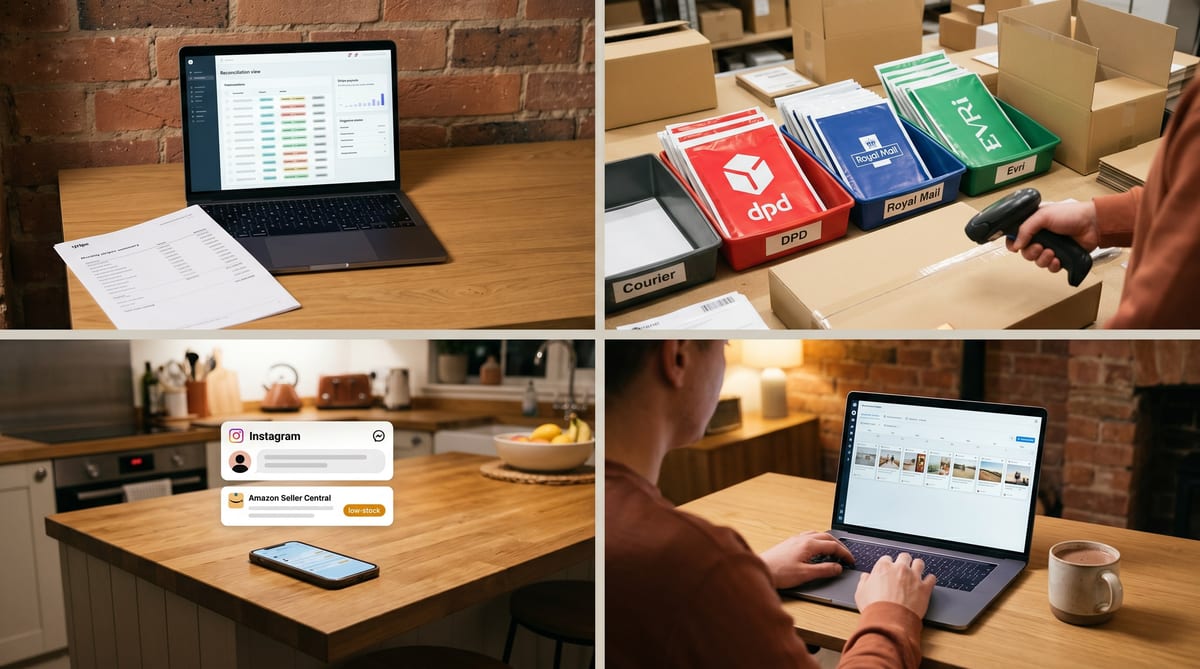
Example problems we could solve
Five things we hear most often from UK e-commerce sellers - with what the solved version looks like in your week. Each build is scoped per merchant: a £200k single-channel Shopify store typically needs sketches 1 and 2 and the lighter form of 3; a £2m multi-channel seller with TikTok Shop and Amazon FBA typically needs all five; a B2B / wholesale-led store typically needs 1 + 3 + 4 with the trade-pricing layer added. None of it requires ripping out Shopify, Klaviyo, Gorgias, Linnworks, A2X, or Loop where those are doing the job.
1. The inbound customer-service agent that answers in your brand voice - and knows whether the medium’s actually in stock
The same-five-questions moment: the same five questions on Instagram DM at 9pm, WhatsApp Business at 10:30, TikTok DM at midnight, Gorgias inbox during the day, and the missed-call SMS to the warehouse mobile - do you have it in a medium, what’s the lead time, is this gluten-free, can I return it, does it fit a one-year-old? You’ve answered them a hundred times this month and the answer’s already on the product page. The ecommerce-specific weight is that “do you have it in a medium” lives or dies on real-time variant stock - the agent has to answer from the same inventory truth that drives the order, not a stale knowledge-base PDF that was current in March.
The full build: Trainable Inbound AI Agent - trainable AI agent across Instagram + TikTok DMs, WhatsApp Business, web chat, the Gorgias / Zendesk / Front inbox, and missed-call SMS. Referenced across many verticals; the ecommerce version’s vertical-distinct features are the real-time variant-stock read from Shopify or the warehouse (the medium-in-stock answer reflects what’s actually in the warehouse right now, not a stale FAQ), the per-customer order-status read (so “where’s my order?” gets the actual carrier-scan status not a generic “it’s on its way”), the sizing-chart and allergen-and-fit Q&A trained on your real product data, and the escalation-to-human path for the genuinely-novel question that doesn’t loop the customer through a script before reaching the team.
2. The order-status comms that stops the where’s my order phone calls - and auto-routes the failed delivery
The where’s-my-order moment: order placed Tuesday, packed Wednesday, carrier-scanned Thursday, customer rings Wednesday, again Thursday, again Friday when the DPD courier card lands. The ecommerce-specific weight is the failed-delivery scan auto-route - “DPD couldn’t deliver: leave with a neighbour, redeliver Saturday, or pickup from the local shop?” fired direct to the customer’s phone without anyone ringing the warehouse, because every avoided ticket is an avoided cost and the failed-delivery moment is the single highest-volume customer-service trigger after “where’s my order?”.
The full build: Booking & Review Loop - order-status cascade with branded SMS / WhatsApp / email per milestone. Referenced across many verticals; the ecommerce version’s vertical-distinct features are the Royal Mail + DPD + Evri + Yodel + Hermes courier-specific delivery-window logic (each carrier exposes the scans differently and the customer-facing message has to read the same regardless), the failed-delivery auto-route option (the customer taps redeliver-tomorrow / leave-with-neighbour / collect-from-pickup-point and the carrier API picks it up), and the 90-minute post-delivered review prompt with one-tap links to Trustpilot / Google / Reviews.io / Judge.me (whichever your channel mix uses).
3. The Shopify-to-Xero daily reconciliation with the VAT layer you can stop hand-spreadsheeting
The IOSS-Word-doc moment: A2X gives one daily summary journal - gold standard. But IOSS, OSS, EPR PackUK, marketplace facilitator VAT - still a Word doc and a hopeful spreadsheet. The Q1 panic round happens because the running tag-as-you-go discipline never happened. The ecommerce-specific weight is that VAT is genuinely the costliest reconciliation discipline in this sector - IOSS and OSS quarterly returns, EPR PackUK October submission, marketplace-facilitator VAT on Amazon and eBay and Etsy and TikTok, plus the standard UK VAT on the direct channels - and a £200 hour with the bookkeeper is too expensive for what’s structurally an automation job.
Solved looks like: A2X (or Link My Books, whichever you’re on) as the Shopify-to-Xero daily summary backbone, with the awkward bits A2X doesn’t model wired alongside. Per-channel fee reconciliation across Amazon and eBay and Etsy and TikTok Shop runs on the same daily cadence. The compliance side stops being a Q1 panic and becomes a tag-as-you-go discipline - per-product packaging tonnage tagged at product creation feeds the EPR PackUK annual draft; B2C orders into the EU above the €10k threshold feed the IOSS / OSS quarterly draft; marketplace-facilitator VAT on Amazon / eBay / Etsy reconciles cleanly inside Xero. The bookkeeper gets one bookkeeping; the accountant gets the returns as drafts; the founder stops being the IT department. Dext supplier-receipt ingestion runs alongside so the cost side of the same month is in the same shape.
4. The multi-channel inventory sync that pauses the channel before Amazon penalises you
The Saturday-Buy-Box-ding moment: Shopify 12, Amazon 10, eBay 15, TikTok 8. Same SKU. Stockout on Amazon while still showing five elsewhere. Amazon dings the seller score before you noticed Saturday morning. The ecommerce-specific weight is that Amazon’s seller-performance score is a one-way ratchet down - once you’re flagged for chronic out-of-stock penalties, the rating recovery is months of clean trading - and the auto-pause is what protects it on the days a sister channel runs hot.
Solved looks like: a live inventory sync across Shopify + Amazon (FBA + FBM) + eBay + TikTok Shop + Etsy + Faire + Wayfair (the most common UK channel mixes), with a low-stock alert at a configurable threshold per SKU per channel and an auto-pause on the channel that’s heading for zero. The Thursday TikTok viral pauses Amazon by Friday morning instead of dinging the Buy Box on Saturday. Supplier reorder threshold triggers a draft PO into your usual supplier system; in-transit stock is visible per channel as available in three days rather than as a sold-out gap. Linnworks stays an option for higher-volume sellers; for everyone else, this is the bit Linnworks does at £350+/month, ported into your own stack.
5. The PlanPost-powered social cadence that doesn’t go quiet in October
The October-quiet moment: social posts went quiet in October because there’s no weekend to write them. Competitor down the road posts twice a day. By Christmas you’re trying to ramp from cold. The ecommerce-specific weight is that the social cadence is the cheapest customer-acquisition channel for a £200k-£2m DTC brand and the moment it goes quiet is exactly the moment paid traffic costs rise - Black Friday quarter - so the productivity gap costs more than just the missed reach.
Solved looks like: a content cadence on top of planpost - our own social-media scheduling SaaS - tuned to ecommerce voice and the rhythms of the year (Black Friday, January-sales, Mother’s Day, Father’s Day, back-to-school, summer-holiday, autumn-restock, Christmas-gifting). AI-drafted posts you approve on your phone in sixty seconds, scheduled to Instagram + TikTok + Facebook + Pinterest + Google Business Profile where your customers actually are. New-product launches auto-build into the queue when a product lands in Shopify; out-of-stock products quietly drop from upcoming posts. PECR-clean by default - service messages soft-opt-in, marketing strictly behind explicit consent. Same studio that runs planpost runs this for your store; when a platform changes its API, the cadence updates without you noticing. The cadence is wired into your live product catalogue, so the post that goes live on Tuesday morning is for a product that’s actually in stock and on the channel it’s selling on.
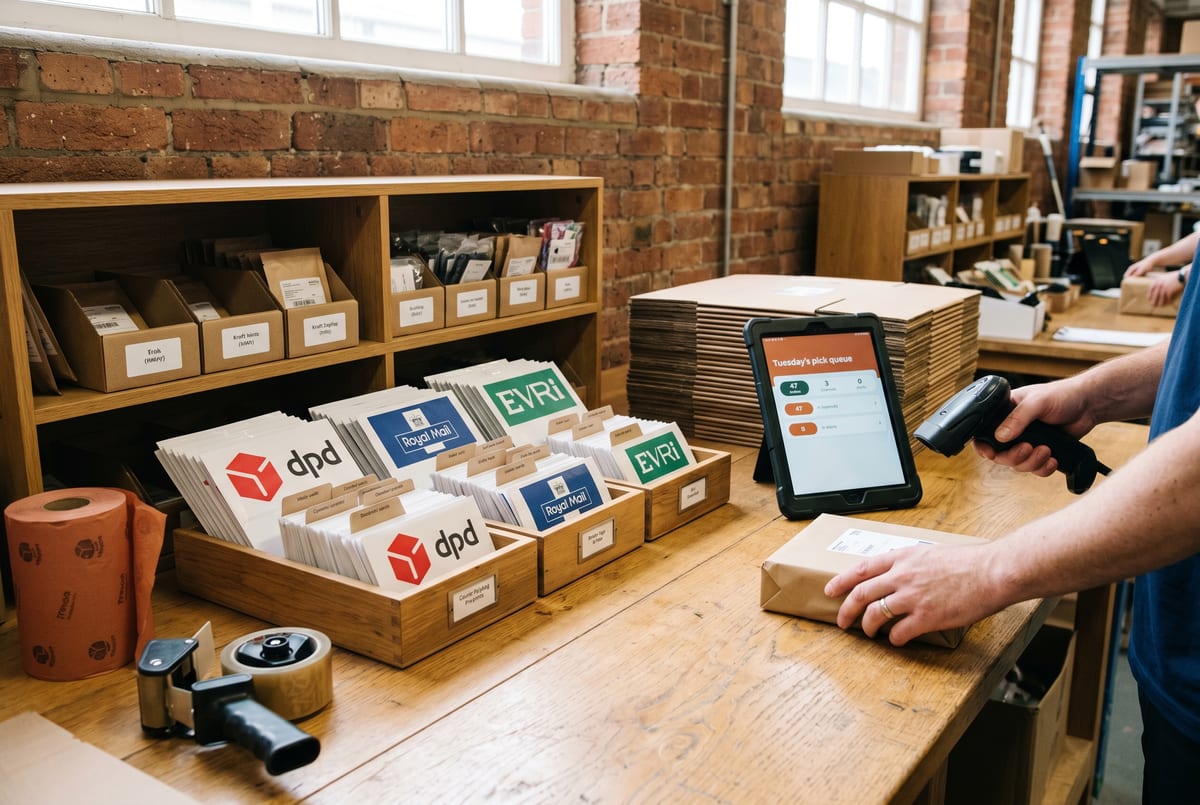
The closest things we’ve already built
- xcelluk merchant - our open-source Shopify-alternative commerce backend (xcell-lumise repo, xcelluk repo). Proof we can build commerce infrastructure end-to-end on the same stack we’d ship for you - when the bespoke route makes sense to replace the storefront too, this is the capability evidence.
- mendmyi - our own UK device-repair business running a service-plus-retail hybrid storefront we built. Different vertical, same dual-stack shape - service operations behind, product catalogue in front. The closest reference for a merchant who’s also a service operator (or vice versa). See Mendmyi.
- mendbuddy - the multi-channel AI agent platform behind sketch 1. Trained on your own product catalogue, FAQ, sizing chart, returns policy - handles inbound DMs across Instagram, TikTok, WhatsApp, web chat, and the Gorgias inbox under one operational view. Live-tested on mendmyi’s price-and-sizing DMs across Facebook Marketplace + WhatsApp + Instagram. See Mendbuddy.
- planpost - our social-media scheduling SaaS behind sketch 5. See Planpost.
- storytimebaker - our own-brand reference for any mobile-app-plus-server build (a branded iOS app alongside the web store, native push notifications, app-specific commerce paths). The pattern when a DTC brand needs a real app alongside Shopify rather than a wrapper. See Storytimebaker.
Sibling verticals
- Device repairif your merchant business has a service component, the device-repair hub covers the operational backbone of the service side and the parts-and-retail storefront pattern.
- Craft food and drinkthe EPR + Natasha’s Law + Food Standards Agency overlay shares discipline with the ecommerce compliance calendar.
- Hospitalitythe multi-channel + multi-POS reconciliation pattern reappears at restaurants and B&Bs; same operational engine, different industry.
- Wedding suppliersif you sell wedding-adjacent products direct to consumer, the wedding-supplier hub is the customer-side of the same conversation.
- Agriculturefor the farm-shop / on-farm-direct-sale arm of a diversified estate; the multi-channel-plus-direct retail pattern carries.
FAQ
Will this replace Shopify / WooCommerce / Magento / Klaviyo / Gorgias / Linnworks / A2X / Loop?
Usually no - those are the best-in-class tools and you should keep paying for them where they’re working. What we replace is the glue between them, plus the bits none of them quite handle (EPR, IOSS, the multi-channel inventory pause, the order-status cascade, the inbound agent that knows your sizing chart). For sellers running an open-source backend, the xcelluk-style stack we’ve built can replace the storefront too - but most won’t want to.
Do you optimise my Klaviyo flows / A/B tests / deliverability for me?
No. Klaviyo / Omnisend / Mailchimp campaign optimisation is your marketing team’s job (or an agency’s). What we build is the software wiring around your email tool - the consent ledger that respects PECR, the first-party data feed from Shopify / Xero into Klaviyo’s segmentation, the server-side tracking that backfills the iOS-14 attribution loss. You run the flows; we make sure the data feeding them is clean.
Can you handle EPR October reporting?
Yes. Per-product packaging tonnage tagged at product creation, modulated-fee estimation per quarter, annual report draft for PackUK and SCS. The earlier you start tagging, the cleaner the annual return; we wire it in as soon as we land on the build.
What about IOSS / OSS post-Brexit EU VAT?
Yes. IOSS for B2C orders under €150 (single Member State of Identification, quarterly return); OSS for B2C distance sales over €10k/year. Customs declarations on every parcel handled via the carrier’s commercial-invoice flow. If you decide the EU traffic isn’t worth IOSS because customer-refusal-on-VAT-on-delivery costs more, we wire that decision in too.
Will you handle Amazon Seller Performance / suspension risk?
The compliance side, yes - the timing of the inventory pause that stops the stockout penalty, the order-defect-rate monitor, the A-to-z claim handling cadence. The strategic side of Amazon (brand registry, A+ content, advertising) is your call; we’ll wire whichever tool you choose for it.
Triple Whale vs Northbeam vs Polar - which?
Depends on stack size, ad-platform mix, and which one your team can actually log into and act on. We’ve wired all three; the right answer is the one your operator opens on a Tuesday morning. The build is the same either way.
Can you build a branded native iOS / Android app alongside the web store?
Yes - storytimebaker is our own-brand reference for that pattern (mobile app plus server, native push, app-specific commerce paths). When a DTC brand needs a real app rather than a Shopify-wrapper, the build is a discovery conversation about which app-specific surfaces (loyalty, push-driven flash sales, app-only product drops, in-app community) earn their place against the cost of maintenance.
What does it cost?
Every build is scoped per merchant - depends on revenue band, channel count, subscription stack, whether the EPR / IOSS / TikTok Shop / native-app layers are in scope. We talk it through, agree the price in writing. See pricing.
How long until something’s live?
The Shopify-to-Xero stack and the order-status cascade can be live in a few weeks. The multi-channel inventory sync typically takes longer - depends on how many platform integrations need wiring. The trained customer-service agent is a few weeks once the source-knowledge ingestion (product catalogue, FAQ, sizing chart, returns policy) is signed off.
My business is single-channel Shopify under £500k revenue. Is this overkill?
The small-merchant scope is leaner - usually the Shopify-to-Xero stack, the order-status cascade, and the trained customer-service agent. Multi-channel inventory and the EPR / IOSS layer come in when the business is past those thresholds. We scope to where you are now.

Tell us what your merchant stack looks like
Send an enquiry - revenue band, primary platform (Shopify / WooCommerce / BigCommerce / Magento / open-source), channel mix (single / multi / TikTok-led / B2B-led / subscription), what’s on the subscription bill today, what’s eating your team’s evenings, whether a branded native app is on the wishlist. We’ll come back with a sketch of what we’d build and what it would cost. No calendar, no demo to sit through. Email reply, scoped sketch, you decide.