

Software for UK storm-damage roofers
Storm Babet hit on a Thursday. The phone didn’t stop for three weeks. I lost good customers I couldn’t get back to, and I won bad ones because I was desperate.
Storm-damage roofing is a different business. The customer isn’t really the customer - the loss adjuster is. The work isn’t paced - the weather is. The cashflow isn’t monthly - it’s autumn-feast / summer-famine, with a sixty-to-ninety-day wait between completion and payment, and insurer T&Cs you can’t argue with mid-claim. You’ll spend a quiet July wondering whether to hire, and a busy October running three crews you can’t quite afford until the November BACS lands. And every January the broker who sent you fifteen claims last autumn has forgotten your name.
This page is for the roofers whose work is mostly storm and insurance. You live and die by loss-adjuster relationships, photo-evidence packs, and capacity decisions made in the wrong season. If you do the occasional insurance job alongside a domestic re-roof book the main roofers page is the better fit; if you’re commercial-maintenance led, the commercial-maintenance spoke is the sibling. Storm-damage is its own thing because third-party-led is the operational pattern - the loss adjuster sits between you and the homeowner who thinks she’s your customer, and between you and the insurer who’s actually paying the bill.
What your week actually looks like
- Three jobs running concurrently, each with a different loss adjuster (Sedgwick on one, Crawford on the next, a direct-claims handler on the third) on a different insurer’s evidence requirement.
- A photo pack for an October claim that’s still being chased in February - you can’t remember which phone the initial damage shots are on, and the adjuster wants a during shot of the underlayment that no-one took.
- A new amber severe-weather warning landing on Wednesday, and a diary that’s already full of last week’s storm.
- A claim that came back denied because the evidence pack was missing one during shot of a lead flashing repair, and the homeowner thinks it’s your fault and the broker thinks it’s hers.
- A scaffold inspection record the loss adjuster wants but you only have on WhatsApp.
- An insurer who pays at sixty days when they’re easy and ninety when they’re not, and a quarterly VAT bill that doesn’t care which it is.
- A summer of half-empty diary you’re not sure how to fill - and a referrer relationship with three regional adjusters and two brokers that goes cold the moment you stop being top-of-mind.
- An NFRC / CompetentRoofer scheme renewal email landing in March that the insurer’s panel-management team will ask about in October, and you’d rather not be hunting for the proof on a Friday afternoon.
- The line between I’m a roofer doing storm repair work and I’m advising on a claim - which is FCA territory you don’t want to cross, even when the homeowner asks you to.
This isn’t a customer-flow software problem. It’s a third-party-led workflow with a sixty-to-ninety-day cash gap stapled to it.

Example problems we could solve
1. The photo-evidence pack the loss adjuster will actually approve first time
The denied-pack moment: twelve photos, a schedule of works, the scaffold inspection, your insurance cert, and a description that matches the insurer’s wording. Currently spread across three phones in two formats, going to four different adjusters who all want it slightly different. The claim came back asking for a during shot of the lead flashings that no-one took.
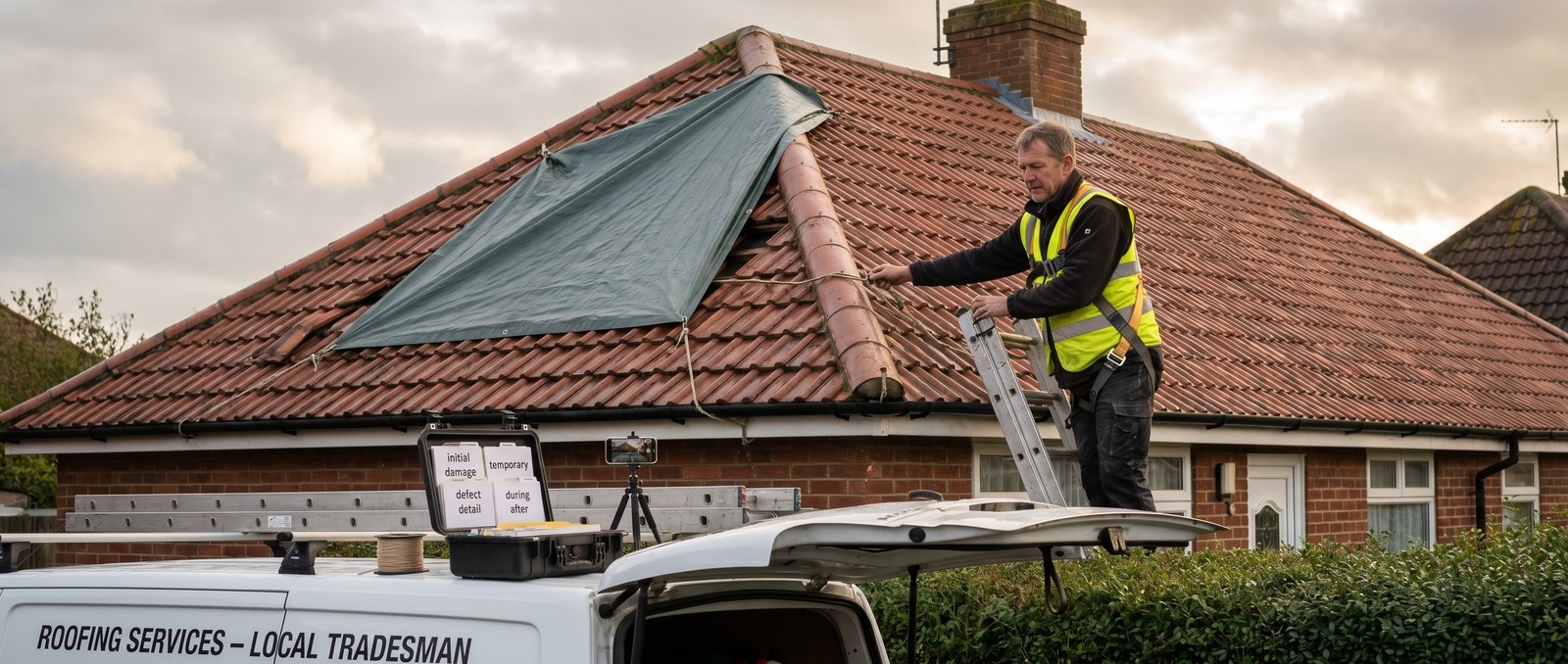
Solved looks like: a per-claim photo-capture flow stage-tagged on the tablet - initial damage (pre-tarp), temporary repair (the storm-damage emergency mode tarp or the lead-flashing patch), defect detail (close-up of compromised tile / felt / lead / dry-fix ridge / single-ply lap), during (work in progress, with each stage prompted), materials (batch references for lead, single-ply membrane, EPDM, dry-fix system), after - assembled into a branded PDF pack on demand, with the insurer’s preferred field order. Insurance cert, scaffold inspection record, your contractor PI and your NFRC / CompetentRoofer membership auto-attach. Per-adjuster templates so the pack you send to Sedgwick looks like Sedgwick and the one to Crawford looks like Crawford. The homeowner gets a parallel status SMS at each stage so she stops ringing you for updates while you’re up a ladder in the rain. The audit-log discipline - every action timestamped, every doc retrievable in one click - is what makes the six-months-later disputed-claim query a two-click answer instead of a Sunday evening hunting through phones.
2. The claim-status board you can show an angry homeowner
The chase-call moment: homeowner rings every other day because she thinks you’ve forgotten her - you’re waiting on the loss adjuster, who’s waiting on the insurer, who’s waiting on a panel surveyor. The storm-damage-specific moment is that the homeowner can see for herself who’s holding the ball - the homeowner-facing status board (submitted → with adjuster → site visit booked → schedule approved → tarp in place / temporary repair → work in progress → completed → paid by insurer) stops the chase calls without you doing the explaining.
Solved looks like: a per-claim homeowner-facing status board with automated state transitions from your inbox, the adjuster portal, and your engineer’s tablet. The homeowner sees the same record the adjuster sees, in her own voice - “tarp in place; schedule of works with Sedgwick since Tuesday; site visit booked for next Thursday”. The adjuster sees the structured workflow with the photo pack one click away. You stop being the explainer in the middle. The longer version lives at /solutions/customer-and-third-party-portal; the storm-damage version’s distinct feature is the insurance-pipeline-state visibility (Sedgwick / Crawford / Davies / direct-claims-handler workflow) shown to the homeowner without exposing her to the insurer’s actual system.
3. Capacity planning for a storm season you can’t predict
The Storm-Babet moment: “By the end of Storm Babet I had three crews and a fortnight’s diary I couldn’t fill. By the following July I had one crew and a hiring problem.”
Solved looks like: a thin capacity-planning view that ties your active claims, your historical storm-season win rate by referrer, and the live Met Office severe-weather watch into a single weekly digest. When a yellow or amber warning lands for your operating area, the view flags how many of your usual referrers (insurers, brokers, public-adjuster contacts) are likely to send work and projects against your crew and scaffold-subbie availability, so you can pre-book before the rest of the trade does. It won’t predict storms - nothing does - but it’ll stop you being the last one to make the calls when one hits. Storm-damage emergency mode then becomes a checklist you flip into for a week rather than a fortnight of chaos: triage script for the up-a-ladder line tightens, the tarp-first crew goes top of the diary, the homeowner-side comms cadence tightens to twice-daily, and the photo-evidence pack discipline gets enforced on every site visit.
4. Referrer-relationship cadence that doesn’t go cold in July
The forgotten-by-April moment: “Loss adjusters and brokers send work to whoever they remember. I’m busy in October and forgotten by April.”
Solved looks like: a thin referrer ledger - every adjuster, every broker, every insurer’s regional repair coordinator, with the date you last spoke and the number of claims they’ve sent you. A monthly nudge in the off-season - you, the system, or the agent on your behalf, your call - keeps the relationship warm. A printable annual report at year-end you can hand to a broker partner - here’s the eighty-two claims we ran for you, here’s the average time-to-completion, here’s the homeowner-satisfaction score, here’s the first-time-approval rate on the evidence pack - turns you into the contractor they’d struggle to replace. The longer version lives at /solutions/recurring-service-recall (the recurring-cadence chassis); the storm-damage version is the same engine pointed at referrer relationships rather than installed roofs.
5. The cashflow ledger that survives sixty-to-ninety-day pay
The VAT-bill moment: “VAT bill in March on a claim that won’t pay until May. My accountant says go flat-rate, my insurer pays gross of VAT, and I’m in the bank manager’s office trying to explain a sixty-day claim cycle to someone who’s never met a loss adjuster.”
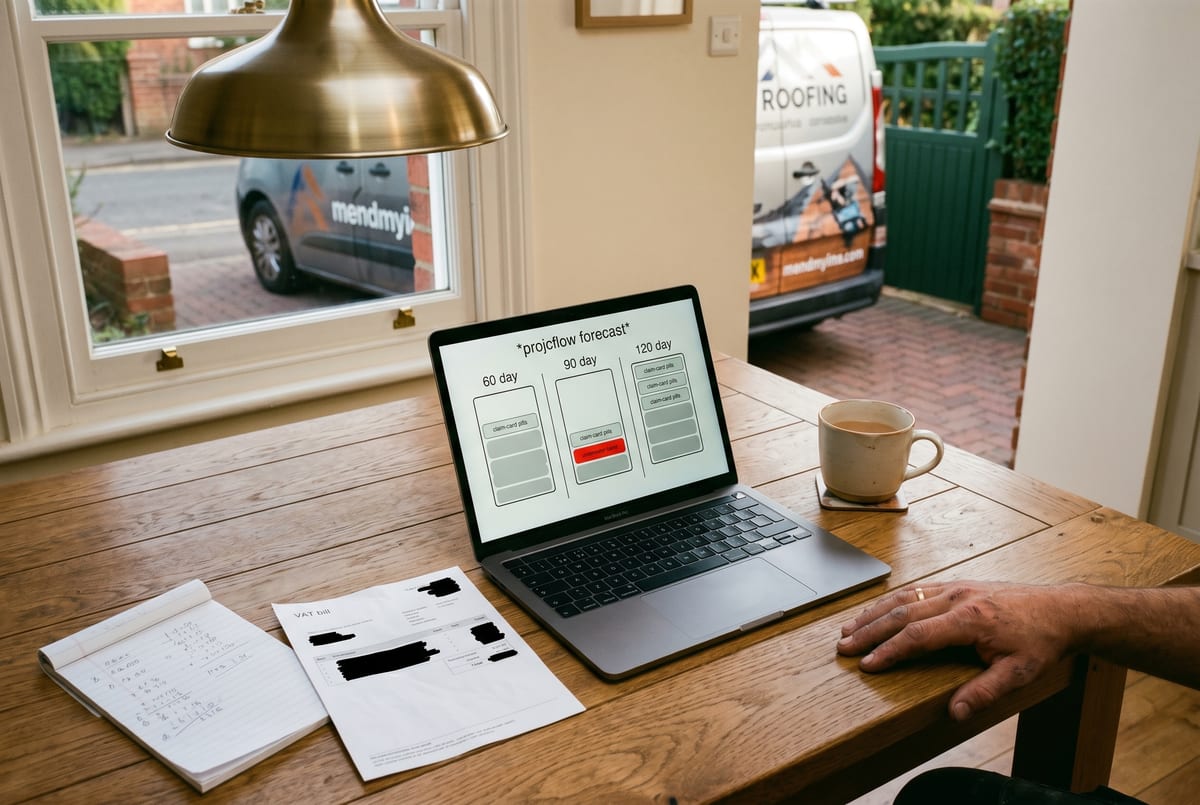
Solved looks like: a claim-paced cashflow projection on top of your existing bookkeeping. Each completed claim becomes a forecast cash event with an insurer-specific expected-pay date (sixty, ninety, sometimes one-twenty for the slower carriers, tracked per insurer from your own historical book); your VAT, CIS, payroll and subbie obligations sit alongside; the view shows you when you’re in a squeeze before the squeeze, not after. The chase ladder runs polite-but-firm and insurance-tuned - escalates to a phone call before email, names the adjuster, references the claim number, cites the statutory-interest position on the commercial side without sounding like you’re spoiling for a fight. The longer version lives at /solutions/invoice-and-dunning-ladder; the storm-damage version’s distinct feature is the per-insurer payment-cycle history driving the cashflow forecast.
6. Staying the contractor, not the claim adviser
The FCA-line moment: “The homeowner wants me to argue her claim. I want to be paid for the roof, not be a public adjuster in disguise - and I’m not authorised to advise on the policy.”
Solved looks like: a tightly-scoped homeowner-comms layer that draws the line for you. Templated language that explains what you do (assess damage, document evidence, repair) and what you don’t (advise on cover, dispute scope on the homeowner’s behalf, mediate with the insurer). A signposting flow that points the homeowner at the FCA-authorised public-adjuster register where appropriate. An audit log of every message - so if a claim gets sticky and someone asks whether you crossed a line, you can show that you didn’t. Less a product, more a guardrail - but storm-damage roofers we’ve talked to say it’s the single thing they’d most like the software to handle for them.
The closest things we’ve already built
- Allways Roofing Haverhilldomestic pitched-roof contractor in Haverhill, Suffolk. Allways’ book skews domestic but the studio that built the site understands the storm-and-insurance shape; the closest live reference for a storm-led roofer who wants the website and the back-office automation by the same hands. (Pull-quote and final outcome figures hold until the permission checklist clears - see /case-studies/allways-roofing.)
- mendbuddythe multi-channel AI agent platform that handles the storm-Sunday-night inbound surge, the off-season referrer outreach, and the homeowner-side status updates that stop the chase calls. Voice + SMS + WhatsApp + web chat + iOS. See /case-studies/mendbuddy.
- RepairMinderour SaaS for running an inbound-items repair business. Different vertical, same operational shape as the claim-pack and homeowner-portal flows here: job in, stages tracked, deliverable out, customer kept informed, audit log that survives years. See /case-studies/repairminder.
FAQ
Will this replace Eclipse Proclaim / Symbility / Xactimate / Buildxact?
Usually no. The claim-estimating platforms work fine for the actual scoping; what’s missing is the bit between site visit done and paid by insurer ninety days later. We sit on top, automate the pack assembly, the homeowner comms, the referrer cadence, and the cashflow projection - leave the estimating to the tool you’re already in.
Do you integrate with loss-adjuster portals?
Some yes, some no - depends which insurer and which adjuster firm. Where there’s a portal we can submit through, we wire it. Where there isn’t, we produce the pack in the adjuster’s preferred email format and queue it for you to send. Either way the homeowner-side status board stays current off the same record.
Will you handle the FCA / advice line for me?
No - we’ll build the guardrail (problem 6) but the regulatory line stays where it is. Public-adjuster advice is an FCA-authorised activity; you’re a contractor. We make it easier to stay clearly the contractor.
What does it cost?
Scoped per business - depends on claim volume, how many insurers and adjuster firms you work with, whether the pack workflow includes drone photography or thermal imaging, whether you want the cashflow dashboard. We talk it through, agree price in writing. See pricing.
My referrers send work via WhatsApp groups. Can you handle that?
Yes - WhatsApp Cloud API on the inbound side, with the agent triaging claims out of group chat into your claim ledger. The group stays where the relationship is; the work goes where the audit trail wants it.
Will the system handle the storm-damage emergency mode on its own?
For the inbound triage and the tarp-first scheduling, yes - the line tightens to the emergency script, the homeowner cadence tightens to twice-daily, the photo-evidence prompts harden on every site visit. The hiring and crew decisions stay with you; the operational layer just stops being the thing that breaks when the call volume goes 20x for a fortnight.
Up to the hub
← UK roofers (main page) · Commercial flat-roof + maintenance → · Lettings (sibling vertical) →
Tell us about the claims you’ve got running
How many concurrent claims, which insurers and adjuster firms, what the pack workflow looks like today, what your cashflow squeeze looks like in March. Send an enquiry - we’ll come back with a sketch.