


Software for UK independent funeral directors
Phone went at 3:17am. By 3:20 I was on the way. By 4 I was at the home. By 9 the family had a meeting in the diary, the registrar was provisionally booked, and the paper notice was drafted. The clergy invoice arrived three weeks later. The bookkeeper’s still matching it to the right funeral.
You’re the principal at a family funeral firm in a Suffolk market town, or the partner at a three-branch independent across mid-Essex, or the practice manager at a multi-branch family business that’s quietly fielding acquisition approaches from the consolidators every few months. NAFD / SAIF membership in the cabinet by the front door. Eulogica’s been your case-management system for fifteen years; it works, it’s the industry standard, most firms keep it. But the kitchen-table arrangement meeting is still a paper booklet with sixty-plus fields you re-key in the office on Monday morning. The disbursement reconciliation - clergy, organist, doctor, florist, paper notice, crematorium fee, doves, the charity-in-lieu collection that came in cash - is the bookkeeper’s Sunday afternoon for as long as anyone can remember; eight invoices a funeral, three different payment cycles, one estate-final-bill that gets sent to the family two weeks after the service. The Tell Us Once explanation is the third one this month. The memorial-mason hand-off at six months keeps the relationship alive in theory; in practice the family rings the mason near the crematorium at week four because nobody got in touch.
We make custom software for UK independent funeral directors - scoped per firm, sized to the bit between the 3:17am phone call you’re already taking yourself and the family who hears from you within sixty seconds with the ETA, the kitchen-table intake that lands in Eulogica without re-keying, the eight-invoice disbursement that reconciles itself into an estate-final-bill ready for Xero, the Tell Us Once baton the family actually completes, the six-month memorial conversation that lands when the family signals readiness. Not an Eulogica replacement - it’s the industry-standard case-management system and most of our clients keep it. Not a Funeral Manager / Plotbox / Oak / FuneralPlanner / Adage switch - the firm’s data lives where it’s been living. The bit between the case-management system that records what’s happening and the operational reality of running a funeral firm - that’s the bit we build. It lets the firm spend its time on the conversations only the firm can have (sitting with a family at four in the morning) and lets the paperwork assemble itself in the background between the first call and the estate-final-bill.
What you spend your week on that you shouldn’t have to
- 3:17am phone call. You’re out of bed, dressed, in the car by 3:25, at the home by 3:55. While you’re driving, the bereaved family is sitting up alone wondering whether to ring another firm. The twenty minutes between the call and your arrival is the trust-establishing window the next firm down the road will fill if you miss the call.
- 90-minute meeting at the family’s kitchen table on Tuesday afternoon. Sixty-plus data points in a paper booklet - deceased details, family details, hymns and readings, music, flowers, paper notices, hearse and cars, cortège route, catering, the charity-in-lieu the daughter wants to support, the two doves the grandson asked for. Wednesday morning you’re re-keying it all into Eulogica; the spelling of the deceased’s middle name has three variants because the family member who filled in that page wasn’t sure.
- Disbursement reconciliation. This funeral: clergy £180, organist £85, doctor £82, florist £340, paper notice £165, crematorium £950, doves £170, the charity collection that came in £640 of mixed cash and one cheque. Eight invoices land across the next four weeks, each on a different payment cycle, each needing matching back to the right funeral from three months ago. The bookkeeper’s Sunday afternoon for three Sundays running.
- Tell Us Once explanation to the family. Third time this month. The widow’s overwhelmed, the daughter’s the practical one, you walk them through the digital service one paragraph at a time and write a note in the booklet about where they got stuck. Three weeks later the daughter rings to say HMRC sent a letter the family doesn’t understand; you suspect Tell Us Once wasn’t completed.
- Registrar appointment in some boroughs is five days out, sometimes seven. The family’s stressed, the crematorium’s already provisionally booked, the funeral date’s now in question. Three phone calls between the family, the registrar, and the crematorium to re-stitch the timing.
- Paper-notice copy to the Suffolk Free Press, Bury Free Press, and the EADT for one funeral. Three different deadlines, three different approval workflows, three different invoice formats. The family sends edits in by SMS at 9pm; the printing deadline’s 11am tomorrow.
- Memorial-mason hand-off at six months. The BRAMM mason you usually refer to is good; the conversation should happen at twelve weeks if you’re keeping in touch and ends up at eighteen months if you’re not - by which point the family has already paid a deposit to the mason whose advert was in the parish magazine.
- Cortège planning Tuesday afternoon for Thursday’s service. Chapel of rest to the home, the home to the church, the church to the crematorium, the crematorium to the wake venue. School run cuts across the second leg; the hearse needs a slow lead but the limos need to keep up; the driver rota’s mostly in your head. Phone calls between three drivers all morning.
- Pre-paid plan paperwork on a new plan sale. Disclosure log, customer acknowledgement, provider documentation, the SMCR statement of responsibility you’re not entirely sure where you filed last quarter. The plan-provider’s portal works fine when you can find the password.
- A family member rings three weeks after the service - the daughter’s husband says the floral tribute wasn’t what was discussed at the meeting. The order is in the booklet, in your handwriting, in the kitchen-table notes. The conversation he’s remembering is the one his wife had with you in the kitchen four weeks ago. The order is right; the memory is grief-blurred. The response needs to be careful.
These aren’t problems Eulogica’s next release is going to solve. They’re the layer between the case-management system that records what’s happening and the family that hears from you within sixty seconds of the 3am call, the intake that lands in Eulogica without re-keying, the disbursement that reconciles itself, the Tell Us Once baton the family actually completes, the memorial conversation that lands at six months not eighteen. That’s the layer.
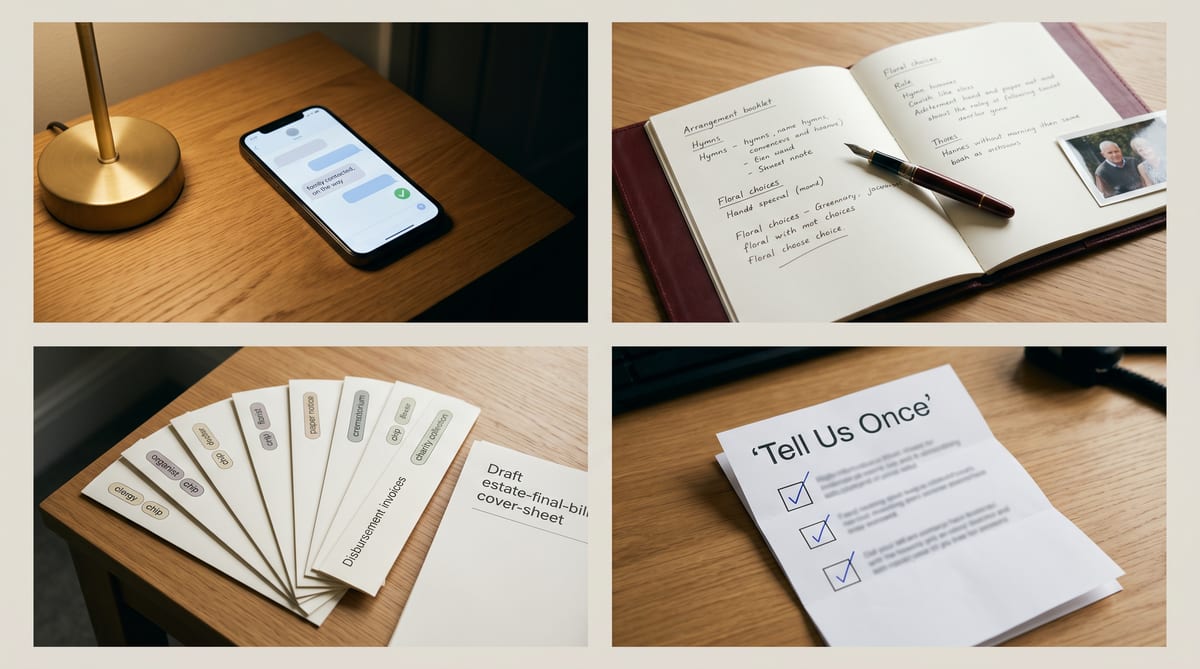
Example problems we could solve
Five things we hear most often from UK independent funeral directors - with what the solved version looks like in your week. All five apply universally across traditional independents, multi-branch independents, direct cremation specialists, and BRAMM-aligned memorial firms - with the texture (single-branch vs multi-branch, plan-selling vs not, memorial-paired vs not) scoping in discovery. Most single-branch firms start with problems 1 + 2 + 3; multi-branch firms typically need all five plus a branch-coordination layer.
1. The 3am call where the family hears from you in sixty seconds - and the agent that escalates too eagerly, not too late
The 3:17am moment: the phone rings. You’re out of bed by 3:20, in the car by 3:25, at the home by 3:55. The twenty-five minutes between the call and the doorstep is the window where the family is sitting up alone wondering whether to ring another firm - and the single most trust-establishing exchange in the entire customer relationship. The funeral-distinct weight is that the wrong thing said to a bereaved family at three in the morning is unrecoverable - so the default we build around is the agent doesn’t speak. The call is picked up within a ring or two, the line is held open gently for up to ninety seconds while the on-call rota wakes, the on-call director is paged in parallel with whatever caller-ID and location context the line carries, and the first voice the family hears is your director’s, dialling back from the car. The strict escalation matrix routes every signal of distress, ambiguity, or any caller who isn’t the immediately bereaved family member straight to the on-call director; the default is escalate too eagerly. For firms that explicitly prefer a spoken acknowledgement during the hold, the opt-in alternative is a tightly-bounded scripted opening (“someone from our firm is on their way to you, and they’ll be with you very soon”) reviewed with the principal before any live use - gentle, slow, and going no further than that single line, with anything beyond “we’re on our way” handing to a human immediately.
The full build: Trainable Inbound AI Agent - the trainable AI agent on the practice phone with sensitive-context voice training, plus on-call rota escalation with a 90-second second-on-call fallback. The funeral version’s vertical-distinct features are the silent-hold default (the agent picks up and keeps the line open without speaking, paging the on-call director in parallel so your director’s voice is the first the family hears), the opt-in gentle scripted opening for firms that explicitly prefer a spoken acknowledgement during the hold (the agent’s first words reviewed with the principal before any live use), the strict escalation matrix (any open-ended question, any distress signal, any caller who isn’t the immediately bereaved family member hands to the on-call director instantly), the parallel-dispatch behaviour (the agent texts the on-call director the deceased’s name + location + family contact while still holding the line so the dial-back from the car already has full context), and the post-call audit (every recording reviewed for tone in the first month, then by sampling, so the voice stays in the gentle, slow, bounded register and never drifts into the brisk, efficient, scripted one).
2. The 90-minute kitchen-table meeting that lands in Eulogica without re-keying
The Tuesday-afternoon moment: you’re at the family’s kitchen table on a Tuesday afternoon, taking down the arrangement - names, dates, ceremony, hymns and readings, music, flowers, paper notices, hearse and cars, cortège, catering, the charity-in-lieu wording, the two doves the grandson asked for. Sixty-plus data points on a paper booklet. Wednesday morning back at the office you’re re-keying it all into Eulogica; the spelling of the deceased’s middle name varies three ways across the booklet because three different family members filled in three different pages. The funeral-distinct weight is that the arrangement meeting is the single most emotionally weighted hour-and-a-half of the entire engagement and the document captured in it carries every detail forward to every subsequent stage of the service. Capture-on-the-day needs to be complete, structured, and re-keying-free - so Wednesday morning is on the family’s needs, not data entry.
Solved looks like: the arrangement intake as a structured tablet-based flow, branded to your firm, that lives where the meeting actually happens - at the family’s kitchen table, in the chapel-of-rest meeting room, wherever you sit with them. The flow’s shaped around the actual arrangement conversation: gentle opening (the deceased’s name as the family wants it remembered, the family present, the relationship to the deceased), ceremony preferences, hymns and music and readings, flowers (with specific line-items: spray for the coffin top, individual posies for the children, charity-in-lieu wording), paper notices (with the press list per region - Suffolk Free Press, Bury Free Press, EADT, Newmarket Journal, with deadlines and copy-approval workflow per paper), hearse and cars, cortège route, catering, charity-in-lieu, doves / pipers / poems / special requests. Each section auto-saves; the family can review the captured detail at any point during the meeting and correct on the spot. When you leave the kitchen table, the intake has already imported to Eulogica (or Funeral Manager, or Plotbox - whichever you run); the order-of-service draft, the paper-notice draft, and the family-portal preview are assembling in the background by the time you’re back at the office.
3. The disbursement ledger that reconciles itself - and the estate-final-bill ready for Xero by Friday
The bookkeeper-Sunday moment: eight invoices a funeral. Clergy, organist, doctor, florist, paper notice, crematorium, doves, the charity collection. Each on a different payment cycle. The bookkeeper’s Sunday afternoon for the next three Sundays is matching them to the right funeral from three months ago. The estate-final-bill takes a fortnight to assemble after the wake. The funeral-distinct weight is that an independent funeral firm’s disbursement reality is genuinely complex - eight independent suppliers, three payment cycles, multi-party reconciliation, a final bill that needs to read clearly to a grieving family - and the bookkeeper-Sunday is the cost of doing it manually. The build is shaped around making the reconciliation automatic so the estate-final-bill arrives with the family within the week, not the fortnight.
Solved looks like: the disbursement ledger as a structured per-funeral object that tracks every third-party expense from the moment it’s incurred. At the arrangement meeting (problem 2) the intake captures the expected disbursements - clergy fee, organist fee, doctor fee (if cremation), florist order with line items, paper notice across each named publication, crematorium / cemetery fee, doves, pipers, charity-in-lieu collection method. Each disbursement carries an expected amount, an expected supplier, and a status (ordered / invoiced / paid). As the invoices land - by email, by post, by the supplier’s portal - they’re parsed automatically and matched to the right funeral by reference + supplier + date; ambiguous matches drop into a one-screen queue with the suggested funeral and a one-tap confirm / re-assign. When all disbursements are reconciled, the estate-final-bill PDF generates with the structured detail (so the family sees clergy £180, organist £85, doctor £82, florist £340 broken out clearly, not bundled into a single line) and the Xero invoice posts at the same time with the correct codes and supplier-level splits. The charity-collection side (cash + cheque + online) reconciles separately to the named charity.
4. The Tell Us Once baton the family actually completes - and the registrar slot the system finds on the family’s behalf
The third-Tell-Us-Once-this-month moment: Tell Us Once explanation for the third time this month. The widow’s overwhelmed, the daughter takes the notes. Three weeks later HMRC sends a letter the family doesn’t understand. You suspect Tell Us Once wasn’t completed. The registrar slot’s five days out anyway - the funeral date the family wanted’s already slipping. The funeral-distinct weight is that a bereaved family is asked to navigate the most administratively-dense fortnight of their adult life at the moment they are least equipped to do so. The funeral director is the human guide they trust to help them through it; the build is shaped around making the guidance structured and persistent so the third explanation is the system’s job, and the funeral director’s time stays on the conversations only they can have.
Solved looks like: the family-concierge layer that walks the family through the post-death paperwork sequence on their phone, in their time, in plain language. The Medical Certificate of Cause of Death state (digital in some councils, paper in others) is tracked structurally - the family sees “we’re awaiting the digital MCCD from the hospital; estimated [date]; we’ll let you know the moment it’s released” rather than wondering. The registrar-booking step shows the next available slots across the local register offices in the family’s preferred area with the funeral-date impact noted (“booking on Friday means the funeral can be held from Thursday week; booking on Tuesday opens the Wednesday after”); the family taps the slot that works, the system books the appointment and confirms in your customer-side voice. The Tell Us Once script is presented as a plain-language checklist with each organisation the service notifies (HMRC, DVLA, Passport Office, DWP, local council electoral / council tax / blue badge) and a “done / not yet / need help” tap per item - the family completes at their pace, the firm sees the completion state on the case file, and where the family flags “need help” the conversation gets prompted before it becomes a March-letter from HMRC. Cremation Form 1 / Form 2 paperwork pre-fills from the case file with only the medical-referee signature outstanding.
5. The six-month memorial conversation that lands on the right Tuesday - not at month eighteen, not at week four
The lost-memorial moment: memorial-mason hand-off is supposed to happen around six months. In practice the family rings the mason whose advert was in the parish magazine because you lost touch at week four. By month eighteen they’ve already paid a deposit. The memorial work that’s part of your firm’s offer just goes elsewhere. The funeral-distinct weight is that the memorial conversation is genuinely time-sensitive - too early reads as commercial and breaks trust, too late and the relationship’s gone elsewhere - the right moment is per-family rather than per-month. The build is shaped around making the cadence a respectful, opt-in conversation that lands when the family signals readiness, not a CRM blast and not a folder of forgotten leads.
Solved looks like: the memorial-recall cadence as a per-family scheduled conversation with explicit family consent captured at the arrangement meeting (problem 2). Where the family opted in at intake, the system schedules gentle check-ins at four / six / nine / twelve months - “It’s been six months since we said goodbye to [Name]. When you’re ready, and only when you’re ready, we’d be honoured to talk about a memorial with you. There’s no pressure - many families wait longer, and the conversation’s the same whenever it happens. If now isn’t the right time, just reply LATER and we’ll check back in a few months. If you’d rather not hear from us about this, reply STOP and we’ll quietly close the loop”. The cadence respects the family’s reply - LATER pushes the next check-in by a configurable interval, STOP closes the channel permanently with the consent-state logged. Where the family engages, the conversation hands off to the principal or the memorial-paired BRAMM mason with the family’s preferences from the arrangement intake already in context (the burial / cremation choice, the location of the ashes or grave, the religious context, the budget hints from the original meeting). The dashboard shows the firm’s memorial-conversion rate at six and twelve months, and the cohort of families currently in-window who haven’t yet been contacted, so the principal sees where the relationship is alive and where it needs a gentle nudge.

The closest things we’ve already built
- mendbuddyour multi-channel AI agent platform. Behind the 3am out-of-hours first-response in problem 1 (the gentle, voice-trained agent that holds the line for ninety seconds with “someone from our firm is on the way to you” and escalates to the on-call director at the first sign of anything beyond that), the Tell Us Once family-concierge messaging in problem 4, and the six-month memorial check-in cadence in problem 5. Voice + WhatsApp + SMS + web chat - the voice-side trained specifically on funeral-sector sensitivity for clients of this kind. See Mendbuddy.
- repairminderour SaaS service-business management software. The case-file + job-history + photo-evidence + status-cascade pattern is shape-wise the same as a funeral case file from the first call through the estate-final-bill: a customer (family) + asset (the deceased’s service arrangement) + history events (arrangement, viewing, ceremony, cortège, wake) + structured comms. The funeral-side build inherits the pattern. See Repairminder.
- mmi-servicesour legacy insurance-claims system being modernised. The reference when a firm wants to keep Eulogica (or Funeral Manager, or Plotbox) as the case-management system-of-record and add the operational layer around it - same shape, different domain. See Mmi Services.
- pharmaceutical-analytics.comanalytics dashboard built for an analytics consultancy. The principal’s KPI surface (case load by branch + director, disbursement-state across open cases, plan-book health across the FCA-aligned plan portfolio, memorial-conversion rate at six and twelve months, average estate-final-bill cycle time) sits on the same pattern: operational data captured at every touchpoint, decision dashboard for the principal. See Pharmaceutical Analytics.
If your firm’s narrower than the whole of the above
Most of the funeral-firm shapes we work with - single-branch independents, multi-branch independents, direct cremation specialists, BRAMM-aligned memorial masons working alongside a funeral firm - share most of the hub above. The bits that genuinely differ scope in discovery: a single-branch traditional firm often starts with problems 1 + 2 + 3 and adds 4 + 5 when the family-concierge and memorial-conversion conversations land; a multi-branch independent typically needs all five plus a branch-coordination layer where the on-call rota and the disbursement ledger cross between branches; a direct-cremation specialist needs a streamlined intake (problem 2) and a family-concierge (problem 4) shaped for the no-attendance funeral; a memorial mason needs the memorial-conversation half of problem 5 with the funeral-firm pairing on the referral side. None of these warrant their own page yet - they’re a discovery conversation, not a separate buyer.
Adjacent verticals
- Solicitorsthe closest professional-practice adjacency; many independents have a long-standing referral relationship with the local high-street firm doing probate work, and the case-file + disbursement + structured-comms pattern is genuinely similar.
- Charitiesfor the charity-in-lieu side of the arrangement: many families specify a named charity for in-memoriam giving, and the donor-comms loop crosses into the charity’s stewardship sequence.
- Lettings + property managementfor the property-clearance and estate-handling side that overlaps with the period between death and probate (lettings agents are sometimes the first call from the executor).
- Professional servicesfor the wider practice-management shape where the project-based + retainer-cashflow + structured-intake pattern recurs.
FAQ
Will the build work alongside our Eulogica / Funeral Manager / Plotbox / Oak / FuneralPlanner / Adage install?
Yes for all the named ones - the case-management system stays as your system-of-record for the funeral case file. The build sits as a layer around it: the out-of-hours triage, the tablet-based arrangement intake, the disbursement reconciliation, the family concierge, and the memorial-recall cadence all read from and write to the existing system via the integration surface it exposes. Eulogica has a workable API and a long-established install base; Funeral Manager is modern cloud and well-suited to integration; Plotbox and the others have varying integration surfaces - we confirm in discovery against your specific install.
Will the 3am agent really know when to stop talking?
That’s the design rule. The agent is trained to do one thing in the first thirty seconds - say “someone from our firm is on the way to you, and they’ll be with you very soon” in a gentle, slow voice - and to escalate to the on-call director at the slightest signal of distress, ambiguity, complexity, or any caller who isn’t the immediately bereaved family member. The default is escalate too eagerly. Every recording is reviewed for tone in the first month of operation, then by sampling, so the voice stays in the gentle, slow, bounded register and never drifts. Where you’d rather the agent not answer at all and simply hold the line for ninety seconds while paging the on-call director, that’s the configuration we’d ship by default.
Will the disbursement reconciliation talk to Xero / QuickBooks / Sage / FreeAgent?
Yes for all four. Each disbursement is captured at the arrangement meeting as a structured line, matched to its expected supplier and expected amount; as invoices land they reconcile automatically against the funeral and write back to the accounting system with the correct codes (clergy fee, professional fees, paper notices, crematorium fees, etc.) and supplier-level splits. The estate-final-bill posts as one structured invoice with the disbursements broken out clearly for the family.
Will the family-concierge layer respect the family’s pace and the sensitivity around bereavement comms?
Yes - that’s the whole design rule. Every cadence (3am triage, intake follow-ups, post-funeral check-ins, memorial recall) carries an explicit family-consent state captured at the arrangement meeting; every message is reviewable in your voice before any go-live; every channel honours STOP / LATER / PAUSE on a single reply. The system never sends commercial-feeling messages without the family having opted in to that specific cadence, and the tone is reviewed for funeral-sector sensitivity before any live use.
Will the build handle our pre-paid funeral-plan paperwork - disclosure logs, customer acknowledgements, provider documentation, SMCR statements?
Yes - for firms operating as appointed representatives of authorised plan providers (Golden Charter, Ecclesiastical Funeral Plans, Co-op, Open Prepaid Funerals, Best Welcome, MemoriaPP), the system captures every plan sale with the structured disclosure record + customer acknowledgement signature + provider documentation upload, and assembles the annual SMCR evidence pack into a single submission-ready record. We don’t make the FCA-accountable judgement - that stays with the named senior manager - but the evidence assembles itself as you operate.
Will the cortège-coordination side talk to the crematorium booking systems and the per-crematorium paperwork?
The crematorium-side paperwork (Form 1, Form 2, authority - variations per crematorium) pre-fills from the case file with only the medical-referee signature outstanding. Booking is via each crematorium’s portal (most are bespoke or per-Memoria / Westerleigh-group templates) which we read and write against where the integration surface exists. The driver rota for cortège day is a structured rota with status updates to each driver at chapel-departure / home-arrival / church-arrival / crematorium-arrival / wake-arrival, and the family’s lead car gets the same updates so the moments are predictable.
What does it cost?
Every build is scoped per firm - depends on branch count, current case-management system, plan-book size, memorial-mason pairing, and whether the build covers all five problems above or a subset. We talk it through, agree the price in writing. See pricing.
Tell us what your week looks like
What firm you run - single-branch independent, multi-branch, direct cremation, BRAMM memorial mason - and how many funerals a year. Your case-management system (Eulogica / Funeral Manager / Plotbox / Oak / FuneralPlanner / Adage / EVA Online / something else / paper-and-Excel). Whether you sell pre-paid plans and which provider you work with. Where the operational pain lives - the 3am call gap, the kitchen-table re-keying, the bookkeeper’s Sunday afternoon, the Tell Us Once explanations, the registrar slots, the memorial-mason hand-off. Send an enquiry - what you do, what’s slowing you down, what you’ve already tried. We’ll come back with a sketch of what we’d build and what it would cost. No calendar, no demo to sit through. Email reply, scoped sketch, you decide.