

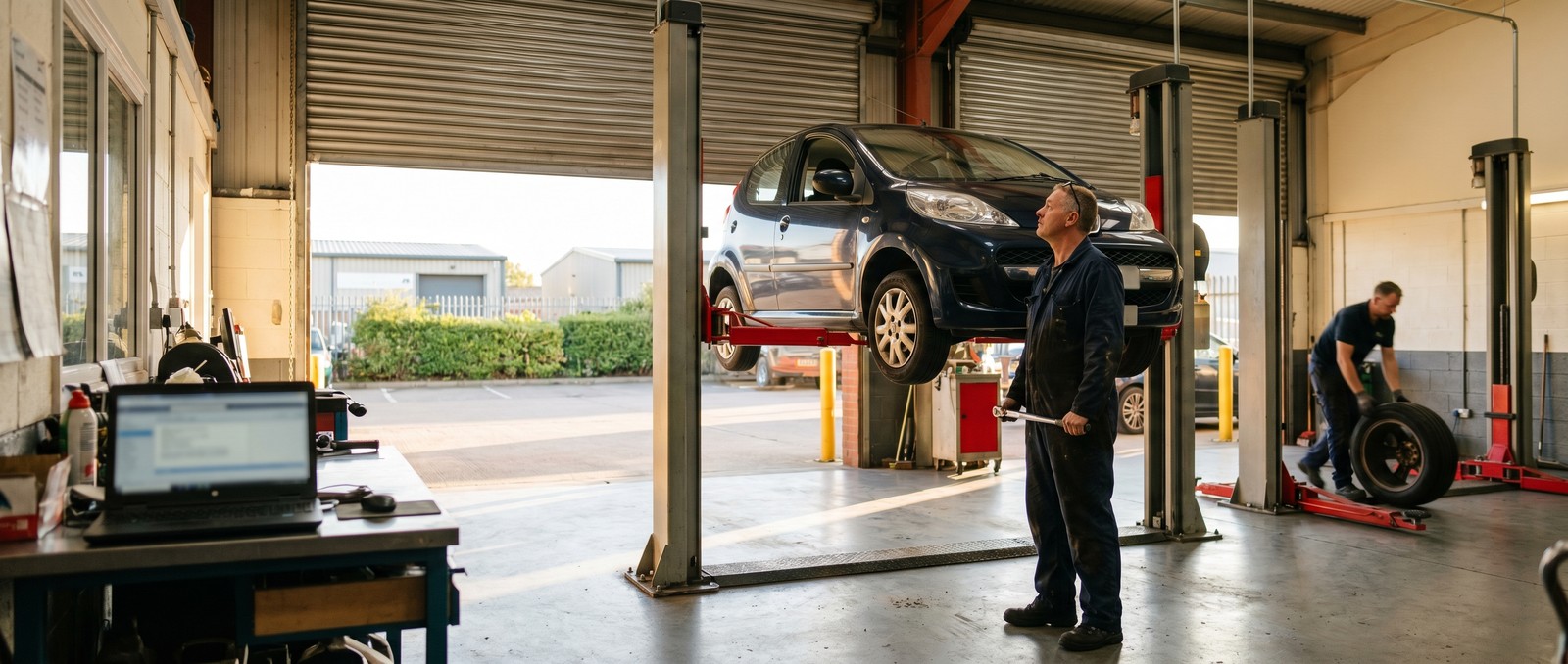
Software for UK independent garages
DVSA gives me the data. Every car I MOT’d eleven months ago should be back this month. Sixty went somewhere else last year because the place down the road texted them at thirty days. I’ve got the same data - I just don’t have a system that uses it.
You’re the owner-mechanic at a four-bay independent in a market town doing services + MOTs + repair, or the principal at a small bodyshop with two ramps and a paint booth, or the partner running the office while your husband’s under the Astra on bay two, or the IGA-affiliated MOT centre on the edge of an industrial estate with two Class IV bays and a Class VII for the LCVs. Either you’re on Garage Hive - works fine, the diary’s clean, but the MOT recall ladder you’d hoped would automatically book the customer back is sitting unconfigured because it’s been a busy quarter; or you’re on Autowork Online - works, looks like it was last updated a decade ago, the integrations don’t quite reach; or you’re on GenesisAutomotive or TechMan or AutoChain or a spreadsheet and the bookings WhatsApp the office number you check between jobs. The DVSA recall the API hands you on a plate isn’t getting used. The £400 of advisory work the tech found at 10am Tuesday is sitting in a voicemail the customer didn’t pick up until 4pm. The wishbone you quoted at £85 on Tuesday went up to £91 by Wednesday at Euro Car Parts and you ate the £6 - three times a week, £900 a year gone for nothing. The Skoda Citigo you’re running as a courtesy car is parked at the petrol station two miles away with an MOT that ran out last month. Saturday morning’s the usual - four booked, six walk-ins, MOT bay running separate, the apprentice on the verge of tears.
We make custom software for UK independent garages - scoped per workshop, sized to the bit between the DVSA MOT history we already have access to and the customer who actually books back in. Not a Garage Hive / Autowork Online / GenesisAutomotive / TechMan / AutoChain rip-and-replace - the diary system works for what it works for. Not a Euro Car Parts / GSF / Andrew Page / Motor Parts Direct replacement - the wholesaler relationships sit where they sit. The bit between the GMS and the wholesaler and the DVSA API and the customer’s WhatsApp - the MOT recall that converts at thirty days not at expiry day, the photo estimate with one-tap-per-line approval that lands in the customer’s pocket while she’s still at her desk, the Saturday-morning bay re-shuffle that re-flows the diary in real time, the parts margin that catches the £6 slip before invoice not on Sunday afternoon, the loan-fleet register that knows its own MOT date - that’s the layer we build. Tell us what your workshop’s week looks like and we’ll come back with a sketch.
What you spend your week on that you shouldn’t have to
- The MOT customer who rings on the day her certificate expires - “can you fit me in this afternoon?” You can’t; the place that texted her at thirty days could. Sixty of those last year, at roughly £35 / vehicle margin × 800 vehicles MOT’d × 70% conversion if the recall ladder actually ran - that’s the real cashflow argument, sitting unconfigured on the GMS dashboard since the day the install engineer left.
- A tech who finds £400 of advisory work at 10am Tuesday - brake discs, pads, lower-arm bush - photo on the workshop phone. Service advisor rings the customer, voicemail. Calls again at noon, voicemail. The bay’s been earmarked all day; by 4pm the customer picks up the voicemail and says “can’t approve over voicemail anyway, can you ring me tomorrow?” The bay’s now a wash and the advisory work goes onto the book it next time list that nobody reads.
- A pair of wishbones quoted at £85 Tuesday. Customer signed the estimate. Wednesday morning the ECP trade price went up to £91 - you eat the £6, or you have the awkward call. Three times a week, £900 a year of silent margin slip you don’t see until your accountant rolls up the year-end and tells you the parts line was worse than last year “by a few hundred quid”.
- Saturday morning. Four booked across the bays, MOT bay running its own slot-rota. By 9:15 there’s a walk-in with a flashing engine light, by 9:45 there are six in the waiting area, by 10:30 the apprentice’s lost track of which key belongs to which Corsa and the Audi customer is shouting because her service has slipped two hours.
- Wholesaler statements drop monthly - Euro Car Parts, GSF, Andrew Page, Motor Parts Direct. Sunday afternoon reconciling against jobs raised, parts returned, parts credit-noted. The £180 of credit note ECP still owes from March is on a printed sheet somewhere; the wrong-side wishbone that came back unopened never made it onto the spreadsheet.
- Five jobs in, two customers asking for a courtesy car, you’ve got one - and the one you’ve got is the Skoda Citigo whose own MOT lapsed three weeks ago because nobody’s looking after the loan-fleet diary the way they look after the main bay diary.
- A Trustpilot / Google review timing problem - five-star reviews bunch when you remember to ask, the rating drops the week you don’t. The customer who really did get a great job done Tuesday gets the “how did it go” SMS Wednesday at 6pm when she’s making tea, doesn’t open it, by Friday the moment’s gone.
- A new-customer Facebook DM Thursday lunchtime - “can you book me in for an MOT next week?” - the shop’s deep in a clutch job, the DM gets picked up at 5pm, by then she’s booked elsewhere and your acquisition cost on the next one’s the same again.
- Bodyshop work (where you do it) - Audatex estimate, Glass’s image upload, Repairify diagnostic session, insurer call centre, courtesy-car despatch. Five logins, four T&Cs, one job, three days of admin per claim.
- EV / hybrid work - you’ve got one tech with the IMI Level 3 EV TechSafe, the other two aren’t qualified to go near the high-voltage harness. The booking diary doesn’t know that. The hybrid Yaris just got booked in with the apprentice marked against it because the booking flow doesn’t read the V5C fuel type.
These aren’t problems Garage Hive’s next release is going to solve. They’re the layer between the diary system that records what’s happening and the customer who comes back, the £400 of advisory that converts at 10:15am not 4pm, the parts margin that holds, the loan car that doesn’t fail its own MOT. That’s the layer we build.
Example problems we could solve
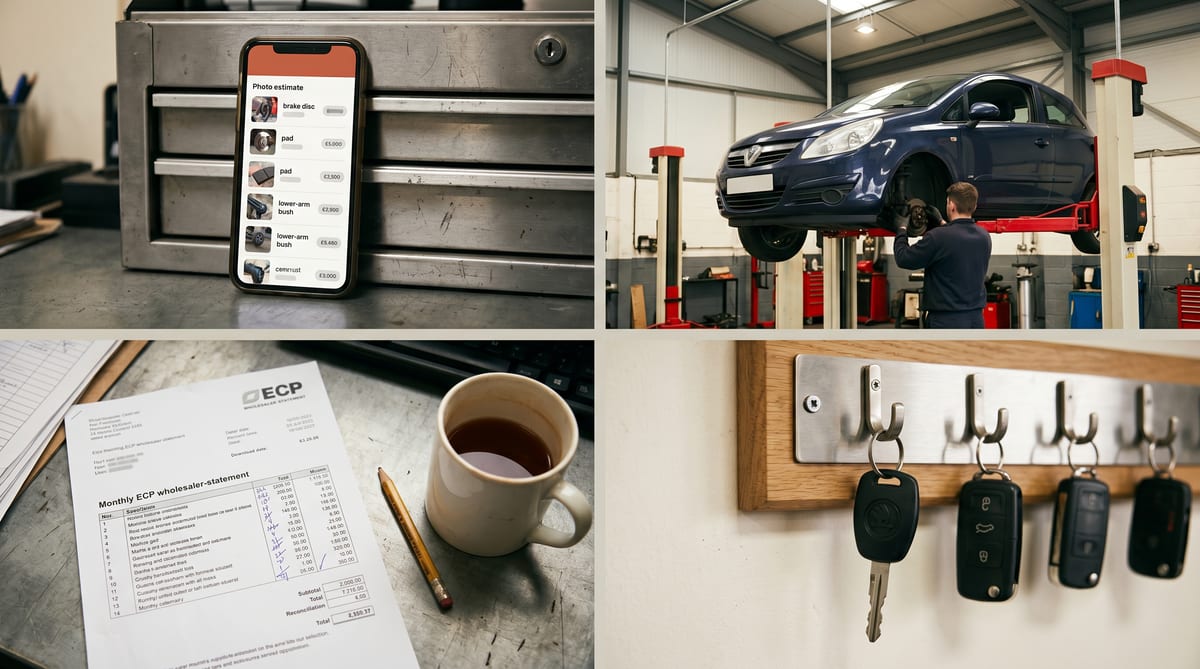
Five things we hear most often from UK independent garages - with what the solved version looks like in your week. Three are universal across the trade (the MOT recall annuity, the photo-estimate-with-one-tap-approve, the Saturday-morning bay re-shuffle); two are sub-segment-specific where the parts-margin discipline or the loan-fleet register genuinely earns its place. Every build is scoped per workshop: a two-bay service-and-repair on the edge of a market town probably needs the first three; a multi-bay MOT centre with serious bodyshop volume and a courtesy-car fleet might want all five. None of it means binning Garage Hive / Autowork Online / GenesisAutomotive / TechMan / AutoChain on day one - they’re the booking system-of-record; we sit on top.
1. The MOT customer who comes back at thirty days, not the day the certificate runs out
The £35 × 800 × 70% moment: DVSA hands you every MOT due-date for every car you’ve ever tested via the MOT history API - it’s there, it’s free, and it’s not being used. The customer who got a clean MOT in May should be in the diary now; the place down the road has already texted her at thirty days. The independent-garage-specific weight is that the MOT recall is a who-asks-first wins market - the first SMS through her phone is the booking - and the lapsed-15-month-customer reactivation over the DVLA Vehicle Enquiry API catches the customers who’ve been to Halfords once and would come back if anybody asked. The cashflow argument is concrete: roughly £35 per vehicle of MOT margin × 800 vehicles in the back catalogue × 70% conversion at thirty days is the line item the recall ladder pays for itself with in one cycle.
The full build: Recurring Service Recall - per-vehicle MOT-recall annuity over the DVSA + DVLA APIs with 30 / 14 / 3-day cadence and the lapsed-15-month-customer reactivation. Referenced across twenty-two verticals; the independent-garage version’s vertical-distinct features are the DVSA-MOT-history-API-driven next-due-date capture (no manual data-entry - the dates exist already), the who-asks-first-wins timing advantage on the 30-day SMS, and the service-interval pairing (the MOT recall pulls forward the due-a-service recommendation for the customer who’s overdue both, so the booking that lands is a full-day on the bay, not a 45-minute MOT slot).
2. Photo, one-tap-per-line approve, the customer’s phone - the voicemail-tag estimate killed
The 10am-Tuesday-£400-advisory moment: the tech finds £400 of advisory work - brake discs, pads, lower-arm bush - photo on the workshop phone. Service advisor calls the customer, voicemail. Calls again at noon, voicemail. The bay’s been waiting all day. By 4pm the customer picks up - “can’t approve over voicemail, ring me tomorrow” - the bay’s a wash, the advisory drops off the list, and the £400 doesn’t convert because nobody’s chasing a voicemail at 2pm Wednesday either. The independent-garage-specific weight is that bay time is the constraint that defines the day’s revenue and voicemail-tag burns it half a job at a time. The photo-paired per-line approval has to land in the customer’s pocket while she’s still at her desk, tappable in five seconds with the line totals visible per-item - not a generic “call to discuss”, not a free-form WhatsApp she’ll think about it.
The full build: Quote & Chase Ladder - every quote becomes a tracked object with a nudge ladder running on top. Referenced across fourteen verticals; the independent-garage version’s vertical-distinct features are the photo-estimate-and-one-tap-per-line approval shape (brake-disc approve, brake-pad approve, lower-arm-bush decline-and-do-next-service, all from the phone in her pocket), the bay-knows-immediately update so the apprentice can stop tracking-it-on-paper, and the “the part’s been ordered, here’s when we can fit you back in” auto-conversion the moment the per-line approval lands - so the £400 advisory becomes a confirmed booking on the way out, not a book it next time note.
3. Saturday morning bay re-shuffle - the 10:05 walk-in that doesn’t tank the booked 10am
The four-booked-six-walk-ins moment: Saturday. Four booked. By 9:15 a walk-in with a flashing engine light, by 9:45 there’s six in the waiting area, by 10:30 the apprentice’s lost track of which key’s whose, the MOT bay’s running its own clock, and the bay that should’ve been on the Audi is on the Corsa because the Corsa’s customer is shouting. The independent-garage-specific weight is that a workshop’s day isn’t booked-and-execute, it’s booked-and-walk-in-and-re-shuffle. The apprentice is the integration layer until they cry. The build is shaped around making the re-shuffle the system’s job, with the customer-side ETA-SMS that stops the “is my car ready” call eating the front desk’s morning.
Solved looks like: the live bay diary as a working surface, not a static booking grid. Every booked job carries an estimated bay time (from the service type + the workshop’s own history on similar jobs); every walk-in lands on the diary the moment it’s logged at the front desk with a triage-level (MOT-only / quick check / diagnostic / extended); the diary re-shuffles in real time - “Audi service slipped to 11:15 because the diagnostic walk-in is on bay 2 til 10:45; ETA SMS goes to the Audi customer now”. Customer-side: each booking gets an ETA SMS that updates as the schedule moves - “Hi James, running about 45 mins behind on the service today - we’ll have you out by 12:30 if that still works” - so the “is it ready” call doesn’t come in. MOT bay runs its own slot-rota with the Nominated Tester’s allocated hours visible (no MOT booked into a slot the tester’s already maxed). The EV / hybrid routing reads off the DVLA Vehicle Enquiry API - a hybrid Yaris flags as “requires IMI Level 3 EV TechSafe” and the diary refuses to land it on the apprentice. The owner sees bay utilisation by hour across the week - Tuesdays bleeding capacity, Saturdays the constraint - so the next quarter’s pricing or staffing decision has a number behind it.
4. The wishbone that went up on Wednesday - the per-job margin that doesn’t drift
The £85-quoted-£91-paid moment: quoted £85 for the pair of wishbones Tuesday. Customer signed the estimate. Wednesday morning ECP price went up to £91. Fitted Thursday. The wholesaler statement that lands at month-end I won’t notice the slip on til Sunday afternoon. Three jobs a week, £18 a job, £900 a year gone for nothing. The independent-garage-specific weight is that parts margin in independent garage work is the single thinnest discipline in the business - the wholesaler price changes faster than the quote cycle, and a 5-7% silent slip across the parts line is the gap between a five-bay workshop being viable and the owner working Saturdays for free.
Solved looks like: the parts-margin layer over the workshop’s existing wholesaler accounts. Every quote line item with a part number writes a quoted-cost-at-time-of-quote against the job (read from the wholesaler price feed at the moment of quote - Euro Car Parts, GSF, Andrew Page, Motor Parts Direct, with regional factors handled where they expose a feed); the purchase invoice when the part’s ordered writes the actual-cost-paid against the same job; the variance fires a flag to the service advisor before the job’s invoiced - “wishbone pair: quoted £85, paid £91, margin slip £6 - adjust the customer estimate before invoice (one tap), or absorb (one tap)”. The wholesaler monthly statement reconciles against the job-tagged purchases - credit notes for returned parts (the wrong-side wishbone in the opened bag) flag as unmatched until they land back as a confirmed credit, so the £180 of credit-note money doesn’t sit lost on a printed sheet. The owner’s view shows margin by job type (services vs MOTs vs diagnostics vs bodywork), by service-advisor, and by wholesaler - so the “are we still making money on a clutch?” answer is one screen, not a Sunday spreadsheet.
5. The loan fleet that knows its own MOT - and the courtesy-car juggle that stops being a juggle
The Citigo-with-the-lapsed-MOT moment: five jobs in. Two customers want a courtesy car. You’ve got one. The one you’ve got is the Skoda Citigo whose own MOT ran out last month because the loan-fleet diary isn’t a diary, it’s a sticky note on the fridge. The customer’s not getting a car, the bodyshop next door has Enterprise-supplied vehicles, and you just lost a service customer to them on the way out. The independent-garage-specific weight is that the loan fleet is a small-business cashflow constraint dressed as a customer-service offer - the moment it loses its own MOT or gets misplaced, the goodwill turns to grievance.
Solved looks like: the loan-fleet register as a structured vehicle register, with the same recall layer the customer-MOT side gets in problem 1 applied to the workshop’s own vehicles. Each loan car carries its own MOT date, tax, service interval, insurance renewal - and the same 30 / 14 / 3-day recall cadence hits the owner / service advisor instead of a customer. The courtesy-car booking calendar runs against the bay diary - when a job’s booked in with “customer needs loan car”, the system shows which loan car’s available across that window, who’s currently in which one, who’s expected back when. Customer-side: the “your loan car’s the silver Citigo, here’s the route to drop it back, here’s the photo for the damage log when you collected it” SMS goes out with the booking confirmation; the “reminder to return the loan car by Friday 4pm” nudge fires at Thursday evening so the Saturday morning doesn’t open with a missing vehicle. Damage condition photos round-trip in the same flow so disputes don’t escalate.
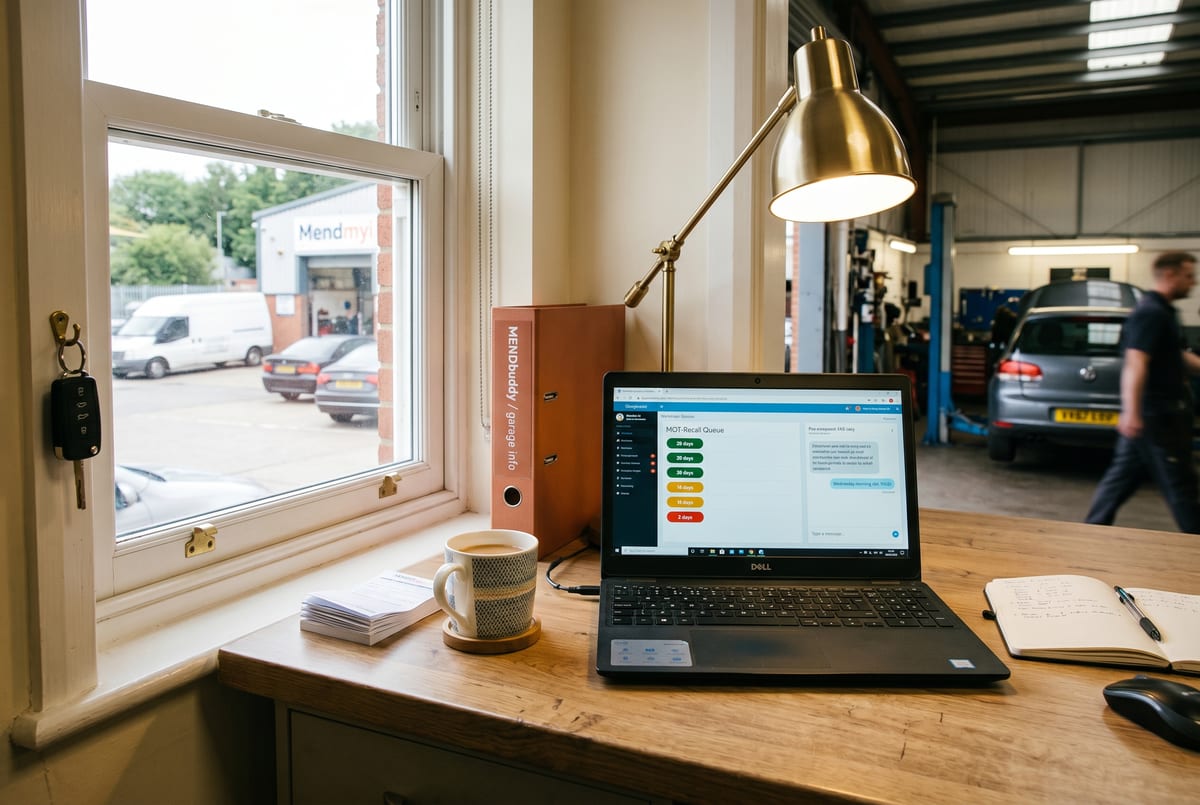
The closest things we’ve already built
- repairminderour SaaS workshop-management software (built for the founder’s own device-repair business, dogfooded for years on the bench-to-collection flow). The intake-job-ledger-status-comms-completion shape is identical to the workshop bay diary in problem 3 and the photo-estimate flow in problem 2: customer + asset (device or vehicle) + technician + photo evidence per job + status updates + invoice on completion. The garage-side build is the same engine, with the DVSA MOT API and the wholesaler-parts integrations layered on. See Repairminder.
- mendbuddyour multi-channel AI agent platform behind the MOT-recall comms in problem 1 (the SMS / WhatsApp drafting that goes out in the workshop’s voice, the conversational booking back-and-forth that asks “Wednesday morning or Thursday afternoon work?” and books the slot), and the new-enquiry triage from Facebook DM / web chat / inbound call that lands on the front desk while the owner’s under the Astra. Voice + WhatsApp + SMS + web chat + Facebook DM. See Mendbuddy.
- mendmyiour founder’s service-business storefront with ecommerce on the same site (device-repair + parts retail under one roof). The parts-margin side of problem 4 is shape-wise the same: parts going through both retail (over-the-counter or online) and trade (as part of a workshop job) with the same wholesaler accounts feeding both - the reference for any garage running a small parts retail counter alongside the workshop. See Mendmyi.
- pharmaceutical-analytics.comanalytics dashboard built for an analytics consultancy. The owner’s KPI surface in problems 3 + 4 (bay utilisation by hour, margin by job type by advisor, MOT-recall-conversion rate, loan-fleet availability) sits naturally on the same pattern: operational data captured at every workshop touchpoint, decision dashboard for the owner who’s still on the bay most days. See Pharmaceutical Analytics.
If your workshop’s narrower than the whole of the above
Most independent-garage types we work with - service-and-repair, MOT-only Class IV / VII centres, small bodyshops, mobile mechanics, tyre-fitters, EV / hybrid specialists, classic / restoration - share most of the hub above. The bits that genuinely differ scope in discovery: a small bodyshop needs the Audatex / Glass’s / insurer-claim admin flow where the MOT recall normally lives; a mobile mechanic needs the on-doorstep ID-capture and the card-terminal-in-the-van flow where the front desk normally lives; a tyre-fitter needs the per-tyre size-and-fitment lookup over the V5C and a tyre-stock module where the parts-margin layer normally lives; an EV / hybrid specialist needs the IMI Level 3 EV TechSafe register and the high-voltage isolation procedure-evidence flow as a first-class compliance layer. None of these warrant their own page yet - they’re a discovery conversation, not a separate buyer.
Adjacent verticals
- Device repairthe same intake-and-fix-and-return loop, different asset class; repairminder is the build that powers both, and the operational shape is structurally identical.
- Trades (the umbrella)the trade-buyer shape (owner-on-the-tools-plus-paperwork) is similar and many garages share a customer base with the local trades.
- Pet servicesclosest shape-wise for the booking + recall + photo-update-of-the-pet / car pattern; the operational shape is essentially the same.
- Self-storagefor the multi-unit / multi-asset register pattern that the loan-fleet sketch shares.
FAQ
Will the MOT recall layer work with our Garage Hive / Autowork Online / GenesisAutomotive / TechMan / AutoChain install?
Garage Hive exposes a modern API we read and write against - bookings, customer records, vehicle records all flow through. Autowork Online has limited integration surface; we typically read the DVSA MOT history directly and write the customer + booking out via its import format, or run the recall layer alongside with the booking landing back via web form. GenesisAutomotive, TechMan, and AutoChain have lighter integration patterns; we confirm against your install in discovery. The DVSA MOT history API is the source-of-truth either way - the recall doesn’t depend on the GMS knowing about it.
Will the photo-estimate flow respect our existing service-advisor process?
Yes. The flow starts from how the tech currently captures advisory work - photo on the workshop phone, note against the job - and adds the customer-side SMS / WhatsApp with the structured per-line approve / decline. Where the workshop already runs Garage Hive’s digital VHC, we feed our flow off it; where the workshop’s on paper VHCs, we replace the paper.
Will the parts-margin layer work with our wholesaler accounts (ECP / GSF / Andrew Page / Motor Parts Direct / others)?
All four named ones have trade-account APIs or daily price feeds we read against. The quoted-cost-at-time-of-quote reads from the live wholesaler feed; the actual-cost-paid reads from the purchase invoice when it lands. Other wholesalers (regional factors, specialist suppliers) - depends on integration surface; we confirm in discovery. Where no feed exists, the layer falls back to quote-vs-purchase-invoice reconciliation against the wholesaler’s monthly statement.
Will the bay diary replace our existing booking system?
Only if you want it to. Most workshops keep the existing diary (Garage Hive / Autowork Online / GenesisAutomotive / TechMan / Google Calendar / a paper book) as the booking system-of-record and let the bay-re-shuffle layer sit on top - reading the bookings, adding the walk-ins as they land at the front desk, surfacing the ETA-SMS-to-customer side. Where the workshop wants to consolidate, we build the diary as part of the new layer.
Will you handle our DVSA MOT scheme audit, brake-roller calibration, IMI EV TechSafe renewals, COSHH risk assessments, or IGA-side scheme paperwork on our behalf?
No. Each is the workshop’s accountable responsibility as Authorised Examiner / employer / data controller / IGA member. What the system does is surface the renewal dates as a calendar against the workshop, assemble the evidence pack as you work (VT20 / VT30 records pulled from the diary, calibration cert uploads against the equipment register, NT-hour logs, IMI qualification register per tech), and one-URL-ready it when the DVSA Site Risk Assessment lands or the Senior Examiner visit’s announced. The submissions and the responses stay with the AE.
Will the EV-qualification routing actually block the apprentice from getting the hybrid Yaris?
Yes - vehicle reg lookup via the DVLA Vehicle Enquiry API returns the fuel type; an EV / hybrid flag against the booking checks the tech-qualification register; the diary won’t let an EV / high-voltage job land on a tech without a current IMI Level 3 EV TechSafe entry. Renewals fire as a calendar reminder against each qualified tech.
What does it cost?
Every build is scoped per workshop - depends on workshop size, bay count, MOT-class mix, wholesaler accounts, whether the build covers all five problems above or a subset, and whether you’re consolidating off Garage Hive / Autowork Online / GenesisAutomotive or layering on top. We talk it through, agree the price in writing. See pricing.
How long until something’s live?
The MOT recall ladder is the fastest payback and the fastest to land - a few weeks from scope to live SMS going out the door. The photo-estimate flow ships alongside in the same window. The bay-diary layer and the parts-margin reconciliation typically run a little longer because the integrations take longer to wire than the SMS flows. The loan-fleet register slots in alongside without its own separate build cycle.

Tell us what your workshop’s week looks like
Send an enquiry - what kind of garage you run (service-and-repair, MOT centre, bodyshop, mobile mechanic, tyre fitter, EV / hybrid specialist, classic), how many bays, your current GMS (Garage Hive / Autowork Online / GenesisAutomotive / TechMan / AutoChain / paper diary / something else), where the operational pain lives (the MOT recall that’s never been switched on, the voicemail tag on Tuesday’s £400 advisory, the wholesaler statement that takes Sunday afternoon, the Saturday morning chaos, the Citigo with the lapsed MOT). We’ll come back with a sketch of what we’d build and what it would cost. No calendar, no demo to sit through. Email reply, scoped sketch, you decide.