

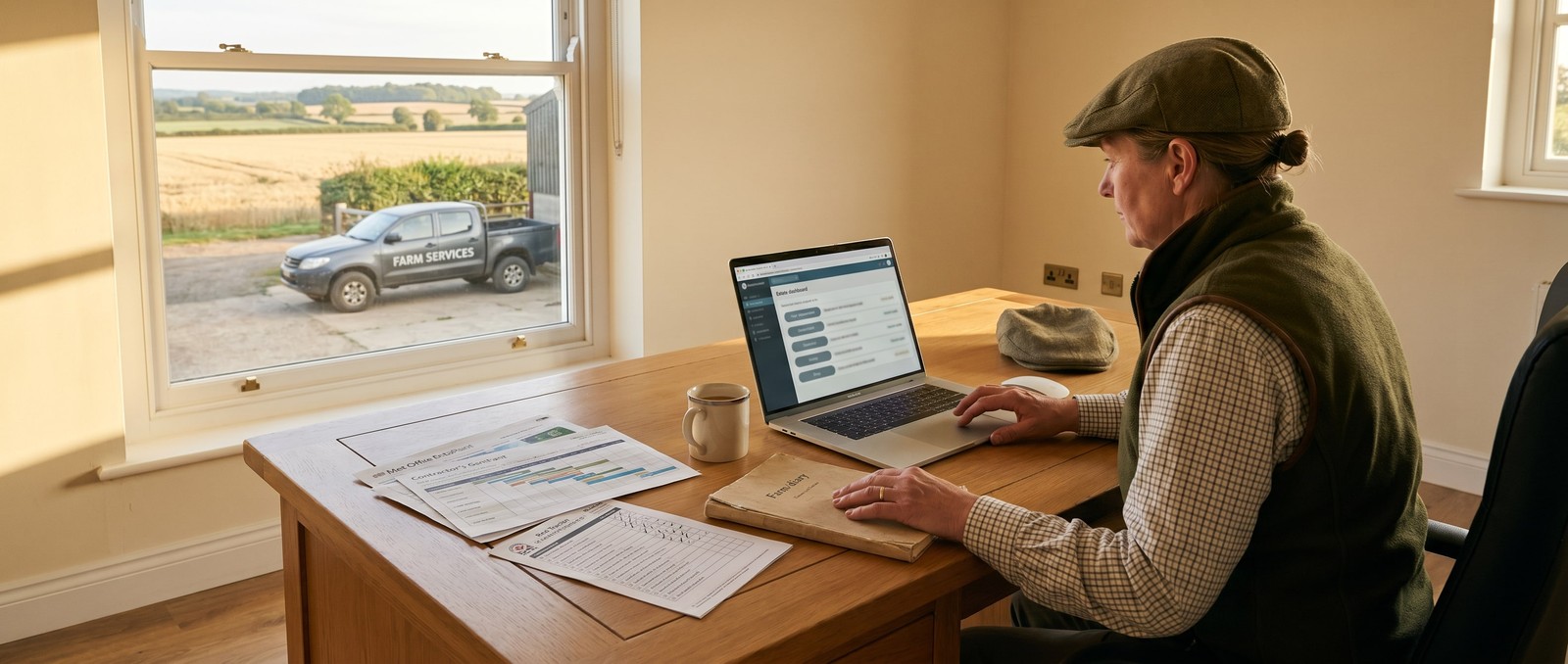
Software for UK SME agriculture and diversified estates
Farm Ltd plus the barn-wedding-venue Ltd plus the holiday-let cottage sole-trader plus the grain-store rental LLP plus the woodland partnership. Five separate VAT returns. Same farmyard. Same family. Accountant charges £8k a year just to keep them straight. Plus the SFI application that’s open, the Red Tractor inspector with fourteen days’ notice, and the £700-per-tonne ammonium-nitrate decision.
You’re the principal at a 1,200-acre mixed-arable estate in west Suffolk that’s quietly become a diversified business with a barn-wedding-venue arm, four holiday-let cottages, a farm-shop, and a glamping site the third generation built into the woodland; or the partner at a 600-acre sugar-beet-and-cereal contract farm wrestling with the BPS exit, the SFI scheme choice, and the British-Sugar-Bury contract; or the principal at an agricultural contracting business running combines and beet harvesters across five neighbouring farms in September; or the BASIS-registered agronomist whose February-to-April advice season is the entire business; or the partner at a large-animal vet practice running TB-testing rotas across the catchment. The stack you’re on is fragmented per sub-sector - Gatekeeper or Muddy Boots for the arable side, Herdwatch for the livestock, a venue stack for the barn, Square or Lightspeed for the farm-shop, Sage 50 Farm or Xero for the books, the Defra / RPA / Red Tractor / AHDB / LEAF portals for the regulators - and none of them speak the others’ language. The chartered accountant who keeps the five-entity Xero straight costs eight grand a year and is the only person who actually knows what the diversified estate’s net position is.
The pressure isn’t abstract. Cereal farm income fell to £17k for 2025/26. Fertiliser, red diesel, and ag-chem volatility makes cashflow modelling difficult; the BPS-to-SFI transition narrative has changed three times in eighteen months; the April 2026 APR / BPR succession-relief cap turns family-farm inheritance from a five-year “we should talk” into a six-month race. The Red Tractor inspector turns up with fourteen days’ notice and wants records across cattle passports, medicine register, sprays, fertiliser, soil sampling, water testing, contractor RAMS, staff training, machinery records, and IPM plans - half on paper, half in Gatekeeper, half in your head. The combine contractor’s £800-an-hour and the weather forecast Wednesday says Friday rain.
We build software for UK SME agriculture, scoped per farm / contractor / agronomist / practice / estate. Not a Gatekeeper / Muddy Boots / Farmplan replacement (Gatekeeper is the UK arable case-management standard for a reason; we layer alongside). Not a Defra / RPA / Red Tractor side-step (the regulator portals stay as the submission surfaces). The layer between the fields, livestock, kit, and diversified arms you actually run and the five-entity Xero that consolidates itself, the SFI + Countryside Stewardship payment dates that land in your cashflow forecast, the fertiliser-and-diesel decision that has a price-feed-driven scenario behind it, the Red Tractor audit pack that’s already assembled when the inspector calls, the combine weather-window that books itself across the contractor’s five farms, the diversification arms that share a customer database and a multi-entity P&L instead of seven parallel admin loads.
What you spend your week on that you shouldn’t have to
- Five separate Xero entities - farm Ltd, venue Ltd, holiday-let cottage sole-trader, grain-store rental LLP, woodland partnership. Five VAT returns. £8k a year of accountant fees just to keep the books from contradicting each other. Intercompany journals at year-end are a forensic exercise.
- SFI application open, 102 actions to choose from, adviser charges £2k for a plan; DIY through the Defra portal is a week of evenings. The Countryside Stewardship side continues alongside. The BPS legacy payment from the 2024 cycle’s final tranche is the last drop of that scheme.
- Ammonium nitrate quote - £510 a tonne today, £370 in summer, £700 in autumn 2022. The buy-now-or-buy-later call is dart-throwing without a per-farm-level usage forecast; you’ve made the wrong call three of the last five years.
- Red Tractor announced inspection - fourteen days’ notice. Records the inspector wants: cattle passports, medicine register, sprays, fertiliser, soil sampling, water testing, contractor RAMS, staff training, machinery records, IPM plan. Half are in Gatekeeper, half on paper, half on a Post-it in the cab. The fortnight before the visit is a panic.
- Combine contractor - 240-acre block harvestable in eight hours dry, two days wet. Wednesday’s forecast says Friday rain. Five farms want priority; the contractor’s standard rate doubles in the last-week-of-window panic. The decision-tree on whose field goes first is in your head.
- April 2026 - APR / BPR succession relief capped at £1m. 600 acres at £10k an acre plus buildings and equipment is an £8m+ estate. £7m above the relief at the 20% effective rate is a £1.4m IHT bill that could break the family farm. Succession conversation with Dad has been on the list for five years; now it’s a six-month race.
- Sugar-beet contract - British-Sugar-Bury’s contract is the heartbeat. Spot price plus contract plus bonus / penalty, plus the haulage logistics, plus the factory lift slot. The beet harvester contractor’s £800 an hour for 12 acres a day; the 80-acre field needs 7 days of dry weather; the booking has to be three weeks ahead.
- Wedding-venue Ltd had a great August (eight weddings, £40k revenue), but the integrating-with-farm-Ltd VAT-mixed-supplies question is becoming a problem. The cottage holiday-let arm took the April-2025 FHL hit. The farm-shop ticks over at £150k. Each arm has its own admin; the diversified-estate consolidated view doesn’t exist.
- Spray operator records on paper in the cab. Gatekeeper has the structured fields but the operator doesn’t always log; Mondays you reconcile what was sprayed from the empties in the chemical store. One mistake on glyphosate-vs-bee-buffer-zone and the Red Tractor audit’s compromised.
- Cattle movement - BCMS passport says “this animal not registered to your CPH”; six hours sorting out a transferred holding number that should’ve been routine. Sheep EID at the chip-reader gate fails 30% of the time; manual scan slows down the haulage that’s waiting.
- Rural connectivity - the yard’s on 3G with 1-bar signal. Gatekeeper sync fails in the field. The mobile spray app needs offline-first or it doesn’t work.
These aren’t problems Gatekeeper’s next release is going to solve. They’re the layer between the farm operations that actually produce the income and the five-entity consolidation, the SFI cashflow forecast, the input-cost decision support, the audit pack that’s already assembled, the diversification cross-arm visibility, the combine weather-window that books itself.
Example problems we could solve
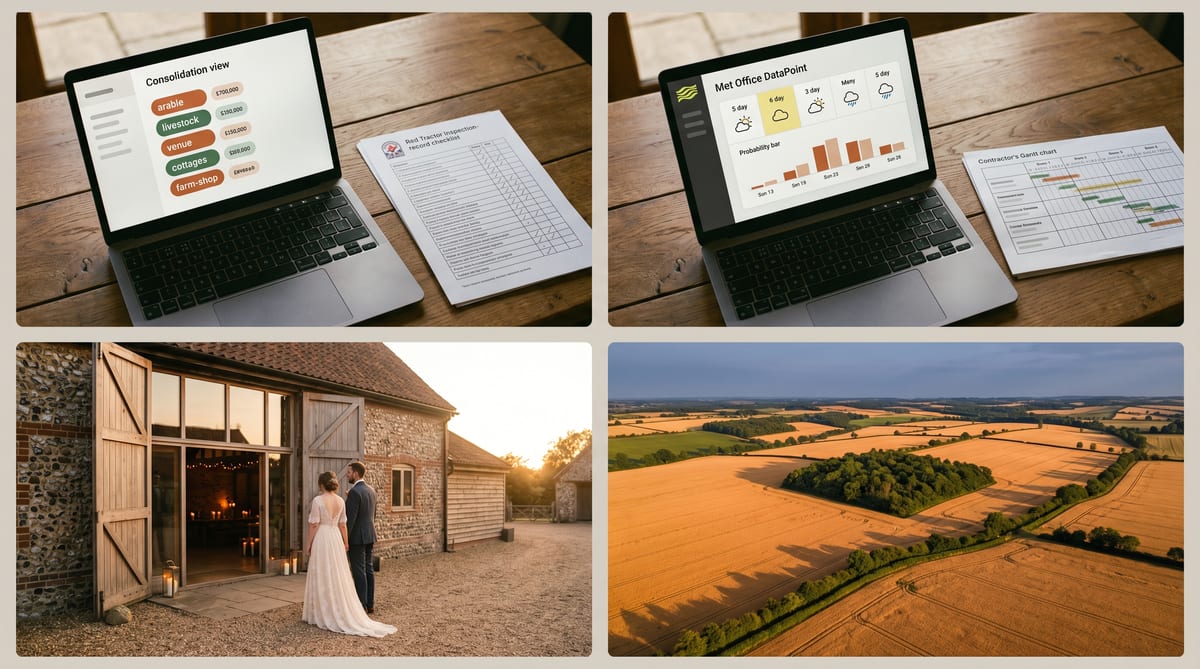
Five things we hear most often from farm principals, contractors, agronomists, agri-vet practice principals, and diversified-estate managers - with what the solved version looks like in your week. Every build is scoped per farm / contractor / practice / estate: diversified estates typically need all five; pure-arable farms typically start with sketches 2 + 3 + 5; contractors typically need sketch 3 alone; agronomists typically need 2 + 5.
1. The five-entity diversified-estate consolidation - farm Ltd + venue Ltd + holiday-let + grain-store + woodland into one P&L the family can read
The £8k-accountant moment: farm Ltd + barn-venue Ltd + holiday-let cottage sole-trader + grain-store rental LLP + woodland partnership. Five separate VAT returns. Same farmyard, same family. The accountant’s £8k a year is just to keep the books from contradicting each other. The consolidated view of what the diversified estate actually earned doesn’t exist on a screen. The agriculture-specific weight is that the multi-entity reality is genuinely how diversified estates are structured (because each diversification carried its own tax / VAT / legal-liability rationale at the moment it was set up), the consolidation overhead is the cost of that structure, and the build is shaped around making the consolidation a feature rather than a fortnight of accountant time.
Solved looks like: the multi-entity layer over the underlying accounting systems. Each entity stays as its own Xero (or Sage / QuickBooks / Farmplan Business Manager) with its own VAT registration and its own statutory filing; the consolidation layer reads from each, harmonises the chart of accounts to a farm-standard structure (“income from cereals”, “income from sugar beet”, “income from venue hires”, “income from cottage lets”, “income from farm-shop”, “input costs - fertiliser”, “input costs - diesel”, “machinery depreciation”, “family drawings”), and renders the consolidated P&L + balance sheet month-by-month. Intercompany journals (the farm Ltd cross-charging the venue Ltd for a barn rebuild) capture as structured transactions with the VAT treatment correct on both sides; the year-end consolidation becomes a click-through review for your accountant to sign off. The family-facing view shows the “how is the estate actually doing?” answer on one screen - per-arm contribution, per-arm margin, per-arm cash position - with the underlying entity-level detail one click below. For the mixed-supplies question that catches diversified estates, the consolidation surfaces the cross-entity transactions that need VAT review before the inspector queries them.
2. The fertiliser-and-diesel buy-now-vs-buy-later call that has a price-feed-driven cashflow scenario behind it
The £700-per-tonne moment: ammonium nitrate £700/tonne autumn 2022, £370 summer 2024, £510 autumn 2025. Red diesel volatile. Ag-chem the same. Cashflow planning is dart-throwing. Buy early and you’re holding stock; buy late and you’re at the mercy of the spot price. The agriculture-specific weight is that input cost volatility is the single biggest swing factor in arable cashflow - fertiliser alone is 15-25% of cereal-farm cost base and moves 30%+ between seasons - and the buy-now-vs-buy-later call is genuinely consequential.
Solved looks like: the input-cost forecasting layer over the farm’s underlying field-and-crop record. Each field carries its planned crop rotation across the next two years; the system models per-acre input needs (fertiliser by type / nitrogen rate, the agronomist’s recommended pesticide programme, expected diesel hours across cultivation / drilling / spraying / harvest) → total farm-level input quantity per month. The live price feeds (fertiliser via the Yara / CF / Origin price-monitoring services, red diesel via the regional wholesaler, ag-chem via the agronomist’s pricing) feed forward to the “what do these inputs cost at today’s prices?” answer. The decision-support view shows the buy-now-vs-buy-later cashflow scenarios - “buy March requirement now at £510, lock in £45k spend; buy in late August on current trajectory at £570 expected, £51k spend; the price difference is £6k against the cashflow benefit of holding £45k til August; here’s what your bank position looks like under each scenario” - with the farm’s own cashflow constraints (the September wheat sale, the December sugar-beet contract payment, the SFI quarterly receipts from sketch 5) plugged in.
3. The combine weather-window that books itself across the contractor’s five farms - and the sugar-beet lift slot the factory needs three weeks ahead
The Friday-rain moment: combine contractor, £800/hr, 240-acre block, eight hours dry / two days wet. Wednesday’s forecast says Friday rain. Five farms want priority. Contractor’s standard rate doubles in the last-week-of-window panic. The sugar-beet lift’s a separate scheduling beast with the factory slot three weeks ahead. The agriculture-specific weight is that harvest scheduling is genuinely the highest-stakes operational moment in the arable year - the difference between a dry harvest and a wet one is the year’s income - and the weather window is the constraint that defines everything.
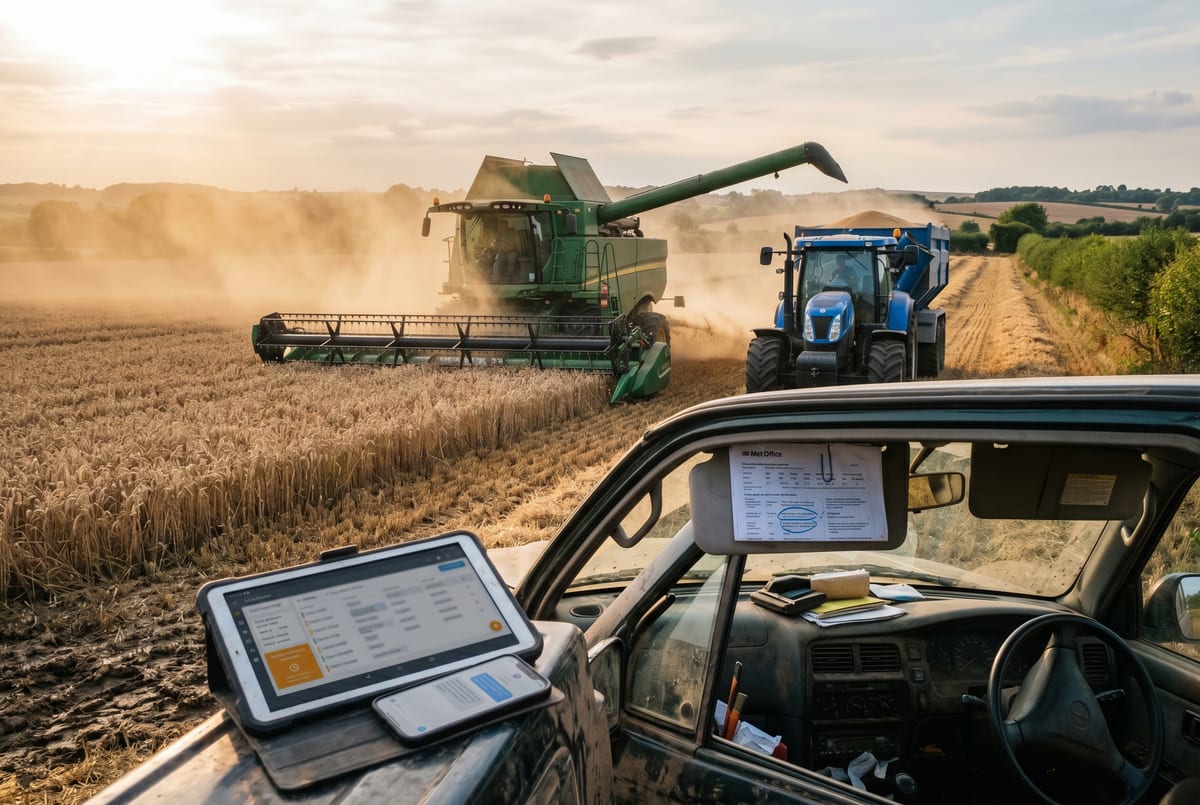
Solved looks like: the harvest scheduling layer over the contractor’s calendar + the farms’ field-and-crop-maturity register + the live weather forecast (Met Office DataPoint feed at a regional level so the accuracy is genuinely usable). Each farm carries the structured field record (acres, crop, expected maturity-window, soil conditions, priority-ranking for the contractor); the contractor’s calendar shows day-by-day capacity; the weather feed shows day-by-day forecast across the next 14 days. The scheduling engine works the booking back from the weather window - “Friday’s looking dry across the catchment, Saturday rain, Sunday-Monday dry; farms A + B (combinable wheat, ready) and farm C (combinable barley, marginal) are within capacity for Friday; farm A’s 240-acre block fits the dry window if start 6am, farm B’s 180-acre fits the afternoon, farm C’s 280-acre exceeds the day so push to Sunday-Monday” - with the resulting plan visible to the contractor and each farm with the ETA SMS at each transition. For sugar-beet lift bookings, the same engine integrates the British-Sugar-Bury factory-slot calendar with the haulage logistics; the seven-day-dry-window requirement is built into the scheduling logic.
4. The diversified-estate cross-arm bridge - farm + venue + cottages + farm-shop sharing customers, calendars, and the Saturday changeover crew
The bride-stayed-in-the-cottage moment: wedding-venue Ltd’s £80k year; cottages four-cottage holiday-let arm; farm-shop £150k revenue. Each runs its own admin in its own platform. The bride who booked the venue stayed in the cottage the night before her wedding; the photographer used the farm-shop café between the ceremony and the reception; nobody knows because the systems don’t talk. The agriculture-specific weight is that the diversified estate is genuinely a multi-revenue-stream business with the farmyard at the centre, and the cross-arm potential is real but unrealised because the customer-and-calendar systems don’t connect.
Solved looks like: the diversified-estate bridge as a structured customer-and-asset layer that connects the farm operations to the diversification arms. Customers (the wedding couple, the cottage guest, the farm-shop café visitor, the agri-tourism walk-around) carry a shared identity across the arms; the venue booking surfaces the “would the couple like to add a cottage night the evening before?” upsell at the same booking flow; the cottage booking surfaces the “would the guests like a farm-shop hamper waiting on arrival?” upsell; the farm-shop café POS captures the “this customer attended a venue tour last month” signal and offers the wedding-couple discount. The cross-arm calendar shows the Saturday-changeover overlap (the cottage cleaner crew + the venue setup crew + the farm-shop staffing all sharing the family’s staff resource on a Saturday morning in August) so the staffing decision is made with the full picture. The cross-arm cashflow view (built off the consolidation in sketch 1) shows each arm’s contribution; the cross-arm marketing runs as one estate-wide cadence rather than four parallel campaigns.
5. The Red Tractor / LEAF / AHDB / retailer-specific audit pack that’s already assembled - and the SFI evidence record that fills itself as you operate
The fourteen-days’-notice moment: Red Tractor 14 days’ notice; cattle passports + medicine register + sprays + fertiliser + soil + water + RAMS + staff training + IPM plan; half in Gatekeeper, half on paper, half in your head. The agriculture-specific weight is that a commercial farm carries six-to-twelve simultaneous certifications and standards with overlapping evidence requirements - Red Tractor + LEAF Marque + AHDB benchmarking + Tesco Sustainable Dairy + Arla 360 + Muller Direct + retailer-specific welfare audits - and the SFI / Countryside Stewardship quarterly payments reconcile against actions evidenced (cover crops, no-till, hedgerow management) as you operate.
The full build: Compliance Evidence Record - multi-standard structured live record with operational-event-writes-to-every-applicable-standard-link routing + per-standard audit-pack assembly + SFI quarterly action-evidence reconciliation, pairing with Grant & Submission Handling for the Defra grant cycle (SFI, Countryside Stewardship, residual BPS tranches) where the application and the evidence pack are the same data in two formats. Referenced across many verticals; the agriculture version’s vertical-distinct feature is the same data, three formats multi-standard pack generation - a spray record logged once on the tablet at the field gate auto-writes to the Red Tractor record, the LEAF record, and the SFI action-evidence record in the right shape for each. For BCMS cattle passport + sheep EID + Defra movement records, the same engine handles the structured per-animal lifecycle so the “this animal not registered to your CPH” error doesn’t surface six hours into the haulier’s wait.
The closest things we’ve already built
- mendbuddy - our multi-channel AI agent platform. Behind the contractor weather-window comms in sketch 3 (the SMS to each farm with “you’re in the Friday slot, ETA your block 6:30am, here’s the priority order”), the diversification cross-arm guest comms in sketch 4 (the venue-to-cottage upsell, the farm-shop hamper-on-arrival prompt), and the audit-record-due reminder cadence in sketch 5. See Mendbuddy.
- repairminder - our SaaS service-business management software. The asset + customer + job-history + cert-and-renewal pattern is shape-wise the same as the field / crop-rotation / spray-record / livestock-movement ledger that powers sketch 5; the per-record-tied-to-multiple-standards mapping is the same pattern as the per-job-tied-to-multiple-warranty record in repairminder’s engine. See Repairminder.
- mendmyi - our founder’s service-business storefront with full ecommerce. The direct-sale + farm-shop online side of sketch 4 is the same shape; for the on-farm artisan-food side of the farm-shop, the
craft-food-drinkhub covers the producer-stack pattern that applies. See Mendmyi. - planpost - our own-brand social-media scheduling SaaS. For the farm-diary content cadence and the diversified-estate cross-arm campaigns (the “come to the lambing weekend” event, the “wedding-venue showcase Sunday” open day, the “new season’s farm-shop preserves” drop). See Planpost.
- A private-hire event venue we’ve built end-to-end - the direct reference for the barn-wedding-venue arm of a diversified estate. The farm’s wedding-venue arm runs on the same operational pattern as a standalone venue.
Adjacent verticals
- Holiday letsfor the cottage-arm of a diversified estate; the holiday-let build is the direct companion for the cottages on the estate.
- Hospitalityfor the barn-wedding-venue arm of a diversified estate; the studio’s end-to-end venue build powers this shape directly.
- Wedding suppliersfor the supplier side of the wedding-venue arm (florists / photographers / cake-makers who work the estate’s weddings).
- Craft food and drinkfor the farm-shop / smokery / brewery / vineyard / cheese / preserves arm of a diversified estate.
- Equinefor the supply-chain side of the equine cluster (the farm supplying hay, the dairy supplying milk, the field grazed by liveries) and mixed-farm-with-livery arrangements common in the Newmarket area.
FAQ
Will the build work alongside our Gatekeeper / Muddy Boots / Farmplan / Sum-It / Cropwise / Climate FieldView / KisanHub / Herdwatch / Sage 50 Farm install?
Yes for all named ones. Each stays as your domain-specific system-of-record (Gatekeeper or Muddy Boots for arable field records, Herdwatch and the Cattle Information Service for livestock movements, Sum-It or Farmplan Business Manager for farm accounting, Hostaway or Hostfully for the cottage arm). The build sits as a layer around them: the multi-entity consolidation reads each entity’s accounting system; the audit-evidence layer reads the structured fields from Gatekeeper / Muddy Boots and adds the per-standard mapping; the harvest scheduling reads the field-and-crop register and adds the weather + contractor scheduling on top.
Will the multi-entity consolidation handle our specific entity mix (Ltd + sole-trader + LLP + partnership)?
Yes - each entity type is supported with its own statutory filing and VAT treatment. The consolidation harmonises the chart of accounts to a farm-standard structure while keeping each underlying entity correct; intercompany journals (the cross-charges between farm Ltd and venue Ltd) capture as structured transactions with the VAT treatment correct on both sides. The year-end consolidation that was previously the accountant’s forensic exercise becomes a click-through review.
Will the input-cost forecasting work with our specific suppliers (Yara / CF / Origin / GrainCo / local agronomist / regional wholesaler)?
Yes - the price-feed integrations cover the major fertiliser suppliers (Yara, CF, Origin Fertilisers, GrowHow / CF Fertilisers UK), the red-diesel wholesalers, and the ag-chem distribution chain (Origin Amenity, Hutchinsons, Agrii, Frontier). Where a specific local supplier doesn’t have a public price feed, the system reads from the supplier’s invoice or quote when it arrives and trends the price across the season.
Will the harvest scheduling work with our contractor + our combine + the sugar-beet lift?
Yes - the engine handles both the contractor side (calendar across multiple farms with priority-ranking and weather-window optimisation) and the in-house side (the farm’s own combine + driver capacity vs the contractor option). The sugar-beet lift integrates the British-Sugar-Bury factory-slot calendar + the haulage logistics + the field’s access conditions; the seven-day-dry-window requirement is built into the scheduling logic.
Will the audit-evidence layer pre-assemble for all the standards we hold (Red Tractor + LEAF + AHDB + Tesco / Arla / Muller + Soil Association if applicable)?
Yes - the per-standard requirements map covers Red Tractor (Combinable Crops, Beef & Lamb, Dairy, Pigs, Poultry, Fresh Produce, Combinable Crops & Sugar Beet), LEAF Marque, AHDB benchmarking, Soil Association Organic, Tesco Sustainable Dairy, Arla 360, Muller Direct, Sainsbury’s Suppliers, and the major retailer-specific welfare audits. The same underlying records map to each standard in the inspector’s expected format.
Will you handle our SFI / Countryside Stewardship application or our Red Tractor inspection on our behalf?
No - the SFI application stays with the named applicant on the Defra / RPA portal; the Red Tractor inspection conversation stays between you and the inspector. What the system does is make the underlying evidence assemble itself as you operate, surface the SFI / Countryside Stewardship action records ready for the application, and one-click-ready the audit pack when the inspector’s visit is announced. The submission and the inspection conversation remain yours; the assembly is the system’s job.
Will the build handle the rural-connectivity reality (3G / 1-bar yard, intermittent field signal)?
Yes - every operational capture (spray record, livestock movement, harvest entry, livestock check) is offline-first: the field tablet or phone captures locally, syncs when connectivity returns. Critical alerts (SFI payment landed, audit window opens, harvest weather changes materially) can fall back to SMS where data signal is unreliable.
Will the build help with the April 2026 APR / BPR succession-planning reality?
The structured estate-asset record + the cross-entity P&L from sketch 1 + the historical valuation trend provide the input data for the succession conversation with your accountant and solicitor. The system doesn’t make the IHT calculation (that stays with the accountable adviser) and doesn’t replace the legal-and-tax planning work - but it makes the data available in the format the adviser needs to model the scenarios (gifting, trust structure, family partnership restructure, lifetime transfers). The April 2026 deadline urgency is real; the data-readiness for the conversation is what we provide.
What does it cost?
Every build is scoped per farm / estate / contractor / agronomist / practice - depends on size (sole-trader farm vs 200-acre vs 1,500-acre vs 3,000-acre diversified estate), sub-sector (arable vs livestock vs dairy vs mixed), diversification mix, current platform mix, and whether the build covers all five sketches above or a subset. We talk it through, agree the price in writing. See pricing.

Tell us what your week looks like
Send an enquiry - what you run (arable / cereal farm, mixed farm, livestock, agricultural contractor, BASIS-registered agronomist, agri-vet practice, equipment dealer, diversified estate, processor) and acreage / staff / arm count. Your current platform stack (Gatekeeper / Muddy Boots / Farmplan / Sum-It / Cropwise / Climate FieldView / KisanHub / Herdwatch / Cattle Information Service / Sage 50 Farm / Xero / paper-and-WhatsApp). Where the operational pain lives - the five-entity consolidation, the SFI / Countryside Stewardship choice, the input-cost decision, the Red Tractor audit prep, the harvest weather-window, the April 2026 APR / BPR succession deadline. We’ll come back with a sketch of what we’d build and what it would cost. No calendar, no demo to sit through. Email reply, scoped sketch, you decide.