

Software for UK independent self-storage operators
Tuesday eleven pm enquiry through the contact form - guy moving house Saturday, fifty square feet. By Wednesday lunchtime I’ve seen it. He’s already at Big Yellow because their site quoted him in ninety seconds. I lose thirty percent of pipeline to that single missed window. The acquirer that asked last quarter wanted my tenant ledger in their format. Half my answers were “let me check the spreadsheet”.
You’re the owner of a thirty-unit yard on the side of a Cambridgeshire farm, or the principal of a four-site regional chain across the East of England, or the partner running a 200-unit business-storage-led operation paired with a virtual-office service. SSA UK membership in the office cabinet. The stack is Stora if you’ve modernised in the last few years; Sitelink if you went US-legacy a decade ago; Storeganise or SpaceManager or easyStorage if you’ve picked something in between; or a spreadsheet and a paper licence if you’ve been talking about “going digital” since 2021 and never quite made the jump. Either way the back office runs - quote on the phone, paper licence, walk-around to issue the access code, monthly DD via the bank-mandate system, chase the arrears, vacate when they ring - and either way the front office (the website, the 11pm enquiry, the chatbot, the live-availability widget) is meaningfully behind what Safestore, Big Yellow and Shurgard run as table stakes. Big Yellow has a call centre; you’ve got a phone you can’t always answer. The DD bounced on Tuesday - half the time it’s a renewal of card details, half the time it’s actual non-payment - and the arrears ladder is you, a Tuesday-morning phone call, and a Sunday-evening Xero reconciliation. The acquirer who’s been buying single-site operators in your county wanted last year’s utilisation by month, the tenant ledger by anniversary, and the lease structures by size band; half of what they asked for is in the spreadsheet and half is in your head.
We make custom software for UK independent self-storage operators - scoped per yard or per chain, sized to the bit between the yard you actually run and the 11pm enquiry that books itself in, the DD bounce that triggers its own arrears ladder, the unit that re-lists itself within twenty-four hours of the vacate, the access-control hardware that flags its own batteries before the tenant’s at the gate at 10pm, the multi-site utilisation snapshot you can hand to an acquirer in her format. Not a Stora rip-and-replace - it’s the modern UK-built management system and we’d often recommend it as the case-management spine. Not a Sitelink override - the data lives where it’s been living. The bit between the management system that records what’s happening and the operational reality of running a yard - that’s what we build. It lets the yard book itself in at eleven at night, fills the slot the same week, and arrives at any acquirer’s due-diligence ask in the shape you already keep your data.
What you spend your week on that you shouldn’t have to
- 11pm Tuesday enquiry through the contact form. “Moving house Saturday - need 50sqft for two months minimum, maybe four.” You see it Wednesday lunchtime. He’s already at Big Yellow because their site quoted him at 11:02 and his card was on file by 11:08. Thirty percent of pipeline goes through this window across the year.
- Tuesday morning Xero reconciliation. DD failure on three tenants - one’s a card-renewal that’ll resolve itself if you retry next week, one’s a forgotten standing-order replacement, one’s actual non-payment that’s been quiet for two months and will turn into a Sale of Goods Act 1979 process if you don’t act. You can’t tell which is which without three phone calls.
- Nokē Smart Entry - battery dies on unit 47 at 10pm. Customer can’t get in. Rings you at home. You can’t physically fix it in the dark, you talk her through the fallback override (which is itself a 4-minute phone call she’s not happy about), and the two-star Google review goes up Wednesday morning anyway.
- Customer rings to vacate unit 23 at 4pm Friday. You confirm, agree pickup of the keys Monday. Monday’s busy, Tuesday she drops them, you do the final inspection Wednesday, photograph the unit Thursday, list it back on the website Friday - the unit’s sat empty for a full week between vacate-confirmed and re-listed. Three of those a quarter is a couple of thousand pounds of lost revenue.
- A new-customer enquiry on Wednesday at 2pm wants a quote on the phone - “how much for a ten-by-ten, twelve months”. You quote, the customer says she’ll think about it, you move on. Thursday she rings back, you can’t quite remember what you quoted, you re-quote slightly differently, she queries the difference, the conversion’s wobbled before it’s a confirmed licence.
- Business-storage tenant - four units, monthly invoice, the AP office wants a PO number on every invoice, wants the billing address on the third floor not the registered office, runs on 60-day terms. You manage this on a paper notebook and a bank mandate that doesn’t quite know about the PO process; you spend an hour a month on the statement chasing.
- The acquirer who came in last quarter wanted utilisation history by month-by-site, the tenant ledger by anniversary, the lease structures by unit-size band, the maintenance schedule, the planning consents, and the access-control specs. Half of what she asked for is in your dashboard in a format she didn’t recognise; half is in your spreadsheet; the answer to “what’s your churn rate by tenant cohort?” is “let me check”.
- “Self storage near me” in Haverhill - Big Yellow Cambridge ranks above you, twenty-two miles away. Their Google Business Profile is updated weekly; yours is last touched in 2022. The local-search funnel that should be your strongest channel quietly leaks to a yard you’re nowhere near.
- Container yard outdoor. Winter weather, padlocks frozen Sunday morning, a customer can’t get in. The south-facing locks bake solid in August. The operational reality lives in your phone, not in the software.
- A new tenant signs a licence Tuesday - paper, in the office, you scan it Wednesday, file it, set up the DD mandate Thursday, issue the keypad code Friday. Four-day lag between “I want the unit” and “I can use the unit”; the customer’s already mentally moved on by Friday.
These aren’t problems Stora’s next release is going to fix. They’re the layer between the management system that records what’s happening and the funnel that fills itself, the DD that chases itself, the unit that re-lists itself, the access-control system that tells you about its own batteries before the tenant does, the dashboard that talks to an acquirer in her format. That’s what we’d build.
Example problems we could solve
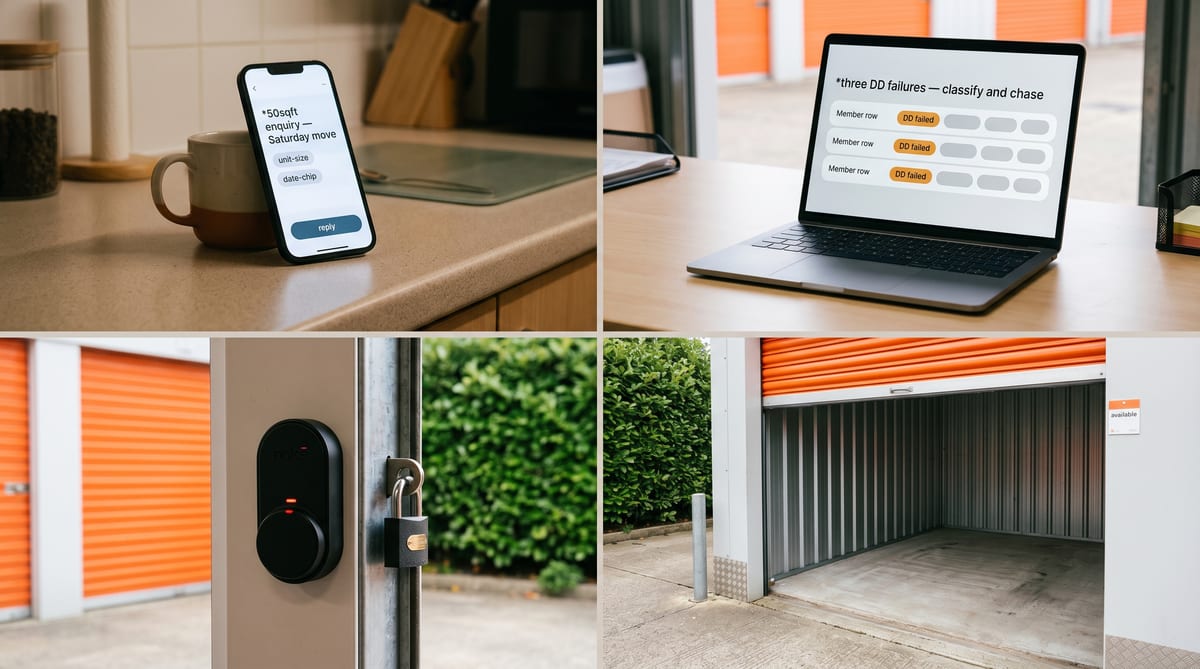
Five things we hear most often from UK independent self-storage operators - with what the solved version looks like in your week. All five apply universally across single-site, multi-site, business-storage-led, container-yard, and climate-controlled operators - with the texture (Stora vs Sitelink vs spreadsheet; Nokē vs Janus vs keypad; business vs domestic tenant mix) scoping in discovery. Most single-site operators start with problems 1 + 2 + 5; multi-site operators typically need all five.
1. The 11pm enquiry that’s a paid licence by 11:08 - without the owner’s phone ringing
The Tuesday-11pm moment: Tuesday 11pm contact-form enquiry. Wednesday lunchtime you see it. He’s already at Big Yellow because their site quoted him in ninety seconds and took his card by 11:08. You lose thirty percent of pipeline to this single window across the year. The self-storage-distinct weight is that a meaningful slice of the pipeline arrives outside your working hours, the conversion happens to whoever quotes and contracts first, and the build is shaped around making that whoever be your yard - without your phone ringing at 11pm, without you sitting in the office Sunday afternoon updating live availability.
Solved looks like: the 24/7 web-quote-to-access funnel on your own site, sitting on top of Stora / Storeganise (or replacing the spreadsheet for spreadsheet-led yards). Customer lands at any hour - live-availability widget shows the units actually open, in the actual sizes, at the actual prices; she selects, the system quotes, asks the few questions that affect the price (duration, access need, insurance opt-in), and offers the reserve. Reserve takes her through e-sign on the licence, then to the DD mandate, then to the access-code issue - all in the same browser session, all landing in your CRM the next morning with the tenant onboarded, the licence filed, the DD set up, and her access code already on her phone. Where she wants to talk to a human first, the AI agent answers WhatsApp / SMS / web-chat / inbound voice in your voice, with your pricing, your unit-mix and the live availability - and either books the slot or hands the conversation to you with the full context already collected. The Sunday-afternoon manual update of the live-availability widget stops being a thing.
2. The DD bounce that triggers its own arrears ladder - with the Sale-of-Goods-Act trigger at day 60 and the abandoned-goods auction at day 90
The Tuesday-DD-bounce moment: DD failure Tuesday, three tenants. One’s a card-renewal that’ll resolve, one’s a forgotten standing-order replacement, one’s actual non-payment that’s been quiet for two months. The self-storage-distinct weight is that arrears recovery is the single biggest difference between a profitable yard and a marginal one - the Sale of Goods Act 1979 legal procedure for abandoned contents is well-defined but the admin discipline is what kills the implementation. The 14-day notice generation, the lock-cutting decision, the goods-photographing-and-cataloguing audit trail, the public-auction notice - each step needs structured evidence at the moment it happens. The build is shaped around making the ladder run by itself for the routine 90% and surfacing the 10% where the operator’s judgement matters.
The full build: Invoice & Dunning Ladder - DD-failure-into-arrears cadence shaped for the self-storage timeline. Referenced across sixteen verticals; the self-storage version’s vertical-distinct features are the bank-side DD-failure-reason classification (retry-vs-chase split - card-renewal automatically retries on the next cycle while non-payment routes into the chase ladder), the access-suspension bridge at day 30 (the access code suspends automatically while the unit’s still treated as live tenancy), the Sale of Goods Act 1979 trigger at day 60 with the 14-day notice generated against the structured tenant + unit record (the notice text is per-yard configurable but the legal scaffolding is sealed), the lock-cutting + goods-photographing + cataloguing workflow at day 75 (every action timestamped, every photograph carries unit-and-date metadata, the inventory list assembled to the format auctioneers expect), and the abandoned-goods public auction at day 90 with the notification cadence to the named tenant maintained throughout. The arrears ladder runs gently in your voice for the first three weeks; the legal mechanism is structurally watertight from week four onward.
3. The vacate that re-lists the unit on the website within twenty-four hours - not three weeks
The week-long-empty-unit moment: tenant rings Friday to vacate unit 23. You confirm, agree key pickup Monday. Monday’s busy. Tuesday keys come back. Wednesday final inspection. Thursday photograph. Friday re-listed. Unit empty for the full week between vacate-confirmed and re-listed. Three of those a quarter is two grand of lost revenue. The self-storage-distinct weight is that a vacant unit is pure lost revenue from the moment it’s empty until the moment it’s re-listed, the lag between vacate-confirmed and re-listed is mostly operator-admin rather than work-needed, and the build is shaped around collapsing the gap to a same-or-next-day cycle.
Solved looks like: the vacate workflow as a structured sequence tied to the website’s live-availability widget. Tenant requests vacate (via portal, WhatsApp, phone, or web form); the system captures the proposed vacate date, schedules the access-revoke for that date + 1 day (so the tenant has the day itself to clear), schedules the final-inspection task on your dashboard for the morning after, sends the tenant the “here’s the vacate checklist - please leave the unit empty and locked-off, here’s where to drop the keys, here’s the access code lifetime”. On vacate day: access code expires automatically, the inspection prompt fires on your phone with the structured checklist (empty? swept? damage? lock returned?), photographs upload as you walk the unit, the “available” state writes back to the website’s live-availability widget the moment you tap “inspection complete” - so the unit’s online in the new-enquiries funnel within minutes, not days. For damaged-unit scenarios, the photographs and structured damage record feed the deposit-deduction conversation with the tenant (where there is a deposit) and the maintenance task for the contractor work that’s needed before re-let.
4. The multi-site snapshot - and the acquisition-ready data pack already in the buyer’s format
The half-my-answers-were-‘let-me-check’ moment: three yards across Cambridgeshire. Friday-morning Sitelink reports take half a day to assemble. The acquirer who came in last quarter asked for utilisation by month, tenant ledger by anniversary, lease structures by size band, maintenance schedule, planning consents. Half your answers were “let me check”. It killed the valuation conversation. The self-storage-distinct weight is that independent yards are an actively-traded asset class in the UK - the Big-6 plus the PE-backed roll-ups consolidate single-site operators every quarter, and the “we’d want to see your data” moment is the inflection point of the valuation. The build is shaped around making the data already exist in the shape the buyer expects to receive it, so the conversation is about price, not about whether the data exists at all.
Solved looks like: the multi-site dashboard + acquisition-ready data layer over the underlying management system. The Friday-morning operational view shows utilisation by site (current + trend), revenue against budget, arrears state by site (current vs 30 / 60 / 90 days), GBP review-score and review-velocity, new tenant volume vs vacate volume by site this month, top three operational alerts (the Nokē unit needing a battery replacement, the DD failure that hasn’t responded, the unit that’s been listed for re-let for fourteen days without an enquiry). On demand - and this is the lever - the acquisition-ready pack assembles itself: utilisation history monthly for the trailing three years per site, tenant ledger structured by anniversary with the lease term + price + renewal history per tenant, lease structures aggregated by size-band and contract-type, maintenance schedule + open-ticket list, planning consents per site (the B8-storage classification + any Article 4 / restrictions), access-control system specs, insurance schedule, business-rates state. The pack exports as a PDF in the format the UK consolidators (Storage King, Easistore, Lock Stock, Safestore, the PE-backed roll-ups) actively use - they all ask for substantively the same data.
5. The Nokē battery that texts the tenant before she’s at the gate at 10pm - and the access code that knows about the DD
The 10pm-can’t-get-in moment: Nokē Smart Entry - battery dies on a unit at 10pm. Customer can’t get in. Rings you at home. You can’t fix it in the dark. Two-star Google review the next morning. The self-storage-distinct weight is that access-control infrastructure is the operational layer that genuinely sits between a yard that runs and a yard that has a customer-experience problem at 10pm Tuesday, the breakage events are predictable but not currently surfaced until the tenant calls, and the build is shaped around making the access-control system tell the right person at the right moment - before the tenant’s at the gate, before the review goes up, before the call comes to your house at 10pm.
Solved looks like: the access-control bridge between your management system (Stora / Storeganise / Sitelink) and your access-control hardware (Nokē Smart Entry, Janus, Bear Lock, PTI keypad, biometric). Every access code is structurally tied to the tenancy state - when the tenancy starts, the code provisions automatically; when the DD fails into arrears (problem 2) and access-suspension kicks in at day 30, the code suspends automatically; when the tenant vacates (problem 3), the code expires automatically. Battery state and fault state on the hardware feed back as structured events - “unit 47 lock reports battery 18%, est. 14 days remaining” triggers an engineer-dispatch task on your dashboard and a courtesy SMS to the tenant - “your unit 47 lock will need a battery change next week; we’ll fit it, and in the meantime if there’s any issue with access just message us and we’ll talk you through the override in five seconds”. So the 10pm-can’t-get-in moment becomes the 10pm-tenant-already-knew moment. Fault states (lock unresponsive, gate sensor offline, keypad disconnect) escalate to you with the structured context so the response is a fifteen-second WhatsApp to the tenant, not a four-minute phone-call where you’re working out what’s wrong.

The closest things we’ve already built
- mendbuddyour multi-channel AI agent platform. Behind the 24/7 web-chat + WhatsApp + SMS + inbound-voice quote-and-reserve agent in problem 1 (trained on your yard’s actual unit-mix, your actual pricing, your live availability), the arrears-ladder messages in problem 2 (drafted in your voice, sent on the channel the tenant prefers), and the access-control courtesy SMS in problem 5. See Mendbuddy.
- repairminderour SaaS service-business management software. The customer-and-asset-and-job-history shape is the same engine as a self-storage unit-and-tenant-and-occupancy-history record: the asset (the unit) carries the tenant, the lease, the access code, the photographs, the maintenance log; the customer (the tenant) carries the licence, the DD, the comms history, the arrears state. See Repairminder.
- mendmyiour founder’s service-business storefront with full ecommerce. The 24/7 online-quote-to-paid-licence flow in problem 1 is shape-wise the same as the device-repair-and-parts-retail flow: a customer arrives on a self-service surface, configures the thing she wants, pays, and gets the access she needs - without the operator picking up the phone. See Mendmyi.
- pharmaceutical-analytics.comanalytics dashboard built for an analytics consultancy. The multi-site dashboard in problem 4 sits on exactly this pattern: operational data captured at every yard touchpoint (occupancy, DD state, vacate volume, GBP signal), decision dashboard for the principal who’s looking at four sites and an acquirer’s data request. See Pharmaceutical Analytics.
If your yard’s narrower than the whole of the above
Most of the self-storage operator-shapes we work with - single-site owner-operator, regional independent chain, business-storage-led yard, container / outdoor yard, mailbox / virtual-office combo, climate-controlled specialist - share most of the hub above. The bits that genuinely differ scope in discovery: a single-site owner often starts with problems 1 + 2 + 5 and adds 3 + 4 when the multi-site or acquisition conversation lands; a regional chain typically needs all five from the first scope conversation; a business-storage-led yard needs the AP-and-PO discipline (the per-customer billing terms, the named AP contact, the 60-day terms culture) layered into problem 2; a container yard needs the outdoor-weather and frozen-padlock reality reflected in problem 5. None of these warrant their own page yet - they’re a discovery conversation, not a separate buyer.
Adjacent verticals
- Independent garagesclosest operational shape (asset + customer + recurring service + multi-bay / multi-unit register) ported to a different asset class.
- Pet servicesfor the recurring-DD + waitlist + customer-portal pattern; daycare wait-list management shares a lot with self-storage unit-availability funnels.
- Holiday letsfor the multi-site + cleaner-orchestration + direct-booking pattern; some operators run both holiday lets and storage from adjacent properties.
- Lettings + property managementfor the tenancy + DD + maintenance pattern; landlord-portfolio operators sometimes diversify into storage on the same footprint.
FAQ
Will the build work alongside our Stora / Storeganise / Sitelink / SpaceManager / easyStorage install?
Yes for all the named ones. Stora and Storeganise have modern APIs we read and write against (units, tenants, occupancy, DD state, access codes); Sitelink has an integration surface we work with on the website-quote and tenant-portal sides; SpaceManager and easyStorage - depends on the install; we confirm in discovery. The management system stays your system-of-record. For spreadsheet-led yards (still 20%+ of the independent market by unit-count), we’d typically build the new front-end and migrate to Stora or Storeganise as part of the engagement; the migration concierge is part of the scope.
Will the access-control bridge work with our Nokē Smart Entry / Janus / Bear Lock / PTI keypad / biometric system?
Yes for Nokē Smart Entry, Janus International, and Bear Lock; PTI Security Systems and most biometric systems - depends on the system version (older PTI hardware has limited integration surface, newer is fine). The bridge reads access-event data, writes access-code provisions and suspensions, and surfaces battery / fault state. Where the hardware doesn’t support API-level integration, the bridge falls back to scheduled-task patterns (daily code-state sync rather than real-time).
Will the arrears ladder follow the Sale of Goods Act timeline correctly?
Yes. The cadence runs gently in your voice for the first three weeks (day +3 WhatsApp, day +7 phone task, day +14 firmer message - each configurable per yard); the access-suspension bridge fires at day 30; the Sale of Goods Act 1979 trigger lands at day 60 with the 14-day notice generated against the structured tenant + unit record, the lock-cutting + goods-photographing + cataloguing workflow at day 75 (every action timestamped, every photograph carries unit-and-date metadata, the inventory list assembled to the format auctioneers expect), and the abandoned-goods public auction at day 90 with the notification cadence to the named tenant maintained throughout. The audit trail is comprehensive - the legal compliance is intact whatever cadence shape you choose around the gentle-chase weeks.
Will the multi-site dashboard work for two sites, four sites, ten sites?
Yes - the dashboard scales linearly. Two-site operators typically use the Friday-morning view; four-plus sites typically use the dashboard daily because the operational signals are sharper. The acquisition-ready pack scales the same way (per-site detail aggregated across the portfolio with the underlying per-site data still drillable).
Will the build handle our tenant goods-insurance upsell - Storefirst, StoreInsure, On Track Insurance, Insurastore, Safestore Insurance?
The insurance upsell prompt at the e-sign step (problem 1) presents the available cover with the price-per-cover-band clearly stated and the consent / decline structured. Where you’re an appointed representative of the insurer, the disclosure stays compliant with the FCA appointed-representative requirements; where the insurance is bundled via your management system (Stora-bundled, for example) the upsell prompt routes via the existing channel. We don’t make the FCA-accountable judgement - that stays with the named accountable person at the insurer side - but the prompt-and-capture flow stays clean.
Will the build work for our business-storage tenant base - POs, 60-day terms, separate billing addresses?
Yes. Business-tenant profiles carry the PO requirement, the billing address (which may differ from the registered office), the AP contact, the contract terms (30 / 60 / 90 day), and the invoice cadence. Invoices generate with the PO rendered in the format the AP system expects; statements assemble per the agreed schedule; arrears chase runs to the AP contact (not the on-site operations contact) with the right tone for the business relationship.
Will the GBP / local SEO side help our ‘self storage near me’ ranking?
Yes - for the local-search funnel, the GBP listing per site gets a structured cadence of posts, an active review-velocity discipline (asking new tenants at the right point, not the wrong one), and a structured Q&A built around the local-search queries (the “where’s the nearest 24/7 access yard” / “do you take cars / motorbikes / boats” / “what’s the minimum term” questions). Worth noting: GBP optimisation alone won’t beat a competitor whose yard is genuinely better-positioned for their searcher; it’ll bring you up to where your yard’s relative quality merits.
What does it cost?
Every build is scoped per operator - depends on yard count, current management system, access-control hardware, whether the build covers all five problems above or a subset, and whether there’s a spreadsheet-to-software migration in scope. We talk it through, agree the price in writing. See pricing.

Tell us what your week looks like
What you run - single-site, regional chain, business-storage-led, container yard, mailbox-and-virtual-office combo, climate-controlled specialist - and how many units. Your current management system (Stora / Storeganise / Sitelink / SpaceManager / easyStorage / spreadsheet). Your access-control hardware (Nokē / Janus / Bear Lock / keypad / nothing-yet). Where the operational pain lives - the 11pm enquiries that go to Big Yellow, the Tuesday DD bounces, the unit that took three weeks to re-list, the acquirer who asked for data you couldn’t quickly assemble, the Nokē battery that died at 10pm. Send an enquiry - what you do, what’s slowing you down, what you’ve already tried. We’ll come back with a sketch of what we’d build and what it would cost. No calendar, no demo to sit through. Email reply, scoped sketch, you decide.