

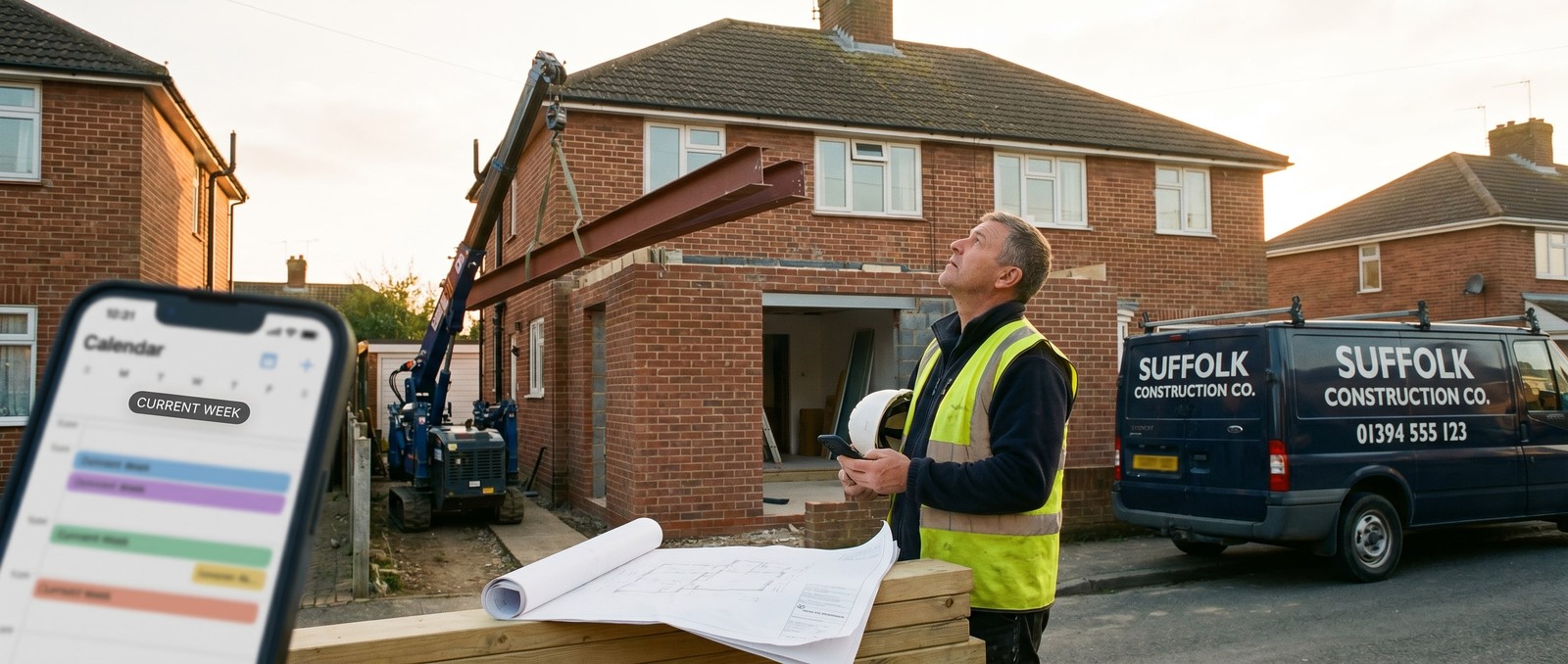
Software for UK extension and conversion specialists
Six months on the structural drawings. Four weeks waiting for the steels. The customer thought the deposit was the deposit.
Domestic extension is a different business from breakdown and repair work. The ticket is £25k-£60k+; the project runs 8-16 weeks from strip-out to handover; you’re choreographing sparkies, plumbers, plasterers, tilers and kitchen-fitters around weather and supplier lead times. The customer spent six months getting the planning consent, the structural calcs and the Party Wall award; she’s been visualising her kitchen-extension on Instagram for a year; she rings every morning at 06:55 from work asking what time you’re starting. The deposit was 15-25% - she thinks it was everything. The strip-out invoice goes in three weeks later and she queries it. The first-fix invoice goes in and she’s anxious. By the time you’re at plastering you’re running the customer-relationship project alongside the build project, and one is harder than the other.
This page is for builders whose week is mostly £25k-£60k+ domestic extensions, loft conversions, garage conversions and kitchen-bathroom refurbs. If extensions are one part of a mixed week alongside call-out work, the main builders page is the better fit; if your business is mostly small commercial fit-outs, the commercial-fit-out spoke is the sibling. Extension is its own thing because the cadence is its own thing - 8-16 weeks of multi-trade choreography with a four-to-five stage-payment ladder, a structural engineer, Building Regs Part A / B / L / F / O / M / P all live in the same project, and the customer’s emotional investment is the largest in her house outside the house itself.
What your week actually looks like
- A £42k single-storey rear extension at a customer’s house in Sudbury - week 5 of 12, the steels arrive Tuesday, the sparky first-fixes Thursday, the plasterer’s booked for the following Tuesday.
- A loft conversion at a Victorian terrace - Party Wall Act notification served eight weeks ago, structural calcs in, Velux on a four-week lead from the supplier, fire-door for Part B in stock at last.
- The customer’s husband texting at 06:55 asking what time the lads are starting, every morning.
- A Howdens kitchen delivery on Friday for a different project - they swapped the integrated dishwasher brand without telling you, customer queries the invoice line on Saturday morning.
- Structural engineer sign-off on the foundation pour - the engineer wants a half-day’s notice and a photo set, the foundation is going down Monday morning.
- Building Regs Part B inspector visit booked for the day you’re on holiday - the loft conversion fire-spread and means-of-escape evidence pack needs to be ready for the foreman; the LABC inspector doesn’t reschedule for one builder’s calendar.
- A stage-payment invoice that went into the customer’s email spam folder; three weeks later she’s complaining you never asked for the second-fix money.
- A planning condition (the obscure-glazed window on the side elevation) you missed at first-fix; remedial work eats half a Saturday.
- The Party Wall surveyor’s award you need to attach to the next-door-neighbour’s evidence pack before the wall comes out.
- A snagging walk on handover Friday - fourteen items, half of them the kitchen-fitter’s silicone bead or the painter’s drip runs, all on your reputation.
- Part L overheating calc and Part F ventilation evidence the LABC inspector wants at pre-completion sign-off, FENSA cert from the window supplier, MVHR commissioning record from the M&E sub - three different paper trails the customer’s solicitor will ask for in five years’ time when she sells the house.

Example problems we could solve
1. The customer-side project portal that stops the 06:55am text
The husband-at-06:55 moment: customer’s husband texts at 06:55 every morning - “what time are you starting?” - you’re starting when the plasterer turns up, and the plasterer’s already messaged to say he’s on the M11 having been bumped from yesterday’s job by a no-show of his own. A domestic build is the biggest emotional purchase in a customer’s house outside the house itself; the relationship is the build, the build is the relationship. The text isn’t really what time are you starting - it’s am I still in your week.
Solved looks like: a per-project customer-side portal showing this week / next four weeks as a simplified Gantt - first-fix electrics Tuesday, plastering Wed-Thu, kitchen delivery Friday, second-fix start Mon - with a Friday close-of-play photo-set auto-attached and a Saturday-morning weekly update in your voice landing as an SMS before the husband can text. Trades-side updates from the multi-trade Gantt (problem 3) feed the customer-side view automatically; she sees enough to know she’s still in the schedule without seeing the dependency graph that would worry her. The longer version lives at /solutions/customer-and-third-party-portal; the extension version’s distinct features are the simplified this week / next four weeks customer-side Gantt and the Saturday-morning weekly update cadence that turns the 06:55 text into the customer opening the portal at 06:55.
2. The stage-payment ladder, photographed, signed, and not lost in spam
The spam-folder moment: “Strip-out invoice went into her email spam folder. Three weeks later we’re at first-fix and she’s complaining I never asked. By the time we’re at plastering the cashflow’s underwater and the bank’s looking at me funny.”
Solved looks like: stage payments as a first-class object inside the contract from day one. Deposit (15-25% on signed contract), strip-out (10-15% on photo-evidenced strip-out complete), first-fix (15-20% on first-fix electrics + plumbing + steels + foundation), second-fix (15-20% on second-fix + plastering + windows), completion (15-25% on snag-list sign-off). Each trigger fires an SMS to the customer (never email-only - emails go to spam) with the photo evidence, the “what’s been done” paragraph in plain English, the schedule of what’s next, the card or open-banking payment link, and a one-tap accept. Late-payment chase ladder from day 7 - domestic stage payments rarely need statutory interest because the customer’s already in her own house, but the chase ladder cites the contract terms and the photo-evidence per trigger stops the “how do I know you’ve done that” conversation cold. The spam-folder problem is universal and the SMS-first delivery is what closes it. The full stage-payment ladder lives at /solutions/stage-payment-and-retention-ledger; the dunning side at /solutions/invoice-and-dunning-ladder.
3. Multi-trade scheduling tuned to extension cadence
The Tuesday-slip moment: “Strip-out week 1, foundation week 2, steels week 3-4, first-fix week 5, plastering week 6-7, second-fix week 8, kitchen week 9, snagging week 10-11. Plasterer slips three days, every dependent slides, customer panics, husband texts at 06:55.”
Solved looks like: the project schedule as a multi-trade Gantt the foreman opens on his phone - sparky, plumber, plasterer, tiler, kitchen-fitter, glazier, roofer (where the extension touches the existing roof), Velux supplier, steels-fabricator, structural engineer for sign-off visits. Each trade slot carries the dependencies (plastering can’t start until first-fix is signed off; kitchen install can’t start until the floor’s screeded and dried). When one trade slips, the cascade re-times the dependents and fires a WhatsApp ping to the affected trades - “plasterer pushed to Thursday, your second-fix moves to Friday at 09:00, confirm yes or call”. Daysheets land via WhatsApp at the end of each shift; the customer-side portal (problem 1) updates automatically; the cashflow forecast updates against the new stage-trigger dates. Supplier-lead-time-awareness is baked in - Velux on four-week lead, the structural-glazing supplier on six, the bespoke kitchen on eight - so the Gantt knows what’s waiting not just what’s late. The cascade-when-one-trade-slips is the single biggest predictor of project profitability - the build is shaped around catching the slip in hours, not days. The longer version lives at /solutions/booking-and-review-loop.
4. Building Regs + planning compliance pack at handover
The obscure-glazing moment: “Forgot the obscure-glazed window on the side elevation. Building Regs inspector flagged it at pre-completion. Half a Saturday of remedial work, an awkward customer conversation, the completion certificate held.”
Solved looks like: every project has a compliance checklist baked in from design-and-build stage - Building Regs Part A (structural sign-off on foundations + steels), Part B (fire-spread / means-of-escape on loft conversions), Part C (site preparation / contamination), Part F (ventilation in extensions with extract systems and MVHR), Part L (energy efficiency + insulation), Part O (overheating in new dwellings and extensions - the post-2022 ASTRO calc the LABC will ask for), Part M (accessibility on bigger work), Part P (notifiable electrical work via the sparky’s competent-person scheme), Party Wall Act 1996 notices and awards where applicable, planning conditions per the consent (obscure glazing, restricted-hours, drainage discharge, materials), FENSA / CERTASS notifications for window-supplier sign-offs, MVHR commissioning record from the M&E sub. As each milestone completes, the foreman checks off the corresponding compliance item with photo evidence; at handover, the pack assembles automatically as a single PDF for the customer + the LABC inspector + the customer’s solicitor (if she sells the house in five years’ time and the conveyancer asks for the cert pack). The “forgot the planning condition” and “can’t find the FENSA cert” problems are universal and the compliance pack assembly stops both from being a handover-day scramble. The longer version lives at /solutions/compliance-evidence-record.
5. Snagging workflow that doesn’t eat your weekends
The handover-Friday moment: “Handover Friday. Customer walks the job with a notebook. Fourteen items on page three, half of them not mine - that’s the kitchen-fitter’s silicone bead, that’s the painter’s drip on the architrave, that’s the tiler’s grout-line on the splashback. But it’s my reputation on the line. Weekend gone.”
Solved looks like: snagging as a structured workflow on the tablet at handover. Customer walks with you; each item captured with a photo, the room, the trade tag (sparky, kitchen-fitter, plasterer, painter, tiler, your own crew), the type (cosmetic, functional, defect). Items auto-route via WhatsApp to the responsible trade - “kitchen-fitter: silicone bead on the bathroom mirror unit needs redoing, photo attached, due Tuesday”; sign-off photo returns to close the item. Items that aren’t yours flag clearly on the customer-side portal - the conversation about whose snag this is happens once, with photo evidence, not three times. Final snag-list sign-off triggers the completion stage payment (problem 2). The snag-list is the last impression of the project and the cost-leakage point - the build is shaped around making the routeing automatic and the responsibility visible. Same audit-log discipline ports straight into the NHBC-warrantied workmanship record for any sub-contract work you’ve taken on under a main contractor.

The closest things we’ve already built
- HC Electricaldifferent trade, same Suffolk trade-chassis with the customer-comms cascade pattern on the EICR / EV-install side. The closest reference for how a multi-stage customer-relationship cadence runs in a Suffolk trade business, and how the cert-pack discipline ports across to the Building Regs compliance pack in problem 4. (Named pull-quote and final outcome figures hold until the permission checklist clears - see /case-studies/hc-electrical.)
- mendbuddythe multi-channel AI agent platform behind the 06:55am-text triage in problem 1 and the customer-side comms cadence during a long extension. Trained on your scope bands, your stage-payment language, your supplier list and your customer voice. See /case-studies/mendbuddy.
- Allways Roofing Haverhilldifferent trade (roofer), same long-project multi-stakeholder customer-comms-heavy shape on the storm-damage / re-roof side. The photo-evidence-per-stage discipline that ports into the stage-payment ladder in problem 2. (Named pull-quote and final outcome figures hold until the permission checklist clears - see /case-studies/allways-roofing.)
FAQ
Will the multi-trade Gantt force my sparky / plasterer / kitchen-fitter to use new software?
No. The trades get WhatsApp pings in their existing chat surface; the Gantt is the foreman’s tool, not the trades’. The trades confirm or push back via WhatsApp; the cascade runs server-side. Daysheets land via WhatsApp at the end of each shift. We’ve yet to meet a plasterer who wants a new app on their phone.
Will you handle the Party Wall Act 1996 paperwork for me?
No. Party Wall surveyor appointments and awards stay with the surveyor - you’ll usually instruct a professional Party Wall surveyor under the Act for any notifiable work. We build the reminder, the document store, and the audit log so the next-door-neighbour evidence pack is ready when the project needs it.
Can you integrate with my structural engineer / architect’s drawing system?
Where they publish a feed (most don’t), yes. Where they don’t, the drawing set lives in the project portal as the canonical reference; the engineer’s sign-off visits book through the same Gantt as the trades. Same shape works for the M&E sub’s MVHR commissioning record and the FENSA cert from the window supplier.
My customer’s solicitor wants the FENSA / CERTASS / Building Regs sign-offs five years after handover. Will the pack still be there?
Yes. The compliance pack at handover lives in the project record indefinitely; the customer’s portal access doesn’t expire. Five years later, she logs in and pulls the PDF for the conveyancer.
Can the stage-payment ladder handle the customer who pays the deposit by card and then wants to pay the rest by bank transfer?
Yes - payment-method-per-stage is a setting against the contract. Deposit on card via the one-tap link, strip-out and first-fix on open banking with auto-reconciliation against the invoice, completion stage on whichever the customer prefers. The reconciliation against Xero is the same shape either way.
What about Part O overheating calcs on extensions - does that apply to me?
Part O bites on new dwellings primarily, but the LABC will increasingly ask for an overheating note on substantial extensions with significant glazing (rear extensions with structural-glazed gables, loft conversions with south-facing roof lights). We don’t do the calc - that’s the architect or a Part O consultant - but the compliance checklist flags the trigger and the pack carries the note when it’s there.
What does it cost?
Every build is scoped per firm - depends on project mix, average ticket, whether the multi-trade Gantt and the compliance pack are both in scope, and what’s already on your phone. We talk it through, agree price in writing. See pricing.
Up to the hub
← UK builders (main page) · Commercial fit-out (sibling) → · Electricians (adjacent trade) → · Plumbers (adjacent trade) → · Roofers (adjacent trade) → · Gas engineers (adjacent trade) →
Tell us about the extension side
What’s your modal ticket, how many trades you typically coordinate, where the customer-comms is breaking, what supplier-lead-time pain shows up most often. Send an enquiry - we’ll come back with a sketch.