

Software for UK commercial flat-roof maintenance roofers
The reactive repair pays the bill this month. The annual inspection contract pays the bills for the next five years.
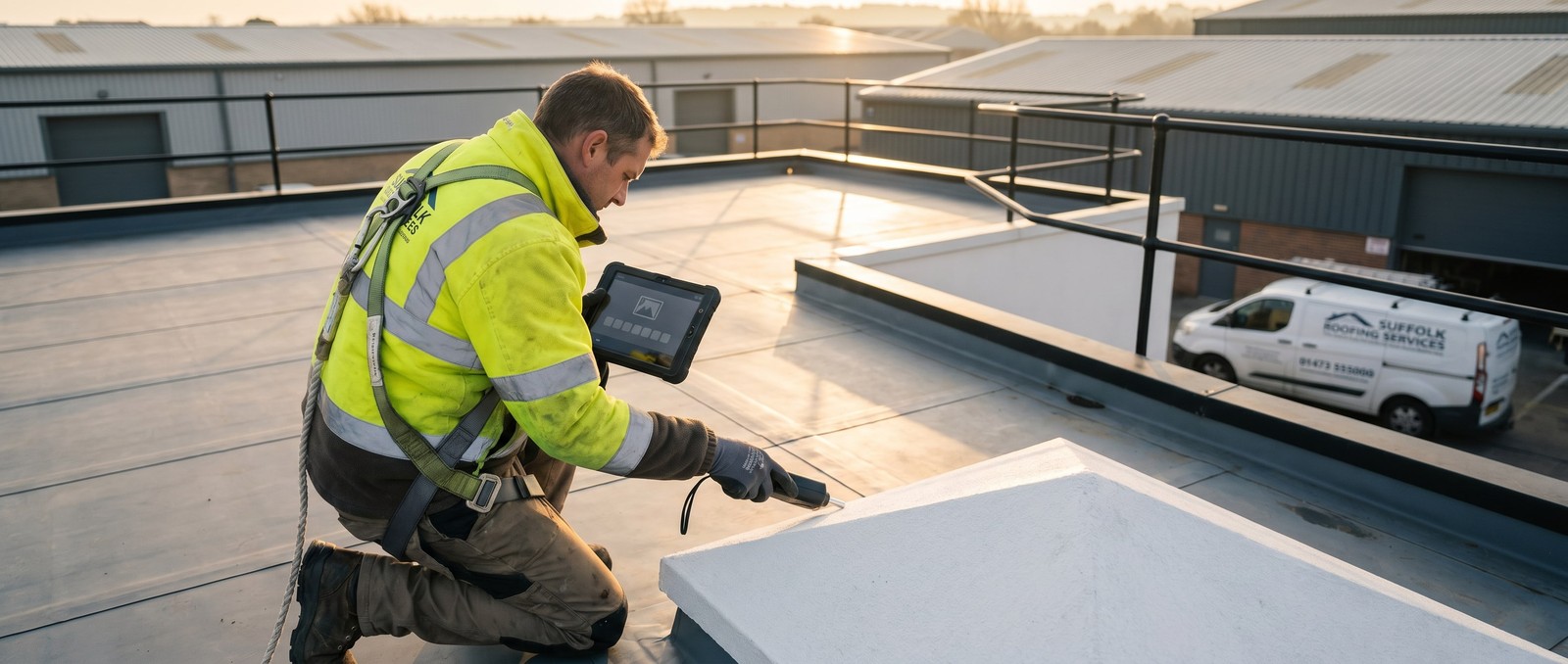
Commercial flat-roof maintenance is a different business. The customer isn’t a homeowner who’ll feel it personally if the felt fails - it’s a facilities manager with twenty buildings, an annual budget, and a slightly different procurement process for every estate she looks after. The work isn’t a job, it’s a contract: an annual planned-preventative-maintenance (PPM) visit on every roof, a quarterly check on the higher-risk sites, a reactive call-out every other Tuesday, a five-year manufacturer warranty conversation in November. The cashflow is the thing - recurring monthly retainers smooth the autumn-feast / summer-famine that destroys a reactive-only roofing book.
This page is for roofers who’ve moved beyond domestic re-roofs and storm-chasing into property-manager relationships. If you’re mostly storm and insurance the storm-damage spoke is the sibling. If you do the occasional commercial inspection alongside a domestic book the main roofers page is the better fit. The buyer here isn’t really thinking about a roof at all - she’s thinking about budget defensibility, single-pane-of-glass reporting across the portfolio, and a contractor who turns up before the call.
What your week actually looks like
- Four annual inspections due this month, across three property managers with three different reporting formats - one wants a Sika-templated PDF, one wants a spreadsheet, one wants the Fixflo job ticket updated.
- A reactive call-out at half-four on a Friday - single-ply membrane patch on an industrial estate that’s on a three-year framework with two more years to run.
- Quarterly invoice run via GoCardless on the retainer side, with one site’s billing on hold because the property manager went on parental leave and nobody told you.
- A five-year manufacturer warranty (Sika, Bauder, IKO, SCC) on a flat-roof you laid in 2021 - a defect to log, a manufacturer claim form to fill, and a property manager copied in who’d rather not deal with it.
- CDM 2015 paperwork on a refurb that creeps over the threshold - F10 notification to HSE, principal-contractor RA, H&S file at handover, every site in a different GC’s format.
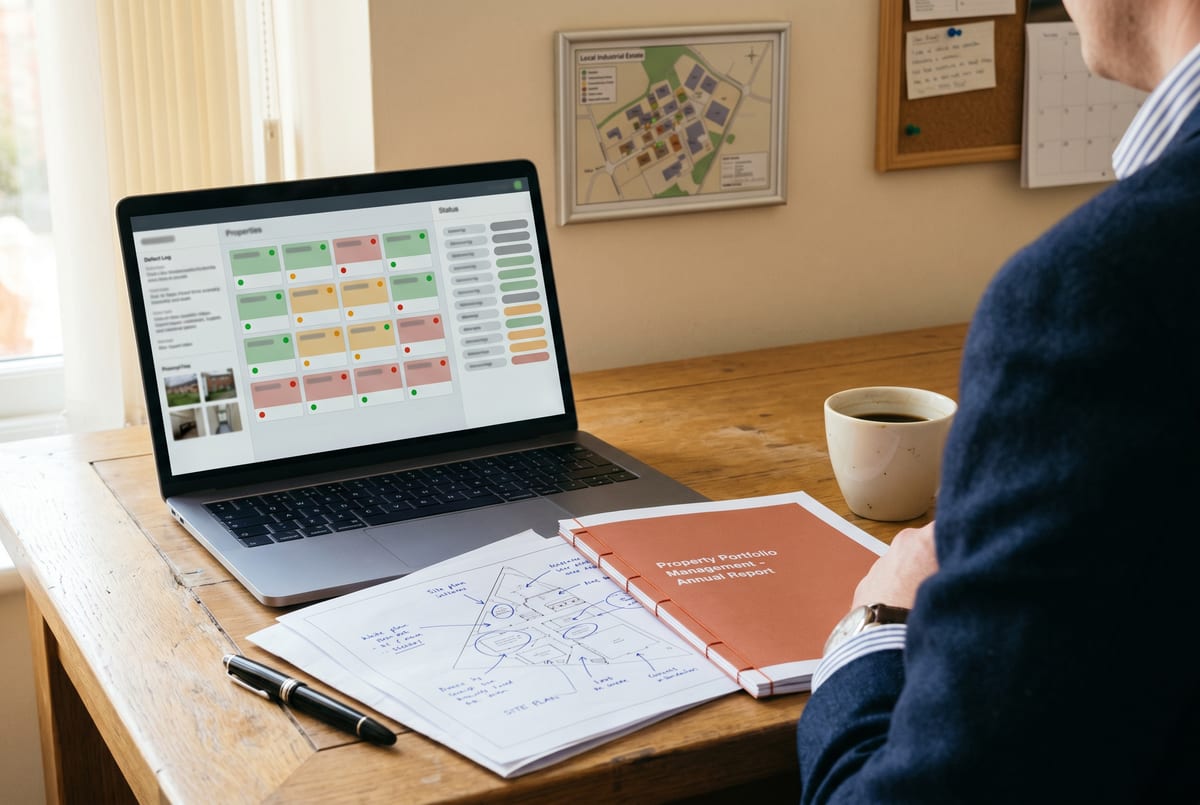
- A multi-site portfolio dashboard the property manager keeps asking for and you keep promising to build her.
- Six annual inspections that drag every December because the property manager wants them done before year-end and the weather wants you not to be on the roof.
- A PI insurance renewal where the broker wants evidence you’ve inspected your last-five-years of installations.
- An NHBC-warrantied workmanship record for the commercial sub-contract work you did under a main contractor in 2023 that the main contractor’s QS is now asking for.
The shape is contract-based, not job-based. Most roofing software is built for the reactive job. That’s the gap.
Example problems we could solve
1. The annual inspection round as a first-class object
The somewhere-in-last-year’s-spreadsheet moment: “I know I should be inspecting twenty-eight sites this autumn. I’m only sure of twenty-two. The other six are in last year’s spreadsheet - somewhere.”
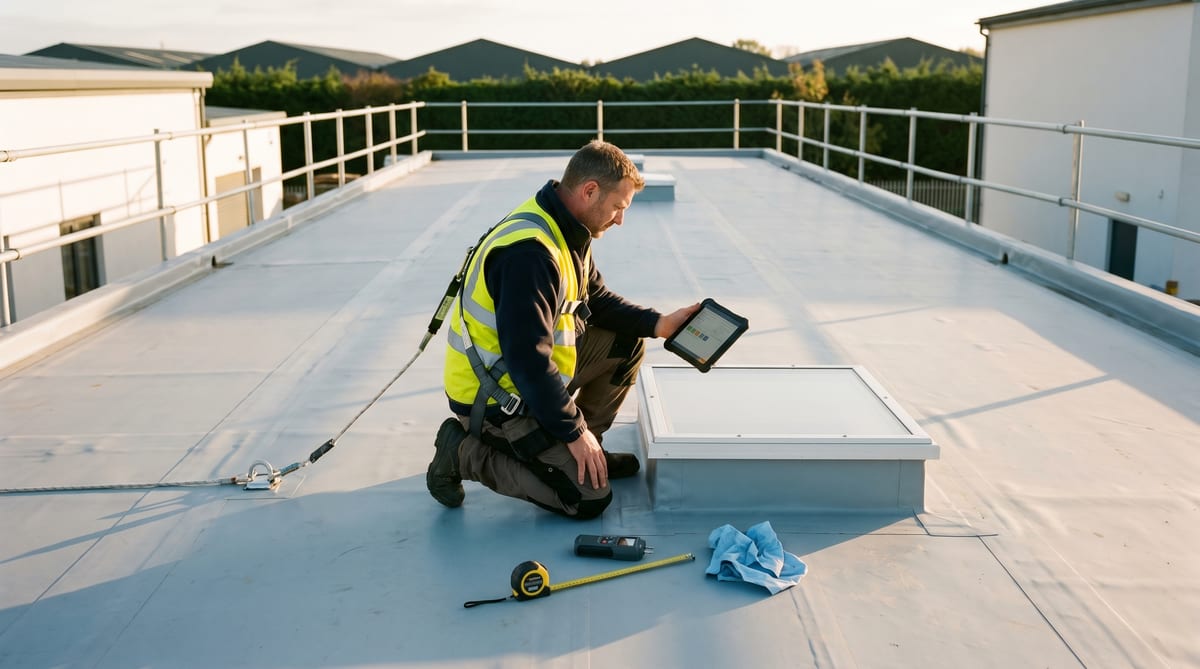
Solved looks like: every inspection contract becomes a recurring service object in one ledger - site address, last inspection date, next due date, contracted SLA, the property-manager contact, the historical defect log, the manufacturer warranty status, the asset register (number and type of roof lights, AOVs, plant penetrations, edge protection, lightning protection). Twelve months before each due date the round auto-builds, the diary slots get suggested, the property manager gets a heads-up SMS, and your engineer leaves the office in November with a tablet that knows what they’re looking for on every roof. Variations and defects logged on site flow back to the same record so next year’s inspection starts where this year’s finished - and the same ledger feeds the manufacturer warranty tracker in problem 4. The longer version lives at /solutions/recurring-service-recall; the commercial-maintenance version is the same engine tuned to the multi-site PPM cadence rather than the single-property annual service.
2. The property-manager portal that earns next year’s contract
The “what did you do at Stowmarket” moment: property managers love a dashboard; you send them a PDF report; three months later she rings asking what you did at the Stowmarket site. Re-tender season you’re not competing on price - you’re competing on visibility, which is a fight you’ve already won if she can see every inspection, every defect, every photo and every invoice in one place.
Solved looks like: a per-property-manager portal showing every site, every inspection, every defect, every photo, every invoice, the auto-assembled annual PPM report, and the five-year manufacturer-warranty status per roof. The commercial-maintenance-specific moment is that the portal is the deliverable, not a side-document - the manager opens it instead of ringing you. Per-property-manager themes and report templates so the pack she sees is in the format her bookkeeper and her client (the landlord or the estate) recognise. The longer version lives at /solutions/customer-and-third-party-portal; the commercial-maintenance version’s distinct features are the manufacturer-warranty-tracking-per-roof and the annual PPM report auto-assembled from the year’s data.
3. CDM-15 site pack - for when the refurb tips you into principal contractor
The Sunday-in-February moment: “Single-ply overlay on a school sports hall. Started as routine maintenance, turned into a CDM-notifiable project. F10 to HSE, construction phase plan, RAMS, H&S file - and a property manager who thinks it’s all included.”
Solved looks like: a CDM-15 site pack template - F10 submission, construction phase plan, RAMS, asbestos register reference, H&S file structure, weekly toolbox-talk record. Generated per site from a template; updated as the site progresses; the H&S file at handover comes out of the same store, in the format the property manager (or her CDM consultant) wants. Where the GC has a specific format we templatise theirs alongside the generic one. Not legal advice - your CDM duty as principal contractor stays with you - but the document production stops being a Sunday job in February. Same audit-log discipline as the inspection ledger, tuned for the longer cadence of a CDM-notifiable refurb.
4. Manufacturer warranty tracking and defect claims that don’t fall through the cracks
The defect-in-2026-on-a-2022-install moment: “Sika, Bauder, IKO and SCC each have a different five-year-warranty process. The defect’s on a roof I laid in 2022, the installer who did it has left, and the manufacturer wants photos I’m not sure we kept.”
Solved looks like: every system installation gets a warranty record on creation - manufacturer (Sika, Bauder, IKO, SCC, Alwitra, Protan), system spec, install date, installer, photo set, batch references on the membrane and adhesives, warranty expiry, manufacturer claim-form template. When a defect is logged in the field, the system pulls the matching warranty record, pre-fills the manufacturer claim form, attaches the install-time photos, and queues the claim for your office to review and submit. The property manager sees status in her portal; the manufacturer sees a complete pack on first submission; the defect doesn’t sit in a “we’ll get to it” pile for three months while the warranty window narrows. Shape-wise like the cert-as-trigger flow on the HC Electrical case study - historical install record becomes the workflow trigger years later, only here the trigger window is five-to-twenty-five years rather than five.
5. The framework-contract billing flow your finance team will actually use
The quarterly-statement moment: “Three-year framework, agreed monthly retainer plus T&M reactive call-outs at agreed rates, a different reporting format for the property manager and the head of finance, and a quarterly invoice that’s never quite right.”
Solved looks like: a framework-aware billing layer that sits between your engineer’s site notes and your accounting (Xero, QuickBooks, Sage). Each engineer visit logs labour and materials against the framework’s agreed rate card; reactive work auto-distinguishes from contracted PPM; the monthly retainer invoice generates from the framework spec; T&M lines append at the agreed rates. End-of-quarter, finance sees a single statement per framework with a clear breakdown - retainer, reactive, variation, materials. The property manager sees the same data in her portal, in her preferred format. Disputes happen on numbers, not on whether you’ve got the numbers. The longer version lives at /solutions/invoice-and-dunning-ladder; the commercial-maintenance version’s distinct features are the per-framework rate card driving the invoice assembly and the retention ledger for refurb work running alongside the PPM retainer stream.
6. The renewal nudge that wins the re-tender before it goes to tender
The lost-framework moment: “Three-year framework’s up in May. The property manager will go to RFP in March if I don’t pre-empt. I’ve meant to ring her for six months. It’s never been Tuesday morning.”
Solved looks like: a contract-renewal ledger that knows when every framework is up, how much it’s worth, and what your historical win rate looks like with each property manager. Twelve months out from expiry, a renewal workflow triggers - a portal summary of the contract performance to date, a draft renewal proposal that pre-fills from the year’s data (inspections completed, defects rectified, manufacturer warranty positions, satisfaction signals), a sequence of light-touch outreach moments (a coffee, a quarterly digest, an end-of-year defect report) the agent or you can fire. By the time the property manager is thinking should I go to tender, you’ve already given her the answer. The longer version lives at /solutions/quote-and-chase-ladder; the commercial-maintenance version is the same chase chassis pointed at framework renewals rather than fresh quotes.
The closest things we’ve already built
- Allways Roofing Haverhilldomestic-led pitched-roof contractor in Haverhill, Suffolk. Allways’ book skews domestic but the studio that built it understands the recurring-revenue shape; the closest live reference for a roofer who wants the website and the back-office automation by the same hands. (Pull-quote and final outcome figures hold until the permission checklist clears - see /case-studies/allways-roofing.)
- HC Electricala different reactive trade in the same Suffolk catchment. Different regulator stack, same trade-chassis: the cert-as-trigger flow that drives the EICR recall annuity is the closest shape-wise reference for the manufacturer-warranty tracker in problem 4 - historical install record becomes the workflow trigger years later. See /case-studies/hc-electrical.
- RepairMinderour SaaS for an inbound-items repair business. Different vertical, same shape as the inspection-round ledger and the warranty tracker: service objects with recurring triggers and an audit log that survives years. See /case-studies/repairminder.
FAQ
Will this replace SimPro / Joblogic / BigChange / FieldEdge?
Usually no, where they’re working. The mid-market FM platforms do scheduled work fine. What’s missing is the property-manager-facing portal, the manufacturer warranty tracking, and the framework-billing layer. We sit on top, add the bits that don’t exist out of the box, and leave the scheduling engine where it is.
My property managers all want their own format. Can you handle that?
Yes - that’s the point. Per-property-manager portal themes, per-property-manager report templates, per-framework rate cards. The work to set up a new property manager is a couple of hours, not a couple of weeks.
Will you take over my framework tender writing?
No - tender writing is your relationship, your scope, your liability. We’ll build the data layer that makes the tender easier to write (defect history, response times, manufacturer-warranty positions, customer-satisfaction scores) but the tender stays with you.
What does it cost?
Scoped per build - depends on portfolio size, number of property managers, whether the manufacturer warranty tracker is in scope, whether the framework-billing layer is integrating with Xero, Sage or QuickBooks. We talk it through, agree price in writing. See pricing.
Can you handle multi-trade FM contracts (we do gutters + roofing + drainage)?
Yes. The inspection ledger doesn’t care what trade the service object is for - gutter-cleaning rounds, drainage CCTV surveys, roof inspections all sit in the same shape. If your business is multi-trade FM, the portal is more useful, not less.
Can the manufacturer-warranty tracker hand off to the storm-damage flow if a roof we maintain gets storm-hit?
Yes. The warranty record and the install photo-set are already there; the storm-damage spoke workflow picks up the same record and adds the loss-adjuster pack flow on top. The roof doesn’t have to be re-mapped halfway through a claim.
Up to the hub
← UK roofers (main page) · Storm-damage / insurance → · Lettings (sibling vertical) →
Tell us about the portfolio you maintain
How many sites, how many property managers, what the framework rates look like, what manufacturer warranty programmes you’re running across the book, where the year-end inspection round always slips. Send an enquiry - we’ll come back with a sketch.