

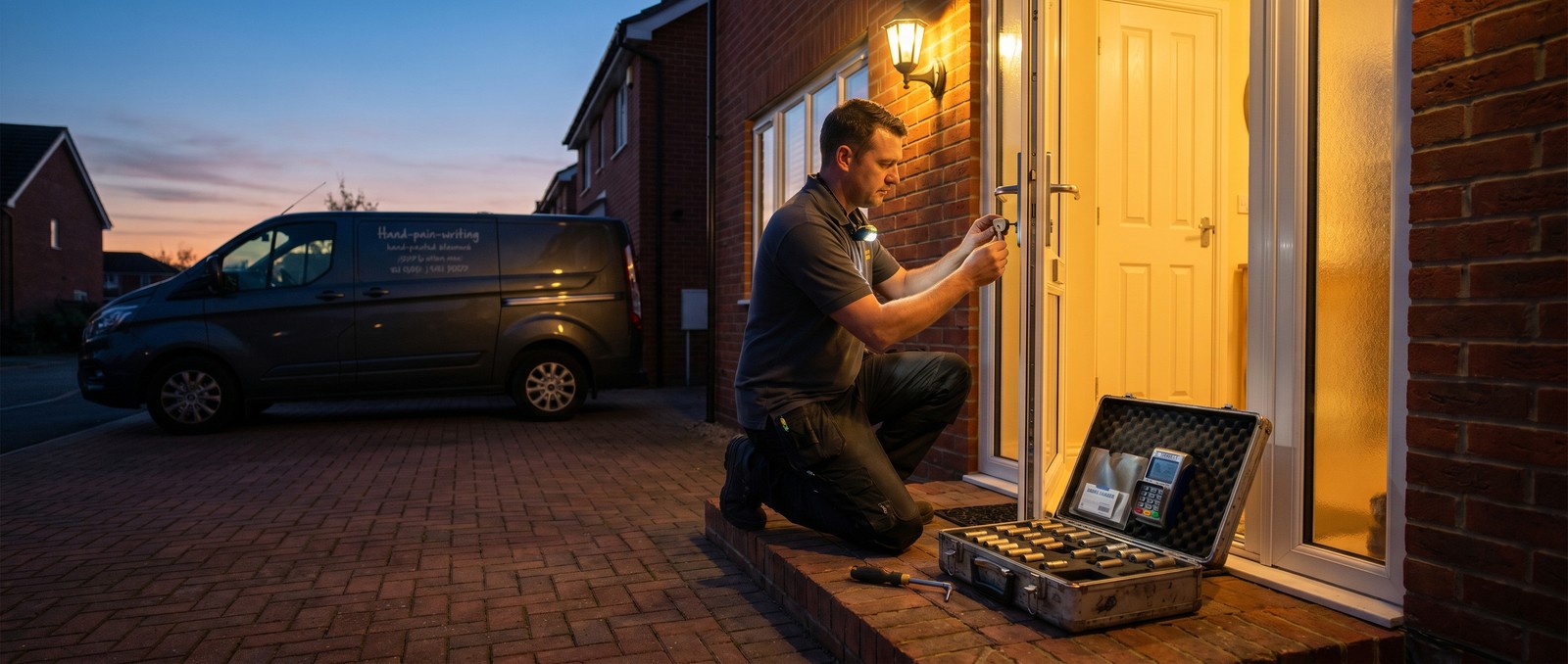
Software for UK locksmiths
Locked out at 9pm. Three numbers in sixty seconds. The one that picked up was the cowboy.
She’s locked out of her own house in the dark and she rings three numbers in sixty seconds. The one that picks up first wins - and half the time it’s a cowboy on a £49 call-out who’ll be £400 by the time the cylinder’s been drilled and binned and a no-name replacement’s on the door. The hour you spent fitting a snap-resistant TS007 three-star cylinder on a £140 call, lost to a five-minute drill-and-replace by someone who shouldn’t be in the trade. The card terminal’s flat on a doorstep at half ten, her bank app needs Face ID she can’t get because her phone’s locked in the house, and you’re driving home with cash you didn’t want to take. Eight HMOs on the same letting agent - tenancy changeovers every couple of months, lock-change-and-rekey done ad-hoc, never banked as the £4k-a-year contract it actually is.
We make custom software for locksmiths and handymen. Small apps and automations that sit on top of what already works for you - ServiceM8, Tradify, Workever, paper-and-WhatsApp, whatever you run - and quietly do the bit that loses you the £180 emergency, the recurring letting-agent round, and the doorstep that didn’t reconcile. Not another app to learn on a 5-inch screen at the kerb. Tell us what your week looks like and we’ll come back with a sketch.
What you spend your week on that you shouldn’t have to
- The locked-out customer at 9pm who rings three numbers in sixty seconds - and by 9:04 has booked the one who picked up.
- The cowboy-locksmith reputation drag - Watchdog ran the piece again in March, the £49-call-out-to-£400-upsell trade, and your verified Google reviews are spending half their wordcount explaining you’re not that.
- The phone-quote shopper asking “how much for a lock change” and ringing off mid-sentence about anti-snap cylinders, TS007 three-star, BS 3621 insurance approval, and the £85-to-£260 range that depends on what’s actually on her door.
- Five small jobs in a half-day handyman visit - door rehung, two euro cylinders changed, a dripping mixer fixed, a shelf put up, grout - and a customer who’ll query the breakdown if you give her one and suspect the total if you don’t.
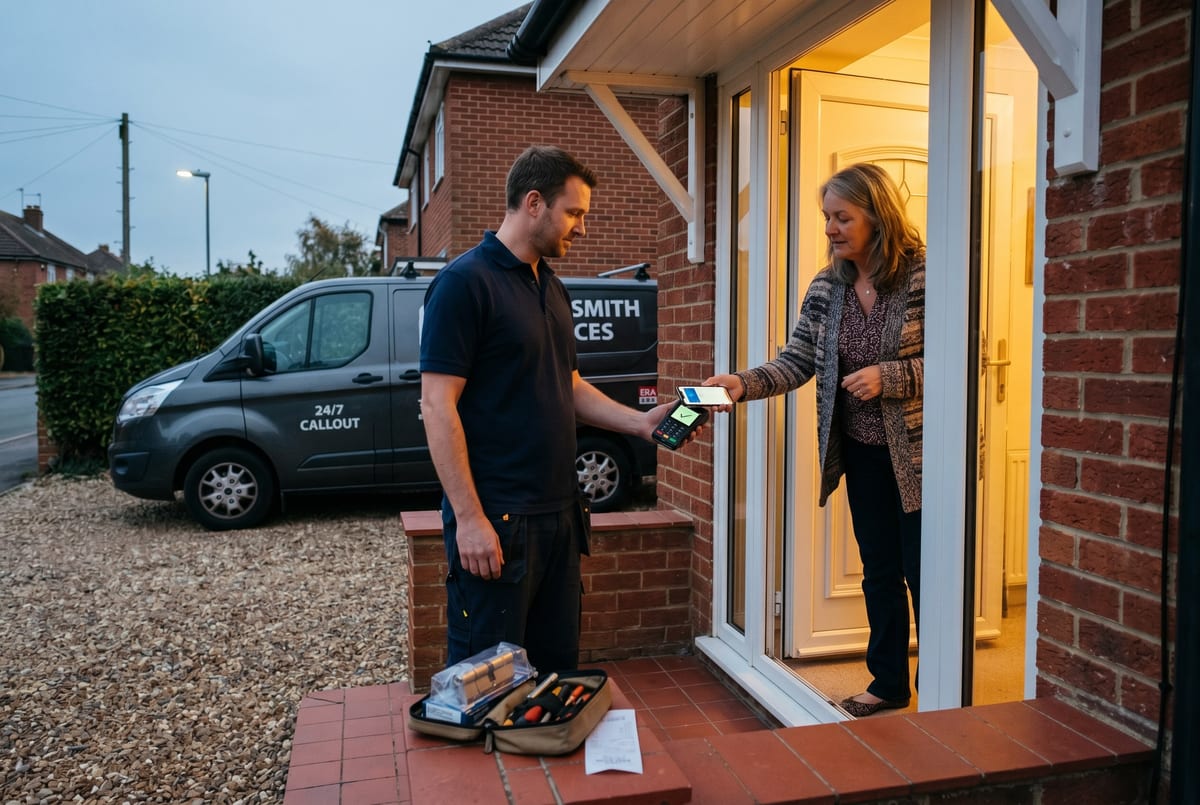
- SumUp out of charge on the doorstep at half ten, the customer’s only got Apple Pay, the bank’s shut, and on Monday you’re banking cash with a guess at which job it sat against.
- Eight HMOs on the same letting agent’s portfolio going through tenancy changeovers every couple of months - £80 a pop, six times a year, never quite negotiated into the £4k-a-year retainer it should be.
- A 35-mile drive for a £120 lock change because the reviews matter more than the diesel, then forgetting to ask for the review on the doorstep and watching the relief fade by morning.
- The CCTV install for a small business where the customer thinks it’s “just cameras” - and you’re owed the ICO registration conversation, the DPIA, the signage spec, and the GDPR posture.
- An MLA membership cert, a DBS check, a £6m public-liability line - credentials that never surface on the quote SMS, while the cowboy at £49 lands first in the customer’s pocket and wins on price alone.
- An NSI Gold or BAFE audit on the security-install side wanting commissioning sheets, handover packs, and a corrective-action log on one PDF - assembled from twelve places in your phone the day before the auditor arrives.
These aren’t problems for a generic field-service app. They’re the bit between phone ringing and door open, card tapped, customer reviewed, key round banked as a contract. That’s the bit we build.
Example problems we could solve
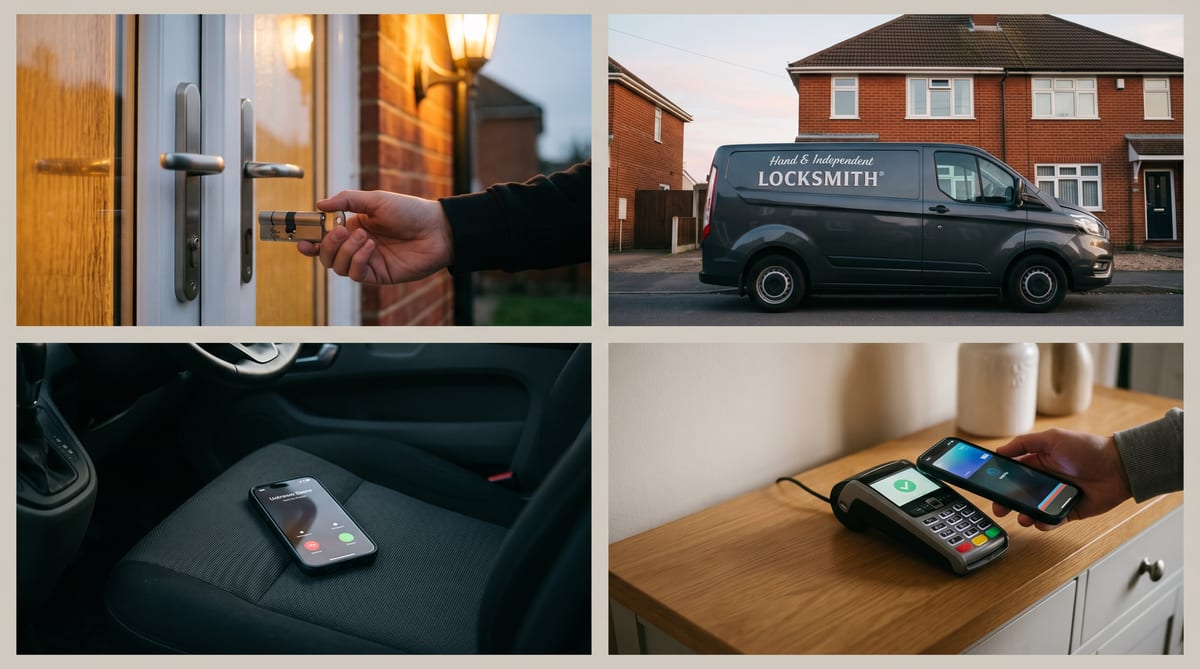
Six things we hear most often from locksmiths and handymen - with what the solved version looks like in your week. Every job is sized to your business: a sole-trader emergency locksmith probably needs the first two; a four-van firm running emergency, security-install and letting-agent property maintenance might want all six. None of it means binning what already works.
1. The sixty-second window - the locked-out customer who’s about to ring next
The cowboy-wins moment: she’s on the doorstep at 9pm, phone running flat, ringing the next number on Google in sixty seconds. The £49-on-the-phone wins and the trade earns the Watchdog piece again. Locksmithing is the trade where missed-call leakage is existential - and the trust signal that actually beats the cowboy (MLA membership number, DBS check, £6m PL cover, verified Google review count, the non-destructive-entry sentence) has to land in her pocket inside that sixty-second window or it doesn’t land at all.
Solved looks like: an answer-on-your-behalf line that picks up while you’re on a callout - across calls, SMS, WhatsApp, Facebook Messenger, Instagram, and the chat box on your website - in your voice, trained on your lock-type price bands and your trust credentials. “I’m locked out of my flat in CB9, what’s the call-out” gets a price-range SMS back inside sixty seconds with the MLA number, the verified review count, the “non-destructive entry where possible, no drill-and-replace upsell” line, and a one-tap booking link - before she’s read the third Google result. The longer version lives at Trainable Inbound AI Agent; the locksmith setup is tuned for emergency-vs-quote-vs-info triage on the line, with the cowboy-beating trust signal as the first paragraph.
2. The phone-quote SMS that wins on credibility, not price
The price-shopper moment: the caller asks “how much for a lock change” and rings off before you’ve finished the sentence about UPVC multipoints, anti-snap cylinders, TS007 three-star ratings, and the £85-to-£260 range that depends on what’s actually on her door. Honest quoting takes a paragraph; the cowboy quotes £49 in five words and wins.
Solved looks like: the moment she rings off, an SMS lands in her pocket with the price range, the lock-type detection question (“is it a UPVC multipoint with a thumbturn, or a euro cylinder with a brass plate?”), the trust credentials (MLA, DBS, £6m PL, verified review count), and the firm-quote-on-arrival caveat - written so it reads honest, not legalese. The cowboy’s £49 looks suspicious next to a four-line SMS with a price range and a credentials line; that’s the entire game. The longer version lives at Quote & Chase Ladder; the locksmith version pairs the price-band library (ABS, Avocet, ERA, Yale, Mul-T-Lock anti-snap cylinders at your CEF / Insafe / Locks Online buying prices) with the trust-credential SMS, and runs the nudge ladder for the non-emergency quotes - the “thinking about upgrading my front-door cylinder to a snap-resistant” customer who needs three days, not three minutes.
3. Booking, en-route, and the 24-hour review window
The 35-mile-and-forgot moment: customer 35 miles away, single lock change, £120, you lose money on the drive but you do it because the reviews matter - then you forget to ask. The locksmith review window is materially more time-sensitive than other trades: at 24 hours the relief is still fresh; by 72 hours she’s moved on. Miss the window, lose the review, watch the cowboy’s two-stars pull yours down by association.
Solved looks like: booking → night-before reminder if it’s a planned visit → en-route SMS that fires automatically off your calendar flipping to travelling (“running 20 minutes late, sorry - fitting an anti-snap on a UPVC before yours, ETA 21:40”) → finished-work SMS with the cylinder make and key-cut count on it → 24-hour review prompt with one-tap links to Google, Checkatrade and Trustist. Negative sentiment routes back to you privately before it lands as a public review; positive sentiment goes out the moment she taps. The longer version lives at Booking & Review Loop; the locksmith timing is tuned to the relief-is-fresh 24-hour window, not the trades-default 90-minute one.
4. Doorstep payment reconciliation - every tap is also the bookkeeping entry
The SumUp-out-of-charge moment: half ten on a Saturday, doorstep cylinder change done, SumUp’s flat, the customer’s got Apple Pay but no bank app, you take cash, and on Tuesday evening the books have three reconciliations across three terminals and a cash float you’re guessing at. Locksmiths and handymen run more small-card and cash payments per week than almost any other trade - and the bookkeeping is where the margin quietly leaks.
Solved looks like: every doorstep payment lands on a single ledger across SumUp, Zettle, Stripe Terminal, Stripe Tap-to-Pay on your phone, and cash-on-doorstep - each one auto-tagged to the job, the customer, and the invoice the moment it taps. The receipt SMS sends itself. The end-of-week reconciliation rolls into Xero, QuickBooks or FreeAgent with the cash float tracked separately and the “paid-in-full vs awaiting-balance” state shown for any 50/50-split job. The doorstep tap is also the bookkeeping entry, not a thing to reconcile later. Tuesday evening at the kitchen table gets two hours back a week.
5. The letting-agent and HMO key-round that banks itself as a contract
The eight-HMOs-£80-a-pop moment: the agent does six tenancy changeovers a month across the portfolio. Lock-change plus rekey on tenancy turn, sometimes a master-key system audit on the HMOs, the occasional comms-cabinet padlock for the cleaner’s access. You do them ad-hoc. Eight HMOs, six times a year, £80 a pop - should be a £4k-a-year contract, never quite negotiated, always “next time.”
Solved looks like: every recurring letting-agent / HMO / commercial-maintenance relationship enters the system as a contract object. The first ad-hoc job auto-suggests the “would you rather a monthly retainer with a fixed call-out fee on top?” conversation, with a proposal draft built from the last six months of actual work. On the agent’s portal, every tenancy changeover triggers from their helpdesk feed (Fixflo, Propertyfile, ARPM where they run them; structured email where they don’t); the engine books a slot, fires the access SMS to the tenant where applicable, and runs the post-visit photo report into the monthly batch invoice on the agent’s stated payment date. Renewal anniversary fires 60 days out with a re-priced proposal. The HMO key-tracking ledger sits alongside - every key cut, every cylinder issued, every duplicate logged with the property and the tenancy, scoped so the agent sees only their keys, not your other clients’ inventory; restricted-key blanks (Mul-T-Lock, Avocet ABS) sit behind an extra access layer. BS 3621 dual-keyed front doors, BS 8621 thumbturn cylinders on HMO fire-escape doors, BS 10621 lockable thumbturns where night-secure mode is needed - the spec lives on the cylinder record, not in your head. The longer version lives at Recurring Service Recall; the agent-side cashflow ladder lives at Invoice & Dunning Ladder.
6. The half-day handyman bundle as one priced object
The five-jobs-twelve-lines moment: customer wants a door rehung, two euro cylinders changed, a kitchen tap fixed, a shelf put up, and a strip of bathroom grout re-done. You can do it in half a day. The moment you write twelve lines on a quote she queries each one; the moment you write one line she suspects the rest. The bundled half-day visit is the entire handyman value proposition and no off-the-shelf field-service app prices it as one object.
Solved looks like: the multi-skill quote as a single bundled object. On the phone (or in the chat) you add jobs to a list - “hang interior door, change x2 euro cylinders to TS007 three-star, fix dripping kitchen mixer, fit shelf bracket, regrout bathroom tile run” - and the engine prices the bundle as a half-day or full-day visit at your transparent fixed anchor rates (sized to van and crew, the figure agreed with you on day one). Customer gets a one-tap-accept SMS with the all-in price as the only number on the page; the constituent jobs sit underneath, queryable in a customer portal if she wants to know what’s covered. The accepted bundle auto-books a half-day slot. After the visit, the invoice settles as one line not twelve - which is what she wanted in the first place. None of which stops you writing the longer quote for the five-cylinder front-and-back-door upgrade she actually wants on top.
The closest things we’ve already built
- HC Electricala domestic and commercial electrician in Haverhill, Suffolk. Different trade, same trade-chassis on the inbound-triage and on-the-way SMS pattern, the cert-and-evidence engine, and the letting-agent batch billing. The closest live reference for a small-ticket high-volume trade running a Suffolk catchment with trust-signalling on the front and reliable cashflow on the back. (Named pull-quote and final outcome figures hold until the permission checklist clears - full case study at Hc Electrical.)
- mendbuddyour own multi-channel AI agent across SMS, WhatsApp, web chat, Facebook Messenger, Instagram and inbound + outbound voice. The 60-second SMS-back in problem 1 and the credentials-led phone-quote SMS in problem 2 are locksmith-shaped versions of this - trained on your price bands, your scope, and your MLA / NSI / BAFE / DBS / £6m PL credentials. See Mendbuddy.
- RepairMinderour software for running an inbound-items repair business. Different vertical; same shape as the job-thread pattern across the handyman bundle and the key-round ledger - work comes in, gets tracked, customer kept in the loop the whole way through, payment captured on completion. See Repairminder.
Adjacent trades
- Electriciansthe trade-chassis reference; HC Electrical is the named-build proof. Closest adjacency on the security-install side, where alarms, CCTV and access control overlap with the electrical scope.
- Plumberssame handyman crossover on the “five small jobs in half a day” visit, same Sunday-emergency doorstep-payment shape.
- Buildersadjacent on commercial property-maintenance and HMO refurb-and-rekey work, and on the practical-completion handover pack for any locksmith working into fit-out scope.
- Lettings agents and landlord portfoliosthe other side of the key-round contract conversation; if a couple of agents are most of your week, the agent-side hub is the better build target for the agent’s own stack.
FAQ
Will the 60-second SMS quote a firm price over the phone without me seeing the lock?
No - and that’s the point. The SMS quotes a price range (anti-snap euro cylinder £85-£140, UPVC multipoint £180-£260) with the firm-quote-on-arrival caveat. The cowboy-locksmith trap is the “£49 firm price over the phone” dance, and we don’t replicate it. The trust signal (MLA membership number, DBS check, £6m PL cover, verified review count) lands alongside the range so she can compare you to a cowboy on credibility, not just on price.
Can the agent integrate with my MLA / NSI / BAFE / SafeContractor / CHAS records?
Membership numbers, audit dates and scheme references live as profile fields and auto-attach to every outbound quote SMS, quote PDF and customer-facing trust page. MLA, NSI, BAFE, VCRP, SafeContractor and CHAS all sit in the same store. We don’t submit renewals or sit assessments for you - those are yours - but the reminder, the audit-pack assembly and the trust-signal injection are wired.
Will the letting-agent key round expose my key inventory to the agent?
No. Per-agent access is scoped - the agent sees the keys cut and issued for their properties only, not your other clients’ inventory. Master-key system records carry an extra access layer; restricted-key blanks (Mul-T-Lock, Avocet ABS) sit behind it, with cut authorisation tracked against the named keyholder.
How does the cylinder spec across an HMO portfolio handle BS 3621 / BS 8621 / BS 10621?
The cylinder record carries the spec against the property and the door - BS 3621 dual-keyed for entry doors where insurance requires it, BS 8621 thumbturn cylinders on HMO fire-escape doors so a tenant can get out without hunting for the key, BS 10621 lockable thumbturns where the property switches to night-secure mode. TS007 three-star rating and key-cut audit trail sit on the same row. When the agent asks for a cert pack, the per-property cylinder spec is what comes out.
What about the GDPR / DPIA on CCTV installs?
We build the customer-facing privacy notice template, the ICO registration check, the DPIA template, and the signage spec - but the ICO registration itself is yours to make, and the processing posture lives in the customer’s hands. Same posture on NSI Gold and BAFE: we build the evidence record, the commissioning-sheet flow and the handover pack; you sign as the competent person.
Do I have to bin ServiceM8 / Tradify / Workever?
No. We sit on top of what works for you and replace the bit that doesn’t - usually the missed-call recovery, the price-band SMS, the doorstep payment reconciliation, the letting-agent key-round contract, and the multi-skill bundle quote. ServiceM8’s per-job pricing kills the £60 lock-change; Workever is built for plumbers; Tradify’s diary is fine if it’s what your crew uses. We hook into your export and start from there.
What does it cost?
Every build is sized to your business - depends on your van count, your emergency / handyman / security-install / letting-agent mix, your MLA / NSI accreditation depth, and what’s already on your phone. We talk it through, agree the scope and the price in writing, then build. Send an enquiry and we’ll come back with a sketch. See pricing for how we work.
How long until something’s live?
Most locksmith builds we’ve sketched go from scope conversation to a working version you can run a real Saturday-night lockout through in a few weeks, then a couple more weeks of running real work through it before go-live. Exact cadence depends on what’s being replaced.
Tell us what your week looks like
Send an enquiry - what’s your van count, what mix (24/7 emergency, handyman, security-install, letting-agent property maintenance), what’s already on your phone for missed-call recovery and doorstep payments, what the letting-agent annuity looks like or doesn’t. We’ll come back with a sketch of what we’d build and what it would cost. No calendar, no demo to sit through. Email reply, scoped sketch, you decide.