

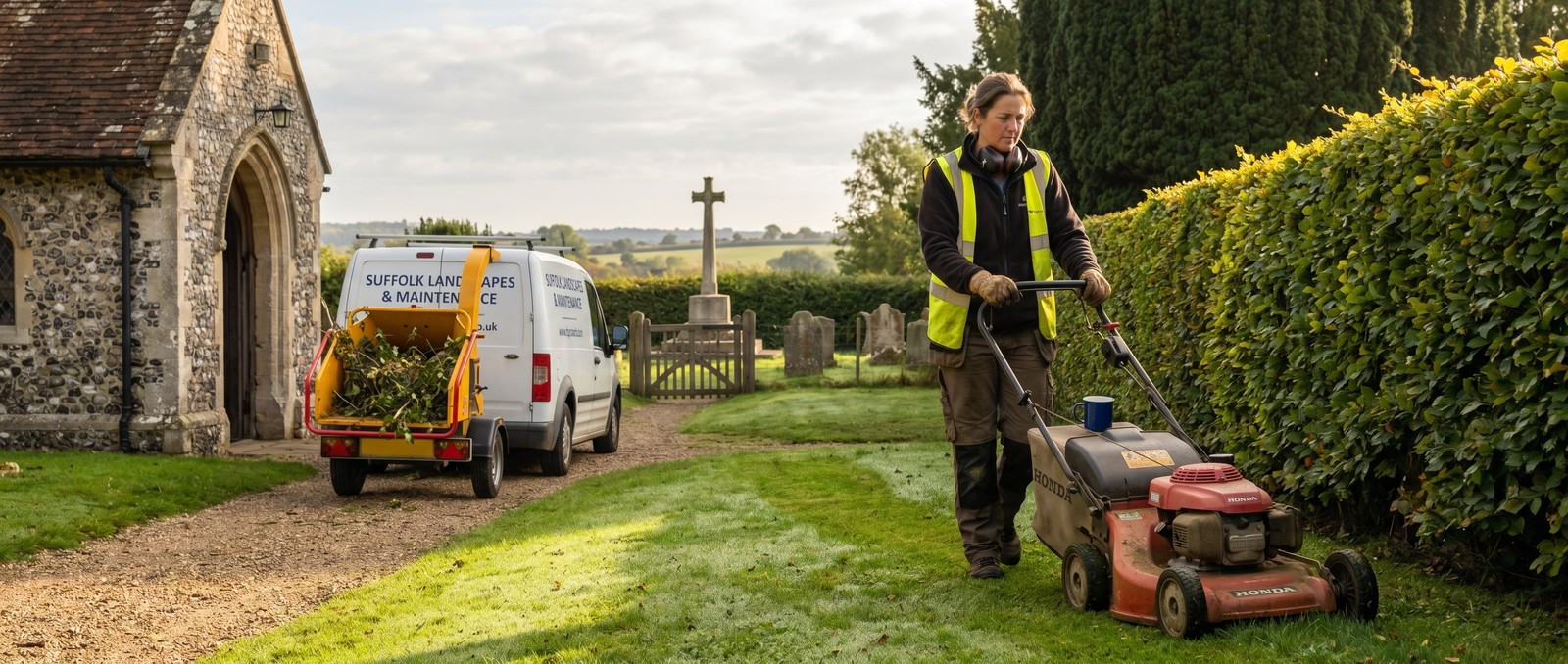
Software for UK landscapers, gardeners, and tree surgeons
Christmas done, January’s empty. February the boiler at home dies. Spring’s still six weeks away.
Landscaping is the trade where seasonality is existential. November to February is dead; May to September is impossible; the maths only works if you turn Q2 and Q3 into enough revenue to carry Q1 and Q4 - and if you quietly convert as many one-off jobs as you can into a fortnightly mowing round on a monthly Direct Debit. You’ve done Mrs P’s garden fortnightly for six years and she still pays cash on the day; when she goes on holiday, that’s £80 you won’t see. The Tuesday round is Aldeburgh in the morning, Saxmundham midday, somehow back in Snape by 2 because you forgot Mrs T moved last spring - twenty-two miles of unnecessary diesel. The forecast said dry Tuesday; it wasn’t; eight customers were texting by 9am; by Friday the diary’s three days behind and you’ve cancelled Saturday rugby. A council parish-mowing contract renewal sat in the clerk’s inbox for four months - margin on a year’s mowing, gone. Storm Babet melted the phone for three weeks and you took the cheap fence-down jobs because you were scared the calls would stop, then lost the proper customers because you couldn’t get back to them.
We make custom software for landscapers - sole-trader gardeners through five-van firms, garden-design / install specialists, commercial grounds contractors, fencing specialists, PA1 / PA6 lawn-treatment operators, artificial-turf / decking / pond specialists, and tree surgeons. Small apps and automations that sit on top of what already works for you - the paper diary, ServiceM8, Tradify, Powered Now, Aspire, the WhatsApp groups, whatever you run - and quietly do the bits that waste your Sunday evening. Not LMN (US-shaped, written for American lawn-care franchises); not Arborgold (US tree-surgery); not ServiceM8 (per-job pricing kills £40 mowing visits). The bit between one-off garden quote and banked monthly DD round on a weather-aware route, with a council contract that renews itself and a storm-week that doesn’t burn the long-term customer base - that’s the bit we build. Trade-chassis-wise, same shape we run for sparkies, plumbers and roofers; tuned for the landscaper’s three distinct moments - seasonal cashflow, the under-monetised mowing round, and the weather that’s more existential here than for any other trade.
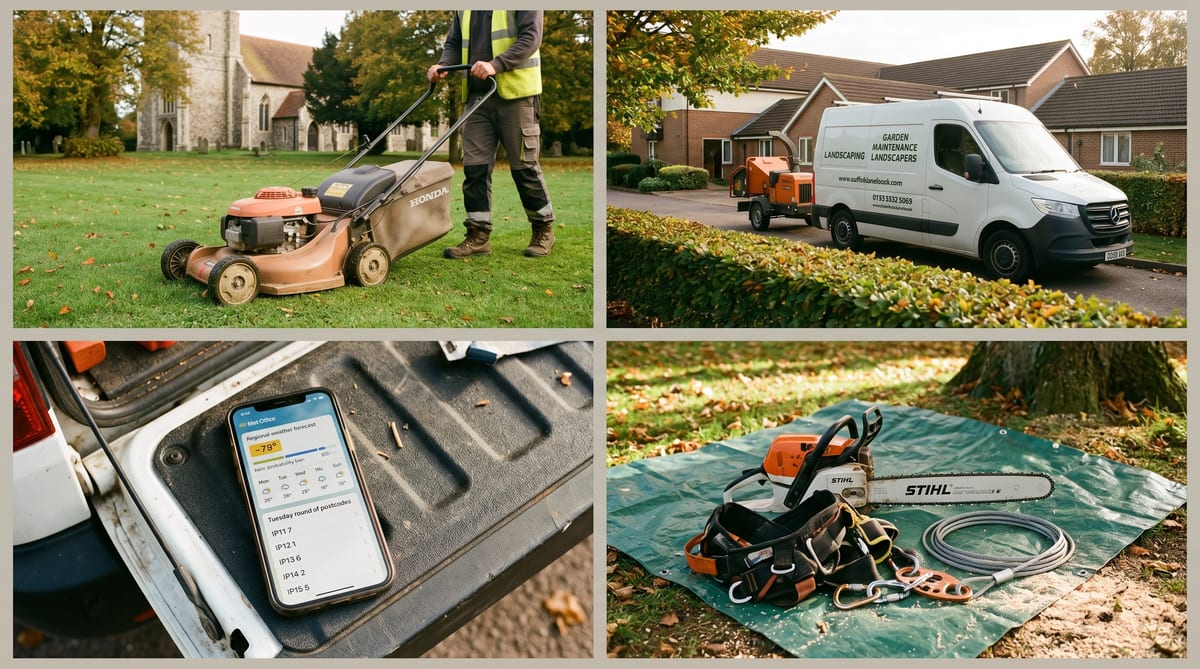
What you spend your week on that you shouldn’t have to
- Christmas done, January empty, February’s bills not waiting for spring - the maths between Q1/Q4 idleness and Q2/Q3 chaos with the fortnightly mowing round as the only thing carrying the dead months.
- Mrs P’s fortnightly garden round for six years, still on cash-on-the-day, still the £80 gap every time she goes on holiday - and the forty-customer round where at most twelve are on a standing order.
- Tuesday round driving Aldeburgh → Saxmundham → Snape because you forgot Mrs T moved last spring - twenty-two miles of wasted diesel and a 2pm finish that should have been 12.
- Weather forecast said dry Tuesday - it wasn’t; eight customers texting by 9am; the Saturday rugby cancelled by Friday because the week’s already three days behind.
- A council parish-mowing contract renewal sat in the clerk’s inbox for four months - the year’s contract value, on the edge of going to whoever the parish remembered last.
- A care-home grounds-maintenance contract wanting a monthly photo-report PDF alongside the invoice - last contractor lost it because he sent the invoice and forgot the photos.
- Storm Babet - phone melts for three weeks, you take the cheap fence-down jobs because you’re scared the calls will stop, lose the proper customers because you can’t get back to them; three weeks of feast, six months of bad reputation.
- A £6,800 garden-design quote you wrote up on a Sunday evening - silence, then in autumn the customer comes back urgent and the budget’s changed.
- Suffolk council tip wants the upper-tier waste-carrier reg, Cambridgeshire wants the lower-tier; £5 mistake at the gate and half an hour’s gone.
- A Japanese knotweed disclosure on a quote you wrote without realising the customer’s hedge had it - CL:AIRE protocol-aligned management plan now needed.
- A PA1 / PA6 spraying weather-window on a council lawn-treatment contract - no rain in the next 4 hours, wind below 6mph, temp above 8°C - and the operative cert expiry sitting somewhere on a piece of paper in the cab.
- A climbing-harness LOLER inspection due Friday - you had it in your head as next month; tree surgery is the side of the business that doesn’t tolerate that mistake, and the NPTC CS30 / CS31 / CS38 / CS39 renewal cadence runs alongside.
- BALI / APL / Arboricultural Association member-renewal paperwork in three different folders; CHAS / SafeContractor / Constructionline annual re-accreditation in three more.
These aren’t problems for a generic field-service app written around sparkies. They’re the bit between one-off summer job and banked recurring annuity that carries the winter, on a weather-aware route, with a council contract renewing itself on time. That’s the bit we build.
Example problems we could solve
Six things we hear most often from landscapers - with what the solved version looks like in your week. Every build is sized to your firm: a sole-trader with a Honda HRX and a chipper trailer probably needs the first two and the fifth; a five-van firm running tree work and commercial grounds alongside the domestic round might want all six plus both spokes. None of it means binning what already works.
1. The inbound AI agent that triages a £40 mow from a £6k design from a tree across the patio
The lost-enquiry moment: web enquiry comes in for “the back garden” while you’re on the chipper; could be a £40 mow round, a £6,800 design-and-install, or a leaning sycamore over a Range Rover. By the time you’re off the kit she’s already rung the next landscaper on Google. Or - phone rings four times while you’re rigging a fell in Lavenham; the caller’s a parish clerk asking whether you can quote for the contract renewal, leaves a message you don’t hear until Friday, and by then the parish has already short-listed three others.
Solved looks like: an answer-on-your-behalf line that picks up while you’re on the kit - across calls, SMS, WhatsApp, Facebook DM, Instagram and the chat box on your website - in your voice, trained on your geographic patch and your last-sent quotes. The landscaper-specific thing is the recurring-or-one-off qualifier at the front: the agent asks whether the caller wants a fortnightly round, a one-off mow, a garden-design conversation, a tree job or an emergency storm callout, and routes each to its right next step. The single biggest revenue lever in the trade is whether every new domestic enquiry lands in the “shall we make this a Tuesday-round visit?” conversation by default - and the build is shaped to make that conversation the routine first move, not the awkward afterthought. Photos and videos are first-class - a customer sending three shots of a back garden gets a sensible same-channel reply and a survey window in the diary that night. The longer version lives at Trainable Inbound AI Agent; the landscaper setup qualifies recurring-vs-one-off + route-catchment + design-vs-maintenance + emergency tree-work and routes each to its right next step.
2. The garden-design quote that doesn’t ghost - photos in, mood-board out, +90-day reactivation
The Sunday-evening moment: half a Sunday spent measuring a £6,800 garden-design quote at Long Melford - Japanese knotweed flagged in the surveyor photos, decking gone soft, lawn full of moss; you write up a twelve-page proposal with the plant schedule referencing RHS-aligned species, the install phasing, the soil-amendment notes. Three weeks later - silence; the customer can’t visualise what you’ve described; she’s on Pinterest looking at someone else’s portfolio.
Solved looks like: the photo set the customer sent on enquiry (plus the ones the foreman took on the half-Saturday survey) drives a structured quote - a scope-of-works PDF assembled from a landscaper-shaped template library (small-courtyard refresh, full domestic re-design, ride-on lawn-treatment programme, decking / pergola / outdoor-room install, pond / water-feature), with the plant schedule referencing RHS / Crocus / Hilliers Hampshire / Burncoose-aligned stock, hard-landscaping prices from your trade-merchant feed, and the install phasing on a visible timeline the customer can read at a glance. Mood-board imagery from the customer’s Pinterest (where she’s shared it) drops into the proposal as a side-by-side with your similar past work, so the “can I picture this?” question answers itself. The chase ladder runs in your voice in the channel she replied on - “are we doing this or shall I park it” on the morning she was actually going to decide, not three weeks too late. The landscaper-distinct feature is the +90-day reactivation: three months on, if the design’s gone cold, a polite “is the garden still on your list this autumn?” nudge runs - because garden-design enquiries cycle quarterly, and the autumn-reactivation is the second-best moment in the year after the May rush. CL:AIRE-aligned Japanese knotweed disclosure auto-includes where the survey photos flagged it. The longer version lives at Quote & Chase Ladder; the landscaper version’s distinct features are the RHS-aligned plant schedule, the photo-paired mood-board PDF, the +90-day reactivation cadence, and the CL:AIRE-aligned knotweed line that auto-includes where it’s needed.
3. Weather-aware diary + route optimisation + the customer-comms cascade
The Tuesday-morning moment: “Forecast said dry. It wasn’t. Eight customers texting by 9am. Tuesday round was wrong-order to start with - Aldeburgh in the morning, Snape in the afternoon, twenty-two miles back across the round because Mrs T moved last spring. Storm Babet melted the phone for three weeks and I lost the proper customers because I couldn’t get back to them.”
Solved looks like: the round diary as a live, weather-aware route. Each round day, the engine pulls the Met Office five-day forecast against every visit’s postcode; rain-affected jobs flag 48 hours out with a customer-side SMS in your voice - “Hi Sarah, looks wet Tuesday afternoon - push your mow to Thursday, or hold the slot and we’ll come if it dries?” - and the diary refills from a small waitlist of dry-weather-flexible jobs. The route itself geocodes every visit and optimises the order - Tuesday morning becomes Aldeburgh / Saxmundham / Friston / Snape in one sweep, not the backtrack you’ve been doing for two years. Day-of, the customer gets a one-tap ETA window SMS in your voice (“Riki here, on my way, should be with you between 10:15 and 10:45”) so the “is he coming?” anxiety doesn’t generate a phone call. Storm-week capacity mode kicks in when emergency-call volume spikes - inbound triage auto-prioritises P1 dangerous-tree / fence-down / property-at-risk calls; lower-priority maintenance work books into the post-storm slot with a customer-side SMS managing expectations; the proper customers don’t lose their place to the cheap one-offs. PA1 / PA6 spraying weather-window jobs read against a tighter forecast (no rain in the next 4 hours, wind below 6mph, temp above 8°C) and only confirm when the window’s met. The landscaper-specific moment: weather is more existential here than for any other trade - the build is shaped around making the weather a managed input rather than a daily disruption.
4. Invoice on completion + dunning ladder + monthly photo-report for the commercial side
The “switched contractor” moment: “Cash-on-the-day for half the round customers. Direct Debit for the other half. A care home wants a monthly photo report alongside the invoice; I send the invoice - never the photos - and they switched contractor at renewal.”
Solved looks like: invoices that go out on completion with the customer-type already tagged. Domestic round visits paid on the day, with a soft conversion conversation to Direct Debit running quietly alongside (problem 5). Commercial grounds-maintenance invoices batched monthly with a structured per-site photo-report PDF assembled automatically from the foreman’s tablet captures - “site A: mowing 4 visits, hedge cut 1 visit, leaf clearance 2 visits, weather-deferred 1; photo evidence per visit attached” - and the monthly report bundle goes out together so the “we never got the photos” conversation doesn’t happen. Day-31 statutory-interest line cites the Late Payment of Commercial Debts (Interest) Act 1998 where it’s earned on the council and FM-side debts. The landscaper-distinct piece is the photo-report alongside the invoice - what differentiates a council-contract retention from a switch at renewal - and the contract-renewal proposal that drafts itself at -60 days from each contract’s anniversary with last year’s scope + last year’s actual delivery + inflation-indexed pricing + suggested “and also…?” scope additions. The longer version lives at Invoice & Dunning Ladder; depth on the council / care-home / business-park side lives on the commercial-grounds spoke.
5. The Recurring Round Optimiser - turning Mrs P’s cash into a banked annuity
The forty-customers-twelve-on-DD moment: “Mrs P’s garden for six years. Still cash. Still on the day. Still the £80 gap when she goes on holiday. The whole round is forty customers and at most twelve are on a standing order - and Q1 cashflow lives or dies on the answer to that.”
Solved looks like: every customer enters the system with a clear intent - one-off, trial round, banked round. On the first or second visit, the engine offers the customer a Direct Debit mandate in your voice - “Hi Sarah, easier for both of us if your fortnightly visit goes on a monthly Direct Debit - covers two visits, you don’t think about cash on the day, I don’t lose the visit if you’re on holiday. Want to sign up?” Mandate captured on the customer’s phone; future visits auto-invoice against the mandate on visit-complete. Operator dashboard shows the round as a structured asset - banked-DD count, cash-on-day count, conversion rate, holiday-impact gap, annual round revenue projected forward. Seasonal cashflow forecast sits on the same screen: this quarter’s banked round revenue + this quarter’s design / install pipeline + Q1 projection at current rates + what Q1 would look like at 60% / 80% / 100% banked-round conversion. The landscaper-specific moment: the round is the only thing that carries Q1 and Q4 - and the maths between thirty cash customers and thirty DD-banked customers is the difference between February panic and February idle. The build is shaped around making the mandate-conversion conversation routine rather than awkward. For the commercial-side mirror - annual grounds-maintenance contract renewals on a council fiscal-year refresh - the same engine runs the renewal cadence at -90 / -60 / -30 days, which is the spine of the commercial book. The longer version lives at Recurring Service Recall; the depth on annual contract renewals lives on the commercial-grounds spoke.
6. The compliance calendar - PA1 / PA6, LOLER, NPTC, BALI, waste-carrier, knotweed disclosure
The “in my head as next month” moment: “Climbing harness LOLER inspection due Friday. NPTC CS31 lapsed without me noticing. PA1 expired in April. Waste-carrier upper-tier reg renewal was the same week. All of it lived in my head or on a piece of paper in the cab.”
Solved looks like: the operative-and-kit compliance register as a single store. Per operative: NPTC certs (CS30, CS31, CS32, CS38, CS39 - and the LANTRA awards alongside), PA1 / PA2 / PA6 spraying certs, RHS qualifications, first-aid-at-work / forestry first-aid+F, MEWP / IPAF / PASMA on the access kit. Per kit-item: climbing harness, ropes, lanyards, fall-arrest, chipper, MEWP, helmets - with 6-monthly LOLER inspection dates + the inspector + the certificate PDF; chainsaw service intervals per machine. 90 / 30 / 7-day expiry reminders fire to you with one-tap re-book to the usual training centre (Tomkat, Logic4Training, Able Skills, NPTC) or the LOLER inspector. BALI / APL / Arboricultural Association member-renewal paperwork, CHAS / SafeContractor / Constructionline annual re-accreditation, ISO 9001 / 14001 / 45001 where carried - all assemble from the same store with format-specific exports. Waste-carrier registration (upper-tier vs lower-tier, Suffolk vs Cambridgeshire vs Essex variation) tracks alongside with the renewal reminder pre-loaded. Japanese knotweed CL:AIRE-aligned disclosure language sits in the same store, ready to drop into the quote where the survey flags it. The landscaper-specific moment: the compliance burden is heaviest on the tree-surgery side, and the next-due date is what’s most often missed - the build is shaped around making the expiry visible 90 days out, not 7 days too late. Depth on the tree-surgery side lives on the tree-surgery spoke.

The closest things we’ve already built
- HC Electricala domestic and commercial electrician in Haverhill, Suffolk. Different trade, same Suffolk trade-chassis with the route-and-customer-comms pattern across the CB9 catchment. The closest live reference for how a trade-round in Suffolk runs on one software chassis - the cert + recall discipline ports straight across to the landscaper’s annual-contract-renewal cadence. (Named pull-quote and final outcome figures hold until the permission checklist clears - see Hc Electrical.)
- mendbuddyour own multi-channel AI agent for inbound conversations across voice, SMS, WhatsApp, Facebook DM, Instagram and web chat. The on-the-chipper line in problem 1 and the storm-week capacity mode in problem 3 are landscaper-shaped versions of this. Trained on your scope questions, your route catchment, your supplier names and your customer voice. See Mendbuddy.
- PlanPostour own social-media scheduling SaaS. The seasonal cadence (RHS Chelsea, summer bedding, autumn pruning, winter prep, January planning) is the marketing-side counterpart to the operational round, and the landscaper queue layers straight onto it. Own-brand case study, ships full-fat - see Planpost.
- RepairMinderdifferent vertical, same operational backbone: ticket in, work tracked, status communicated, deliverable out. The round-visit pattern shares structure with the repair-ticket pattern; useful reference for the per-customer recurring history kept against each property indefinitely. See Repairminder.
If your week’s narrower than the whole of the above
The week looks different enough for two sub-audiences that they have their own pages:
- Tree surgery / arboriculture →if your business is mostly tree work (climbing, dismantles, fells, surgery, storm-emergency, insurance-pipeline work), the NPTC chainsaw certs (CS30 / CS31 / CS32 / CS38 / CS39) + LOLER 6-monthly harness inspections + storm-week capacity manager + BS 3998 method-statement pack + insurance-pipeline track is the build. Arboricultural Association approved-contractor evidence, TPO consultation handling, £6m PL insurance posture as the modal operating context.
- Commercial grounds maintenance →if your week is mostly multi-site grounds-maintenance contracts (council parishes, care homes, schools, business parks, residential management blocks), the annual contract-renewal engine + monthly photo-report bundle + multi-site dispatch with SLA-aware FM ticket integration + CHAS / SafeContractor / Constructionline / BALI evidence pack is the focus. 30-60 day payment terms, retention on the bigger contracts, monthly photo-report alongside the invoice as the gate to retention at renewal.
Adjacent trades and verticals
- Buildersthe multi-trade you often work alongside on extensions and conversions; groundworks frequently overlaps, and the commercial fit-out spoke carries the same retention-tracker shape as the council-contract retention on the commercial-grounds side.
- Roofersadjacent trade sharing weather-aware-rescheduling and the storm-week capacity surge; sibling Suffolk-catchment trade with the same insurance-pipeline cadence as the tree-surgery side.
- Electriciansthe trade-chassis reference; HC Electrical is the named-build proof of how this shape runs in a Suffolk trade business.
- Decoratorssibling Suffolk-catchment trade with the same +90-day reactivation cadence on quotes and the same recurring-round / landlord-portfolio rhythm on the property-maintenance side.
- Gas Safe engineersthe boiler / heat-pump engineer you may be scheduling around on landscape-and-extension projects; the landlord-CP12 spoke is the gas-side mirror of the commercial-grounds annual-renewal cadence.
- Lettings agents and landlord portfoliosthe agent side of every property-maintenance conversation if you cover landlord gardens or HMO communal-space rounds.
- EquineNewmarket-cluster overlap; equine yards often retain a grounds-maintenance arrangement alongside the stables.
FAQ
Will the round optimiser force my Mrs P onto a Direct Debit?
No. The mandate offer is in your voice and her choice - most customers say yes when asked properly because the cash-on-the-day handover is awkward for both of you. Where she declines, the system keeps her as cash-on-the-day and tracks the holiday-impact gap so you can decide whether to keep her on the round at all.
Can you handle Japanese knotweed disclosure on quotes?
Yes. The quote engine flags knotweed-suspected substrate from the survey photos (visual signature where the foreman captures it); the disclosure language and the CL:AIRE protocol-aligned management plan auto-include as optional lines. The actual knotweed treatment is your call - we build the disclosure, not the herbicide schedule.
Will the weather-aware diary handle the spraying weather window for PA1 / PA6 work?
Yes - lawn-treatment / spraying jobs read against a tighter forecast window (no rain in the next 4 hours, wind below 6mph, temp above 8°C) and only confirm when the window’s met. PA1 / PA6 cert expiry tracks alongside in the compliance calendar from problem 6.
Will you take on the tip / waste-carrier ticket reconciliation?
We build the ticket-capture (photo of the weighbridge ticket on the day) and the per-job cost reconciliation; the tickets themselves are yours to produce at the gate. Council variation (Suffolk vs Cambridgeshire vs Essex, upper-tier vs lower-tier registration) handles in the cost-comparison report and the renewal calendar.
My business is mostly tree surgery - am I in the wrong place?
The tree-surgery spoke is your primary page if tree work is most of the week. The hub covers mixed gardener-plus-occasional-tree-work; the spoke covers the LOLER / NPTC / climbing / storm cadence and the insurance-pipeline track at depth.
Will you handle BALI / APL / Arboricultural Association member-renewal paperwork?
The reminders and the renewal-evidence assembly, yes - same audit-log discipline as the EICR / CP12 evidence record on the other trade hubs. The membership itself stays with the firm. BALI Registered Contractor evidence, APL member evidence, Arboricultural Association approved-contractor renewal on the tree side - all assemble from the same compliance store.
Do I have to bin ServiceM8 / Tradify / Powered Now / Aspire?
No. We sit on top of what’s working and replace the bit that doesn’t - usually the inbound triage, the quote / chase / +90-day-reactivation loop, the weather-aware diary cascade, the recurring-round mandate-conversion conversation, the monthly commercial photo-report bundle, and the compliance calendar. If your job entry and diary are fine in Tradify, we hook into the export and start from there. Aspire is built for US lawn-care franchises; ServiceM8’s per-job pricing kills £40 mowing visits.
What does it cost?
Every build is scoped per firm - depends on van count, recurring-round size, whether tree surgery + commercial grounds are both in scope, what’s already on your phone. We talk it through, agree price in writing. See pricing.
How long until something’s live?
Most landscaper builds we’ve sketched go from scope conversation to a working version you can run a real Tuesday round through in a few weeks, then a couple more weeks of running live work through it before go-live. The recurring-round optimiser usually ships first because the Q1 cashflow case stacks fast; the weather-aware diary comes alongside; the commercial photo-report bundle and the compliance calendar phase in over the next few weeks.
Tell us what your week looks like
What’s your van count, what mix (mowing rounds / design / tree / commercial), what your DD-banked vs cash-on-day split looks like today, what your Q1 cashflow tells you, what BALI / APL / Arboricultural Association / CHAS status you carry, where the storm-week melt is breaking. Send an enquiry - what you do, what’s slowing you down, what you’ve already tried. We’ll come back with a sketch of what we’d build and what it would cost. No calendar, no demo to sit through. Email reply, scoped sketch, you decide.